Successful Blog

  • Home
  • Community
  • About
  • Author Guidelines
  • Liz’s Book
  • Stay Tuned

Are You Using History Strategically … to Claim Your Business and Life Future?

January 16, 2012 by Liz

History Invents Itself

cooltext443809602_strategy

The town I grew up in had a population of 20,000 people. The school I went to kept the same kids in the same classes all through 8 grades … then many of us went to the same high school.By third grade the first week of school held few surprises. I suppose that way good in some ways.

But in one way that situation made for a terribly skewed view of how the world worked.

We grew up in a universe where the people rarely changed. That was true in too many ways.
We rarely changed in that

      we were the same individuals with the same names.


      we were the same in our relationships to each other.


    we were the same in that we couldn’t change or outgrow the stories we knew about each other.

The “kid who wet his pants in first grade” was still that “kid who wet his pants in first grade” on the day he graduated high school. And I can still tell you his name today.

Anyone who’s ever attended a family or school reunion knows what this means. We live up to the stories that define us and sometimes when we get back to the people who were there when those stories first came to be, we revert to being who we were when the story happened.

We believe that our history defines our present.
Don’t believe that. Claim the right to define your business and your life.

The Place of History in Business and in Life

We’ve all heard that history repeats itself. That those who don’t pay attention to it’s lessons are bound to end up learning them again. But not all of histories lessons remain important and relevant. And staying tied to them when situation, skills, and experience change isn’t always a good thing.

That boy who had a bathroom accident at age 6 is now quite successful business man. The people he meets today never see him as that “kid who wet his pants in first grade.” Part of the man’s success is that he knows that story from the past might be true, but it’s irrelevant. He doesn’t let it define the person he is today.

The gorgeous cheerleader named “Cookie” who had straight As, personality, and the coolest crowd going for her in high school is now working as bartender in that small town of 20,000. She still tries to live the old stories, but they’ve faded.

History can be dangerous in it’s ability to keep us stuck in the past. Like a fifteen-year-old hairstyle, if you’re still telling a story from the past to define why your life or your business isn’t good — the story isn’t working for you.

Wisdom comes when we learn from history and use it to write a new and more successful story now. That’s true of business as well as life.

Using History Strategically to Claim the Future

Once SEARS was the World’s Largest Store and named a radio station WLS to celebrate that. The catalog won that title is gone. ABC bought WLS in 1960 and the SEARS Tower was sold in 1994.

Sears story of past success is irrelevant, unless they look at how a future SEARS might apply what they did in the context of a 21-century Internet environment. Even with the same vision and mission, Sears is in a new position with new conditions. They’ll need to make new decisions, build new networks, and new systems to find the unique opportunities to build success — much as they did in the late 19th and early 20th Centuries.

Numbers are important and useful, but they are not as deep as the questions we ask. All numbers we have — sales numbers, revenue numbers, even responses to commercials, ads and blog posts — report history, the success or failure of we did in the past. We can set new goals and build new plans with numbers to measure them, but once we execute to where the measurement occurs that action is past. Those mile markers on the road, at best, show us how far we’ve come.

History can’t drive the present into the future. The right questions will lead to our best true story now. A typical view of history and numbers will inform that, but the right questions will ask:

  • what were missed opportunities.
  • what behaviors always led to your successes.
  • what you’ve learned from wrong turns.
  • and what you want to learn to make your future stronger, faster, easier, more meaningful.

In other words, use history to benchmark how you’ve grown and to guide your path. But make your one true story about who you are and where you’re going and why your history doesn’t draw the picture only adds nuance to the colors.

Research and mine your history to know what was and might have been true once. Then interpret and reapply that lesson to the new situation, skills, and experience to use history to invent a new future — combining what you wish you knew then, what you know now, and the two offer unique future opportunities for you to go.

Are you using history to claim your business and life opportunities?

–ME “Liz” Strauss

Filed Under: Strategy/Analysis, Successful Blog Tagged With: bc, history, LinkedIn, opportunity

Beach Notes: Do You Follow One Course?

January 15, 2012 by Guest Author


by Guest Writers Suzie Cheel and Des Walsh

When I saw this watercourse this week at the beach it made me think of the quote:

Follow One Course Until Successful- anon

Are you a follow one course type or do you follow many courses?
What is successful for you?

Suzie Cheel & Des Walsh

Filed Under: Motivation, Successful Blog Tagged With: bc, Des Walsh, LinkedIn, Suzie Cheel

Using Foreign Languages to Drive Traffic to Your Blog

January 13, 2012 by Guest Author

By Adria Saracino

cooltext443809602_strategy

Connecting Globally

One of the single greatest aspects of the Internet is the ability to connect with people from all over the world. Social media and blogging have quickly created an environment conducive to erasing the distance between people. Now more than ever, information can quickly spread within a matter of seconds.

This global market is great news for website owners, as it means there is opportunity for more people to visit your site. However, you may not be capturing as many of those visitors as you think.

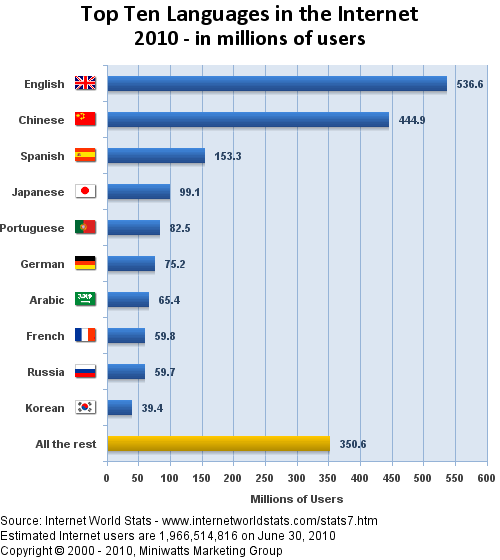
This graph shows that only one fourth of all Internet users are English speakers. Since ¾ of Internet users are not native English speakers, disregarding this audience on your website could mean a missed opportunity for more traffic.

So how do you make sure to capture non-English users? Cater to their native language.

For quick results, using programs like Google Translate (http://translate.google.com/translate_tools?hl=en) to translate your site content will give your international readers—who may have come to your site via English search terms—the option to view your content in a much friendlier environment. This shows cultural sensitivity, and as a result could encourage brand loyalty.

However, note that using free automatic translating services tend to produce very literal translations, which is often free of colloquialisms and common slang. Such literal translations oftentimes come off as poor grammar, so if your translations are faulty it could turn off potential foreign visitors.

Thus, more traditional methods of language learning (http://www.pimsleurapproach.com/) and translating your own content is probably the best way to ensure your site is suited for an international audience. Investing in programs like pimsleur French (http://www.pimsleurapproach.com/learn-french/) and pimsleur German (http://www.pimsleurapproach.com/learn-german/) are great for learning the fundamentals of the common languages you are hoping to optimize for. Whichever route you decide to take, make sure your site content is carefully edited for accuracy.

There are other benefits to catering to an international audience besides showing cultural understanding and sensitivity. Translating your site to popular languages also optimizes your site for international search engine results, since onsite factors are a major indicator of how well you will rank in search engines. This should give you a unique advantage over many of your domestic competitors who otherwise might not optimize for the often overlooked foreign web community.

As translation software improves and the web advances, translating your site should get easier. Until then, invest the time and resources needed to get your web properties optimized and into the search results of foreign visitors before your competition.

____
Author’s Bio:
Adria Saracino is the Head of Outreach at Distilled, a creative internet marketing agency in Seattle. When she’s not connecting with interesting people on the web, you can find her talking about style at her personal fashion blog. Follow her on twitter @adriasaracino to stay in touch.

Thanks, Adria!
_____

Be irresistible!
–ME “Liz” Strauss
Work with Liz on your business!!

Buy the Insider’s Guide to Online Conversation.

Filed Under: Marketing /Sales / Social Media, Successful Blog Tagged With: bc, Blogging-in-a-Foreign-Language, foreign language, internet traffic, LinkedIn

Make Your Own Opportunities

January 12, 2012 by Rosemary

A Guest Post by
Rosemary O’Neill

cooltext443809558_authenticity

The only way to know for certain that you won’t win the Publisher’s Clearinghouse is to
not enter the sweepstakes.

The same principle applies to just about every opportunity out there. The successful
entrepreneurs, A-list bloggers, and business leaders all made it because of two things:
?rst, they had radar for opportunities, and second, they seized them.

Think about it. What might have passed you by in the last week or so because you
thought it was too dif?cult, you didn’t have time, you didn’t have the skills, or you just
plain thought “I’ll never make it.” Instead, you should be opportunistic in a good way.

Here are some tips:

  • Recognize your little voice – when it starts telling you why you can’t grasp that chance, don’t listen. Tell it to take a break while you submit that guest post inquiry.
  • Train yourself to see opportunities – you need ?nely tuned opportunity radar. Notice the call for speaker submissions and recognize it as a chance for you to shine.
  • Remember that if you don’t ask, you don’t get – the only reason I am blogging here right now is because I summoned up the guts to ask. Take a deep breath and do it.
  • Don’t get discouraged – the other differentiator for successful people is that they use every rejection as a springboard to the next opportunity. They move on quickly to the next one until they are successful.
  • Always have “lines in the ocean” – you can add so much excitement to your life if you have several things out there, waiting for a response. Will you get accepted to that course? Will your panel proposal be accepted for the conference? Will your photograph win the contest? How much fun to go through life waiting for exciting news!

How about an assignment this week? Go right now and ?nd an opportunity, then just go for it without fear. Tell them Rosemary and Liz sent you.
_____
Author’s Bio: Rosemary O’Neill is an insightful spirit who works for social strata — a top ten company to work for on the Internet . Check out their blog. You can find her on Google+ and on Twitter as @rhogroupee
_____

Thank you, Rosemary!

You’re irresistible!

ME “Liz” Strauss

Filed Under: Business Life, Marketing /Sales / Social Media, Successful Blog Tagged With: Action, bc, LinkedIn, opportunity, Strategy/Analysis

Hierarchy of Influence: Matching Your Actions to Expected Reactions

January 10, 2012 by Liz

Redux: I wrote this post in Feb. 2011. Based on recent conversation, it seems even more relevant now and so I choose to pick it up, add some clarity and publish a newer version this week.

Not Every Attempt Gets the Expected Outcome

cooltext443794242_influence

When our son was barely five years old, he was a shy child who lived by his own timetable. He had his own ways of doing things. If you wanted his attention, your best bet was to make eye contact and simply explain what you what you had to say.

It was during that year, that his grandparents came to visit us in Austin. Together as a family, we planned several outings to enjoy the city and our favorite restaurants. One evening, the whole group was getting ready to go dinner and our son was still playing — not getting ready. This circumstance stressed out three of four adults in his company. Suddenly one, then two, then all three of them were using loud firm voices to tell a child, half their size, to “Get upstairs to change in to clean clothes, immediately!!”

The child froze like a deer in the headlights.

The mom in me responded with like to like. In firm and loud voice, I said, “Who are you to gang up on a little kid like that? Get away from here!”

The three adults moved into the kitchen and spoke quietly to each other.
I took the little boy by the hand. “I said let’s go upstairs and find what you’ll wear to dinner.”

When we came downstairs ready to go to dinner, I walked into the kitchen and apologized for my outburst. In return I got three calm apologies that also said I was right to intervene on the child’s behalf.

Not every attempt at influence gets the outcome we’re going for.

Which Actions Achieve the Outcomes You Seek?

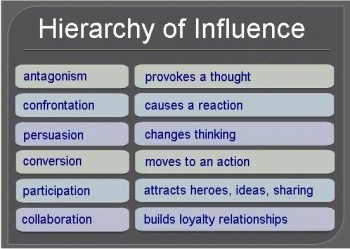
If we can agree that influence is some word or deed that changes behavior. Then plenty of influence occurred in the story I just related. I suspect that had I been privy to the whole scene in the kitchen I would have found that that single story included examples of confrontation, persuasion, conversion, participation, and collaboration. The only thing missing in this family scene would be true antagonism. Six different approaches to influence which lead to entirely different outcomes.

I’ve been reading about, thinking about, and talking to people about influence for months, because influence and trust are integral understanding to loyalty relationships. Let’s take a look at six of the usual forms of influence and the outcomes that result from them.

  1. Antagonism – provokes thought Your values are everything I believe is wrong with the world. You can’t stomach anything that I stand for. We are not competitors. We are enemies at war. Your words and actions might provoke thoughts and deeds, but what I’m thinking is how wrong you are, how to thwart you, or if I have no power, how to hide my true thoughts and feelings. An order from an enemy can influence a behavior but won’t change my thinking.
  2. Confrontation – causes a reaction You say it’s black. I know it’s white. I respond in some way — I fight back. I run away. I consciously ignore you. My response will probably change based who is more powerful. You might overpower me. I might stop responding, but it’s unlikely that you will actually change my thinking. Confrontation leads people to build a defense, to strengthen their own arguments.
  3. Persuasion – changes thinking You look at me and think about how what you want might benefit me. Rather than telling me, you show me how easy, fast, or meaningful it is go along with you. You’ve changed my about what you’re doing. I now see your actions from a new point of view.
  4. Conversion – moves to an action Your invitation to action is so convincing and beneficial to my own goals that I do what you ask. You’ve influenced my behavior to meet your goal. You have won my trust and commitment to an action. It’s not certain I’ll stay converted.
  5. Participation – attracts heroes, ideas, and sharing You reach out with conversation. We find that we are intrigued by the same ideas, believe in the same values, and share the same goals. Your investment in the relationship builds my trust and return investment. You invite me to join you in something you’re building. My limited participation raises my investment, gives me a feeling of partial ownership, and moves me to talk about you, your goals, and what we’re doing together.
  6. Collaboration – builds loyalty relationships We develop a working relationship in which you rely on my viewpoint. We share ideas and align our goals to build something together that we can’t build alone. You believe in my value to your project. I believe in the value of what you’re building. You have gained my loyalty and commitment. I feel a partnership that leads me to protect and evangelize the joint venture. I bring my friends to help.
Strauss_Hierarchy_of_Influence
Strauss Hierarchy of Influence

Not every campaign or customer situation will need to move to collaboration. But understanding each level will help us manage expectations allowing us to move naturally and predictably from confrontation to persuasion, so that we don’t expect the loyalty of collaboration from a momentary conversion.

Could be useful when looking to connect with that special valentine too.

How might you use the hierarchy to change the way you manage your business, your event, your community, and your new business initiatives?

–ME “Liz” Strauss
Work with Liz on your business!!

Buy the Insider’s Guide to Online Conversation.

Filed Under: Community, Marketing /Sales / Social Media, Successful Blog Tagged With: bc, influence, LinkedIn, relationships

Ideas & Infographics: So You Thought Your Mobile Habits Were Harmless?

January 9, 2012 by Guest Author

by Mihaela Lica

cooltext443809602_strategy

Getting Smart about Smart Devices

These days, if you are not heavily heeled with smart devices and wired into the social web, your business is probably suffering. This is no big secret. However, the habits and devices you use may have adverse affects on you that are seldom publicized. Does your neck ache? Ever get blurry vision? Read on.

Have you ever thought about just how your body is positioned while using your iPad or other smart device. Probably not, that is unless your eyeballs get so red from bad positioning your friends think you have a hangover. The infographic below reflects on how smartphone or device use can mimic the improper wearing of eyeglasses.

[Click the image to see the isolated infograph and again to see it full size.]

[Created by Mezzmer Eyeglasses]

The advances in mobile technologies and the ever increasing adaptation of them by us poses not only huge benefits, but sometimes very bad consequences. Smart devices, like any tool designed to accelerate or enhance our abilities, should be used properly.

If you are a habitual smartphone or pad user, maybe you should consider refining your habits? Or, maybe a pain in the neck is your cup of tea?

—-

Author’s Bio:

Mihaela “Mig” Lica founded Pamil Visions in 2005 where she uses her hard won journalistic, SEO and public relations skills toward helping small companies navigate the digital realm with influence and success.

You can find Mig on Twitter as @PamilVisions

Thanks, Mig! Thank you also to Mezzmer.com!

–ME “Liz” Strauss
Work with Liz on your business!!

Buy the Insider’s Guide to Online Conversation.

Filed Under: Business Life, Successful Blog Tagged With: bc, Infographic, LinkedIn, mobile habits, smart devices

  • « Previous Page
  • 1
  • …
  • 48
  • 49
  • 50
  • 51
  • 52
  • …
  • 190
  • Next Page »

Recently Updated Posts

The Creator’s Edge: How Bloggers and Influencers Can Master Dropshipping

Is Your Brand Fan Friendly?

How to Improve Your Freelancing Productivity

How to Leverage Live Streaming for Content Marketing

10 Key Customer Experience Design Factors to Consider

How to Use a Lead Generation Item on Facebook


From Liz Strauss & GeniusShared Press

  • What IS an SOB?!
  • SOB A-Z Directory
  • Letting Liz Be

© 2025 ME Strauss & GeniusShared