Successful Blog

  • Home
  • Community
  • About
  • Author Guidelines
  • Liz’s Book
  • Stay Tuned

Beach Notes: Balance

December 5, 2010 by Guest Author

by Des Walsh and Suzie Cheel

balance

Balance is partly poise, partly letting go. Struggling doesn’t work, or not for long anyway. How’s your business balance, one with the wave, or struggling? Try relaxing (but not so much as to fall off the board, so to speak).


Suzie Cheel & Des Walsh

Filed Under: Motivation, Successful Blog Tagged With: balance, bc, Beach Notes, LinkedIn

Vitamin Angels Doubles Their Reach and We Can Too!

December 3, 2010 by Liz

cooltext443809437_relationships

Last year at SOBCon was one of four nonprofits the entire group worked with on the Give Back Challenge Day. We talked about their work in help children grow with the right nutrition. They told us of their quest to increase distribution of vitamin A to reach 20 million children and supply over 100 million multivitamins to children and mothers. By connecting essential nutrients with those most in need we can reduce child mortality.

This year they have doubled their reach and they’re on the brink of being able to that again!!

Marine Nutriceutical is matching your contribution dollar for dollar through the end of 2010.

Just click the image below to chip in to help any little bit with be worth twice what you give.

vitamin-angels

Want to do more? Just pick up the badge and pass this message on to your network for them too. See what a community can do.

Thanks.

–ME “Liz” Strauss
Work with Liz on your business!!

Buy the Insider’s Guide to Online Conversation.

I’m a proud affiliate of

third-tribe-marketing

Filed Under: Community, Successful Blog Tagged With: bc, LinkedIn, nonprofit, Vitamin Angels

Technology shouldn’t torture people

December 2, 2010 by patty

by Patty Azzarello

cooltext466496263_leadership

Really?

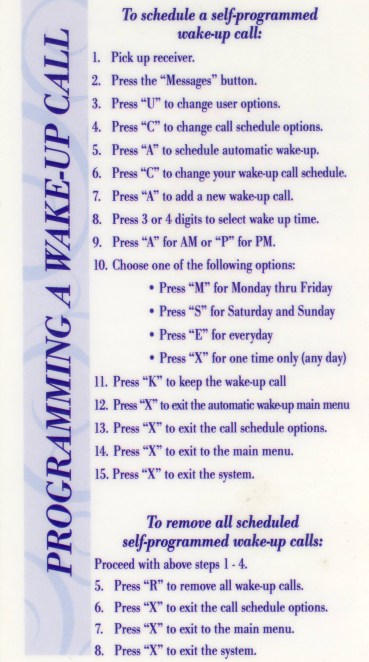
I was traveling in Cincinnati recently, and was greeted with the following in my hotel room. I was staggered.

I removed the actual hotel name, but this was real.

Is it just me, or are these 19 steps to program a wake-up call a bit much?

wake-up-call

Technology and Humans

I built a successful career in technology by following one guiding principle:

Make the technology less painful for humans to use.

Focus as much (if not more) energy on the human interface as on the technology itself.
Don’t ever show of the richness of your technology in the user interface. 

Focus completely on the user’s task. Understand how people are thinking about the task they need to do, and help them do it the way they are inclined to do it.

The point is never to show that your technology is smart and powerful, it’s to make your user feel smart and powerful.

Patty’s 3 Laws of Technology

(Break them at your own business peril.)

1. Technology should not rob people of their humanity
2. If you present technology instead of a human interface it HAS TO WORK
3. Technology should never make people feel stupid

Here is what I mean:

1. Technology should not rob people or their humanity.

Probably the best example of this are those voice automated systems that make you talk to a computer on the other end of the phone.   I don’t know about you, but I hate this. I would feel much less robbed of my humanity if I was greeted with a computer voice that said…

I know I’m not a person like you are, and that you’d rather talk to a person, but we think we can help you faster if you are willing to give this a try. We won’t make you talk to a computer and pretend it’s a person, and feel like an idiot shouting answers and phrases repeatedly because we can’t actually understand them… Please help us route your call by keying in your account number and answering ONE question – then you’ll be connected to a real person.

Any time your user interface makes a person translate something they are thinking or feeling into a narrow input that your technology will accept, you have robbed them of some humanity.

2. If you present technology instead of a human interface it HAS TO WORK

If you want me to sign up for your service on your website, don’t require a special new version of a flash plug in for me to do it.  Don’t invite me to leave you feedback, only to have a link that doesn’t go anywhere.  Don’t optimize your interface so much for one platform or environment that it doesn’t work right in others.

When something goes wrong…

A human can recover and use creativity and judgment (and opposable thumbs)  if the transaction does not work. Technology just sits there there not working, and the user goes away having failed to complete the task.

I was duped recently at the airport when I accepted a boarding pass sent to my mobile phone and got to an airport that didn’t have the ability to read it.

I was promised I could pick up a prescription after hours, from an automated pharmacy dispenser, and they had mis-spelled my name when they input the prescription so there was no way I could pick it up and no way for the machine to recover.  There was a phone support number on the machine connecting me to a line which was un-manned after hours.

Make it fool proof
Test everything.  One of the best software tests  I ever saw was a CEO who sat on the keyboard.  The system broke.  Test your technology in ways users are not supposed to use it, because they will always do things they are not supposed to do.

Use Standard (boring) components
Go out of your way to use technology components that are as standard and hard to break as possible.

Don’t try to make your screens extra-pretty, or use bleeding edge widgets and gadgets in your user interface because they amuse you, you are trying to be impressive, or you want to try something new — especially if if there is to be no-human back up when it doesn’t work.

Set your standard to “It has to work”.  Not “It has to be leading edge”.

Don’t lose customers
If you replace humans with technology, if it doesn’t work you will lose customers because you have given them no possible alternative but to go away. There is a corollary to this law which is “Don’t make people work hard to give you their money”.

3. Technology should never make people feel stupid

This issues is starting to go away as technology is actually working better and young people are immune to thinking that it is their fault if it doesn’t work.

Complexity is the enemy
But when technology is unnecessarily complicated and hard to use, it makes (us old) people feel inadequate because we can’t accomplish the task at hand.

I don’t think I have ever got through a self-checkout lane without requiring assistance from a clerk and feeling a bit stupid.

If you buy wine, someone still needs to check your ID. You Fail.
If you by an item that is too large to put in the bag, the system will freeze because it can’t sense that you put it in the bag after you scan it. You fail.
If you buy organic produce, it doesn’t have a selection for organic. You Fail.

At this point you are given the choice either to wait for help (you feel stupid) or to steal money from the store because you can’t find a way to pay the organic up-charge (robbed of your humanity, and being made to work too hard to give them your money).

The good, at least mitigating, news is that most self-checkouts follow rule number 2.  It HAS to work – so they put human backup there.

Making technology better for humans is good for business.

Apple is an obvious example. But even putting Apple aside as an outlier, I can tell you that in every business where I had responsibility to bring technology products to market, focusing on the human interface was good for business.

We put extra effort on the user’s thinking process, the user interface, the install, the demo, the “start here” experience, the documentation, the customer support help desk, and the sales and contracting documents and processes.

By doing this, my businesses were able to steal share from competitors who were overly focused on the features of their technology alone, and tortured their customers and partners because of it.

What do you think?

Has technology ever tortured you? Do you think it helps business to make technology easier to deal with? There’s a comment box below, what’s your view?

—–
Patty Azzarello works with executives where leadership and business challenges meet. She has held leadership roles in General Management, Marketing, Software Product Development and Sales, and has been successful in running large and small businesses. She writes at Patty Azzarello’s Business Leadership Blog. You’ll find her on Twitter as @PattyAzzarello

Successful-Blog is proud affiliate of

third-tribe-marketing

Filed Under: management Tagged With: bc, LinkedIn, Patty Azzarello, user experience

Values Questions to Make Decisions that Build Your Unique Brand

November 30, 2010 by Liz

(Updated in 2020)

Liz Strauss. Photo by Anne Helmond

10-Point Plan: How to Use the Values Baseline to Make Decisions

The Amazing Testimonial

They say other people, our customers decide our brand. I’m no longer convinced of that.

I had the most fabulous experience at BlogWorldExpo. While I was talking in the hallway, a woman I respect came up and put her arms around my waist. She looked at the people I was speaking to and said …

I respect and love Liz Strauss because she’s intelligent, generous, real, and she truly cares about other people. But what’s even more important is when I talk to other people about her they all say the same thing that I just did.

Wow! What a testimonial.

It left me thinking … how did that happen? What makes a brand that everyone describes the same way?

I think it comes from the values I chose and the questions I use to simplify decisions and be clear on my business and my brand.

How a Values-Baseline Can Simplify Hard Decisions and Build a Strong Brand

When you know your values and establish a brand-values baseline, every decision — business or living — becomes easier. Rather than thinking through the situational details. Values push us up to the larger picture. We’re left with simple questions. My brand values are authenticity, creativity, intelligent perception, love, and connections. So the questions I ask myself about my life and my business sound a lot like this ….

  • Is this delivering brilliance? Is this an intelligent connected idea? Does it connected intelligent people in a brilliant, seamless effortless way?
  • Does this shine with informed trust in ourselves and others? Does it show authentic belief, integrity, and confidence and a willingness to decide when to set aside fear?
  • Is this smart and sensitive? Does it show respect for the intelligence and heart of the people I want to work for and with? Will it move our business, our lives, and the lives and businesses of the people we care about forward?
  • Will this good news or bad news be truthful, generous, and leave a place to stand for the other person or the business?

So when a difficult real-time decision drops in my lap, I make visit those questions or questions like them — all of them drawn from my brand-values.

Suddenly deciding comes more easily. The decision might be whether to spend some money, take a project, redesign an event, or tell a friend what she’s not doing. By the time I get through the questions — an answer is clear and the direction is true our values.

In this new social business world, we have a chance to live and share our values rather than let people try to find them in a broadcast messages. In that way, an individual or a huge corporation can be the values-based brand and attract the people who value what they do.

Live your values. The brand story will ring clear and resonate.
And like telling the truth you won’t have to remember what you said yesterday.

All of your decision will reinforce you, your team, and your business.

What values and questions might define your brand for you?

Be Irresistible.

–ME “Liz” Strauss

READ the Whole 10-Point Plan Series: On the Successful Series Page.

Filed Under: Community, Marketing /Sales / Social Media, Successful Blog Tagged With: 10-point plan, decision models, irresistible Liz, LinkedIn, values baseline

Does Curiosity Kill the Brand?

November 29, 2010 by Liz

cooltext443809602_strategy

Watch a small child learning about the world. See a bundle of questions.
Watch a great listener, and you’ll see the same thing.

Children learn how to tell a shoe from a sandal from a sneaker by asking questions and constructing new models.

A great listener is curious about the person who is talking, curious about the information, curious about how the ideas fit together, and why they are of interest to the speaker.

So is a great brand.

Curiosity is easy. It’s sexy and attractive.
Curiosity is key to constructing meaning.
We move from the known to the unknown most easily by asking questions; listening to answers; and adjusting the model of what we already know.

Imagine doing the same thing to get closer to how your customers think. Curiosity that challenges our models has real value to understanding what we know and what we only believe. It also establishes relationships that opens communication so that we keep learning more nuances and details that take relationships deeper and fill in meaning.

Just a few curious questions can

  • form a bond between speaker and listener.
  • give conversation focus.
  • demonstrate value and respect people we serve.
  • telegraph self-confidence, integrity, and trust.

Genuine curiosity draws people into a conversation.
AND curiosity is contagious. If your brand is curious about people, they’ll become curious about you.

Curiosity might have killed the cat, but curiosity builds brands.

Where does curiosity fit in your strategic plan?

–ME “Liz” Strauss
Work with Liz on your business!!

Buy the Insider’s Guide to Online Conversation.

Successful-Blog is a proud affiliate of

third-tribe-marketing

Filed Under: Marketing /Sales / Social Media, Successful Blog Tagged With: bc, curiosity, LinkedIn, social-media, Strategy/Analysis

How Do You Stay Connected to Yourself?

November 26, 2010 by Liz

When Your Head Says Yes, But Your Heart Says No

cooltext443809558_authenticity

When we’re born, our hearts are fully wired to our brains. I’m sure of that. We cry when we’re hungry. We cry when we’re mad. Then we learn about things like “good behavior,” and “inside voices.” Then our brains start thinking about where, when, and how to follow our feelings and when, where, and how to over-rule them.

Figuring out the which is what and where is a complicated burden, so for many of us it becomes easier to choose one — usually the brain — as the default. How many times have you heard someone say, “Use your head. What were you thinking?” Or we might choose a brain default for business and a heart default for social situations.

Seriously, that’s a dis-connection. It’s as if we turn off part of our input and output systems most of the time we’re living.

Inner conflict like that can leave us with no certain direction and huge pent up emotion.
It’s hard to take action when you don’t where you’re going.

850676_bucking_zebra

What if we re-connected ourselves to rewire our brains to our hearts — our thoughts to our feelings? It’s not such an outrageous idea. Getting out of our heads to consider situations often gives us perspective into the other people we’re seeing, how they might be feeling, even when to listen.

Being too much in our heads puts our focus on the work not the people doing it, on the product or service not the people who will use it. Being too much in our hearts gets us lost in a labyrinth of feelings without the ability to see clarity of logical reasoning.

But together head and heart can fill out the picture with meaning.

When you’re overthinking, ask yourself what makes me feel this is so important?
When you’re filled with huge feelings, ask yourself why you’re so emotionally invested?
Then check in with your hands and your feet to see which direction they seem to be recommending.

Don’t respond or react until you’ve rewired, reconnected, and rebalanced your view of the situation.

How do you stay connected to yourself?

–ME “Liz” Strauss
Work with Liz on your business!!

Buy the Insider’s Guide to Online Conversation.

I’m a proud affiliate of

third-tribe-marketing

Filed Under: Motivation, Successful Blog Tagged With: bc, connection, direction, head, heart, integration, LinkedIn

  • « Previous Page
  • 1
  • …
  • 92
  • 93
  • 94
  • 95
  • 96
  • …
  • 190
  • Next Page »

Recently Updated Posts

Is Your Brand Fan Friendly?

How to Improve Your Freelancing Productivity

How to Leverage Live Streaming for Content Marketing

10 Key Customer Experience Design Factors to Consider

How to Use a Lead Generation Item on Facebook

How to Become a Better Storyteller


From Liz Strauss & GeniusShared Press

  • What IS an SOB?!
  • SOB A-Z Directory
  • Letting Liz Be

© 2025 ME Strauss & GeniusShared