Successful Blog

  • Home
  • Community
  • About
  • Author Guidelines
  • Liz’s Book
  • Stay Tuned

80-20 Rule of Customers: Stop Thinking 20th Century! Attract Only the Top 20%

March 22, 2011 by Liz

10-Point Plan in Action

Who’s Not Your Ideal Customer?

insideout logo

I was sitting waiting for a friend in a San Francisco Bistro. The art designer at the next table was bemoaning his business clientele. He said,

20% of my customers are a pleasure to work with. 80% are not, but they pay the bills.

It was all I could do to say, STOP THINKING 20TH CENTURY!!

80-20 Rule of Customers: Quit Thinking 20th Century! Attract Only the Top 20%

In the 20th Century, when we were stuck in geographic niches, we were been limited by location and broadcast advertising. We might have had to serve more people who weren’t our ideal clients and customers. Word of mouth referrals could only reach so many more like the ones we loved already.

The Internet and social business through social media together have blown that 20th century notion apart.

Whether we’re a one-person shop or a huge corporation, we can identify our ideal customers — those 20%-ers that make our work faster, easier, and more meaningful. We can get to know them and let them get to know us. We can develop trust and relationship, discuss solutions and suggest creations, so that by the time they find our front door, they’re already in our community of fans.

Here’s how to do attract those 20%-ers …

  • Build an offer that only can deliver. Design it to the detail to suit the customer group you know best. Set your highest standards for the outcomes it guarantees. Know every detail of its execution and performance. When you can believe in your head, heart, hands, and soul that you and every member of your team can consistently deliver on it. You’re ready to talk to the people you want to attract.
  • Have standards for customer relationships. Whether your customers buy pencils or designs for major stadiums, know what behaviors you believe in as eithical and trustworthy. Offer those behaviors to your customers and expect those behaviors in return. If a customer disrepects your product or the people who make or sell it — no matter what that product or service is — send the customer packing. No money is worth your ethics or the self-respect of your business.

    Take a minute to remember your best customers – those 20%-ers. The qualities they have in common probably add up to something like these: They

    • Understood your product or service and its value.
    • Were willing to pay a fair price for great work.
    • Saw your unique contribution.
    • Trusted your expertise.
    • Communicated their problems with concern for their needs and yours.
    • Were happy to talk their friends about you and your work.
    • Working with them made you better at what you do.

    So look when you want to identify new 20%-ers that you want to work with, look for people who

    • See how your product or service can improve what they do.
    • Agree on the value of the work and the relationship.
    • Know their own unique expertise and recognize yours.
    • Communicate well and honestly.
    • Share your values and are open with their friends.
    • Enjoy great working relationships.

    Holding your standards on customer relationships will attract customers who have the same standards as you.

  • Invite, don’t sell. The difference between inviting and selling is the strength of your trust relationship. Pack that invitation with the offer you guarantee to deliver on. Describe it with the values you hold for relationships and how that pays off in having more time to building quality and real return on investment.
  • As @MichaelPort of Michael Port says, “Match your offer to the level of trust you’ve developed.”

    Example these words mean something different from someone we love than from someone we just met …

    Come to my room. I guarantee you an unforgettable night of sex.

    Speak with and show respect for work and the people with whom you work. Handle your products like valuable investments. Describe your services with calm and passionate reverence.

  • And as @SteveFarber Steve Farber says, “Do what you love in service to the people who love what you do.” You’ll know in seconds if the people you’re talking with don’t “get” the value you’re offering. If they don’t “get” your products and services don’t try to convert them, they won’t stay converted and they’ll keep asking more of you.Instead find the people who value you.
  • Deliver on every promise so that folks feel proud to talk about you.

Great businesses don’t qualify our customers based only on interest and cash to buy. Though crucial, as our only gating factors, those two alone will lead us to serving folks who don’t value what we do.

80%-ers don’t build our businesses. They take more time, They question every price and every action because they don’t trust. If they’re loyal, they’re loyal to price or because we’re the ones who tolerate their indecision, misbehavior, lack of communication, without charging for time lost

The 20%-er Attraction Standard

When we hold ourselves to our best standards and performance, people notice.
When we treat people with trust and respect, trustworthy and respectable people come to us.

When we invite the right people to try our best offer, we make it easy to choose our products and services. We also make it easy to share our best offer with friends. 20%=ers think of us when they’re asked “Who do you know that can …? ”

And soon those 20%-ers we invite bring their 20%-er friends who want to enjoy that same standard of products, service, value, and respect.

Because 20%-ers know, as we do, that alignment like that is easier, faster, and more meaningful. And we all know that working with lower standards attracts lesser customers, wastes time, costs more, and leaves us feeling like less. Find the fit that matches your 20%-er values.

Have you set your standards high enough to attract only that best 20%?

That’s irresistible.

–ME “Liz” Strauss
Work with Liz on your business!!

Buy the Insider’s Guide to Online Conversation.

Successful-Blog is a proud affiliate of

third-tribe-marketing

Filed Under: Marketing /Sales / Social Media, Successful Blog Tagged With: attracting customers, bc, LinkedIn, relationships

How to Turn Lurkers and Listeners into Advocates

March 14, 2011 by Liz

(Updated in 2020)

Photo by Christina @ wocintechchat.com on Unsplash

10-Point Plan in Action: Living Online and Off

The Cameras Are Always Rolling

Many years ago, I commuted from California to Boston for my job as VP of Product Development for a Publishing Company. I also took several international trips to work with other publishers that had me out of the office for weeks. The travel meant that I often attended executive meetings via teleconference. Basically I was at the office on the phone sitting in the middle of the table.

When I first started attending meetings this way I had no idea how powerful it was to be in lurking inside the telephone during those meetings. Then I started to notice as folks began talking, particularly when they became invested in a conversation, they would forget that I was listening. In essence I was the proverbial fly in the room — they couldn’t see or hear me so I wasn’t there.

But I was.
And I heard everything they said, how they said it, and often when I jumped back in the conversation, they were startled in their seats. My voice had more power than if I had been sitting across the table because they’d lost their sense of what I knew and what and I didn’t because I hadn’t been a visible part of their experience.

And from that unique position, I could often bring a perspective that the people in the room couldn’t see. We all came to value the idea of having an observer — a lurker / listener outside of the room.

Would Your Lurkers and Listeners Advocate for You?

I think about those meetings when I consider the number of people who follow me on Twitter and the number I actually talk to, the number of people who read my blog and the ones I actually see. I think of those listeners and lurkers even more when events happen online that get folks riled up and defending their position on an issue that has more than one side. During those events, it’s easy for us to forget the far larger number of people who follow the story, but hardly ever, maybe never, comment on what they see.

Their silence doesn’t mean they don’t have opinions of our behaviors and our thinking. Their silence doesn’t mean that they won’t remember if they meet us somewhere in another context one in which we might want their support or partnership.

Lurkers and listeners can be powerful advocates, great sources of referrals, and even become customers and clients if we remember them and serve their needs. They can also remember our worst behavior. Here are three things to remember about the Internet and the lurkers, three ways to keep lurkers and listeners on your radar so that they stick around and become your advocates.

  • The Internet is the World’s Largest Reality Show. It’s not good to forget that “cameras” are always on. Lurkers and listeners are in the audience watching and thinking about what they see. In the heat of a moment offline we might have the luxury of forgetting our manners or ranting away with emotion on someone else in a private setting. Not so here.
  • The Internet might move quickly but it archives everything. I can still find a huge row that occurred in 2005 on a blog that’s been deleted and point you to the bad behavior that took place that day. Everything we do is indexed somewhere. Some of it sits in places we can never reach or erase. Lurkers and listeners now and in the future can find and see it on a distant day. One of those watching might be yourself looking back at yourself in a few years.
  • On the Internet it gets easy to tell what you value. Listeners and lurkers can be potential clients. When we make a public mistake or when we react to one, it’s important remember that those silent watchers — the people who might be our next bosses, vendors, partners, or clients — have a better chance to figure out whether they want to work with us than any interview, meeting, presentation, or resume would ever afford them. They if we “forget” that folks are listening — when we rant about a customer on our blog or complain about a client — we don’t know when they leave us without giving us business, thinking they could be our next victim. If you make a huge mistake and try to sweep it under a rug, they won’t be trusting us ever.

A wise man once said behave as if everything you do is going to be published. That pretty much describes the Internet.

That idea can make us better at our business. It can bring us to always align our values with our customers’ values. It can move us to keep the people we serve at the center of everything we do.

On the other hand, it can be what kills us. If we have a fatal flaw, if we forget that people like to be treated like people, some will find a way of reminding us we’re serving only ourselves. And the lurkers and listeners who decide that we’re self-serving will unsubscribe, click away, and never say a word – to us. That doesn’t mean they don’t have opinions that they share other ways.

Loyalty is a relationship with all the people we serve, not just the one who sing our praises. Lurkers and listeners are watching and perhaps deciding whether they want a relationship with us. How do we make sure the lurkers and listeners stay clearly on our radar? What can we do to serve them better so that lurkers and listeners are advocates too?

–ME “Liz” Strauss

Filed Under: Marketing /Sales / Social Media, Successful Blog Tagged With: LinkedIn, lurkers, online behavior, relationships

Negotiations: 3 Steps to a “YES” and a Great Relationship

February 4, 2011 by Guest Author

A Guest Post by
Zelko Kecman

cooltext443809602_strategy

We’ve all heard this when buying a car – “let me check with the manager and see what I can do for you”. The interesting thing for me is this also happens a lot in business and almost the same type of conversations. Someone almost always has to go away and ask for approval either on price or a clause in a contract.

Here are some simple principles that have worked for me over the years that will get you to a mutual Yes and more importantly won’t harm your relationship for future business. Lastly this is a very high level view as what I’ve outlined is generic for both business or personal. There are some additional considerations when dealing with very large organizations and large values.

I see negotiations in 3 phases, Preparation, Discussions and Done Deal. The more time you spend on step 1, the less time you’ll spend in 2 and you will be more likely to get to a good deal.

1) Preparation (aka Do your homework)

– #1 item is listing specifically what is most important to you. What is absolutely not negotiable and what is and how far. WRITE it down and be specific with the details.
– Leverage your network of friends and colleagues (that’s what Facebook and LinkedIn are for)
– Google, Bing, your own internal databases: look for other similar cases, going prices, reviews, what are you worth, how the company is doing, etc
– What role does the person you are going to be talk with have? Think of this, someone in procurement is measured by how much they get from the other side financially in most cases. Also is it month/qtr/year end?

2) Discussions

First of all, before you even get into the hard discussions and start throwing contracts or wants around, try to understand who you are dealing with. If you meet someone who is good at what they do, it almost always starts with seemingly harmless questions and discussion. The reason for this is to get a better sense on who that person is or what is important to them. Also, have faith the other person is being honest, but do not trust. I know this sounds harsh, but being naive will not serve you well.

Here’s a simple checklist during the discussions:
– Keep a cool head all the time, be friendly and keep emotion out of it.
– Be open to heated debate. Just don’t make it personal, keep it factual.
– For each item being discussed, clarify your intent. I can’t stress this one enough. Especially in legal terms, legal is not as black and white as people believe.
– Take notes on actions and decisions and owners of each
– Don’t commit to something unless you are 100% sure. Take it away to verify. Again, with the car, “so if I were to drop $xxx off you would buy the car?” – you’re response should be “let’s take a look at the whole deal and decide then”
– At the end review all the actions and decisions

At this point, you’re either getting closure on the deal or steps 1 and 2 will need to be done a few more times as people take away action items or revisions. Remember this is negotiations and you should be able to give on items (look at your list you wrote down in #1 and push on others you want. Also, it is very important to know that if you truly have 1 item left that there is no mutually agreeable way forward you should be able to step away from the situation and wish the other person well. If you can not you better be ready to give on that item then.

3) Done Deal

Great job, both you and the other person have come to an agreement. Neither side should walk away from the situation feeling like they got taken advantage of, if it does happen, it’s almost guaranteed you’ll never to business again. Close the conversation like it started with a friendly conversation and a follow up once you’ve completed the transaction. You never know when you will be back at the table and having a supporter of you will be important.

Lastly, getting to a point where you are comfortable with negotiations is not something you get from a course or book alone. It really is something that you need to do regularly. It can be with simple negotiations with your kids, spouse, stores, banks, anyone, you just have to be conscious that you are practicing your skills or in participating with others who are seasoned at it.

There are hundreds of resources out there for learning negotiations, however one of the best that I have seen as a starting point is “Getting To Yes” .

I love debate, discussion and comments so please feel free to let me know what you think.

—–
This blog post began as a Twitter conversation with Zelko Kecman – @zelkoCA – You can find out more about him through his linked in profile.

–ME “Liz” Strauss
Work with Liz on your business!!

Buy the Insider’s Guide to Online Conversation.

Successful-Blog is a proud affiliate of

third-tribe-marketing

Filed Under: Business Life, Successful Blog Tagged With: bc, LinkedIn, negotiations, relationships, Zelko Kecman

Are You the Company Who Will Sell to Anybody?

February 1, 2011 by Liz

cooltext443809602_strategy

Her name was Darcy. Well actually, I’m not sure. She wasn’t all that memorable. What I remember most was that every day she would come to work sad, disappointed, and almost depressed that they she didn’t have the slighted prospect for a date. Darcy, or whatever her name was, seemed certain that the problem was outside of her. When I looked at her situation I was as sure. I’ll let you come to your own conclusion on the facts that I knew.

  • The kind of guy she was looking for was any guy who would take her out to buy her dinner.
  • She didn’t care where they went, where they ate, or what he had to say.
  • It was about the transaction not the relationship.
  • She thought she shouldn’t to try too hard to predict what such a guy might find attractive. When he showed up she’d adjust and be what he was looking for.
  • Every night after work she went home to watch television. She didn’t think much about what sort of guy might be the right one or where the right sort of guys might hang out. She was content to wait for anyone who came her way.
  • When I asked her about updating her wardrobe and getting involved in things that might be fun for her, she would say, “I like a lot of things and I like a look of fashion. I don’t want to alienate some guy who might be interested by choosing something that might not be his taste.”

And so I listened daily to the stories of her boring evenings or the awful dates that her family set up for her that never worked out. I never was sure what she was expecting. Did she think the perfect guy was going to figure out she was in the third house from the end waiting to be everything he desired?

I wonder now 20 years later whether she’s still waiting or whether that guy just came up and knocked on her door one day. Darcy was more than willing to go out with any guy who came her way.

Does your business work this way?

Do You Really Want to Attract Customers Who Don’t Value You?

So what kind of woman (or man) wants to date anyone who will make the invitation? And what kind of person wants to date the kind of person who has standards that include everyone?

Let’s just say I don’t want to spend my time with someone who wants to date cheaters, liars, theives, bullies, and serial killers. I don’t care if they’re willing to dress up and pay for dinner. After all the folks we hang with define us in so many ways.

That girl who will go out with anybody is going to attract just anybody. If you’re doing business the way she’s dating, you might consider all that’s wrong with that.

  • Anybody can decide what to value about your offer. It’s our values that attract the people we want to work with. If we don’t put our values out there, other folks get to decide what to value. She didn’t care why someone might want to take her to dinner. We have to care why folks want to be our customer. Great, loyal relationships are built on that.
  • Those “anybodys” define our network. The people with whom we spend invite their friends to meet us and become part of our circle. That girl who dates anybody, soon meets other anybody sorts of people who value her for the same reasons the first anybody did. Was it because she was willing to give herself away so easily? Has she become a magnet for folks who don’t have any standards? Do people who want to be somebody start thinking that she’s like the folks around her? That network of “anybodys” becomes part of her value proposition. Go out with her and you get all of them as your friends.
  • We slowly become what we look at most. If we don’t establish our values and pick our friends and customer based on the values we choose, then we tend to take on the values the friends and customers we choose bring with them. A group around us all doing and believing the same things tends to become our basis for judging reality. For business that means if they we start to take on their world as our own.

The same is true for businesses who don’t choose their values and decide who they want for customers.

This week I had consultations with two businesses that reminded me of Darcy. Both were passionate about connecting with customers, both were uncommitted about who their customers should be. They wanted lasting relationships but they were waiting to define their offer because they didn’t want to alienate anybody who might otherwise come their way.

How do you define the right customer so that you’re not working with “anybody”?

–ME “Liz” Strauss
Work with Liz on your business!!

Buy the Insider’s Guide to Online Conversation.

Successful-Blog is a proud affiliate of

third-tribe-marketing

Filed Under: Successful Blog Tagged With: bc, LinkedIn, Marketing /Sales / Social Media, relationships, sales, value propositon, values

An Engagement Checklist for Successful Business

January 28, 2011 by Guest Author

A Guest Post by
Shawn Hessinger

cooltext443809437_relationships

As the experts and this blog often state, you’re only a stranger once. You’re a stranger up until the moment you extend your hand and introduce yourself. From there, you begin the process of becoming an acquaintance, and eventually, a friend. And social media has taught us that’s where we want to be. People don’t want to do business with logos anymore. Perhaps they never did. They want to do business with people they know, people in their network. To get in their network, you start by saying hello. You engage.

I know. In recent months you’ve no doubt heard the term ‘engagement’ more times than you can recall. Every social media expert wants to lecture you on its importance. But what does it all mean? As a marketing professional, a blogger, an entrepreneur – what types of customer engagement should you be worrying about, and how can you be sure you’re doing enough to not just stop being a stranger, but to start becoming a friend?

Below you’ll find a quick checklist to help you pinpoint opportunities and create new customer touch points.

Are you creating content?

Creating content on a consistent basis is one of the most powerful ways to engage your audience. It gives them something to engage with, while also showing your interest in getting to know them. The simple fact that you’ve penned that blog post, created that resource, or published that newsletter tells your audience you want to be part of the conversation, and you want to create a different type of relationship with them. Your post is your offering to a more intimate conversation. How you choose to create content is up to you. Whether you start a WordPress blog, a Tumblr account or create videos over at YouTube, is your choice. What matters is that you create content. That you give your customers (and potential customers) something to introduce them to your brand, and that shows them what you believe in. The first step of engaging is bringing something to the party.

Are you sharing other content?

Creating good content on your own site is only the first step in becoming part of your community and building awareness for your brand. The second step requires realizing that it’s not all about you and doing your part to lift up the people around you. You do this by sharing other people’s content and promoting their brand. For example, I act as the community manager at BizSugar, a social network focused around connecting small business owners and promoting their content. It’s a place where bloggers, entrepreneurs and others go to lift up other people, and the results of those interactions have been pretty fantastic. Engaging with others doesn’t always mean you go in talking about yourself. Sometimes it means talking about them. In fact, ideally, that’s what it means more often than not.

Some other ways to promote others?

  • Share links to your network on services like Twitter, LinkedIn or Facebook.
  • Recommend or submit great content to social networks like Sphinn (http://sphinn.com/) or BizSugar.
  • Bookmark their posts at places like StumbleUpon or Mixx .
  • Create new content that promotes theirs, perhaps in the form of a YouTube video or a follow-up blog post.

Again, the medium you choose to use isn’t what’s important. It’s that you’re taking time to connect with your community in a way that is welcomed and shows it’s not all about you.

…Are you sharing it on your own site?

All the social media gurus will tell you that a great way to build your personal brand is through guest posting on other people’s blogs to leverage their audience. But what about your own site? Do you accept guest posts, or is it all you, all the time? This blog and Liz Strauss is a great example of a place that does engagement really well. Liz engages with her community by opening her home to them when appropriate, and creating a new level of trust between herself, her audience, and her guest authors. It’s a relationship where everyone benefits, and it’s a powerful form of engagement.

Are you networking online?

Another important way to engage with your community is to go where the action is and talk to people. What are the popular blogs in your niche that house the industry’s most important conversations? Identify them and get involved. What industry-specific social networks does your audience gravitate to? If you find they’re members of Third Tribe , then you might want to become part of that community and establish yourself as a trusted resource. If they’re active in certain Twitter chats, then you may want to block off time to participate in those. You can’t do a good job engaging your audience if you never leave your front porch.

Are you creating a presence offline?

What? You didn’t think you just had to engage online, did you? Don’t forget to also reach out to customers in the real world. That means creating engagement touch points in-store, joining your local chamber of commerce, starting a local Meetup, and partnering with local vendors. This is a great way to strengthen relationships you’ve made online, and to really get to know them as people.

The evolution of social media into marketing has changed the way brands must interact with customers. It’s no longer good enough to offer a great product; now you must offer a great brand experience as well. And that experience starts with that first introduction, when a company extends its hand to engage with a larger community. It’s when they stop being a stranger, and begin on the path to becoming a friend.

—–
Shawn Hessinger is Blogger & Chief Moderator at BizSugar
bizsugar You can find her on Twitter as @bizsugar

–ME “Liz” Strauss
Work with Liz on your business!!

Buy the Insider’s Guide to Online Conversation.

I’m a proud affiliate of

third-tribe-marketing

Filed Under: Community, Marketing /Sales / Social Media, Successful Blog Tagged With: bc, bizsugar, engagement, LinkedIn, relationships, Shawn Hessinger

9 Types of Listeners’ Responses – on Twitter and Everywhere Else

January 10, 2011 by Liz

cooltext443794242_influence

I’m a curious observer. I look, listen, connect things and identify patterns. Then I ask questions to test what it is that I think I’m finding. That’s one way that I keep learning new things about how the world works and how the people in it decide to do things.

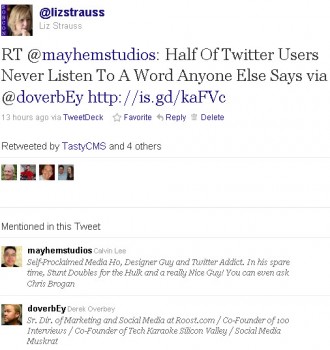
Recently on Twitter, Calvin Lee @mayhemstudios posted an link to an article on Business Insider revealing data about Twitter users who don’t listen. Derek Overbey @doverbEy read it and retweeted it. As did I.

twitter_users_never_listen

As you can see by the image, four people passed it on again.

What to Do About People Not Listening – on Twitter or Anywhere

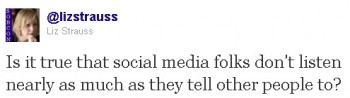
Reading the data about people not listening on Twitter got me curious and turned me into an observer. As I looked, listened, connected things, and identified patterns, I asked a question to test the ideas that we’re coming together.

my-listening-question

Asking questions gives me a chance to listen for myself. Question influence people to respond and in their response are hints and clues to how they think. The response I received fell into a pattern I’ve found predictable when I put an open ended question to the group. I’ve named the types of responses to reflect the group they represent.

  1. The observers retweet the question without sharing their response. Obviously, they’re listening. It would seem that they find the question interesting to pass it on. But they’re not sharing their own opinion on the thought. Maybe their objective is to spread the conversation and listen in to what other folks think. Or maybe they just want to raise their retweet count.
  2. The responding retweeters add a word or two to state whether they agree while retweeting the question to include the reference. They add value with their answer, offer it quickly and share with their friends it in a way that invites others to participate.
  3. The conversationalists add a new thought on the question.They extend the thought with an experience or an additional idea. They’ve considered the question and bring their own thinking to it to share with the group.
  4. The clarity checkers ask for further information about the question. They want further explanation to be sure they understand the question before they join with an opinion.
  5. The controversy seekers find what’s wrong in the premise of the question. Their response is not to seek further understanding or explanation, but to call out the the question itself as wrong.
  6. The contrarians find an answer that’s outside the scope of the question. If you ask whether they prefer fruits or vegetables, they’ll answer steak.
  7. The opportunist teachers see the question as their chance to show how smart they are. They start by answering with what they know on the subject, whether it answers the question or not. Then they continue for several tweets asking questions for which they already know the answers.
  8. and of course,

  9. The spammers find a keyword in the question or an answer to drop a highly promotional link in as if they’re commenting on the conversation. They are people who don’t follow anyone in the tweet stream. They use keyword search tools to interupt for their own spammy purposes.
  10. and the

  11. The lurkers who heard you but choose not to respond They hard to differentiate from the ignorers and the folks who just didn’t show up, but don’t make the mistake of assuming they’re the same.

It’s been said that we can’t talk without talking about ourselves. The words we choose, the metaphors we use, the choices we make of what to respond to and what to leave there all reveal things about our own view of the world and ourselves.

Paying attention to the listens on Twitter is a great way to learn how people think and respond uncovers valuable information that strict data reports cannot – valuable information to any product or marketing person, no matter the conversation or the question at hand.

What might be more important to keep in mind is that we find every one of these types of listeners in every walk of life online and off. If we listen to identify them, we soon some to realize that every kind of listener is looking for a different sort of response and a new question arises …

Some listeners seem to signal by their response that they’re better left to have the final word. What do you think on that?

–ME “Liz” Strauss
Work with Liz on your business!!

Buy the Insider’s Guide to Online Conversation.

I’m a proud affiliate of

third-tribe-marketing

Filed Under: Marketing /Sales / Social Media, Successful Blog Tagged With: bc, LinledIn, listening, relationships, Twitter

  • « Previous Page
  • 1
  • …
  • 4
  • 5
  • 6
  • 7
  • 8
  • …
  • 54
  • Next Page »

Recently Updated Posts

Is Your Brand Fan Friendly?

How to Improve Your Freelancing Productivity

How to Leverage Live Streaming for Content Marketing

10 Key Customer Experience Design Factors to Consider

How to Use a Lead Generation Item on Facebook

How to Become a Better Storyteller


From Liz Strauss & GeniusShared Press

  • What IS an SOB?!
  • SOB A-Z Directory
  • Letting Liz Be

© 2025 ME Strauss & GeniusShared