Successful Blog

  • Home
  • Community
  • About
  • Author Guidelines
  • Liz’s Book
  • Stay Tuned

5 Reasons You Absolutely MUST Share Your Vision Early and Often

September 14, 2010 by Liz

(Updated in 2020)

10-POINT PLAN: 1.1 Articulate the Vision

Why Define the Vision?

Tom Peters says that a business either supports the over-achievers or the under-achievers. The ones who feel supported call up their friends to say “This is a great place to work!” The other group feels unappreciated and leaves. My experience has shown over and over again that this is true. A business reinforces gets the behaviors it reinforces through its models and processes.

Zappos is a great case study in a how to build a internal community of brand loyal fans. What makes the Zappos culture uniquely strong and attractive is the commitment they make to the core values of the community. The vision is articulated clearly and acted upon in highly visible ways.

“Everyone that’s hired, it doesn’t matter what position–you can be an accountant, lawyer, software developer–goes through the exact same training as our call center reps. It’s a four-week training program and then they’re actually on the phone for two weeks taking calls from customers. At the end of that first week of training we make an offer to the entire class that we’ll pay you for the time you’ve already spent training plus a bonus of $2,000 to quit and leave the company right now.” — Tony Hsieh, CEO Zappos, as interviewed in Fast Company, The Happiness Culture …

They pay new employees to leave!

It’s Not How Or What … It’s Why That’s Important

Zappos says that it’s not a company it’s a mission — the Happiness Culture. That says something about who they are and why they do what they’re doing. Read the the core values of the Zappos culture.

The Zappos Core Values are:

  1. Deliver Wow Through Service
  2. Embrace and Drive Change
  3. Create Fun and a Little Weirdness
  4. Be Adventurous, Creative and Open-Minded
  5. Pursue Growth and Learning
  6. Build Open and Honest Relationships with Communication
  7. Build a Positive Team and Family Spirit
  8. Do More with Less
  9. Be Passionate and Determined
  10. Be Humble

They explain why people work there, why people do business there, and why people talk and write about them.

Tony Hsieh has articulated, built, and protects the community values that make Zappos a great place to work and a great company to work with. No wonder Zappos has such a huge and love-them loyal fan base.

That vision built a company in an enviable position. There is Zappos! and the companies who wish they had what Zappos does.

It’s Not the What or How, It’s the HUGE WHY Behind It

Leaders know where they’re going — direction and vision. They know how they will get there — a strategy and tactics. Leaders who are community builders articulate that direction and strategy with intelligence and resolve, with clarity and passion, and through a generous invitation for collaboration.

At the core of community building are three key understandings:

  1. A community-building business offers financial, professional, and philosophical/political growth for the community. As we invest our time and resources, a thriving community and its members become more successful at earning income / revenue, gain more visibility and professional authority within their industry, and know that their work has meaning and contributes to a higher purpose.
  2. A community-building business looks to align goals rather than trade services. Communities collaborate and communicate to raise a barn. Gone are the hierarchies and silos that used to negotiate to build a coliseum. The difference is in shared ownership of ideas, interactive problem solving, and commitment to the vision. Invest in people and they will return the investment.
  3. A community-building business knows that the people doing the work know what’s working and what isn’t. The exact interpretation of how the HUGE WHY vision is put into action is defined at the team level. Teams discuss and design simple decision models based on the agreed upon core values. As a result, people at every level know how to respond to new situations with positive action.

The vision of where a community-building business is gone draws from those three understandings. It’s good to know them, but it’s not enough.

5 Reasons You Absolutely MUST Articulate Your Vision

It’s critical to put the three key understanding of community building into action by defining and sharing a distinct vision. The vision sets the value of the business and the higher purpose that attracts and unites the community. It defines the internal brand and affects everything from hiring decisions to how employees treat customers.

Here are 5 reasons you absolutely must share your vision early and as often as you can:

  1. To make the thinking concrete and achievable. We all know things better when we have to communicate them. By articulating our vision, we internalize our commitment, begin to know it, and see the reality and flaws our thinking.
  2. To fulfill your leadership responsibility. It’s the role and responsibility of the community leader to define the reality of the community. The vision is and will be what attracts and retains the best employees, vendors, partners, and customers as part of the community.
  3. To visibly underscore the community values. Once the vision is articulated, the core values of the community can be listed, illustrated, discussed and integrated into every part of the business.
  4. To unify the community around one well-defined vision. Without a well-articulated vision, each community manager and member will be forced to make his or her own definition of what the community stands for and how those values are best incorporated into decision making.
  5. To empower and protect the community. In the same way that a budget or a schedule allows people to make decisions with confidence, the definition of the vision allows people to make decisions. A strong vision statement lends confidence to people who want to do the right things for the business.

A loyal internal community is a huge advantage. Every employee becomes a brand ambassador who invests emotionally in building the community as well as the company. Even in a solo practice, not to set your vision is to leave yourself in a place where your idea of where you’re is open to redefinition and loss of focus far too easily.

The strongest businesses know where they’re going and can share that with confidence and clarity. Yet too often we assume that folks understand the importance of where we’re going and why we’re going there. We have to share our vision or folks won’t see it and believe it’s going to happen.

Have you set the vision for your business? Is it HUGE enough to include everyone who helps your business thrive?

Related
To follow the entire series: Inside-Out Thinking to Building a Solid Business, see the Successful Series Page.

–ME “Liz” Strauss

Filed Under: Inside-Out Thinking, Strategy/Analysis, Successful Blog Tagged With: 10-point plan, internal community, LinkedIn, Strategy/Analysis

7 Reasons Why Investing in an Internal Community Makes Solid Business Sense

September 7, 2010 by Liz

(Updated in 2020)

10-POINT PLAN: A Foundation of Solid Thinking

Photo by Toa Heftiba on Unsplash

A Good Business Values Customers; A Great Business Values Every Person Who Helps the Business Thrive

I once had the best job of a life-time, working for the best boss I could have ordered up in my wildest dreams. Our relationship brought out the best in each of us and that ethic was true throughout the entire company. The operation of that business was smooth, reliable, and totally centered on customers and how to serve them. In an industry that was experiencing 2-3% growth, we were doing 10 to 20 times that. Conversations were honest and thinking was naturally strategic.

We were a community on a quest.
We loved what we did and we were outstanding at doing it.

Love. Not like, enjoy, or get kick out of, but have a passion for, live for, hold in highest esteem.

Every company that wants to grow should have some of that.

Here’s how to explain the value of internal community to leadership in ways that shout ROI and make business sense.

Why a Loyal Internal Community Is Crucial to Every 21st Century Business

People perform amazing feats when they’ve got a quest, a cause, and a purpose. We rise to our better selves when we become part of a community dedicated to building something that no one of us could possibly build alone.

Why?

It’s how we’re wired as humans. We’re better when we’re inspired by deep feeling. We bring our best to whatever challenge we face. Any less is inauthentic, second-best, didn’t try, plan b, ho-hum, phone it in, stand in right field and let that pop-fly pass us by instead of saving the game . . . we might as well be out!

There’s a reason that so many folks — online, in IT, in academia, in every career — say the same thing. . . . find your passion, do what you love.

The people who understand passion and work are not promoting self-indulgence. When people do what they love they perform better, faster, and with more skill. When a community gathers around a common quest, they raise the performance bar even higher by supporting each other.

What Makes an Internal Community So Important Now?

Big brands and small businesses have been talking about building customer communities for a few years. Yet, it’s been proven that the way we treat our employees is the way they treat our customers. So, it only follows that the strongest community starts inside the business.

The high touch and high concept of community draws a company together around a single goal. What could attract and support brand evangelists better than that?

In his book, A Whole New Mind, Dan Pink points out that “high concept” and “high touch” values (design, story, symphony, empathy, play, and meaning) are as important to business success in the 21st Century as linear thinking, detailed analysis, and spreadsheets.

In this global economy, conversation and relationships matter as much as schedule and budget do.

In plain and simple words, thinking and doing what everyone always has thought and done no longer work.

It’s time align our goals and values and invest in what we do together. That’s the only way to attract the best people — employees, partners, vendors, and customers. That’s the only way to be the best.

Rather than checking our personalities at the door, why not check out what a loyal internal community can do for a business that wants to build a brand that wins the loyalty of life-long customers and fans.

7 Reasons Why Investing in an Internal Community Makes Solid Business Sense

A community challenges us to bring our best to a situation. We invest in the community and they invest in us. And in that manner, we share our goals to build something that becomes a common cause. When we bring all of who we are, full engagement of head and heart, 7 deeper values and higher outcomes show up in our work.

1. Complete presence — focus. We’re all there — the all thinking business is no longer sufficient. The business is more well-rounded and friendly to the people who help it thrive. Computers can’t smile. Computers can’t listen to the spaces between words. People conceive, design, build, buy and talk what we sell.

2. Peak performance — productivity. A computer might work every minute achieving great computation effort, but it will only be as good as the people who program it and it will never over-achieve its programming. People invest more, do more, go further for the work we love. People connect to other people who are doing that.

3. Tolerance — perseverance. We have more patience, time, and energy for problem solving when we directly reap the benefits. Peter Drucker proved that money is a disincentive … it has the most effect when it’s not there or too small. What leads folks to achieve greatness is the payoffs that a loyal community offers: support, feedback, acknowledgment, sense of purpose.

4. Value and Appeal — compelling story. To compete a product or service has to be useful and beautiful. Simple and elegant, for to the adult and the kid in each one of us. Bringing logic and emotion to a business outdistances the world view of logic alone. Competence and great execution are expected. A loyal community builds in added value in how they tell the story, how they treat the product and the customers who buy it, and how they talk about the company as a value in their lives. What’s more appealing than working with someone who’s not only good but also loves his or her job?

5. Total Differentiation — identity. An internal community develops it’s own culture and identity. The uniqueness of that common bound shines through in concept and execution. The respect of a loyal community shows in everything it does. It becomes it’s own barrier to entry. The competition can’t knock that off.

6. Fully Invested and Worth Investing In — market value. Rolling all of the above values into one, nothing beats the 360 degree investment of brains, money, and dreams all in the same direction. Any financial firm worth its salt looks for that combination when funding a small business.

7. Sense of Worth — authority. Community builds authority. We value what we earn and what we love. That value telegraphs itself. It’s contagious. Customers, vendors, and partners pick it up as well.

Can you see why it’s only sense that a strong business would move to build the most supported internal community on the planet? A fiercely loyal internal community is a secret weapon that stands on its own.

Have you ever worked for or interacted with a business that was a community of loyal fans? What was your experience of that?

Related
To follow the entire series: Liz Strauss’ Inside-Out Thinking to Building a Solid Business, see the Successful Series Page.

–ME “Liz” Strauss

Filed Under: Community, Successful Blog Tagged With: 10-point plan, Community, internal community, LinkedIn, Strategy/Analysis

3 Key Strategies and 3 Crucial Insights to Growing Business on the Social Web

August 30, 2010 by Liz

What to Keep and What It Means Now

insideout logo

At the Social Media Masters Summit, I spoke about three crucial business growth strategies.

  1. Make an irresistible offer. Remove things that customers don’t want. Enhance and expand what they love. Then find ways to add in extraordinary value that only you can provide.
  2. Grow products and services as you grow (and get to know) your customer base. Review. Revise. Repackage. Be on a continual cycle of offering something new for old customers and something revised or repackaged to new customers. Avoid dying by offering old product to old customers for too long. Avoid the huge risk and expense of building something new for a whole new market — dividing your resources while trying to attract people to something new.
  3. Value loyal customers. We never recover the lost of replacing one who deserts the fold. The loss of revenue over time is high and noticeable. When it is combined with the opportunity loss, the cost of acquiring a new customer, and the negative word of mouth (the average deserter tells three friends) the impact is huge.

I also spoke about three key insights we need to fully leverage the speed and reach of the social web …

  1. Solution is the new location. Once it was important to be at the corner of State and Main. Now it’s important to be at the top of a search engine when people type in a problem they’re looking to solve.
  2. The attention economy requires a clear message sent to a clearly defined customer group. The social web makes it easier to amplify our message and to reach out to the ideal customers and partners we want to attract. In geographically limited marketplace, we could claim to serve a less-clarified market, because the community was limited. The loss of limits leaves a lack of definition in a position to be entirely overlooked. The value proposition for a specific niche is what makes us different from all other competitor’s on the web.
  3. Narrowing a niche widens opportunity. Geography no longer limits our community and customer base. A clear narrow niche works like a laser beam to focus attention on what we offer and our best value proposition for the ideal customers that we’re trying to attract.
234036_laser_green_light_2

No wonder the social web has become such a revolution. Once a brick and mortar store could count on a limited number ideal customers and be required to offer products and services beyond their needs to less ideal customers just to survive. The freedom of the Internet offers us an opportunity to choose the exact ideal customer base we want to serve. We can hone and tailor our products and offers to reach out with intention, knowing that the world market has far more customers of that description than any single geographic location ever could.

It’s the beauty of direct mail with out the cost of the catalogs … without the long development time between offers and seasons.

What businesses do you see demonstrating that they understand the reach of Internet? Not many I bet.
How are you leveraging the opportunity that the social web represents?

–ME “Liz” Strauss
Work with Liz on your business!!

Buy the Insider’s Guide to Online Conversation.

I’m a proud affiliate of

third-tribe-marketing

Filed Under: Marketing /Sales / Social Media, Successful Blog Tagged With: bc, LinkedIn, social business, Strategy/Analysis

Win Brand Loyalty and Get Free Word of Mouth at the Same Time

August 24, 2010 by Liz

cooltext443809602_strategy

Research proves that customer investment and word of mouth marketing are most effective business development initiatives any company can have to build a brand, to build sales, to build lasting value. It’s true that a word from a friend we trust makes a huge difference in what gets our attention.

Getting my attention doesn’t mean I’ll buy.

If you want me to buy your product or service, show me

  • how it makes my life smarter, faster, more efficient and you’ll win my thinking.
  • how it makes my life more fun, more entertaining, more meaningful and you’ll win my emotional investment.
  • how it seamlessly and easily integrates into my life and you’ll win my participation.

It’s the last one that most products and services leave out. Build a great product that’s meaningful or fun, but make it hard to get to, too expensive to buy into, or just plain something that doesn’t fit into what I already do — I might remark on it, but it’s unlikely that I’ll use my discretionary income to try it out. A chance at converting me into a loyal fan is a far stretch.

551663_jp_tj_2_fit_easily

If your product makes me feel smart, makes me feel better about myself, and fits easily into my already crowded life, chances are great that I’ll buy if I can. And if your product lives up to those promises, chances are even greater that I’ll be telling all of my friends. That’s free word of mouth from a new evangelist. And when I bring my friends back with me to try out your product the cycle will happen again.

How can you make what you’re offering fit more easily into your customer’s life?

–ME “Liz” Strauss
Work with Liz on your business!!

Buy the Insider’s Guide to Online Conversation.

I’m a proud affiliate of

third-tribe-marketing

__________

Filed Under: Marketing /Sales / Social Media, Successful Blog Tagged With: bc, LinkedIn, Strategy/Analysis

Be the ONLY: How to Claim Your Ground and Own It

August 9, 2010 by Liz

A Real Contribution

cooltext464169308_branding

Last week, Jeff Bezos announced plans to release a new-generation Kindle that will be even cheaper ($139) than the current generation, but will make only a few modest improvements in quality and performance. Even as analysts applauded the success of the Kindle thus far, they wondered why Bezos and his colleagues weren’t making the device much more functional, colorful, and powerful. In other words, why weren’t they taking the simple Kindle and enhancing it to go head-to-head with Apple’s iPad and other companies searching for an iPad killer?

To which Bezos offered a strategic insight about his business just as compelling as Andrea Guerra’s take on his business. “There are going to be 100 companies making LCD tablets,” he told the Wall Street Journal. “Why would we want to be [company] 101? I like building a purpose-built reading device. I think that is where we can make a real contribution.” — Bill Taylor, Do You Pass the Leadership Test, Harvard Business Review. Aug. 03, 2007

It was still the 20th Century when someone told me that I could count on these four words to always be true …

This too will change.

And since the 21st Century has arrived, those same four words have become a part of my daily reconnaissance.

Like Jeff Bezos and Bill Taylor, who wrote about him, I believe that being good at something is no longer an option. In this ever-shifting, high-noise environment, we

  • have to be the only and best at something
  • have to be the first trusted source
  • have to claim our ground and own it.

And this is more than 20th century specialization, it’s making a real contribution. It’s leadership focused to serve a distinct customer group with a clear solution. It’s irresistible service.

In the 20th century we had the advantage of geographic protection. People could only find sources as far as their shoes, their cars, and their catalogs would show them. Now the Internet has not only brought the world to their door, but Google is willing to sort it for them.

The Ground Rules to Claiming Your Ground

Apply what Jeff Bezos said to the massive opportunity that is today’s marketplace and it becomes obvious that our ideal customers are faced with overwhelming choices. The number of options for whatever anyone wants to purchase are outlandishly huge at every level: value, relationship, and cutting edge-luxury niches.

The leaders in the field have decided exactly which customers they are selling to and they signal their commitment to serving those customers on every level. Narrow your niche and you’ll still have a world of ideal customers, but you’ll be able to serve them.

apple-in-education2

Every choice of text, image, offer, or even white space in the Apple Education website reflects their commitment to educators. That focus is key to becoming the first, trusted source to the ideal customers you want to serve. But before you can own that space you have to be able to name that space and claim it.

Three simple questions can help you identify a space that holds the best opportunity for your skill set and your brand. Let’s call them the Ground Rules.

  • Where do the rules of the game / industry / current trends favor you? Make your own game. Check where your skills cross your mission. Look for opportunities where they meet. The same computer can be positioned and packaged differently to meet the needs of a specific trend or group. We can do that too. Be the best, the most, the fastest, the only. Do you write the lightest code, offer the most unique design, or maybe tailor your service to each individual?
    Example: Let’s consider that last one. As technology moves us faster, people have less time to do what they used to do and less time to do things that are meaningful. Can you configure be the simplest, fastest solution and still an outstanding value? Can you do one outstanding thing for less cost in less time? Can you make that contribution easier, faster, more meaningful, more fun?
  • What ground works for you? Be obsessed with easy. Reach out to the customers you can reach easily. If you can’t reach the customers for your idea, partner with someone who can holds that ground …. or recongfigure your idea for the customers you can reach. Repurpose products you already have to attract new customers to you. Build for the customers who already love you.
    Example: Amazon started with readers and moved out from there. Apple moved into education by offering their computers to schools and grew new customers. Software companies extend their reach by partnering with computer companies who load their offer on new computers. Who has a list that serves the people you want to reach? Who is already within your reach now?
  • Where will you find the best rewards? Claim an audience and serve them. Don’t claim a tool meant for everyone. Tools don’t make relationships people do.
    Example: It’s better to claim service professionals moving online than to claim to sell a service to all small businesses. If you clearly claim a group, you can serve them well. They’ll tell their friends about you. Not everyone who buys a book on Amazon reads it. Some give books as gifts. Some use them to fill their book shelfs. Some intend to read and never do. It’s easier and more efficient to grow a clarified customer group than to try to grow a group from individuals who have nothing in common.
1187616_stake_a_claim


Narrow your space to your ideal customer group and your unique expertise become clearer and more defined. It’s true. Show up with the skills, expertise, integrity, and competency and deliver on what you say you do.

Once you own your ground everyone else becomes a “knockoff.” You become the barrier to entry … the ONLY. There can be only one Cirque du Soleil, only one Mac, only one SOBCon – those who follow will be facsimiles.

Look around at the winners, they claimed their ground before they owned it. Amazon claimed the world’s readers before they captured that market and now they serve readers products of every sort … including a simple Kindle that will never compete with the iPad.

What space can you claim? What unique value will you deliver to the people you want as your ideal customers?

–ME “Liz” Strauss
Work with Liz on your business!!

Buy the Insider’s Guide to Online Conversation.

I’m a proud affiliate of

third-tribe-marketing

Filed Under: Marketing /Sales / Social Media, Strategy/Analysis, Successful Blog Tagged With: bc, Bill Taylor, category of one, claim your ground, Jeff Bezos, LinkedIn, personal-branding, Strategy/Analysis

3 Agency Models: How to Sell Pencils to Attract Fiercely Loyal Fans

August 3, 2010 by Liz

Which One Gets Your Buy In?

cooltext443809437_relationships

I’ve been visiting a lot of social media agency websites lately and I’ve been thinking about how good people are saying one thing and doing another. For example, how many times have you started a conversation with It’s important to listen. then proceeding to talk about why, without listening first ourselves?

Take my advice. I’m not using it.

I was visiting websites to find a great example for the keynote I’m working on. What I found is that companies sell products one of three ways.

Let’s imagine that execution is a given and that all agencies want to deliver high value to their clients. In other words, let’s say that they’re all basically offering the same set of pencils in a few different colors, a different package, and with a different experience.

1233446_set_of_crayons

Here’s what I found about how most agencies approach communicating what they do — how they sell that pencil and their ability to deliver the best pencil to the client.

Traditional Transactional Selling

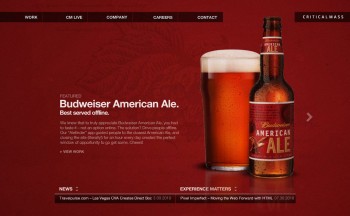
Critical Mass cuts to the chase by answering the question of how to get customers to experience something they have to taste. They underscore their strength in application building and getting to the solution.

We knew that to truly appreciate Budweiser American Ale, you had to taste it — not an option online. The solution? Drive people offline. Our “Alefinder” app guided people to the closest American Ale, and closing the site (literally) for an hour every day, created the perfect window of opportunity to go get some. Cheers!

Critical Mass does a beautiful job of explaining their qualifications and experience. That’s information that new clients surely want to know. I can’t argue with that. [ I do find this ambiguous phrase closing the site (literally) for an hour every day from the quote above and others on the site show a struggle with seeing things through other eyes.]

criticalmass

That’s traditional transactional selling — features and benefits. Sell a pencil by explaining the specs and why your pencil is better. No matter how creative you get with the words, in the end you’re talking about how good you are at making pencils. You win clients who are fans of the best pencils.

Selling Through Prestiqe, Reputation, and Narrative

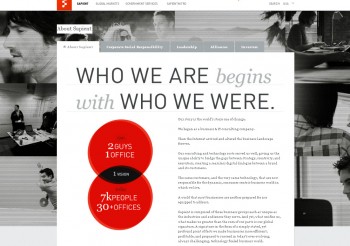
Sapient, which bnet called the Top of the Top 50 Interactive Agencies starts with story. They explain how their unique experience has given them one-of-kind abilities.

The same customers, and the very same technology, that are now responsible for the dynamic, consumer centric business world in which we live.

A world that most businesses are neither prepared for nor equipped to address.

Sapient does a beautiful job of using narrative to pull back the curtain, reveal something about their values, and defining themselves in a category of one. That last sentence in the quote raises them above the competition. The want elite clients who value prestige.

sapient

That’s selling though reputation and narrative — features and benefits are expected. Sell a pencil by explaining why your pencil will be the Stradivarius, because it will be made by people with unique pencil-making skills who transform pencils into art. In the end, the story is still your story and you win clients who value the prestige.

Selling to Attract with Fiercely Loyal Fans

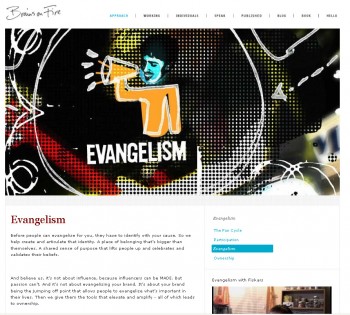
Brains on Fire changes the game entirely — connecting and demonstrating what they do. They talk to the client about creating fans not customers, not about themselves. Everything they discuss is in context of how they serve the mission of creating fans. The site is written with the personal pronoun “you” — something missing from most others.

Before people can evangelize for you, they have to identify with your cause. So we help create and articulate that identity. A place of belonging that’s bigger than themselves. A shared sense of purpose that lifts people up and celebrates and validates their beliefs.

And believe us, it’s not about influence, because influencers can be MADE. But passion can’t. And it’s not about evangelizing your brand.

Brains on Fire does a beautiful job of demonstrating that they believe in and have achieved a culture that thrives on building communities of fiercely loyal fans.

brainsonfire

That’s selling to build community and attract fiercely loyal fans. Execution and hard work are straight out stated as expected. The usual buzzwords — such as influencer — are pulled out and revealed as what they are. It’s the communities that are featured in the work not the agency. Sell a pencil by making heroes of the people who use your pencils. Feature their fabulous mathematical equations, poetry, art, writing and invite them to celebrate the role your pencil have played in making their lives easier, smarter, faster, and more meaningful. Invite them to swap stories and strategies for making pencils last longer and work better for them. Let them personalize and customize the pencils in ways that let them own your brand.

From the beginning, it’s been about the client and their fans. Fiercely loyal fans understand what it takes to attract fiercely loyal fans.

Who do you see that does a great job of selling a pencil in a way that attracts fiercely loyal fans?

–ME “Liz” Strauss
Work with Liz on your business!!

Buy the Insider’s Guide to Online Conversation.

I’m a proud affiliate of

third-tribe-marketing

Filed Under: Marketing /Sales / Social Media, Successful Blog Tagged With: bc, Brains on Fire, Critical Mass Agency, LinkedIn, relationships, Sapient, Strategy/Analysis

  • « Previous Page
  • 1
  • …
  • 7
  • 8
  • 9
  • 10
  • 11
  • …
  • 18
  • Next Page »

Recently Updated Posts

Is Your Brand Fan Friendly?

How to Improve Your Freelancing Productivity

How to Leverage Live Streaming for Content Marketing

10 Key Customer Experience Design Factors to Consider

How to Use a Lead Generation Item on Facebook

How to Become a Better Storyteller


From Liz Strauss & GeniusShared Press

  • What IS an SOB?!
  • SOB A-Z Directory
  • Letting Liz Be

© 2025 ME Strauss & GeniusShared