
Successful Blog

  • Home
  • Community
  • About
  • Author Guidelines
  • Liz’s Book
  • Stay Tuned

Delegate…and relax

February 10, 2011 by patty

by Patty Azzarello

cooltext466496263_leadership
delegate-relax

How well do you delegate?

Most people inherently know that they should delegate more, and delegate better, but one big obstacle keeps them from doing it…

It will be better if I do it myself.

Who’s at fault?

It it doesn’t come out right, the uncomfortable question this raises is – did this person fail to do a good job because:

1. They are not good enough at the job or
2. I am not good enough at delegating?

You don’t need to get comfortable with worry!

The real secret of successful delegating is not to learn how to deal with the emotional discomfort of letting go, and learning to live with being worried about the outcome, or accepting bad outcomes…

It’s about preventing reasons to worry

Your job is to delegate, let go, NOT micromanage… AND create structure, support and processes so you ensure that it is going to get done right.
You don’t deal with the worrying, you ensure it’s not necessary.

Ways to build comfort and insurance into the project

(without micro-managing)

1. Let the person create the timeline, define the deliverables and how you will measure them.  The encouragement and trust goes a long way, and you either get the pleasant surprise of a better plan than you would have come up with, or you get an early warning that this person needs more support.

2. Tighten the Outcomes.  If you are concerned that the person is not capable enough to run with the project, Instead of a 6 month outcome, discuss outcomes that occur every two weeks.

3. Focus on the outcome, not the activity. No two humans will do a task exactly the same way.  If they deliver the outcome, it shouldn’t matter how they do it.  Let them worry about how and what.  You worry about WHY, and what needs to be true when it is done.

4. Create an actual process and tracking system for long term or repetitive tasks – a software development lifecycle with checkpoints is a good example.  But why not define a project lifecycle with checkpoints for a quarterly analyst presentation, a press release, or a marketing campaign?

5. Third party reviews. Get yourself out of the position of always being the one to judge whether a deliverable is good enough or not.  Get the actual consumers of the deliverable to review and provide feedback.  Your employees will learn far more this way.

6. Don’t forget to inspect and measure things along the way.  If you set up a timeline with review steps along the way, you must follow up.  A great deal of your comfort comes from the fact that people take you seriously and actually do the committed work.  A long time mentor of mine always put it “You get what you INspect, not what you EXpect”.

7. Teach. When you are delegating things you are personally good at, always think of delegating as a teaching opportunity. If you need to sometimes jump down and do the work yourself, make sure someone is watching and learning.

Bottom line…

You need to delegate effectively if you want to get anything significant done, get anywhere in your career, and save yourself from an un-doable workload.

If you are either doing the work yourself, or worried about the work not getting done, you need to change your strategy.

You can delegate and feel comfortable that the work is getting done as long as you do the higher level work of setting up the systems, processes and measures that ensure the right things are happening along the way.

What has worked for you?

Please share your ideas about how you got better (and more comfortable) with delegating. Let’s discuss in the comment box below!
—–
Patty Azzarello is an executive, author, speaker and CEO-advior. She works with executives where leadership and business challenges meet. Patty has held leadership roles in General Management, Marketing, Software Product Development and Sales, and has been successful in running large and small businesses. She writes at Patty Azzarello’s Business Leadership Blog. You’ll find her on Twitter as @PattyAzzarello


Filed Under: management, Successful Blog Tagged With: bc, delegating, LinkedIn, Patty Azzarello, time-management

Social Media Book List: How Reliable is your Product & 42 Rules of Product Management

February 9, 2011 by teresa

A Weekly Series by Teresa Morrow of Key Business Partners, LLC

I’m Teresa Morrow, Founder of Key Business Partners, LLC and I work with authors & writers to help them with their book promotion and social media marketing. As part of my job I read a lot of books (I love to read anyway!).

This week I will be highlighting two books; one is with an author I am working with and the other is on my “reading list”.

The books I cover in the Social Media Book List Series will cover a range of topics such as social media, product development, marketing, blogging, business, organization, career building, finance, networking, writing, self development, and inspiration.

‘How Reliable is your Product: 50 Ways to Improve Product Reliability’

by Mike Silverman

How Reliable is Your Product

“After reading Mike’s ’50 Ways to Improve Product Reliability,’ I am impressed to state that if most people who want reliable products would execute fifty or sixty percent of what he is espousing, how great it would be for consumers. Instead of going into depth on each topic, Mike stays at a higher level to give a perspective of reliability within the product development lifecycle. If you need more in-depth knowledge on any of the techniques discussed in his book, you can easily contact a consulting firm such as Mike’s company, Ops A La Carte®, and get the educational or consulting expertise you need. I have known Mike
for over 15 years, and he is one of the most honest people I know. Feel free to get to know him and you will see what I am talking about. Enjoy his book!”
Harry McLean
Manager of Reliability, Advanced Energy Inc.
Author of HALT, HASS, and HASA Explained: Accelerated Reliability
Techniques

“’50 Ways to Improve Product Reliability’ is a great collection of ground-rules that are based upon experience. It describes a number of situations and presents practical examples of what engineers should do to be successful in the area of reliability. In a few examples it also indicates what should not be done in order to avoid problems. The book is organized according to the phases of a project and a maturity matrix is presented as a means to measure progress. Many examples show proactive use of reliability tools for hardware and software. All are accompanied by concise case studies showing how to apply tools and handle common situations. It is a must read for all engineers and managers who are involved with corporate-wide reliability improvement efforts.”
James McLinn, CRE, Fellow, ASQ

About the Book*:

Mike has focused on reliability throughout his 25-year career, and has observed the position of reliability in the organization evolve. In this book, he condenses his expertise and experience into a volume of immense practical worth to the engineering and engineering management communities including designers, manufacturing engineers and reliability/quality engineers.

Among other things, Mike discusses how reliability fits, or should fit, within the product design cycle. He provides a high-level overview of reliability techniques available to engineers today. He lucidly discusses the design of experiments and the role of failure management. With case studies and narratives from personal experience, Mike discusses optimal ways to utilize different reliability techniques. He highlights common errors of judgment, missteps and sub-optimal decisions that are often made within organizations on the path to total reliability.

With How Reliable is Your Product? Mike Silverman has delivered what few have done before–a comprehensive yet succinct overview of the field of reliability engineering and testing. Engineers and engineering managers will find much in this book of immediate, practical value.

About Mike*:
Throughout his 25-year career, Mike Silverman has maintained a singular focus on reliability. He is Founder of and Managing Partner at Ops A La Carte, a reliability engineering consultancy that helps customers build end-to-end reliability into their products.

He owns and operates HALT and HASS Labs, a reliability laboratory in Northern California that has now tested over 500 products. A Certified Reliability Engineer with over a dozen technical papers under his belt, Mike is currently President of the Silicon Valley IEEE Reliability Society.

You can purchase a copy of ‘How Reliable is your Product’ online from the publisher site or on Amazon. *this information came from the author’s website.

Next, I would like to introduce you to another book on the business book list on Amazon and on my reading list: ”.

42 Rules of Product Management

by Greg Cohen and Brian Lawley

This is very valuable for anyone involved with the process of taking products to market. With their extensive experience and contacts, Greg and Brian have gleaned insightful jewels from thought leaders in the product management field. The format is refreshing because you get a fresh perspective on each page since each author has to get their most important observations into two pages. It makes for great reading and, as with one of the other reviewers, I found myself finishing the whole book in one sitting and really enjoyed it.
Gary Parker – Amazon reviewer

Excellent chance to quickly gain great insights into the fine art of product management. Practical, useful topics. I’m proud to have been asked to contribute a chapter and be a part of this very timely book. This is information you can use today to build better products.
J. Cook – Amazon Reviewer

This is a great book for both experienced and new product managers as well as those in closely related responsibilities such as product marketing.

About the Book*
Packed with pearls of product management wisdom, this book has something for everyone. Best of all, it was written with the busy product manager in mind. Each rule is kept to two pages and designed to stand-on its own. They can be read in any order. In less than five minutes a day, you can learn from forty of the best product managers in the world.

’42 Rules of Product Management’ is a collection of product management wisdom from forty experts from around the world. With over five hundred years of combined hands-on product management and product marketing experience, the authors each shares one rule that they think is critical to know to succeed in product management. Whether you are a seasoned and experienced product manager or are just starting out, ’42 Rules of Product Management’ will help you lead with greater effectiveness and influence.

About Greg and Brian*:

Brian Lawley is the CEO and founder of the 280 Group. During his twenty five year career in Product Management and Product Marketing he has shipped more than fifty successful products. He is the former President of the Silicon Valley Product Management Association, won the 2008 AIPMM award for Excellence in Thought Leadership for Product Management and is the author of the best-selling books ‘Expert Product Management’ and ‘The Phenomenal Product Manager’. He is a Certified Product Manager and Certified Product Marketing Manager and has been featured on CNBC’s World Business Review and the Silicon Valley Business Report and writes articles for a variety of publications including the Product Management 2.0 newsletter and Blog.

Greg Cohen is a Senior Principal Consultant with the 280 Group and a 15 year Product Management veteran with extensive experience and knowledge of Agile development, a Certified Scrum Master, and former President of the Silicon Valley Product Management Association. He has worked and consulted to venture start-ups and large companies alike and has trained product managers throughout the world on Agile development, road mapping, feature prioritization, product lifecycle process, and product management assessment. Greg is the author of the book ‘Agile Excellence for Product Managers’ and a speaker and frequent commentator on product management issues.

*courtesy of book website and Amazon

You can purchase a copy of ’42 Rules of Product Management’ at Amazon.

So how do you check your product reliability in your business?

Filed Under: Business Book, Business Life, Successful Blog Tagged With: bc, Brian Lawley, Business Book, Greg Cohen, Mike Silverman, product management books

What We Can Learn From Character Blogs

February 9, 2011 by Guest Author


cooltext455576688_blogging

—-

By Jael Strong

A colleague and I were recently discussing character blogs, a type of blog in which a writer blogs as if he or she is a character off of a television program, movie, etc.  The idea is enticing; it takes anonymity to a new level.  Who doesn’t want the freedom to write behind such a disguise? Unfortunately, this blend of acting and writing doesn’t appear to be open to just anybody.  A writer needs to be hired for such ghost writing.


Still, isn’t there something here to help out the rest of us bloggers?  I think so.  First, what makes this type of blogging inviting?  As I noted above, the freedom of anonymity is appealing.  Blogging offers that to everybody though.  We write in amongst a sea of other writers.  Very few of our readers know us personally, so there is room for a little bit of self-invention in this forum.  I’m not condoning deception of your audience.  I’m saying that if anonymity is what you crave, take this opportunity provided in your blog. 


In practical terms, how would this reinvention work?  For example, if you are withdrawn by nature, your blog can be a place to create a persona that is outgoing.  If you are known in the real world as insensitive, even crass, you could use your blog to develop a more sympathetic, kind self.  If “reinvention” doesn’t sit well with you, we could call it developing a more improved you.  In any case, this is a type of ghost writing in which you are the writer for whom you are the ghost writer.


Is there anything else appealing about this process?  From my point of view, this type of blogging allows for more creativity, especially if you are writing from an entirely new standpoint.  Writing as if you are someone else is not only fun, but allows you to tackle topics from a brand new angle.  The challenges would be different from those of a typical blog, since consistency of character and background would be an issue.  But for someone who loves writing creatively, this obstacle would be enjoyable to overcome.


Simply inventing a new character and writing from that angle sounds wonderful to me.  Tweaking my personality traits via a blog also has its draw.  Both come with new challenges and even new responsibilities, but those writers who do it seem to be having a great time with those difficulties.  What do you think about this type of blogging?


Jael Strong writes for TheWriteBloggers, a professional blogging service which builds clients’ authority status and net visibility.  She has written both fiction and non-fiction pieces for print and online publications.  She regularly blogs at Freelance Writing Mamas .

Thanks, Jael

–ME “Liz” Strauss
Work with Liz on your business!!

Buy the Insider’s Guide to Online Conversation.

I’m a proud affiliate of

third-tribe-marketing

Filed Under: Successful Blog Tagged With: bc

21 Tweeters and What’s Wrong with Viral Marketing

February 8, 2011 by Liz

cooltext443794242_influence

Last week, I was invited to speak at an interdepartmental off-site. People from product, IT, marketing, sales, research, design, and PR were involved. The SVP who designed the event set up the room in teams in which one person from each department was represented. She arranged the day to be filled with interactive information and conversation so that ideas could grow.

The week before the event, I’d had lunch with that SVP to talk about what her goals were for my presentation. She talked about how rumors spread and how people connect. She also used the word “viral” in the proposed title of my talk. I asked if she minded if we edited that word out.

Communicating the nature of viral marketing, was going to be an important goal of my day.

What Is Viral Marketing?

The morning of the off-site I checked into Twitter before I left and thought, Here’s an opportunity to bring social media in action and authority other than my own into the room.

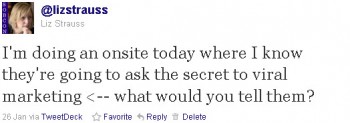
So, I tweeted this question.

onsitetweet

I favorited the responses, pulled them up in my @mentions list, took two screen shots, and made a two-page handout to share. The folks who responded are people I follow on Twitter and after you read what they said I’m betting you’ll want to follow them too, so I’m including links to their Twitter accounts. Top down the tweets are in the order I received them. [Thank you all for making my quest easier, faster, and more meaningful for me and the folks I’d soon be talking to.]

  1. @michaelport I’d say if I knew the “secret” I wouldn’t be here today.
  2. @steveplunkett “being in the right place at the right time, with the right thought” or “controlled manipulation of people online”
  3. @shivya You can’t call it viral until it is viral. The secret is engaging, entertaining, informational, sharable content.
  4. @egculbertson be authentic, be humble, be relevant to your audience, and be funny or approachable. then, hope for a stroke of good luck.
  5. @ElysiaBrooker in the (paraphrased) words of
    @unmarketing : MAKE AWESOME CONTENT and the rest will happen naturally.
  6. @RobPene a video of cute cats dancing to Snoop Dog lol 🙂
  7. @jenniferwindrum I would tell them the only thing that could potentially “go viral” is their stupidity. No secret there. 🙂
  8. @tbains That there’s no way to predict or manipulate what goes viral. Instead, focus on quality first. Lame but true
  9. @chris_c_lucas Do cool sh*t and do it consistently. Then let other people talk about it. It’s simple 🙂
  10. @TheStudioNH Viral marketing makes me get an anti-buy-otic.
  11. @_Signalfire_ like a virus spreading, the right conditions must exist with the right host. It’s all up to the community it’s introduced into.
  12. @DeniseWBarreto Be authentic and have a real desire to better the lives of your target otherwise clever, cool but false intentions #fail
  13. @EOC_jmello Viral Marketing does not actually exist. It’s about having the right content, right audience, at the right time.
    It goes along with agencies that tell clients they can make something go viral. BS! Sometimes luck plays into it too.
  14. @katyboog123 humour is a good one, also shock value.
  15. @minormusic Viral mktg is not a substitute for quality face time w influential ppl in your market. Ur reputation still proceeds u.
  16. @mikecassidyAZ enlighten, enrage, engross, or make ’em smile.
  17. @scotmckee Secret to viral is remembering that the crowd decides what goes viral – not you. 🙂
  18. @DavidFord83 Absolutely true! RT @MinorMusic: @lizstrauss Viral mktg is not a substitute for quality face time w influential ppl in your market.
  19. @AWomansWork Forget viral & think what’s relevant & interesting to your audience. That, or leprechauns.
  20. @TourismCurrents Yesterday we tweeted that the term “viral campaign” needs to be taken out and shot. No change in our position. 🙂
  21. @jason_baker Is it just me or is “creating viral campaigns” in a job description a bit off?! 😉

The problem with viral marketing is that it focuses on the product and the message and not the people we want to share that message. If we want people to listen, engage, and share what we’re doing, we have to make it about them.

What invitation, reminder, or question might you offer to help us all stay focused more on the people and less on the message?

–ME “Liz” Strauss
Work with Liz on your business!!

Buy the Insider’s Guide to Online Conversation.

I’m a proud affiliate of

third-tribe-marketing

Filed Under: Marketing /Sales / Social Media, Successful Blog Tagged With: bc, LinkedIn, loyalty, management, viral marketing

Groupon Super Bowl Ad: When Being Clever Offends and How to Win One for Tibet

February 7, 2011 by Liz

Clever Only Works When Trust Is Around

cooltext443809437_relationships

It must be a hugely stressful and exciting opportunity to find your startup with a slot for a commercial at the Super Bowl. Who wouldn’t want to make a fabulous debut? Can you imagine the meetings that must have been to plan that Groupon ad? Bet it was fun exciting and filled with clever ideas … all meant to go for the win!

By now you’ve heard of or seen the unfortunate Groupon Super Bowl ad that came from the meetings I just described:

Given the human rights crisis in Tibet, it’s not hard to see the response wouldn’t be good. To say it offended people is less than what happened. From Twitter to China, from CNN to Forbes to their own hometown Chicago Tribune the reaction wasn’t good.

CNN International: Super Bowl ad featuring Tibet triggers angry reaction in China
Forbes: Groupon’s 2-For-1 Super Bowl Special: Offend Both China And Tibet Activists
Digital Trends: Groupon’s Tibet Super Bowl ad offends everyone
Deal Book: Did Groupon Cross the Line in Super Bowl Ad Debut?
Chicago Tribune: Groupon Tibet Super Bowl TV ad discounts taste, sensitivity

Clever isn’t clever when it offends.

The problem with clever ideas is that they are a social thing. Clever only works where trust already exists. Clever is risky because it gets us looking at ourselves not the people we’re talking to. Clever backfires completely in a venue or a community where people don’t know us yet. Groupon found out what happens when we try clever without a firm foundation of trust in the mix.

Now, Groupon has problem. What would you do?

Reframing the Problem

The way you frame a problem is what keeps it a problem. This problem can so easily be a huge opportunity. Groupon has been in the social business world long enough to see the outstanding examples of companies who tried to apologize without apologizing and those who have owned their mistakes and won back the trust of the their core fan group instantly.

Here are five well known social media apologies …
Dell’s 23 Confessions
A Commitment On Edelman and Wal-Mart
JetBlue Launches Cross-Media Apology Campaign
Turner Broadcasting Apology Letter
Motrin

Those that worked were those that resonated started from a place of trust and rebuilding trust relationships. If you find yourself where Groupon is, start with these two tenets of connecting in honesty.

  1. Step away from the the clever and open up. Send out an actual human being to talk with your customers. They’re your heroes.
  2. Lead with trust. Trust the human being you send, trust your customers, and give people every reason to trust you. Trust is the currency of relationships.

With that mindset, a clear plan of action toward apologizing early and often is the only way to answer the hugely negative response to their ads.

The Action Plan

What would I advise the Groupon team to do? Realize that the relationships they’ve built have been based on price, not loyalty. Understand that the breach was something like

“If you could make fun of something as serious as that, would also make fun of anything, everything, that’s important to me?”

Here’s an action plan to begin a new kind of relationship and to rebuild what’s been lost by the ad.

  • Read enough to understand why people responded as they did to the ad. Read long enough and deep enough to see the disconnect. A wise, open-mind doesn’t have to read long to see what went wrong.
  • Say thank you to folks who raised the complaints.
  • Admit the mistake and apologize. A true apology includes …
    • a statement of regret …
      I’m sorry.
    • ownership of the act and responsibility for the outcome …
      I behaved badly … It was my fault this happened.
    • acknowledgment of hurt or damage …
      It made you feel small … It broke your trust … It lost you business.
    • a promise for better behavior in the future …
      It won’t happen again.
    • a request or statement of hope for forgiveness or renewed trust …
      I hope you can believe in me.
    • Then go back and read everything — every tweet, post, conversation about it. Talk to everyone you can about it. Become an expert on knowing every blog and blogger, every tweet and tweeter. Respond with appropriate personal apologies to as many as you can.

    Have a beginner’s mind. Listen. Listen. Listen. Say thank you again.
    Then don’t tell folks you’ve changed. Show them.

    How to Recover

    Groupon has a site for donating to the Tibet Fund. Finding out about it now, is too little too late. The ad might have led with that, but it didn’t. Here’s how Groupon might recover by using that site and enlisting from the folks who still want to believe in them.

  • Ask for help. Have a Groupon reverse offer. Offer to pay $500 budget to the first 100 customers who want to make a video version of a new ad. Make the Groupon offer that they get paid. Participate with time. Don’t just throw money at them.
  • Add a page to the Save the Money site to feature the videos they make and allow the audience to cast votes on for the video they think would have made the best Super Bowl Ad for Tibet that might have been. (Limit votes to 1 per email address.)
  • Put the top 10 winners on the Groupon site and donate $1000 to the Tibet fund in the name of each winner – a total of $10,000.

A company admits the error and shows they mean it with everyone watching could make difference in a huge way. Here’s a chance to turn critics into heroes and to use the momentum to make something truly good happen.

Groupon has a huge opportunity to bring visibility and real action to the crisis in Tibet.

This could be a win for the world, if Groupon wants to make it that.

Got more ideas for how Groupon might recover from this?

–ME “Liz” Strauss
Work with Liz on your business!!

Buy the Insider’s Guide to Online Conversation.

I’m a proud affiliate of

third-tribe-marketing

Filed Under: Community, Marketing /Sales / Social Media, Successful Blog Tagged With: bc, Groupon, LinkedIn, Super Bowl Ad, Tibet

Beach Notes: Transport Options

February 6, 2011 by Guest Author

by Guest Writers Suzie Cheel and Des Walsh

Bike with skateboard, owners presumably off surfing.

transport-options

How will you transport yourself today?

Suzie Cheel & Des Walsh

Filed Under: Motivation, Successful Blog Tagged With: bc, Beach Notes, Des Walsh, Suzie Cheel

  • « Previous Page
  • 1
  • …
  • 310
  • 311
  • 312
  • 313
  • 314
  • …
  • 1050
  • Next Page »

Recently Updated Posts

The Creator’s Edge: How Bloggers and Influencers Can Master Dropshipping

Is Your Brand Fan Friendly?

How to Improve Your Freelancing Productivity

How to Leverage Live Streaming for Content Marketing

10 Key Customer Experience Design Factors to Consider

How to Use a Lead Generation Item on Facebook


From Liz Strauss & GeniusShared Press

  • What IS an SOB?!
  • SOB A-Z Directory
  • Letting Liz Be

© 2025 ME Strauss & GeniusShared