Successful Blog

  • Home
  • Community
  • About
  • Author Guidelines
  • Liz’s Book
  • Stay Tuned

So Tell Me, Are You Feeling Lucky?

November 14, 2008 by Liz

The dictionary says that luck is an outside force Lucky means that we receive good fortune or get hit by adversity.

Around here, we we define it differently.

When we say lucky on this blog, we mean ways we connect … Jannie said:
I feel my gurus thus far are you, Barbara Swafford, Cath Lawson and Vered … I feel awfully lucky.

people who encourage us … Vicky said:
I love Melissa and Life In Perpetual Beta too!
I am so lucky to know both of you personally. You both enrich my life and I believe God sent you both to me. To encourage me to dream big as both of you do and you know I have big plans too!

about making our own dreams … Patricia said:
Sigh. This is my dream, to live near the beach and take long walks on the sand.
So soothing. You must conjure lots of dreams for this community on those beach walks. Lucky for us!

We use lucky to talk about relationships … Writer Dad said:
My son and I wake up before anyone else. Every morning he reminds me how lucky I am.

appreciation and gratitude … Karl said:
I take a second to step back and try to appreciate the spot that I am in. It helps me gain perspective and feel lucky to do whatever it is I’m doing. Even giving a financial literacy talk to a bunch of bored teenagers is enjoyable.

I catch myself doing the same thing.
I’m one very lucky blogger.
Don’t think I don’t know that.

Around here, luck doesn’t happen to us.
We choose it for ourselves — in the people we love and the paths we walk.

Luck is an action, a choice, and a point of view.

So tell me, are you feeling lucky?

–ME “Liz” Strauss
Image: sxc.hu
Work with Liz!!

Get your best voice in the conversation. Buy my eBook.

Filed Under: Successful Blog Tagged With: bc, Community, Ive-been-thinking, Luck, personal-development

6 Ways to Build Your Own Personal Developmental Network

November 13, 2008 by Liz

Not a Coach, Not a Mentor, a Network

relationships button

I had an exciting conversation Sunday with Debbie Lawrence. She told me via Twitter that she had an idea in need of thoughts. A few minutes later we were on the phone exploring fresh perspectives. She reached out to get input she needed, and I got to know more about her, about her dream, and about how she’s putting into action. Not a bad trade.

Monday, Tuesday, Wednesday, I did something similar. I reached out to people in my network to hear their thoughts on what I’m doing.

Every day I touch base with people to tweak what I’m thinking to check on directions I might go. I’ve done this consistently with the most important challenges I’m pursuing. The people I ask are my Personal Developmental Network — a small group of intelligent, incredible people, who help me stay on track with my goals.

6 Ways to Build Your Own Personal Developmental Network

Many folks find a mentor by accident. Some never had one. Some turn to the closest person they meet at a new job or choose to go it alone it. Others work with a coach or a trainer. A few make a commitment to a mastermind team. They’re similar, but not the same as a Personal Developmental Network.

In their Wall Street Journal report Kathy E. Kram and Monica C. Higgins defined a personal developmental networks this way.

A better approach is to create and cultivate a developmental network — a small group of people to whom you can turn for regular mentoring support and who have a genuine interest in your learning and development. Think of it as your personal board of directors

Kram and Higgins’ approach to building a developmental network is career and business focused — pointing out how network composition might change based on where we are professional path: entry level, midcareer, or senior manager. Their suggestions focus on career goals.

Their key steps match my own, but their execution is more narrow.

I need a more holistic approach. I don’t want a professional life that’s divorced from my life as a human. When I face down my hugest goals and quests, I want my whole life — head and heart — focused on the same purpose. So I suggest that we start with their key steps to building a Personal Developmental Network and expand them to include more than what happens under the heading “business / professional.”

For me, the purpose of a Personal Developmental Network is to offer guidance in becoming the best I can be inside and outside the world of business. My approach to building my network is life focused — I want a network that helps me grow as a human meant to achieve something and I believe that a network that grows with me offers depth and insight that are priceless.

Here are the five solid, complete, and intuitive main ideas Kram and Higgins put forward and suggestions after each for building your own Personal Developmental Network.

1. Know Thyself — Start with a foundation of concrete not sand.
— Qualitative Observations: Ask people who know you to describe your strongest traits — those that serve you well and those that get in the way. You’ll recognize the people who know you best by the way that you think, feel, and act in their presence. When we’re with people who know us, we don’t think about our responses or edit our behaviors. Explain why you’re asking and offer them more than one way to give you feedback: directly to you in person, on paper, via an interview by a mutual friend.

— Quantitative Assessment: Go over every test, performance appraisal, and personality measure you’ve taken. Check out others for a fresh view and learn what you can from them. Look for friends who have worked with the tools or tests you choose. You might try a combination of Strengths Finder, the Enneagram, and the Myers-Briggs Personality Inventory.

— Personal Reflection: Spend an hour / day for a week thinking about past successes in your life — in personal and business situations. Look for traits and strategies that served you through all of them.

Know what you know and know its value.

2. Know Your Context — Pick your path.
Look three years down the road and visualize where you want to do be. Draw that picture out in as much detail as you possibly can. If you can’t settle your mind on one single path, perhaps that the first task to work on with your network.

3. Enlist Developers — Choose unique and valuable guides.
Choose people you would bet your reputation on — people who share your standards and have similar goals. Take care to choose people who also offer different views. A strong network might include:

— a close friend who knows you and your history, both business and personal.
— someone from your business industry who knows you less well
— two or three someones who are from other industries
— two or three someones you respect and admire, but don’t know well

Decide how you’ll keep them in your life. Will you meet with them when you have questions or meet regularly?

4. Regularly Reassess — Seek opportunities to learn what you’re learning.
Go back to the assessment in Step 1 on a regular basis. Check in with those close friends by asking, “How’ve I changed that you can see?”

5. Develop Others — Return the favor and pay it forward.
Be of service to the people who are helping you. Always reach out for ways to give back more than you receive. When someone teaches you a skill, ask how you might use that skill to help that teacher. Ask questions, listen actively, and be first to offer a favor without strings. People remember sincere curiosity and true generosity.

The best way to seal what we’ve learned is by teaching. Offer to help someone who thinks you’ve already arrived. Take every opportunity to reach out to offer what you’ve learned.

6. AND THE ONE THAT WAS MISSING — Communicate. Let your network know when you need help, when you have questions, or even when you need to vent in a safe venue. A developmental network that doesn’t know where we are can’t help us move ahead.

A developmental network is not made from casual friending or confirming of followers. It’s the people who understand why we’re passionate about our calling. Like a personal board of directors, a true developmental network is people who know us, who value our trust and our reputation, and who are willing to offer their best thinking to move us forward. If we choose them well, we grow in all facets of our life.

Watch for and welcome every wise teacher you encounter. Wisdom and experience are a prize. True teachers show themselves by offering advice, expecting nothing in return. Mentors who come your way, offering experience and connections, see something in you. Let them help you discover what that is and what it could be if you let it grow.

Welcome all wise teachers into a Powerful Developmental Network.

Nobody likes to go it alone, and it’s not a good idea. We need each other for information, insight, and inspiration.

I bet you’ve got some sort of Personal Developmental Network already started. What sort of teacher is missing? How might you more fully engage those important teachers and supporters in the quest you’re on?

–ME “Liz” Strauss
If you think Liz can help you find focus or direction, check out the Work with Liz!!

Related
Self-Promotion as Easy as Knowing What You Do
Money Strategy, a Dead Horse, and Folks
Are You a Freelancer or a Solo Entrepreneur? Use Guy Kawasaki’s Mantra as He Meant

Filed Under: management, Successful Blog Tagged With: bc, LinkedIn, personal developmental network, relationships

What’s Your Best Advice on Hitches, Glitches, and People Who Don’t Show Up?

November 12, 2008 by Liz

(Updated in 2020)

Photo by Markus Winkler on Unsplash

Even Big Hairy Audacious Goals Get Stuck

What makes me think that everyone has been here?

We get an idea. The concept seems whole, simple, brilliant. We can’t wait to start. So we set a dream on the horizon, and we go for it. Enthusiasm, drive, and determination propel us.

We set a plan.
We get to work.
We talk about what we’re doing.
Things are rolling
until …
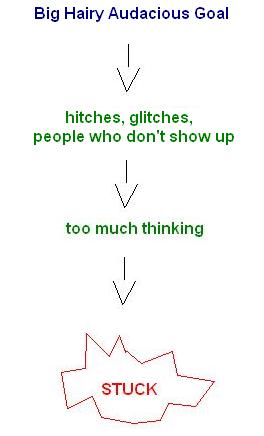
a hitch, a glitch, someone doesn’t show up.
Now what?

Gotta Get a Big Hairy Audacious Goal

Putting a dream on the horizon and moving toward it is a start, but it isn’t quite enough. We need to make it a Big Hairy Audacious Goal.
Suzie Cheel and Glenda Watson Hyatt live by their Big Hairy Audacious Goals. Lots of folks believe in BHAGs. Tim O’Reilly and Rosa Say blogged about their value. Geoff Livingston wasn’t shy about explaining what he why he thinks big hairy audacious goals make things happen.

When they name the BHAG, marching orders crystallize. It’s messy and non-linear, but voracious. Just the ticket for a little magic. The Buzz Bin

I agree. Big hairy audacious goals are messy and nonlinear. The very “big, hairy” name makes it clear that they’re likely to offer deadends, detours, and doers who don’t do what they said they would. Those big hairy interruptions are when too much thinking can get us stuck.

It’s the thinking … questioning?
Is it us?
Is the goal too big and too hairy?
Are we up to the struggle?
That’s the danger. The goal didn’t change, nor did it’s value. What changes is our resolve. Enthusiasm, drive, and determination fade into black and we’re left with voices saying we might have misjudged.

Hitches, Glitches, and People Who Don’t Show Up

I said I’d tell you about the barns and bridges project as things moved forward. It’s been a week since then.

Here’s what’s going on.

  • Hitches: People are asking how to help and I don’t have a system for answering them.
  • Glitches: Bad code stole time from the project and other work needs to get done.
  • People who don’t show up: My designer has gone into the code cave. I think I need to find a new one.
  • What’s on track: conversations with possible sponsors are moving forward, I’ve got help forming the message and the documentation they’ll need to see the project clearly and know their part.

As my friend, Lorelle, often tells me, “You’d be brilliant for other folks, now’s the time to be brilliant for yourself.” With that in mind, I’m offering these plans for now.

The next few days, my free time will be about: keeping the sponsor conversation alive; planning out how to get 2 or 3 key volunteers committed to help manage the project for 2-3 hours a week; start the quest for a new designer; finish the details left open by my computer mess.

Action has always been my best response to making sure a big goal doesn’t get stuck. That’s my advice for me. What’s yours?

Here’s the keys. I hand it over to you …

What’s your best advice about hitches, glitches, and people who don’t show up? What action steps should come next to keep this Big Hairy Audacious Goal of Raising Barns and Building Bridges moving forward? What good things have you been doing that we don’t know about?

Looking forward to what you write in the comment box.

–ME “Liz” Strauss

Related:
Why Play the Game, If We Aren’t Playing for Keeps?

Filed Under: Business Life, Successful Blog Tagged With: barn raising, BHAG, bridge building, The Big Idea, visible authenticity

What LaurenMarie Said . . . About Authenticity

November 12, 2008 by Liz

A community isn’t built or befriended,
it’s connected by offering and accepting.
Community is affinity, identity, and kinship
that make room for ideas, thoughts, and solutions.
Wherever a community gathers, we aspire and inspire each other intentionally . . . And our words shine with authenticity.

Naturally Authentic

When we’re fully expressed in what we’re doing, talking about it comes naturally. The sounds of our engagement breathe through us. We lean into where we want to be. We’re not changed by who’s watching.

Here’s what LaurenMarie said . . .

I notice with myself that sometimes I am just happy to be excited about what I do and share that with people. I hope that they catch the excitement, too, but I’m not hurt if they don’t.

Other times, I am nervous about telling someone about what I do because of what they will think of me. I know this has to do with me, not them, but I wonder what about me determines those two completely different reactions. I’ll have to observe more closely next time. I definitely like the first way better!

Ari, I like what you said. That is very insightful. hehe, employing tactics to be authentic makes you exactly the opposite, doesn’t it?

LaurenMarie from a comment on July 29, 2008

A successful and outstanding blogger said that.
–ME “Liz” Strauss

Filed Under: Motivation, Successful Blog Tagged With: authenticity, bc, LaurenMarie

The Mic Is On: We’re Talking About Saving the World at Work

November 11, 2008 by Liz


It’s Like Open Mic Only Different

The Mic Is On

Here’s how it works.

It’s like any rambling conversation. Don’t try to read it all. Jump in whenever you get here. Just go to the end and start talking. EVERYONE is WELCOME.
The rules are simple — be nice.

There are always first timers and new things to talk about. It’s sort of half “Cheers” part “Friends” and part video game. You don’t know how much fun it is until you try it.

Co-host Mark Carter, Social Media Manager

What Are We Doing to Save the World? Tim Sander’s new book, Saving the World at Work, is about how individuals and businesess can do things to help the planet while still making a profit. He calls this change in our thinking, the Responsibility Revolution. We’ll be talking about responsible business citizenship and what that means. We’ll be talking about what we can do.

  • Does a company’s practices with the environment change whether you would buy their products do business with them?
  • Would you spend more for a product from a company that believes in Corporate Citizenship?
  • Do you see companies and individuals giving up dependence on paper and turning to digital forms of communication for more than email correspondence?
  • How can we help green up our companies, our communities, and our homes?
  • What part can individuals play in saving the world at work?
  • And, whatever else comes up, including THE EVER POPULAR, Basil the code-writing donkey . . . and flamenco dancing (because we always get off topic, anyway.)

    Oh, and bring example links about your ideas.

    –ME “Liz” Strauss
    image: sxc.hu
    Related article
    What is Tuesday Open Comment Night?

Filed Under: SOB Business, Successful Blog Tagged With: bc, blog-promotion, living-social-media, Open-Comment-Night

Are You Listening? Influence and Participation Above the Noise

November 11, 2008 by Liz

Listening Is Essential to Communication

“To listen well, is as powerful a means of influence as to talk well, and is as essential to all true conversation” –Chinese Proverb

Last week, I got a chance to talk with Patrick Rooney, of the Zócalo Group in Chicago. As we discussed social media, Patrick discussed the perspective of corporate clients moving into the social media space now. He made a powerful point about how some corporate clients are slow to enter social media because they perceive bloggers as having no forgiveness for mistakes they might make. [not a direct quote]

Patrick and I talked about the digital divide that needs closing. the stereotypes in both directions: a bunch of undisciplined bloggers and social media rockstars who don’t like companies and a bunch of uptight, uppity corporate folks who think they know more than everything. We discussed opportunities to get some conversations started. I told him about the barns and bridges project. We made some plans to move things forward.

It seems so easy. All we had to was introduce them and get them talking and listening. Listening is the crucial part.

Influence and Participation Above the Noise

If you want to make a deal or a partnership, build a bridge, or solve a conflict, listening is the way in. If we don’t listen to what people believe, what they need, or what their goals are, how could we have their best interests in mind?

Listening is influence. A good listener has the power to change conduct, thought, or decisions, by encouraging discussions to go deeper, thoughts to get bigger, and people to raise their ideas above the noise.

Listening is participation. Great listeners are involved and thinking. That’s how we connect with other people’s ideas and values. Active listening helps us find the places where our minds meet and understand the places where our ideas separate. Here are just a few ways that listening enhances influence through participation.
Listening:

  • is learning
  • demonstrates respect which builds reputation
  • allows us to learn about and improve ourselves and our ability to connect with others
  • gathers information about how people perceive things, making their actions more predictable and increasing our ability to communicate in “their language.”
  • offers attention which opens channels to more information
  • collects data on which to test and build goals and strategy
  • uncovers issues and opportunities
  • invites new ideas which influence future actions
  • sparks new dialogues which lead to deeper relationships
  • allows people to get to know, like, and trust us at their own speed
  • allows us to find places where our goals align with possible partners

We talk, teach, tell people what we think and walk away feeling we’ve had an influence. Have we really? The folks we’re addressing could be ignoring every word we say and smiling while they do so.

If we want to form effective partnerships — raise barns and build bridges — we have to understand what the other guy cares about, where he or she is going and which of our goals match well alongside those. Listening tunes us in to potential partners.

Listen gives us direction and purpose in any collaboration. When we listen first, we make better choices about what we say and how we say it. Our voices become more powerful.

. . . it’s the listening that separates Social Media experts from Social Media theorists. said Brian Solis

Has social media changed the way you listen? How would you explain listening online to someone who’s new here?

–ME “Liz” Strauss
Work with Liz!!

Some Listening Resources:
Chris Brogan offers a slew of advice on how to listen.
Conversations are happening online in all kinds of places. It’s important to understand how to get in there, and how to listen where the conversations are happening. Here’s a very impartial list of places to listen and how.

Once you’re through Chris’ list, here’s a Starter List of a few more Web 2.0 Social Tools.

Some new new tools that help us tune in include:
monitter, which allows you to follow conversations by keywordyacktrack which allows you to track a single term or a url, social mention which searches across 8 web media formats

Can you hear the Internet? Buy my eBook.

Filed Under: Marketing /Sales / Social Media, Successful Blog Tagged With: bc, influence, listening, participation, social-media

  • « Previous Page
  • 1
  • …
  • 496
  • 497
  • 498
  • 499
  • 500
  • …
  • 1050
  • Next Page »

Recently Updated Posts

The Creator’s Edge: How Bloggers and Influencers Can Master Dropshipping

Is Your Brand Fan Friendly?

How to Improve Your Freelancing Productivity

How to Leverage Live Streaming for Content Marketing

10 Key Customer Experience Design Factors to Consider

How to Use a Lead Generation Item on Facebook


From Liz Strauss & GeniusShared Press

  • What IS an SOB?!
  • SOB A-Z Directory
  • Letting Liz Be

© 2025 ME Strauss & GeniusShared