
Successful Blog

  • Home
  • Community
  • About
  • Author Guidelines
  • Liz’s Book
  • Stay Tuned

Unstick the Stories from the Past that Are Stuck in Your Head

May 27, 2011 by Liz

cooltext443809437_relationships

Any time we walk into a familiar situation, we have advantages of knowing how the situation works. We know the people, the place, and the usual routines that each brings to the “system” of what’s going on. That same advantage of knowing, that is also a disadvantage. It can sabotage us by leading our thinking down the wrong paths or leaving us blind to new behaviors unless they are striking different, unable to see that what we expect isn’t what’s going on.

That disadvantage of knowing a situation is one reason why we can’t check our own work. If we know the thinking that went into it, we can’t find the hidden assumptions or the parts that are missing. We already know why we did what we did. We already know why the people involved chose as they chose.

When we invite an intelligent outsider to table to look with “fresh eyes” and a “fresh mind,” that person won’t necessarily understand when he or she encounters the places where we skipped a step in laying out the logic.

It’s a simple case of you can’t know and NOT know at the same time.

The same is true when we meet up with family and friends. We fall back into roles and relationships so familiar that it can leave us blind. We walk in to the situation with hidden assumptions that make the situation familiar, but also keep folks tied to our definition of who they were, making harder for them to show us who they are now. We all have had the same thing happen to us as our parents or our siblings still see us as we were when we were 12 years old and can’t seem to see us as we are now.

If we want change the way people see us, it could work to try on that role of intelligent outsider.
When we meet up with friends this weekend, what would happen if we looked with “fresh eyes” and a “fresh mind” that offers them a fresh starting place — much like the fresh place a new friend of a friend gets to start a relationship with us?

Or as Barbara Kiviat said in such a memorable way . . .

When you hear a tune in your head, it’s tough to put yourself in the position of a person who doesn’t. —BARBARA KIVIAT, Time

What if we unstick the stories of our friends, family, and ourselves from the past that are stuck in our heads for just that short little while?
How might our relationships with friends, family, and ourselves change?

–ME “Liz” Strauss
Work with Liz on your business!!

Buy the Insider’s Guide to Online Conversation.

Filed Under: Community, Successful Blog Tagged With: bc, LinkedIn, relationships

Get Your Leadership ON … Before You Get Folks “on the Bus”

April 5, 2011 by Liz

10-Point Plan: Building a Team

Bringing Irresistible High Performers Into Your Brand

cooltext443794242_influence

Whether you’re a solopreneur in Ladd, Illinois or a C-suite executive at a Fortune 100 corporation, leadership — building a business — means you aren’t doing what you’re doing alone. It’s tried, true, and almost tired wisdom that getting the right folks on the bus is the first step in the process of building a great business. Every advocate of Jim Collins knows that you need the right team to take a business from good to great.

Seems simple. Enlist a great team and win.

Yet when the time comes to get other folks to board the bus, we can so get busy filling seats, much that we could consider about who joins us is left back on the curb long after the bus has already taken off.

In a strange way, we sometimes don’t let our leadership kick in fully until we see a team in front of us and at best that’s a little late. You see at the moment we need someone to help with our business, our brand, or our quest, we often get focused on the task we need with and lose sight of the person who will be doing the task.

Here’s how the process often works.

  • We have a job that needs doing. Someone has left the team or the business is growing and it’s time to add another someone to the group.
  • We determine the nature and scope of the tasks, the level of work, and the skills and time required to fill that gap.
  • We find an old job description. We edit that to construct a new one.
  • We share that new job notice with people who know great people and in places where appropriate candidates will see it and respond. Then we review submissions for experience and expertise.
  • We invite people to interview for the position and select the candidate we feel most likely to be qualified, committed to the work, and a good fit for the team.

Yet, a few months later we often find that we have a whiner, slacker, complainer, an under-performer, or a person who’s personality doesn’t fit the work or the people with whom that person regularly interacts. .

Somewhere between process and performance we’ve left a leadership gap.

Get Your Leadership On … Before You Build the Team

When I worked in publishing, I watched and worried over the variation in performance in freelancers and employees and from employee to employee. With some serious thinking and calculated tweaking, I found the process by which a person was enlisted could get the right people to stay with it to “get on the bus” and the bad fits to decide to pass on that opportunity. What it took was a willingness to go a little deeper – and to leave the “driver’s seat.”

It starts by shifting priorities from those of a boss or a manager to those of a leader building a team.

  • A great boss hires great employees who can get the work done.
  • A manager enlists great people who have the individual expertise and team skills to execute collaborative projects to successful outcome.
  • A leader attracts and chooses other great leaders who have the abilities, motivation, and complementary skills to become a team that can build something outstanding and lasting that no single member could build alone.

A leader spends more reflection on what’s missing and what’s needed to fill out the team — focusing strategically on a longer view and stronger growth rather than on the tactical response to a present need. A leader sets the standards higher. Leaders expand the thinking from not just what we need — someone to do a job — to what will attract true leaders who will grow with the company and even more than that fill in the gaps of the team.

With our leadership ON our priority becomes “all good people” to build the strongest team possible. And we apply that standard to every role that interacts with our team — employee, volunteer, vendor, partner, customer, friend. The key to “all good people” is to develop a process that attracts the kind of people we want and is such that the people who don’t want to be outstanding employees and volunteers just don’t come.

As I describe this leadership matrix, you’ll see how the process can do just that for you.

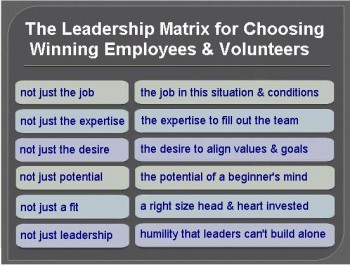
The Leadership Matrix for Choosing Outstanding Employees and Volunteers

Strauss Leadership Matriix for Choosing Winning Employees and Volunteers

Here’s how the process changes when we have our leadership on before we build the team:

  • We have a job that needs doing. Someone has left the team or the business is growing and it’s time to add another someone to the group.
  • Not just the job. We analyze the situation, conditions, and opportunities. We look first at the people currently doing those tasks. We ask those people what they could be doing more of and should be doing less of in order to be bringing their best game to the business.
  • Not just the expertise. We look for the expertise to that’s missing from the team. Some of what the current team could be doing less of to perform higher are tasks that they’ve outgrown. Some of what they could be doing less of are skills that aren’t their strengths. If we build a job description to the team, rather to the immediate set of tasks, we’ll gain new skill sets that aren’t currently available. For example, if the team is great at people skills, but weak on data skills, we can look for someone who also brings that.
  • We share that new job notice with people who know great people and in places where appropriate candidates will see it and respond.
  • Not just the desire or potential. We build a short-answer values and potential survey rather than a submission form. Each question might allow only 100 words. The questions might be …
    • What led you to apply for this position?
    • How do your values align with the values of our business?
    • How do you see your contribution in helping the business grow?
    • What in your life or work experience proves to you that we’d be successful working together?
    • How would you describe the optimal working relationship we might have now and moving forward?
  • We invite people to interview for the position and select the candidate we feel most likely to be qualified, committed to the work, and a good fit for the team.
  • During the interview, we introduce the candidate to the business, to members of the team, and to the employee or volunteer who last joined the business.
  • Not just a fit. We ask the newest employee or volunteer to assign the candidate a small task. The task might be writing a blog post or a proposal for a new idea. The task is chosen to fit the skills needed by the team. The newest team member is asked to give the candidate this slightly ambiguous guidance.
    • This is not a test. It’s so that we have something of a project nature to talk about.
    • It’s not expected that it will be a final, executable idea.
    • When you (the candidate) are ready, please call to set up a meeting to discuss what you bring.
  • Not just leadership. The candidates who set up meetings show up with a project and ready to share their thinking. . The meetings allow you and the team to discuss how the candidate makes decisions and what he or she valued in developing the meeting project.

The task sorts the candidates with leadership qualities, initiative, and motivation. Those who set up a return date are the ones can deal with ambiguity and have the ego strength to bring their ideas with clients and colleagues with confidence. The people who don’t want to invest or risk in that way sort themselves out of the process.

The meeting itself allows everyone — candidate and the team — to try on the fit and by discussing “real work.” The team can see the candidate’s ability to trust in him- or herself, the work, and the group comes out. The candidate can experience how the team discusses ideas and relates to each other as a group.

I used this process for 18+ years and only once did a candidate make who set up the meeting turn out to be one who didn’t belong on the bus. All of the others were high-performers who fit the team.

How do you get your leadership ON before you build a team?

Be irresistible.

–ME “Liz” Strauss
Work with Liz on your business!!
Buy the Insider’s Guide to Online Conversation.

I’m a proud affiliate of

third-tribe-marketing

Filed Under: Community, Successful Blog Tagged With: bc, Hiring, LinkedIn, management, team-building

Why Our Heroes Will Always Be More and Less Than the Pedestal We Put Them On

March 28, 2011 by Liz

All the Stories Are True and Un-True too.

I was 13 when my grandmother died. I never got to know her well. My experience of her was a tall, loving woman who smiled often and spoke only Italian. So you can see the gap.

However, I grew up with a wealth of stories about her to add to my small set of interactions. And because she was and is a hero of mine I was a always curious to know more to fill in the picture of this person I wished I knew better and more deeply as a person.

Now as each day brings closer to the age she was when I knew her, I realize she was more complicated and had more experiences and feelings than I’ll ever know. She will always be more and less of the hero she’s come to be defined in my mind.

It’s important to realize that stories and small sets of meaningful interactions can’t reveal a person to us.

Why Our Heroes Will Always Be More and Less Than the Pedestal We Put Them On

Stories and meaningful interactions are powerful things. But the very essence of what makes a good story or a meaningful interaction is that it highlights one quality, one action that reveals something about the person in question. But no person is only one quality.

Ask my son what he knows about me.

What I’ve learned is that, like great characters in movies, we’ve all got our great strengths and weaknesses. We’ve all got our stellar qualities and our deep flaws. And any one of us that gets put on a pedestal is destined to fall. Here’s why and why I never want to be on a pedestal myself.

  • The heroes we put on a pedestal don’t really know what qualities or traits got them there. They can guess, but they didn’t define the “character” who was raised up and so they’re destined not to live up to the definition.
  • The people who put the heroes on the pedestal can only see the heroes from far away. The closer we get to people the more we see their complexity, the more likely we are to change that hero-worship into friendship. True friends see a whole person and accept the humanity — what’s great and what still needs growing about them.
  • Sooner or later every hero will be human and step outside of pedestal definition. Suddenly the hero-worshipers will feel a betrayal that the hero was less than they thought, but really he or she is also more … the more that they couldn’t see.

So let’s give up the Pedestal mentality. Heroes are only infallible from faraway. It’s unfair to make them one-dimensional and expect them to live up to a definition that no human could possibly be.

I love the stories of my grandmother. I’ll always keep her high in my heart, but I also know that she had to work for what she got and that she faced real decisions and couldn’t have possibly always chosen right. No human ever does.

If we truly want community, it’s our job to remember and protect our heroes as the humans they are so that they can keep growing and showing us what they’ve got. What kinds of fans would we be if we made all of the protection go one way and left all of the heroism to them? Where would Harry Potter be without his band of friends who have his back? No pedestal takes the place of a community of friends.

I think I like her better knowing that. It makes it easier to imagine she’d also be proud of me.

How do you protect your heroes and see them people not characters on pedestals?

–ME “Liz” Strauss

Filed Under: Community, Marketing /Sales / Social Media, Successful Blog Tagged With: bc, heroes, humanity, LinkedIn, relationships

Be Irresistible: Want to Own Your Space? Own Up to Your Highest Standards!

March 15, 2011 by Liz

10-Point Plan in Action

What’s It Mean to Own It?

insideout logo

Going back down to SxSW reminds me of a conversation I had with @copyblogger, Brian Clark at SxSW 2008. It was in the early hours. We were at a club and found a place where we could talk for a minute or two. We were talking about SOBCon and how it had grown. We were talking about how people were coming because of the people who were in the room who were coming because of the people who were in the room.

It wouldn’t surprise me at all if Brian doesn’t remember what he said that night, but I do.

He said: “You and Terry are doing something important.

I said: “i know.”

Then he said: “But you gotta OWN it! Because without it where would I be?”

I replied something flippant like: “Still running the stealth intelligence network of the universe?”

He ignored my attempt at humor and continued with: “You gotta OWN it seriously.”

That advice stayed with me. I told Terry about it.

“Gotta OWN it! We own it, don’t we?”

But for the next year that idea became a mantra, “I’m OWNING it.”
Now I know what that simple sentence means.

Want to Own Your Space? Own Up to Your Own Standards

A few months later, I was at SOBCon 2008 with Brian’s words ringing in my ears. The thought kept running through my mind, “What am I not owning here?”
And as I opened my eyes, I realized that, in an effort to be “easy to work with,” I’d been holding back my best. My job is the content design an execution and we’ve always delivered more, different, and better than the rest, but not as well as I was capable of delivering. I’d let speakers slide just a little, then felt they could’ve shined more for themselves and for the audience. I’d been nice to sponsors and let them be less engaging than they might.

I realized then and there that companies make that mistake all of the time. We lower our price, change our offer, compromise for a vendor. We don’t own what we’re doing, instead we give away what we own.

What we should be doing instead is building trust and proving we’re the best at doing what we do to attract the people who recognize excellence and want to work be in a space that we own.

Every teacher, saloonkeeper, consultant, great business of one or corporation has a responsibility to own our role as a leader, to set the standards of our business so that the people who are in it with us know why and how to reach their greatest potential and so that the business can thrive and grow.

Here’s what I learned about how to do that:

  • Have a vision that is huge, powerful, and worth working toward to building. No smaller vision is worth owning or asking people to take part in. No lesser quest will bring you to put your heart, mind, hands and soul behind it.
  • Set goals that are worth reaching. If you want commitment and high performance, give everyone something to go for that feels like a massive win when they achieve it.
  • Invite only the best to participate in what you’re doing. Own the potential of your investment in the people you ask to come along. Friends are fun to play with, but owning a business requires that you own the responsibility of giving folks a team that they want to work with and for.
  • Make the vision and the goals far bigger than you can control, but the outcome and your belief in it so inspiring that everyone is drawn to work in the same direction . That way people can bring their own best potential to the building, but be building one vision that you protect for them.
  • Be a model of your version of the standard of ethics and excellence. Then layout the challenge for everyone to bring their own version of how they might add value to same standard with their own talents in ways that show their own excellence.

Owning our role, our values, our standards and our value proposition makes it easier for everyone else to own their role with the same values, standards, and value proposition. Like a great bartender or a community manager, we keep the space safe for people to be extraordinary without fear that they will lose by winning.

Own it. Don’t telephone it in.
Make a space, a place where people can show you what their best is and feel that you’ll notice, celebrate it, and protect it.

Do that and they’ll think of your business as owning the space you’re in, because to them it will be better than home.

That’s irresistible.

How do what you do, hold it up to the highest standards, so that the people who work with and for you can know they are working with the best in the business?

–ME “Liz” Strauss
Work with Liz on your business!!

Buy the Insider’s Guide to Online Conversation.

Successful-Blog is a proud affiliate of

third-tribe-marketing

Filed Under: Community, Marketing /Sales / Social Media, Successful Blog Tagged With: bc, Community, LinkedIn, management, owning your offer, value prposition

Be Irresistible: Grow with the Community Who Loves to Tell Your Best Story

March 1, 2011 by Liz

10-Point Plan in Action: The Off-site meeting

Money Can’t Buy Love

insideout logo

At a recent corporate team-building meeting, I experienced a speaker’s dream of a setup. The company VP who spoke before me discussed a tactic used by the competition — how they secretly pay people to talk about them from speaker platforms and in the press.

That simple shocking story made my opening statement easy. I repeated the competition’s tactic, then I quoted Paul McCartney …

I don’t care too much for money. Money can’t buy me love.

The company in the room already had a core community of enthusiasts who are fiercely loyal fans.

We talked about how love beats money and these six steps that will get people who love you together into a community and talking about you:

  1. Build your network before you need it.
  2. Share that story about you that connects people.
  3. Let them tell it the way they want to. Leave lots of room for positive mutation. People feel ownership when they contribute.
  4. Make it easy, fun, and meaningful to share the message with friends.
  5. Make it so that folks feel proud, important, part of something they do together.
  6. Reward and celebrate your heroes who share what you do.

I used this presentation to organize my thoughts around those ideas.

Whos talking about you

View more presentations from Liz Strauss

We discussed how great marketing and growing businesses are a balance of

  • leadership and loyalty — leaders learn from our heroes, align our goals with our advocates, and attract loyal fans with by valuing them.
  • customer and company — great businesses value both customers and company. They know that without the company customers won’t be served and without customers the company can’t survive.

Today, I’m talking to another already irresistible organization about the same six steps and the underlying values inside their value proposition.

Great businesses are about one community — employees, vendors, partners, clients, customers — looking in the same direction, working together to build something no one person can build alone. Communities like that grow companies that serve customers who love them. Those customers bring their trust and their energy and are quick to share your best stories with their friends.

That’s how we get to be the first trusted source — a stand alone value that can’t be copied or replaced.

This week I met with the corporation that held the off-site. We began planning the strategy for making it even easier, faster, and more meaningful — irresistible — for the existing community to meet online, offline and even at the company. We’ll be showing them how they can share ideas, swap strategies, and invite their best friends to join them. We’ll be extending an unending invitation to become a bigger part of the living story of how a company and it’s customers grow together and thrive.

What’s your best story — the one that customers are already telling about you?
How easy are making for your heroes to meet each other and pass it on?

–ME “Liz” Strauss
Work with Liz on your business!!

Buy the Insider’s Guide to Online Conversation.

I’m a proud affiliate of

third-tribe-marketing

Filed Under: Community, Marketing /Sales / Social Media, Successful Blog Tagged With: bc, be irresistible, digital word of mouth. influence, LinkedIn, sobcon, viral marketing, word of mouth

Groupon Super Bowl Ad: When Being Clever Offends and How to Win One for Tibet

February 7, 2011 by Liz

Clever Only Works When Trust Is Around

cooltext443809437_relationships

It must be a hugely stressful and exciting opportunity to find your startup with a slot for a commercial at the Super Bowl. Who wouldn’t want to make a fabulous debut? Can you imagine the meetings that must have been to plan that Groupon ad? Bet it was fun exciting and filled with clever ideas … all meant to go for the win!

By now you’ve heard of or seen the unfortunate Groupon Super Bowl ad that came from the meetings I just described:

Given the human rights crisis in Tibet, it’s not hard to see the response wouldn’t be good. To say it offended people is less than what happened. From Twitter to China, from CNN to Forbes to their own hometown Chicago Tribune the reaction wasn’t good.

CNN International: Super Bowl ad featuring Tibet triggers angry reaction in China
Forbes: Groupon’s 2-For-1 Super Bowl Special: Offend Both China And Tibet Activists
Digital Trends: Groupon’s Tibet Super Bowl ad offends everyone
Deal Book: Did Groupon Cross the Line in Super Bowl Ad Debut?
Chicago Tribune: Groupon Tibet Super Bowl TV ad discounts taste, sensitivity

Clever isn’t clever when it offends.

The problem with clever ideas is that they are a social thing. Clever only works where trust already exists. Clever is risky because it gets us looking at ourselves not the people we’re talking to. Clever backfires completely in a venue or a community where people don’t know us yet. Groupon found out what happens when we try clever without a firm foundation of trust in the mix.

Now, Groupon has problem. What would you do?

Reframing the Problem

The way you frame a problem is what keeps it a problem. This problem can so easily be a huge opportunity. Groupon has been in the social business world long enough to see the outstanding examples of companies who tried to apologize without apologizing and those who have owned their mistakes and won back the trust of the their core fan group instantly.

Here are five well known social media apologies …
Dell’s 23 Confessions
A Commitment On Edelman and Wal-Mart
JetBlue Launches Cross-Media Apology Campaign
Turner Broadcasting Apology Letter
Motrin

Those that worked were those that resonated started from a place of trust and rebuilding trust relationships. If you find yourself where Groupon is, start with these two tenets of connecting in honesty.

  1. Step away from the the clever and open up. Send out an actual human being to talk with your customers. They’re your heroes.
  2. Lead with trust. Trust the human being you send, trust your customers, and give people every reason to trust you. Trust is the currency of relationships.

With that mindset, a clear plan of action toward apologizing early and often is the only way to answer the hugely negative response to their ads.

The Action Plan

What would I advise the Groupon team to do? Realize that the relationships they’ve built have been based on price, not loyalty. Understand that the breach was something like

“If you could make fun of something as serious as that, would also make fun of anything, everything, that’s important to me?”

Here’s an action plan to begin a new kind of relationship and to rebuild what’s been lost by the ad.

  • Read enough to understand why people responded as they did to the ad. Read long enough and deep enough to see the disconnect. A wise, open-mind doesn’t have to read long to see what went wrong.
  • Say thank you to folks who raised the complaints.
  • Admit the mistake and apologize. A true apology includes …
    • a statement of regret …
      I’m sorry.
    • ownership of the act and responsibility for the outcome …
      I behaved badly … It was my fault this happened.
    • acknowledgment of hurt or damage …
      It made you feel small … It broke your trust … It lost you business.
    • a promise for better behavior in the future …
      It won’t happen again.
    • a request or statement of hope for forgiveness or renewed trust …
      I hope you can believe in me.
    • Then go back and read everything — every tweet, post, conversation about it. Talk to everyone you can about it. Become an expert on knowing every blog and blogger, every tweet and tweeter. Respond with appropriate personal apologies to as many as you can.

    Have a beginner’s mind. Listen. Listen. Listen. Say thank you again.
    Then don’t tell folks you’ve changed. Show them.

    How to Recover

    Groupon has a site for donating to the Tibet Fund. Finding out about it now, is too little too late. The ad might have led with that, but it didn’t. Here’s how Groupon might recover by using that site and enlisting from the folks who still want to believe in them.

  • Ask for help. Have a Groupon reverse offer. Offer to pay $500 budget to the first 100 customers who want to make a video version of a new ad. Make the Groupon offer that they get paid. Participate with time. Don’t just throw money at them.
  • Add a page to the Save the Money site to feature the videos they make and allow the audience to cast votes on for the video they think would have made the best Super Bowl Ad for Tibet that might have been. (Limit votes to 1 per email address.)
  • Put the top 10 winners on the Groupon site and donate $1000 to the Tibet fund in the name of each winner – a total of $10,000.

A company admits the error and shows they mean it with everyone watching could make difference in a huge way. Here’s a chance to turn critics into heroes and to use the momentum to make something truly good happen.

Groupon has a huge opportunity to bring visibility and real action to the crisis in Tibet.

This could be a win for the world, if Groupon wants to make it that.

Got more ideas for how Groupon might recover from this?

–ME “Liz” Strauss
Work with Liz on your business!!

Buy the Insider’s Guide to Online Conversation.

I’m a proud affiliate of

third-tribe-marketing

Filed Under: Community, Marketing /Sales / Social Media, Successful Blog Tagged With: bc, Groupon, LinkedIn, Super Bowl Ad, Tibet

  • « Previous Page
  • 1
  • …
  • 6
  • 7
  • 8
  • 9
  • 10
  • …
  • 143
  • Next Page »

Recently Updated Posts

Is Your Brand Fan Friendly?

How to Improve Your Freelancing Productivity

How to Leverage Live Streaming for Content Marketing

10 Key Customer Experience Design Factors to Consider

How to Use a Lead Generation Item on Facebook

How to Become a Better Storyteller


From Liz Strauss & GeniusShared Press

  • What IS an SOB?!
  • SOB A-Z Directory
  • Letting Liz Be

© 2025 ME Strauss & GeniusShared