Successful Blog

  • Home
  • Community
  • About
  • Author Guidelines
  • Liz’s Book
  • Stay Tuned

When’s the Right Time to Expand Your Small Business?

August 6, 2013 by Guest Author

By Ben Thomas

Your first few steady customers are finally paying all your bills – and as celebration-worthy as that is, it also raises new questions in need of executive answers. Where are the next few customers or clients going to come from? What’s a reasonable advertising budget – and how much is too much? How will hiring a new employee (or three) or renting some new space impact your rate of expansion?

Questions like these can make your small business’s first expansion feel at least as stressful as your initial launch – but a little intuitive knowledge of your expansion’s objectives, boundaries and processes can reduce even the most complex decisions down to simple “yes” or “no” analyses. Here, three small-business experts share the analytical strategies that have become second nature to them as they’ve progressed through their own business expansions.

Flow like water

There’s an old saying that water is stronger than rock, because water never cracks – it just reshapes itself to fit whatever surroundings it’s in. The exact same principle holds true in business: The more your expansions – and shrinkages, if and when those come – all follow naturally from the size and shape of your market, the less likely you’ll be to overextend yourself and fragment your team.

In other words, the clearest signs that it’s time to expand are those that make it harder and harder not to: When you’ve got so many customers that sales are slowing you down; when products are selling out too quickly for your space to hold onto stock; when you find yourself giving a lot of referrals for a service you could be providing – and so on. In cases like these, there’s probably no reason to delay an expansion, even if it feels a little intimidating.

“When we started, we only had a small space and we only had one room,” says Donna Alexander, founder and president of Anger Room. “But we started getting so much publicity, and so many customers coming in, that we actually had to start turning people away. And that was like a big neon sign: ‘OK, it’s time to get a bigger space.’”

By the same token, the clearest signs that you’ve overextended your business are those that feel like hitting some kind of wall: When the money you’re pouring into new ads and/or spaces isn’t correlating with any return; when training a new employee is slowing down sales; when you find yourself starting to give referrals simply because you can’t handle the volume – and so on. Although these signs don’t necessarily mean that you can’t expand, they do point to the fact that you’ve got some bugs that need to be worked out.

Scan for indicators

Even if you’re not drowning in customers, your interactions with the customers you do have can serve as strong indicators about whether it’s time for an expansion – and if so, what direction that expansion should take.

“You’ve got to listen to your market, because with every sale – or lack of a sale – those people are telling you what you do for them, and if you could be doing more, or doing something differently,” says Carolyn Andrews, a certified business and executive coach with Actioncoach. “One of the most important things about timing your expansion is looking at how your market perceives you.”

It doesn’t take a market research firm to find out how your customers feel – it just takes some mutually honest conversations.

Those conversations will come in handy as you analyze the shape your sales are taking, and the reasons why. Which products or services are you selling more or less of than usual? What changes in your market could account for those shifts in sales? What’s your competition doing in response? Does their response leave a new vacuum into which you can expand? “Having a really solid handle on what’s happening in your market is crucial,” Andrews says, “and it’s so much easier to get personal insight into your market’s behavior when you listen to what customers are saying to you.”

Andrews advises looking for “green lights” on all three indicators – positive customer conversations, promising sales analysis and under-adaptive competitor behavior – before you make the leap into your expansion. “When you analyze your potential for expansion in terms of those three indicators,” she says, “you end up with one simple answer: a ‘yes’ or a ‘no.’”

Jump straight in

Leaping into your expansion isn’t just a figure of speech – the only way to be sure your expansion will succeed is to throw everything you’ve got (yourself included) into it.

“In the end, there’s no such thing as a perfect time to expand,” says Stacy Deprey-Purper, founder and CEO of Better Business Together. “But you and your staff still have to jump in with a ‘whatever-it-takes’ attitude, because that’s where your reputation, your customer need and your buzz ultimately come from.”

Still, jumping in doesn’t mean jumping blind. So take as much time as you can afford and draw up a clear plan for your expansion, including employee roles, steps of the expansion, timing projections and so on. “I say that everybody needs a plan… so they can deviate from it,” Deprey-Purper says. “You don’t need a detailed long-term plan, but you need to have some idea of what you’ll be spending and where it’s going to go. I had a client the other day who spent $50,000 on decorations for his restaurant, which ate up 99 percent of his marketing budget.” In short, check that your plan makes sense as a whole before you start throwing money at specific parts of it.

A trusted group of advisers can help on that front – and that can mean a business coach, other successful entrepreneurs, consumers in your market or even a lawyer. “We were once approached by a group of investors who seemed very kind and polite in person, but who actually wanted to take over our company,” Alexander recalls. “When we sat down to sign the paperwork, they suddenly told us, ‘We want 90 percent of the company, and you’ll get the other 10.’ Luckily we’d hired a lawyer to look over the papers for us.” It’s situations like this that demonstrate why it’s vital to have some professional second-guessers in your corner.

At the same time, though, it’s important to keep in mind that you’re the boss, and that the decision depends on your instincts in the end. “If you’ve got too much thinking and not enough doing,” Deprey-Purper says, “you can overthink yourself out of taking action. No matter how much planning you do, you’ll always get some curveballs – and you have to take those as opportunities to learn about your business and plow forward.”

Author’s Bio: Ben Thomas writes about careers in marketing, among other business career fields, for The Riley Guide.

Filed Under: Marketing /Sales / Social Media, SOB Business, Strategy/Analysis, Successful Blog Tagged With: advisors, bc, Coach, expansion, Hiring

Smarter Shoppers: How to Convert on New Buyer Behavior

August 2, 2013 by Rosemary

By Darren Creasey

Online marketing is an industry that is acutely aware of buyer behaviors and patterns; in fact, many trends in digital marketing are driven by this awareness. The Internet is a positive feedback loop- it has changed the way consumers research, shop, and buy, which in turn shapes how marketers use the web to market to buyers. Do you know how the Internet influences buyer behavior, and how to capitalize on that information? Read on to find out.

1. Shoppers are smarter

One of the best features of the Internet is the accessibility to learning resources that it provides. This is true of product information as well as academic knowledge. Consumers are now taking advantage of this wealth of online resources to learn more about the products and services they are interested in: what their options are, the key differences from each competitor, and what price levels to expect. This smart shopper means that they have an element control over the sales process – they no longer need to wait for your sales presentation to learn the details about your solutions. Instead, you need to be prepared for dealing with a middle of the funnel customer, with knowledge of the product and specific questions, earlier in the buying cycle.

2. Buyers want you to help make them smarter

While a more informed customer might sound like a tough sale at first, it’s important to look at the positives of the situation. A well informed, inquisitive customer will place a lot more value and trust in your brand if you help contribute to their knowledge. Content marketing is a great tool to use here – by publishing information that helps consumers understand your industry, your products, and their options, you are not only demonstrating value to the buyer, but also strengthening your own position as a reputable, knowledgeable company.

3. Consumers are listening online

But buyers aren’t just going to take your word for it. Social media, forums, and other third party online communities help potential customers hear from real users, and can help sway their decisions one way or the other. You should be actively monitoring and engaging in these conversations; you need to know what people are saying about your company, and you need to be ready to jump into a conversation when a question is asked – this is a great opportunity to help educate the customer.

Your turn: how have you changed your strategy to deal with the new, more informed consumer?

Author’s Bio: This article was written by Darren Creasey to inform people about the advantages of online marketing. He believes that through internet marketing techniques, companies can achieve a greater level of success.

Filed Under: Content, Customer Think, Marketing /Sales / Social Media, Successful Blog Tagged With: bc, behavior, consumer, content marketing, shopper

How to Get Customers to Open Your Email

July 30, 2013 by Rosemary

By Mark Saghy

Email is, has, and continues to be, one of the best ways to retain customers. It reminds them you’re still around. It reminds them they need to purchase something from you that they may otherwise forget about. It is often the single greatest way to highlight a new product, promote a new brand, or inform about an upcoming sale or event.

How to get your email opened

A person’s inbox is, for many, a sacred space; for most of us, we check it daily, hourly, or even more frequently than that. The advent of smartphones makes it impossibly easy to stay connected to our flow of email coming through.

Despite the benefits, sending your customers an email can be a very sharp double-edged sword. With the increased ease of email use and access can often come a heightened sense of intolerance about the amount of business or advertising that flows through it.

Even with your most dedicated and loyal customers, there is a fine line between informing them and annoying them. One extra email, one unhelpful or confusing title, one tiny mistake noticed at an otherwise bad time, and bam–that customer has deleted the email without even opening it, or worse–they have permanently unsubscribed from your mailing list.

Here are some ways to keep that to a minimum, while encouraging customers to open as much of your email as possible.

Remember the Value of Quality over Quantity

Clearly, one of the best ways to lose customers is to inundate them with email. Again, a customer’s inbox is their personal space; they don’t want it being tied up with marketing campaign after marketing campaign. Unless the customer has specifically requested to receive a particular quantity of email from your company, it’s pretty safe to assume that you should pick and choose your battles very carefully when sending out a message. Consider the following:

  • Think about why you are emailing-is it a friendly “hello”, or do you have very important news you feel your customers would like to know?
  • When was the last time you sent an email out, and why? Is your message informing them of something new or exciting, or has business slowed down a bit, prompting you to send out a communication?
  • The last time you sent an email, did you check the number of mailing subscribers afterwards, to see if you lost any? If you did, how many did you lose, and what percentage of the total was that?

Each of these questions should be analyzed, a clear answer formulated, and those answers compared with one another. This should typically be done before every email you send out. Remember, you want to focus on the quality of emails being sent, while also keeping a close eye on the quantity emailed over a period of time. Even the best-crafted emails will start being ignored if you send too many of them.

Personalize

No matter how far we have advanced technologically, some of the basic tenets of sales and customer service still apply to the business world today. Even though email cannot create the same kind of in-person relationship that a brick-and-mortar store can have, you can still try to recreate a perceived sense of a personal relationship with your customer. Done right, this can still be one of your most important retention tools.

One great way to help personalize emails is simply to use names. “Dear Customer” is one way to ensure the customer knows you don’t care enough to address them by name-even if their name is sitting right there in your mailing list database. Why not use “Dear Shirley” instead? It’s a simple fix and, presuming there is indeed a database of names, it can be computer automated.

Furthermore, consider having a name in the “from” portion of the email, too. Rather than yourcompany@yourcompany.com, consider using “Paul D. in Sales” or “Maggie, yourcompany.com’s VP”. In addition to encouraging the customer to open the email, doing this makes it sound more personal, more relatable, and less like a standard form letter-even if you send this same exact email to hundreds of your customers.

Keep It Simple, Keep It Clear

People are busier than ever before, and as such, people are more connected to their inboxes than ever before. Mostly gone are the days of walking out of the office and leaving that world behind until the next morning; for many of us, we are expected or required to maintain email communication with our jobs, no matter where we are-including a the dinner table, while traveling, or while watching our kid’s baseball game. Therefore, it is arguably more important than ever to keep the emails you send your customers as simple, clear, and effective as humanly possible.

You will need to use a little bit of psychology here: instead of thinking about the message from your company’s perspective, consider it from the customer’s point of view. Answer the one very important question your customer is often thinking when staring at your email: “why should I open this?” Whatever you want the answer to be, make that the primary focus of the message.

  • Want to pitch a new product? Make the title pop, give as little background information as is needed in the intro, then pitch that product immediately.
  • Upcoming sale? Make sure the customer knows it within the first few seconds of reading.
  • Just checking in to say hi and keep in touch? Do it quickly; skip the fluff.

Keep your email as short as you can, and get your point across in as few words as possible. After you have composed your email, a great way to edit it for clarity is to go back and remove anything that isn’t absolutely relevant or necessary. When possible, bring in a second set of eyes to help with editing and whittling down the language.

Want to share some of your best email tips? Do you have a favorite subject line?

Author’s Bio: Mark Saghy is a marketing executive at ExhibitDeal.com. He is constantly learning and finds joy in sharing his knowledge with the blogging world. You can find him on Google +.

Image credit: http://us.stocklib.com

Filed Under: Checklists, Marketing /Sales / Social Media, Successful Blog Tagged With: bc, Content, email marketing, Writing

5 Brands Using Instagram to Grow their Business

July 25, 2013 by Rosemary

By Ryan Harris

Analytics company Nitrogram recently released a list of the the top 50 brands on Instagram. Rankings included numbers of followers and mentions on the popular photo-sharing site.

At the top of the Nitrogram 50? Nike, Starbucks, Forever 21, the NBA, and Adidas.
These brands have hundreds of thousands – even millions – of followers who post their own photos with the brands’ hashtags.

#Awesome. But what do these brands have in common that helps them succeed on Instagram? Take a look at the top 5 brands on Instagram to find out what they’re doing right.

1. Nike

Number of followers: +1.8 million
Number of mentions: +14.2 million

What’s Nike doing right? The answer is simple: high-quality photos and videos with inspirational captions. Uploads include colorful Nike sneakers, action shots, and athletes in Nike gear. A recent post, a close-up of a flexed foot in a lime green Nike running shoe, is simply captioned “Innovation is the antidote to limits.”

Nike Instagram photo

Photo credit: http://instagram.com/nike#

But Nike isn’t number one just because of its photos. The brand is integrating Instagram with their business in innovative, exciting ways. Nike PHOTOiD allows users to design their own custom Nike footwear based on their Instagram photos. Just upload an Instagram, choose a Nike shoe, and check out a unique design based on the colors in your photo.

2. Starbucks

Number of followers: +1.3 million
Number of mentions: +3.6 million

Starbucks sticks to the classic Instagram formula: simple pictures that somehow look both artistic and amateur. Starbucks’ uploads aren’t glossy, in-your-face advertisements. They’re photos with artsy angles, muted filters, and simple subjects. This post, captioned “Enjoy the little things,” shows a flower-filled Starbucks mug in front of a stack of unfinished canvases.

Starbucks Instagram Photo

Photo credit: http://instagram.com/starbucks#

But Starbucks’ greatest strength on Instagram? Their lack of self-promotion. Most of Starbucks’ posts include minimal references to the brand. One, a summery shot of an iced coffee by a fountain, is only recognizable by the ubiquitous green straw. Some, like a photo of a father and daughter playing in the ocean, don’t have any brand references at all.

3. Forever 21

Number of followers: +1.5 million
Number of mentions: +1.6 million

Forever 21’s young fan base lends to their success, since most of Instagram’s users are between 18 and 29. But Forever 21’s photos are classic Instagram, too: artsy snapshots with vintage filters. Many of Forever 21’s uploads show partial shots of complete outfits — the post below depicts just a pair of bright blue pants and a hand with a matching manicure.

Forever21 Instagram

Photo credit: http://instagram.com/forever21#

Another one of Forever 21’s strengths is its use of Instagram to interact with customers. Rather than just posting photos of their products, Forever 21 encourages fans to upload their own ensembles for the chance to be featured on the brand’s Instagram account. Fans get instant Instagram fame– and Forever 21 gets more followers and more mentions.

4. NBA

Number of followers: +1.2 million
Number of mentions: +2.4 million

It might be a surprise to see the NBA among the best brands on Instagram – basketball fans and photos with soft, artistic filters don’t seem to mesh. But the NBA’s Instagram account proves that they don’t have to. The NBA’s posts are typical sports photos: close-ups of athletes in action with minimal editing and no-nonsense captions, like this photo of Dwight Howard.

NBA Instagram Photo

Photo credit: http://instagram.com/nba#

The NBA faces a unique challenge on Instagram: keeping the attention of its fans and followers even after the season ends. The NBA accomplishes this by capitalizing on current events. Recent posts include NBA trades, ESPY award winners, and the off-season activities of its biggest stars; one shows Miami Heat player Chris Bosh on a trip to India.

5. Adidas

Number of followers: +799k
Number of mentions: +3.2 million

Adidas, which competes with top brand Nike in the athletic wear market, takes a slightly different approach. Their photos lack the artistic quality of Nike’s, instead trying for simplicity and consistency. Many of Adidas’ recent posts, like the one below, show nothing but a pair of Adidas shoes on a black background. They focus on the product rather than the presentation.

Adidas Instagram Photo

Photo credit: http://instagram.com/adidas#

Adidas also jumps on popular Instagram trends like #tbt, or Throwback Thursday, to promote their brand. Each week on Throwback Thursday, millions of Instagram users post old pictures with the caption #tbt. On a recent Thursday, Adidas posted a #tbt of several classic Adidas shoes, inviting followers to comment with their favorites.

Want to make the most of Instagram for your brand but not sure where to start? Take the lead from some of these big brands and apply them in the same way. Take simple photos and pair them with memorable captions that evoke a certain feeling you want to associate with your brand. Or go the way of Starbucks and go less promotional, more personal, which is what Instagram does so well thanks to its photo filters. Above all, be ready to engage with your customers by encouraging interaction with your posts, and maybe even asking for user submitted posts.

Author’s Bio: Ryan Harris is an Internet marketing strategist and copywriter who specializes in working with businesses large and small to develop strong brands. He writes for a wide array of tech sites including DSL.com. Connect with Ryan directly via email.

Filed Under: Marketing /Sales / Social Media Tagged With: bc, Instagram, personal-branding, photography, social-media

How do you label yourself?

July 18, 2013 by Rosemary

When I was in 8th grade, my math teacher had a tradition of writing down little pithy comments about each student for the yearbook. She read them out loud at the end of the year, in front of the whole class. Her quote about me was: “pretty, pert little lady with an unexpected smile.”

It’s been 35 years since she gifted me with that observation, and it has stuck with me all this time. The power of labels runs deep.

But labels can either empower you or disable you—it’s your choice. How you identify yourself to the world, and how others publicly identify you, makes a big impact on your success. If you commit to a label strongly enough, behavioral science tells us that others will reinforce that label as well.

Labeling behavior happens applies to you as a business person, as well as your website or blog. Don’t forget to clarify your website’s purpose while you’re considering your own “tagline.”

How you label yourself

When you tell someone about your business, or your job, do you use the word “just” (e.g.,, “I’m just a blogger”) or do you minimize your accomplishments (e.g., “I run a small marketing agency—you’ve probably never heard of us”)? Stop doing that.

Be ready with a memorable response when someone asks you what you do for a living. “I’m the creative force behind ABC Agency,” or “I dish out innovative PR advice on a daily basis at the ABC Blog” or “I’m a wild and crazy guy!”

How others label you

Are you paying attention to how others describe you in conversation or online when they introduce you? Do other people know what your secret sauce is, well enough to relay it to others?

Try this experiment today: go ask a few people how they would introduce you at a networking event. Get a nice sampling from your family, a friend, a colleague, and an online acquaintance. I’ll bet the results are revealing!

Use your new “personal tagline” in your online profiles, bios for your guest posts, and corporate marketing materials. Use it when anyone asks you what you do. Remember, it’s perfectly acceptable to evolve your tagline over time.

And don’t forget to smile.

Author’s Bio: Rosemary O’Neill is an insightful spirit who works for social strata — a top ten company to work for on the Internet . Check out the Social Strata blog. You can find Rosemary on Google+ and on Twitter as @rhogroupee

Filed Under: Marketing /Sales / Social Media, Personal Branding Tagged With: bc, labels, personal-branding, reputation

Online Marketing Mentors to Follow on Quora

July 12, 2013 by Guest Author

By Jessy Troy

Marketing has always been a core necessity of the successful business. But as the Internet has become the primary form of shopping for most people, the need to market in a web-specific fashion has increased. While the old and new way are similar, there are differences that have to be accounted for. Not to mention principles that are completely separate that have to be learned and utilized.

Quora is one of the best professional networks on the web. It is full of experts who really know their way around the online marketing field. Since Quora is, by nature, a Q&A site, it is a great idea to follow some of these experts. But who are the best?

That point could be argued, and everyone has their own opinion on who the true experts are. This is my personal list of must-follow Quora profiles in the world of online marketing.

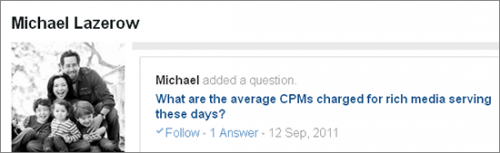
Michael Lazerow

Michael Lazerow on Quora

You might not have heard his name, but you have probably come across his companies (of which he has had several) more than once. His first venture, University Wire, was a network of more than 700 university newspapers that were bought out by CBS. GOLF was bought out by Time Inc., and he has worked for big names like Saving Star. He doesn’t always update, but his answers are always worth reading.

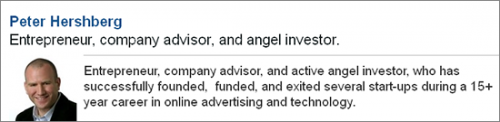
Peter Hershberg

Peter Hershberg on Quora

Specializing in online advertising/marketing, Peter Hershberg is a powerhouse who funded many startups in his day. He is currently a successful angel investor, business owner, company adviser and a handful of other impressive titles that all trnaslate to him knowing his stuff. His answers are always incredibly informative and in depth.

Robert Scoble

Robert Scoble on Quora

Perhaps best known for his time at Microsoft, he is now the startup liason officer at Rackspace. He is also a video blogger, text blogger and technology genius. His Quora profile is well used, and he answers questions all the time. This includes online marketing, of which he is well versed on both a professional and personal brand level. This is one of the must-follow people for anyone interested in either marketing, or technology as a whole. There is a reason this guy is a celebrity in the tech geek world.

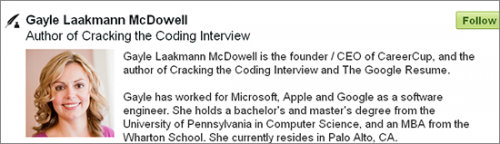
Gayle Laakmann McDowell

Gayle Laakmann McDowell

Less an expert in online marketing on a business level, Gayle is more of a personal branding and self-marketing guru. She teaching people how to deal with branding themselves on a busy and crowded market, including selling yourself in an interview. She also answers questions unrelated to the field, and is just a personable and interesting person. Well worth following for both her advice and her personal stories about her life, she balances information and experience well.

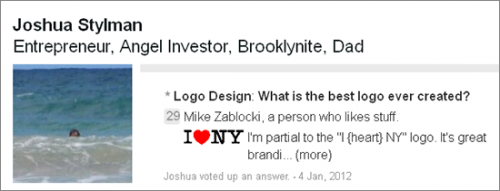
Joshua Stylman

Joshua Stylman on Quora

A business owner and angel investor, Joshua Stylman doesn’t answer very often. But his communications are always worth following, and he is just a good guy to have on your network. Experienced, successful and an overall down-to-earth guy, he has a simple way of thinking that still holds enough personal experience and opinion to take you outside the box in your own thinking. He is also a habitual upvoter on other people’s answers, and a proud New Yorker. What’s not to like?

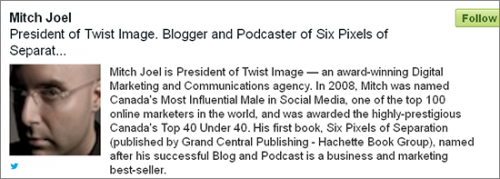
Mitch Joel

Mitch Joel on Quora

President of Twist Image, a company dedicated to digital marketing, Mitch Joel is one of Canada’s most influential social media users. He knows all about leveraging the web for marketing, and he is more than happy to share that expertise. He is one who is worth following of various social media sites, as he is more active on places like Twitter than he is on Quora. But keeping an eye on his answers is also a good idea. If you want a good read, check out his Six Pixels of Separation. It is part of what has made him such a beloved marketing guru, and launched him into industry stardom.

Do you know of anyone who belongs on this list? Who do you follow on Quora for online marketing advice? There are plenty to choose from. Let us know in the comments.

Author’s Bio: Jessy Troy is the self-made marketer blogging for VIP Realty, privately-owned business based business in Dallas. You can follow Jessy on Twitter as @jessytroy.

Filed Under: Community, Marketing /Sales / Social Media, Successful Blog Tagged With: bc, marketers, Mentors, Quora

  • « Previous Page
  • 1
  • …
  • 15
  • 16
  • 17
  • 18
  • 19
  • …
  • 174
  • Next Page »

Recently Updated Posts

The Creator’s Edge: How Bloggers and Influencers Can Master Dropshipping

Is Your Brand Fan Friendly?

How to Improve Your Freelancing Productivity

How to Leverage Live Streaming for Content Marketing

10 Key Customer Experience Design Factors to Consider

How to Use a Lead Generation Item on Facebook


From Liz Strauss & GeniusShared Press

  • What IS an SOB?!
  • SOB A-Z Directory
  • Letting Liz Be

© 2025 ME Strauss & GeniusShared