Successful Blog

  • Home
  • Community
  • About
  • Author Guidelines
  • Liz’s Book
  • Stay Tuned

Tailoring Twitter: Building a Powerful Network that Fits You Perfectly

April 12, 2011 by Liz

Finding People to Spread the News

insideout logo

Every minute we spend on our business is one that helps it grow … or not.
The idea is to connect to all of the people who help us thrive — colleagues, customers, vendors, partners, family, friends — people who want to see our business growing faster, more easily, and with more meaning.

Those people who already know us and love what we’re going are the network, the beating heart, that holds us up and spreads our message to the right people in the very best way. Having a powerful network of fans means our message is seen, heard, understood and spread with the speed and reach of the Internet.

How do you get a network like that?

I often call Twitter the world’s largest networking room, but that doesn’t do it justice. Networking rooms are physical and geographically limited. They can’t expand and contract in size. The people who visit the room are limited by those who can physically get to the location where the meeting and the room exists in space and time. And not every networking event collects the people who are interested in what we do.

Unlike that networking room, Twitter let us decide who is at our “networking event.”
How do we find that first group of friends that we invite to our Twitter networking event?

Building a Powerful Twitter Network that Works for You

Before you build a network, think about the people you want to attract. Who are the people who support what you’re doing and naturally pass it on? Those are the folks you want to attract. Be irresistible for them. Think too about the people who would rather not participate in your success, the people who see you as what you’re not, look things over to see that you’re not attracting them.

When we focus on serving the people who trust our abilities and love what we do, they tell their friends about it. If we work to convert people who don’t trust our abilities and value our service, they look for reasons that we’re not doing what they think we should do.

Concentrate on reaching that first group with the best you can offer.

Know What You Offer

  • Know and share who you are. Have one clear business message. Define yourself clearly as a business person. Use a photo. Write a professional bio. Name the metropolitan area you’re in. Link to a business site that tells more about you. Some folks link to a special page on their blog set up just for Twitter visitors. Add a unique background to further define yourself.
  • Research the ways you might connect. Check out how @DellOutlet , @ComcastCares , @TwelpForce , @AlyssaMilano , @WholeFoods , @SharnQuickBooks and others use Twitter to connect. You may not be as big as they are, but you can learn from their approach.
  • Know and share why you’re there. Manage expectations. Let people know from the beginning the way you intend to serve their needs. If you want Twitter to be your relationship command center, you’ll set it up differently than if you want it to be your idea lab, your outlet store, or your customer service base. Decide before you start.

Find the People Who’ll Value that

  • Start small with friends and their friends. Start by following the friends you already have. Look for people in your industry by using the Who to Follow option at right in the black bar at the top of your Twitter.com page.
    [click to enlarge]

    who to follow nav

    which will take you here. [click to enlarge]
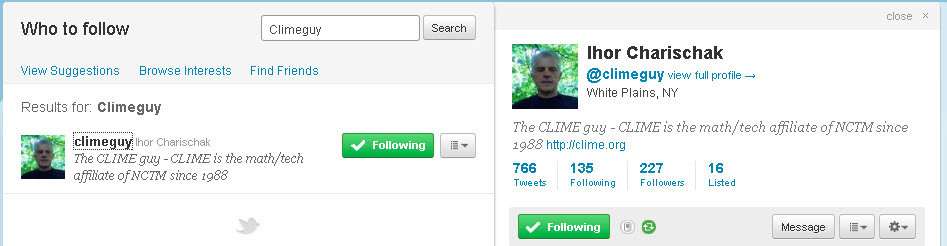
    climeguy

    I’m going to a conference for the National Council of Teachers of Math (NCTM). When I started following folks who know the conference, I met a man who works for CLIME –The CLIME guy – CLIME is the math/tech affiliate of NCTM since 1988 http://clime.org After visiting his page to read his tweets, I knew I wanted to follow him.

    Then I took a look at the people @ClimeGuy follows and I found @samjshah. [click to enlarge]
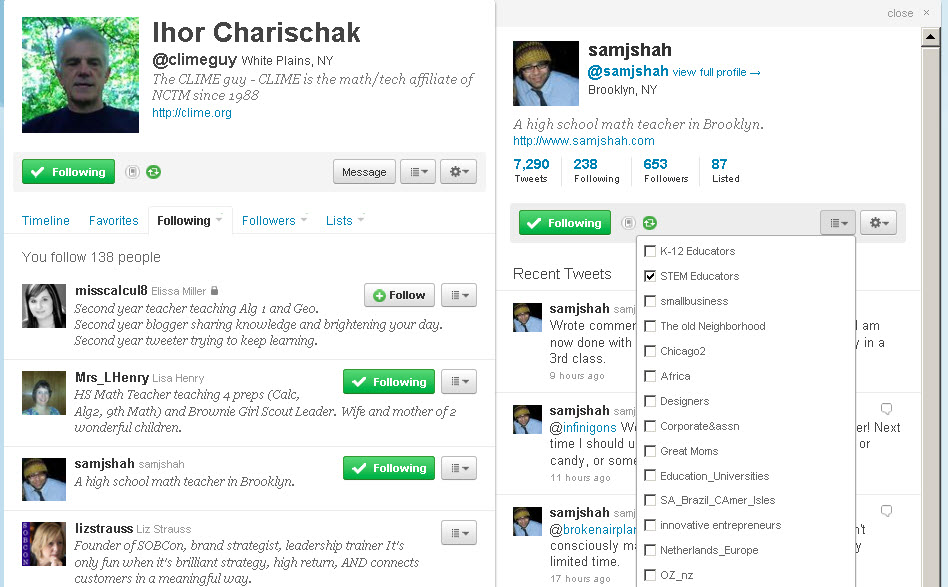
    climeguyprofile1

    So I checked his profiles, read his tweets, and listed Sam in my list of STEM educators (Science Technology Engineering and Math Teachers) so that I could keep up with what Sam is talking about.

  • Check the curated lists and the hashtags to find who and what your heroes find relevant. Choose to follow a limited number a day.

    Tweeps make lists to follow whole conversations by a group of people that the value around a common thread. For example I have a list of Twitter people who commented on blog in 2005. I use it to check in on what my more experienced friends are talking about. You can check my lists from my profile page.

    You can check everyone’s curated lists by exploring sites like Listorious.com which collect the Twitter lists. [click to enlarge]
    listoriouseducation

    and Sulia (once called tlists to more channels of of Twitter people who share your interests.

    and Use the search function at hashtags.org to find and follow tweets that people mark with a hashtag such as #edchat. Or use Search.Twitter.com to go quickly to a hashtag you might already know.#nctm (the name of a conference) or #mathchat (the name of topic of interest.) See who’s sharing insights and information that you find relevant and follow them.

  • Listen before you join in. Get to know how they talk and what they talk about.
  • Following both ways allows you to have private conversations. When quality people follow you back, use that as opportunity to say hello to them in a unique and personal way. When new folks follow you first. check their profile and follow them back if you want to start a relationship. You have to be following both ways to share a private conversation via direct message. Direct message is how Twitter people share information they don’t want to share publicly.
  • Add value to the conversation. Be helpful, not hypeful, just as you might be in person. Use the @ sign (@lizstrauss) to make sure your comment about a person or to a person gets to the person you’re mentioning.

    Some things you might Tweet about and how to Tweet them.

    • Tweet to share an insight or something you’ve observed.
      The more I leave room for my soul to breathe, everyone around me gets nicer.
    • Tweet to respond to what someone said.
      @lizstrauss having margin in life is a good thing huh and not living right up the edge of the paper as someone once told me
    • Tweet to start a conversation by saying hello and asking a question..
      Good morning, Twitterville. How will you make someone’s life better today?
    • Tweet to share information or content using hashtags – especially when you can promote your friends.
      The free Entrepreneur Expo starts tomorrow, featuring our very own @starbucker http://bit.ly/em06Gp #sobcon
    • Retweet to pass on content by J_Bender using the RT button
      J_Bednar Jason Bednar [RT] by kjpmeyer
      “All the biggest miracles take place in classrooms. Nothing happens without teachers.” S. Frears quoted by Charlotte Danielson. #NAESP11
      The above Retweet would look like this if she had typed it — and we can edit / add to it!.
      I agree 100% RT @J_Bednar: “All the biggest miracles take place in classrooms. Nothing happens without teachers.” S. Frears
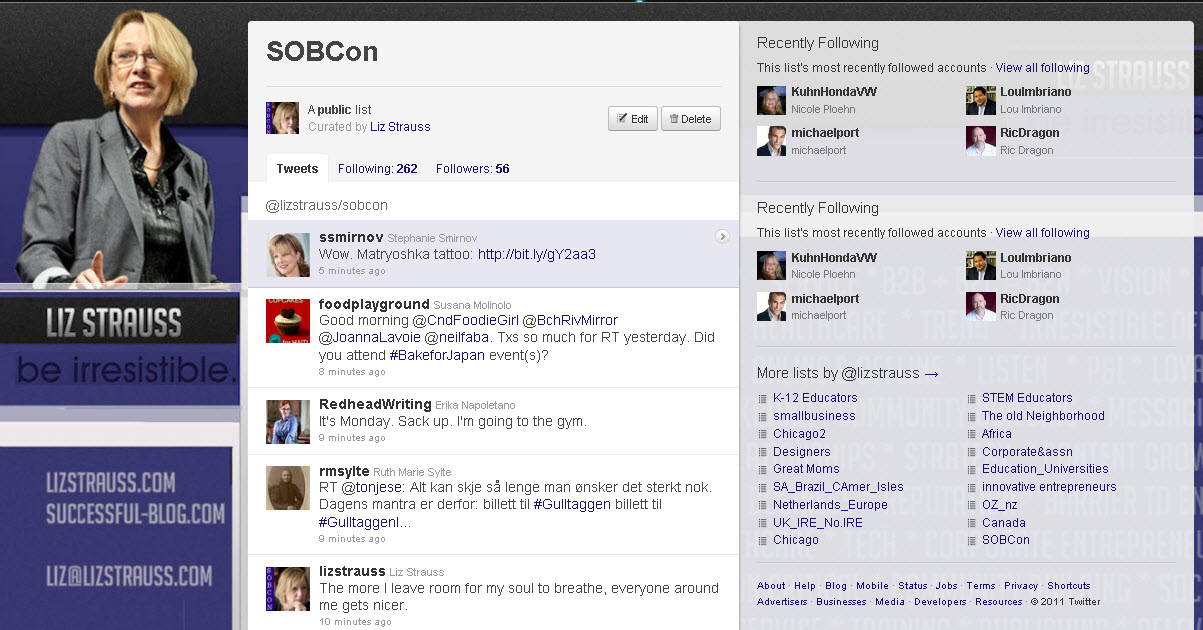
  • Start your Twitter list. This is my SOBCon list — people who attend our yearly business event – SOBCon.
    sobconlist

    Lists draw attention to and from people. Each list can focus on one group of people. Check the lists that other folks make, see what their lists say about them. Have a core list strategy. Lists might include a handful of advisors, thought leaders in your industry, partners and vendors, key customers and clients, people in your home location.

  • Decide early who you will follow – who you want at your networking event. Some folks follow only a few people and keep their followers limited to people in their business. Other folks look for input from a wider group.
  • If you’re looking for clients, don’t just talk to the people who do what you do. It’s fun and safe to talk business with our peers, but the folks who hire us are the folks who don’t know how to do what we do.
  • Like any networking event, Twitter is filled with opportunities to meet people who want to participate, engage, and be a part of what we’re doing. The difference is that some networking rooms are filled with people who have no business in common with us. On Twitter, we can reach out to folks who are interested in being at the same networking event as us.

    Have you figured out other other ways to tailor the Twitter experience to fit your best reason for being there?

    –ME “Liz” Strauss
    Work with Liz on your business!!

    Related:
    Tailoring Twitter: Does Your Twitter Profile Attract the Right People?
    Tailoring Twitter: Get Busy Folks to “Get” Twitter in 2 Minutes Flat!
    Tailoring Twitter: The ROI of Curating Content on Twitter
    Filed Under: Marketing /Sales / Social Media, Successful Blog Tagged With: bc, build a powerful network, hashtags, LinkedIn, lists, Tailoring Twitter, tweets

    Tailoring Twitter: Does Your Twitter Profile Attract the Right People?

    April 11, 2011 by Liz

    Beginner’s Guide to Twitter – Profile

    Is Twitter Working for You?

    insideout logo

    Imagine.

    You are sent or invited to a huge conference or the world’s largest networking event. What a opportunity! People from every industry all over the world are gathered talking and sharing what they do and how they do it. But there’s thousands maybe millions of them who all seem to do know what to do. The opportunity is overwhelmingly huge.

    You stop to look around yourself and realize that you’re only one you.

    How do you get from being a one to being part of the group? How do you find that part of the group that is the best fit for you? That huge opportunity requires the ability to sort and navigate what looks like an almost infinite group. How will you find or gather the group that will make the easiest, fastest most meaningful?

    How Do You Tailor Twitter to You

    This guide to Twitter is for people who are new. It’s also meant for “Tweeps” who know that their Twitter isn’t doing as much as it might do. If you got on Twitter without a strategy. If you’re are feeling like no one sees or hears you. Start from the ground up to tailor Twitter to you and people who would value what you do.

    Let’s visit your Twitter account with a look toward attracting and reaching out to the people you’d want to make relationships with in the World’s Largest Networking Room.

    Networking is all about connecting. It’s natural for people to feel more comfortable connecting to other folks who

    • who know the kind of people they like to talk to
    • who share something about who they are.
    • who offer value that’s easy to see
    • who show generosity and start a conversation to learn more about other people rather than to “sell” themselves.

    On Twitter it helps to know why we’re there – what kind of people you want to meet and talk with. It’s easier to find and attract those people in the world’s largest networking room if we think about them in how we put together everything they see, read, and know about us.

    The Profile

    Just as you decide to what to wear to a gathering at Joe’s Pizza and BrewPub might be different than what you wear to the Ritz Charity Gala, your profile is what you wear into the Twittersphere. What you say in your profile reveals what you value and respect. It’s not about you, it’s about the people you want to connect with.

    Click on anyone’s twitter name and you’ll land on their profile page. If I click on your name, what does your profile page say about you?

    • The avatar: Everyone wants to know who we’re talking to. Does your avatar look like you? Does it show as you might look while talking to the people you want to connect with?
    • The Bio: We’re all broader and deeper than the 160 characters that fit in a Twitter bio.

      Did you think about the people you want to form relationships with while you were assembling it? If you want to connect with other moms and dads, mention your family and your kids. If you want to talk to CEOs, mention your business and what makes your business worth getting to know.
    • The link: We’re all interested in more about the people we know. Do you link to something that tells more about you — your blog, your LinkedIn profile, your about.me page? Is what you’re linking to the same place that the people you want to form relationships with would choose?
    • The timeline of your Tweets: What we tweet and retweet reveals a lot about who and what we value. 0 tweets makes me wonder why you’re silent at a networking event.

      What % of your timeline is only about you? What % is @mentions in which you raise other up? Do you curate and offer content from sources other than your own? If we want people to listen to and participate in our conversation, it helps to think about them and make our messages relate to them deeply.

    • The Following / Follower Ratio: Newbies and spammers follow thousands more people than the number of people who follow them back.

      The ratio of Following to Followers offer insight into whether you are listening or talking. If your ratio is 2/1 or higher (following 2, you’re likely to be broadcasting — talking but not listening. You might also be listening, but you’re not responding. If your ratio is 1.5 you or less, you are likely to be listening as well as talking. If your ratio is less that 1.5, your followers are likely to be listening to you. Find new people to follow knowing that others will look at the ratio as a way of determining whether you’re a broadcaster or a communicator.

    • The Background: The default background is like inviting someone home to a free hotel room. Nothing about it shares anything about you.

      Changing to one of the offered backgrounds is easy. Go to Settings > Design and find one you like that might be attractive to people you’d like to talk with. Uploading a favorite photo or simply changing the color takes little time but shows that you’ve invested even a few minutes in making the space your own.

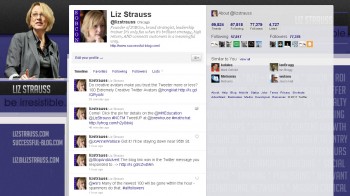
    All together a Twitter profile can offer a picture of someone worth trusting and getting to know. What you put there and what you tweet can lead me to connect with you, learn more about you, explore your expertise. It can be what leads to a relationship in which we swap stories, strategies, and knowledge gathered. A great profile draws the interest of people who value what you do and disinterest people who don’t. Here’s what mine says about me.

    Liz on Twitter


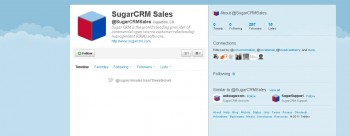
    Or it can make me wonder whether you’re a spammer.

    possible bot or spammer-profile

    Visit your own profile page to consider these questions. If it belonged to a stranger, how much confidence would you have in making a relationship? Would you trust that the person behind the page is real? Would you risk a conversation with him or her? Would trust his or her recommendations? Does your Twitter Profile page attract people you want it to meet — people who value what you do?

    More tomorrow on Tailoring Twitter to Build the Network to Support You.

    Be Irresistible.

    –ME “Liz” Strauss
    Work with Liz on your business!!

    Related
    Tailoring Twitter: Building a Powerful Network that Fits You Perfectly
    Tailoring Twitter: Get Busy Folks to “Get” Twitter in 2 Minutes Flat!
    Tailoring Twitter: The ROI of Curating Content on Twitter
    More on Twitter profiles:

    How to Write a Twitter Bio that Attracts More Followers by @blueskyresumes
    Twitter Avatars as Personal Branding by @ahockley
    The Top 7 types of Twitter avatars by @10000words
    20 Twitter Bios that Demand Attention by Iron Shirt Media Blog.
    How to Write a Great Twitter Bio to Get Targeted Followers by @salmajafri
    What is Your Following/ Follower Ratio? @Gauravonomics

    Buy the Insider’s Guide to Online Conversation.

    Filed Under: Marketing /Sales / Social Media, Successful Blog Tagged With: bc, LinkedIn, Twitter Profile

    What Do You Get from the Pizza Party at My Dad’s Saloon?

    April 4, 2011 by Liz

    At What Price?

    insideout logo

    Near the end of my freshman year in college, we found out that my boyfriend’s fraternity brother — a guy I knew — was getting married. What was amazing, interesting, exciting was that he was getting married in the town of about 20,000 people where I grew up. The wedding would take place on a Saturday that summer. They college kids I knew would be staying for the weekend to party and enjoy each other’s company right now the street from my dad’s saloon.

    My dad was a quiet and generous man who had the wonderful idea that the sun rose and set on my head. He was for almost anything that could bring a smile to me. So when I asked if some of the college folks could come to his saloon that Sunday afternoon for pizza and conversation, his answer was a smile of we can’t have them leaving town hungry. His words were “how many and what time?”

    And as it turned out that my estimate of 10-20 and 2 hours for a pizza reunion became something more like 40-60 and 5 hours of talking. Pizza and fried chicken, beer and soda and other beverages were non-stop for the entire time. The whole while, I got to introduce college friends to my dad as sort of held court and sort of worked the bar.

    Near the end of the afternoon, I noticed one friend looking a little nervous.
    I asked, “How might I help?”
    He said, “I’d like to talk with your dad.”
    “Easy!”

    I introduced my friend to my dad. They shook hands.
    Then my friend said, “I’d like to pay the bill. Could you tell me what we owe for all of this?”

    My dad smiled and nodded. He washed a glass or two and set them on the bar. before he reached out for a small white pad of paper and a tiny orange pencil with no eraser. He began writing, figuring on the pad that was enveloped in his huge hands. He looked up and surveyed the room, then wrote something down. I bet he did that survey five or six times without saying a word, without even a question in his eyes or looking at me.

    My nervous friend waited patiently with his wallet out.
    I could tell he was wondering whether their would be room on his credit card.

    About then, my dad stepped back held the white pad out about arm’s length as if he were doing the math in his head — which could well be. Then he stepped forward again, tore off the slip on paper on which he’d been figuring, and set it in front of my nervous friend.

    dad-wave

    My dad said, “I’ve been over this twice, and as far as I can figure this is what you owe — no tipping on Sunday.”

    The piece of paper read ” $1.50″ — 40-60 people and 5 hours of beer and beverages — one dollar and 50 cents.

    “Hope you don’t mind if I rounded it up. We don’t keep pennies in the register.”

    I learned a lot watching that sale.

    What do you take from this story? Do you see something worth remembering that I might not see?

    Be irresistible … like my dad.
    –ME “Liz” Strauss
    Work with Liz on your business!!

    Buy the Insider’s Guide to Online Conversation.

    Successful-Blog is a proud affiliate of

    third-tribe-marketing

    Filed Under: Marketing /Sales / Social Media, Successful Blog Tagged With: bc, LinkedIn, relationships, Strategy/Analysis

    Be a Magnet Not a Missionary

    March 29, 2011 by Liz

    When Your Values Are Baked Into Your Value Proposition

    insideout logo

    At SxSW this year, I enjoyed a deep conversation with Dave Fleet @DaveFleet about the new offer that Terry St. Marie (@Starbucker) and I are launching. I was telling him how we’re applying the SOBCon models and masterminds method to build high-performance leadership influence teams who

    • guide their decision making with high loyalty customer values and a high ROI value proposition.
    • get to innovative ideas through that balanced customer-company foundation.
    • can make that innovation reality through influence — by showing the benefit of doing it to peer employees, senior managers, and customers

    Needless to say I was quite passionate. I’ve been working on getting this enterprise offer exactly right for about 3 years.

    Then Dave said something like this to me, “So who will be your key market? I would think that with so many companies in Chicago you might never have to leave.”

    I said, “My market will be people, like you, who get what I’m saying as quickly as you did.”

    Be a Magnet Not a Missionary

    What being in an emerging market like social media and building an event like SOBCon has taught me is that I’d rather be a magnet than a missionary.

    According to Dictionary.com, a missionary is “a person strongly in favor of a program, set of principles, etc., who attempts to persuade or convert others.” He or she has to educate, evangelize, relay information about a particular set of beliefs to others who do not hold those beliefs.

    A missionary considers every person in a given group or location a possible client and thus, has to turn disinterested folks, nonbelievers, and skeptics into converts. The very nature of disinterested, nonbelieving, and skeptical folks is that they don’t value or trust what the missionary does. They aren’t likely to pay for what they didn’t want, don’t trust, and didn’t value from the start.

    The missionary has to offer a new belief system that gives disinterested folks, nonbelievers, and skeptics a reason to want to convert. At the same time that missionary has to establish a relationship of trust and communicate the value of his or her work. If the missionary succeeds, it’s a sale, but that’s only the first battle. Converts don’t always stay converted especially in times of stress. When a crisis occurs or difficult decision crops up, the missionary has to do the conversion work over again.

    A magnet has a much easier time. According to the World Dictionary, a magnet is a person or thing that exerts a great attraction. We find people who think in the same ways we do attractive and smart (and those who don’t think as we do are less attractive because they seem to be not so smart or are being difficult.)

    When we have an offer we believe in our bones that we can deliver with highest standards to the benefit of the people we serve, the folks who understand their needs and value what we offer will recognize it immediately. No conversion necessary. If you take the magnet metaphor seriously, it’s our unlike poles — our solution to their need — that forms the true bond. However it’s the magnetic field of immediately clear communication, like values, aligned standards and goals that attracts the ones that fit and repels those that don’t.

    A magnetic person only shares his or her offer with people he or she respects and trusts. When someone of value joins the conversation it’s easy to mention there’s a new offer and let the other person open the door. Then the conversation isn’t about conversion or education, it’s an invitation. The magnet can learn more about the valued friend’s needs and goals, and the valued friend can learn more about what the offer is. The trust and open communication leads to a variety of connections that might be moving forward on that offer, new introductions and referrals, or entirely new ideas that spark in the moment.

    Magnets Win

    If you have to convince or convert someone to work with you, you’ll be convincing and converting every time you make a decision. If you have to explain why what you do is valuable and worth the price more than once, move on.

    It’s easier, faster, more meaningful to be a magnet. And the people attracted to what you do actually value your work. A magnet starts with a bond of trust that a missionary doesn’t. The client who values and trusts you will value your work and trust your decisions. That’s why the client who doesn’t value and trust you is always more work (and never worth the price of admission no matter where you set it.)

    Is your business thinking like a magnet or a missionary?

    Be irresistible.

    –ME “Liz” Strauss
    Work with Liz on your business!!

    Buy the Insider’s Guide to Online Conversation.

    Successful-Blog is a proud affiliate of

    third-tribe-marketing

    Filed Under: Inside-Out Thinking, Marketing /Sales / Social Media, Successful Blog Tagged With: bc, LinkedIn, magnet, missionary, relationships, trust in business

    Why Our Heroes Will Always Be More and Less Than the Pedestal We Put Them On

    March 28, 2011 by Liz

    All the Stories Are True and Un-True too.

    I was 13 when my grandmother died. I never got to know her well. My experience of her was a tall, loving woman who smiled often and spoke only Italian. So you can see the gap.

    However, I grew up with a wealth of stories about her to add to my small set of interactions. And because she was and is a hero of mine I was a always curious to know more to fill in the picture of this person I wished I knew better and more deeply as a person.

    Now as each day brings closer to the age she was when I knew her, I realize she was more complicated and had more experiences and feelings than I’ll ever know. She will always be more and less of the hero she’s come to be defined in my mind.

    It’s important to realize that stories and small sets of meaningful interactions can’t reveal a person to us.

    Why Our Heroes Will Always Be More and Less Than the Pedestal We Put Them On

    Stories and meaningful interactions are powerful things. But the very essence of what makes a good story or a meaningful interaction is that it highlights one quality, one action that reveals something about the person in question. But no person is only one quality.

    Ask my son what he knows about me.

    What I’ve learned is that, like great characters in movies, we’ve all got our great strengths and weaknesses. We’ve all got our stellar qualities and our deep flaws. And any one of us that gets put on a pedestal is destined to fall. Here’s why and why I never want to be on a pedestal myself.

    • The heroes we put on a pedestal don’t really know what qualities or traits got them there. They can guess, but they didn’t define the “character” who was raised up and so they’re destined not to live up to the definition.
    • The people who put the heroes on the pedestal can only see the heroes from far away. The closer we get to people the more we see their complexity, the more likely we are to change that hero-worship into friendship. True friends see a whole person and accept the humanity — what’s great and what still needs growing about them.
    • Sooner or later every hero will be human and step outside of pedestal definition. Suddenly the hero-worshipers will feel a betrayal that the hero was less than they thought, but really he or she is also more … the more that they couldn’t see.

    So let’s give up the Pedestal mentality. Heroes are only infallible from faraway. It’s unfair to make them one-dimensional and expect them to live up to a definition that no human could possibly be.

    I love the stories of my grandmother. I’ll always keep her high in my heart, but I also know that she had to work for what she got and that she faced real decisions and couldn’t have possibly always chosen right. No human ever does.

    If we truly want community, it’s our job to remember and protect our heroes as the humans they are so that they can keep growing and showing us what they’ve got. What kinds of fans would we be if we made all of the protection go one way and left all of the heroism to them? Where would Harry Potter be without his band of friends who have his back? No pedestal takes the place of a community of friends.

    I think I like her better knowing that. It makes it easier to imagine she’d also be proud of me.

    How do you protect your heroes and see them people not characters on pedestals?

    –ME “Liz” Strauss

    Filed Under: Community, Marketing /Sales / Social Media, Successful Blog Tagged With: bc, heroes, humanity, LinkedIn, relationships

    80-20 Rule of Customers: Stop Thinking 20th Century! Attract Only the Top 20%

    March 22, 2011 by Liz

    10-Point Plan in Action

    Who’s Not Your Ideal Customer?

    insideout logo

    I was sitting waiting for a friend in a San Francisco Bistro. The art designer at the next table was bemoaning his business clientele. He said,

    20% of my customers are a pleasure to work with. 80% are not, but they pay the bills.

    It was all I could do to say, STOP THINKING 20TH CENTURY!!

    80-20 Rule of Customers: Quit Thinking 20th Century! Attract Only the Top 20%

    In the 20th Century, when we were stuck in geographic niches, we were been limited by location and broadcast advertising. We might have had to serve more people who weren’t our ideal clients and customers. Word of mouth referrals could only reach so many more like the ones we loved already.

    The Internet and social business through social media together have blown that 20th century notion apart.

    Whether we’re a one-person shop or a huge corporation, we can identify our ideal customers — those 20%-ers that make our work faster, easier, and more meaningful. We can get to know them and let them get to know us. We can develop trust and relationship, discuss solutions and suggest creations, so that by the time they find our front door, they’re already in our community of fans.

    Here’s how to do attract those 20%-ers …

    • Build an offer that only can deliver. Design it to the detail to suit the customer group you know best. Set your highest standards for the outcomes it guarantees. Know every detail of its execution and performance. When you can believe in your head, heart, hands, and soul that you and every member of your team can consistently deliver on it. You’re ready to talk to the people you want to attract.
    • Have standards for customer relationships. Whether your customers buy pencils or designs for major stadiums, know what behaviors you believe in as eithical and trustworthy. Offer those behaviors to your customers and expect those behaviors in return. If a customer disrepects your product or the people who make or sell it — no matter what that product or service is — send the customer packing. No money is worth your ethics or the self-respect of your business.

      Take a minute to remember your best customers – those 20%-ers. The qualities they have in common probably add up to something like these: They

      • Understood your product or service and its value.
      • Were willing to pay a fair price for great work.
      • Saw your unique contribution.
      • Trusted your expertise.
      • Communicated their problems with concern for their needs and yours.
      • Were happy to talk their friends about you and your work.
      • Working with them made you better at what you do.

      So look when you want to identify new 20%-ers that you want to work with, look for people who

      • See how your product or service can improve what they do.
      • Agree on the value of the work and the relationship.
      • Know their own unique expertise and recognize yours.
      • Communicate well and honestly.
      • Share your values and are open with their friends.
      • Enjoy great working relationships.

      Holding your standards on customer relationships will attract customers who have the same standards as you.

    • Invite, don’t sell. The difference between inviting and selling is the strength of your trust relationship. Pack that invitation with the offer you guarantee to deliver on. Describe it with the values you hold for relationships and how that pays off in having more time to building quality and real return on investment.
    • As @MichaelPort of Michael Port says, “Match your offer to the level of trust you’ve developed.”

      Example these words mean something different from someone we love than from someone we just met …

      Come to my room. I guarantee you an unforgettable night of sex.

      Speak with and show respect for work and the people with whom you work. Handle your products like valuable investments. Describe your services with calm and passionate reverence.

    • And as @SteveFarber Steve Farber says, “Do what you love in service to the people who love what you do.” You’ll know in seconds if the people you’re talking with don’t “get” the value you’re offering. If they don’t “get” your products and services don’t try to convert them, they won’t stay converted and they’ll keep asking more of you.Instead find the people who value you.
    • Deliver on every promise so that folks feel proud to talk about you.

    Great businesses don’t qualify our customers based only on interest and cash to buy. Though crucial, as our only gating factors, those two alone will lead us to serving folks who don’t value what we do.

    80%-ers don’t build our businesses. They take more time, They question every price and every action because they don’t trust. If they’re loyal, they’re loyal to price or because we’re the ones who tolerate their indecision, misbehavior, lack of communication, without charging for time lost

    The 20%-er Attraction Standard

    When we hold ourselves to our best standards and performance, people notice.
    When we treat people with trust and respect, trustworthy and respectable people come to us.

    When we invite the right people to try our best offer, we make it easy to choose our products and services. We also make it easy to share our best offer with friends. 20%=ers think of us when they’re asked “Who do you know that can …? ”

    And soon those 20%-ers we invite bring their 20%-er friends who want to enjoy that same standard of products, service, value, and respect.

    Because 20%-ers know, as we do, that alignment like that is easier, faster, and more meaningful. And we all know that working with lower standards attracts lesser customers, wastes time, costs more, and leaves us feeling like less. Find the fit that matches your 20%-er values.

    Have you set your standards high enough to attract only that best 20%?

    That’s irresistible.

    –ME “Liz” Strauss
    Work with Liz on your business!!

    Buy the Insider’s Guide to Online Conversation.

    Successful-Blog is a proud affiliate of

    third-tribe-marketing

    Filed Under: Marketing /Sales / Social Media, Successful Blog Tagged With: attracting customers, bc, LinkedIn, relationships

    • « Previous Page
    • 1
    • …
    • 50
    • 51
    • 52
    • 53
    • 54
    • …
    • 174
    • Next Page »

    Recently Updated Posts

    The Creator’s Edge: How Bloggers and Influencers Can Master Dropshipping

    Is Your Brand Fan Friendly?

    How to Improve Your Freelancing Productivity

    How to Leverage Live Streaming for Content Marketing

    10 Key Customer Experience Design Factors to Consider

    How to Use a Lead Generation Item on Facebook


    From Liz Strauss & GeniusShared Press

    • What IS an SOB?!
    • SOB A-Z Directory
    • Letting Liz Be

    © 2025 ME Strauss & GeniusShared