Successful Blog

  • Home
  • Community
  • About
  • Author Guidelines
  • Liz’s Book
  • Stay Tuned

Liz Strauss – Titan of Web 2.0! Thank You, Davos, for the Honor!

February 21, 2011 by Liz

It Started with an Invitation to Speak in Davos

Davos, Switzerland, 21 February 2011, II World Forum “Communication on Top” took place in Swiss Davos at the end of last week. Trend-makers and key figures from communications industry participated in the Forum. Among them are top-managers of world-known companies like GALLUP, ENEL, EDELMAN, SPN Ogilvy, DELL, leaders of large-scale political and social projects in various countries, and world-famous “stars” in the area of consultancy and communications.

cooltext443794242_influence

Last year, I received an invitation from the project manager of the annual World Forum “Communication on Top”, held in Davos, Switzerland. The content is in the field of Communications, PR, Marketing, Social Media, and Corporate relations: http://www.forumdavos.com

The invitation offered me a keynote session and asked if I would be willing to participate as a nominee for the C4F awards ceremony in the category “Titan of Web 2.0.”

Being asked to speak in Davos is quite a heady experience. Switzerland is famous for great minds meeting at important events.

Such as this interview in which:
Garrett Johnston discusses

  • aritificial intelligence and the singularlity
  • understanding the reasons people consume what they consume
  • creative and uncreative consumers.
  • companies who do well in the crisis


“It’s a question of making the choice easier and more accurate for the consumer. It works for everybody and reduces friction.” he says.

Who Wouldn’t Want to Be at an Event Like that?

Unfortunately Switzerland is also an exclusive ticket to an entrepreneur in the launch phase of a new business. Though I’m usually quick flexible and creative at solving problems in ways that everyone wins, I also had a prior commitment to speak on the other side of the world in Las Vegas during the Davos event.

And my word is my word.

So we agreed that the keynote might wait until next year. Then we’d have proper time to plan for the event. Participation in the nomination moved forward, I met with Helen Brandt of the Davos Top of Communication World Forum Team — It was an early morning interview — 7 time zones apart — on Skype about what being a Titan of the Web might mean.

Here’s a bit of that … Liz Unplugged.

  • a titan – brings images of building things with elaboration and fluency
  • It’s not a titanic labor to raise a blog; it’s a titanic responsibility. You write a blog to connect with people. It’s conversation.
  • I love to show companies how an invitation is more exciting than a pitch. I love to teach the fun of negotiating from the same side of the table.
  • I love showing people how their values attract people who have the same values as they do.


“I love bringing people back to the common sense. There’s so much we can do to bring the world back to the community,” I said.

I had done all I might do to be ready for the Titan of Web 2.0 nomination. Now what was left was to be online during the presentation.

Enter the Titanic in the Titan

When I got to Las Vegas, I was set and ready. I tuned in before my event to watch an learn from the speakers. All was well. Then came the time for the presentations — 7pm in Switzerland / 10am in LasVegas and the livestream in my hotel crashed.

The rest is history. I wasn’t a part of the awards — the skype connection we prepared disappointed us with no service. It was time to go speak on my panel before the wifi came back up.

The panel at the conference in Las Vegas went well. The people were outstanding both on the panel, including that Leadership guy Terry Starbucker, and in the audience. We talked about how social media can change the face of a business and bring customers closer — close enough to build a brand up.

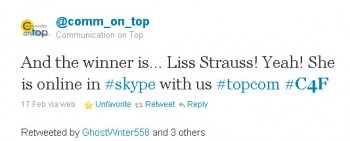
An hour later, when the panel was over, I discovered via Twitter this lovely tweet …

banner1-uus1
and-the-winner-is


And my partner, Terry, who was the first to say “congratulations,” now calls me Liss.
And every life event is worth the worry if you get a great story out of it.

Will I be at Davos next year? You can bet on it. I will be there not only to give that keynote, but to say a proper thank you, share my gratitude for this prestigious recognition

And I’ll try to learn some titan speak.

Blushing just a little, and saying thank you to the Davos Forum, to my friends, partners, and readers, — all of you who make everything I do worth every minute I spend doing it.

You’re the titans that keep this titan on the web.

Related links for more information about World Forum, “Communication on Top,” Davos, Switzerland:
http://forumdavos.com/
http://twitter.com/#!/comm_on_top (hashtag #topcom)
http://www.facebook.com/ForumDavos
http://www.youtube.com/user/forumdavoscom

–ME “Liz” Strauss

Filed Under: Business Life, Marketing /Sales / Social Media, Successful Blog, Trends Tagged With: bc, Communication on Top, Davos, LinkedIn, sobcon, Titan of Web 2.0

Customer Service or torture?

February 17, 2011 by patty

by Patty Azzarello

cooltext466496263_leadership
service-or-torture

Be careful what you measure…

BMW serves as a good example of a company that measures service vs. providing it.   But many companies fall into this trap.  Does yours?

Here is an example of what I mean:

My last car service:

  • I felt bullied by the sales and service people when they told me, as they do each time, that I “have to give them a 5 on everything” when the survey people call.
  • That is not service for me.  It’s gaming the measures for them, (and torturing me).
  • In my last car service, they failed to reset some system.  A warning light came on, and I was forced to go back.  It really screwed up my day.
  • When they realized it was their fault, I got only a cursory, “sorry about that”.
  • After telling them, “you know, when the survey people call, I am not going to give you a 5 this time” and giving them several opportunities to make it better – “Is there something you would like to do for me to improve my experience”? – there was no response.
  • I then gave the low scores on the phone survey – by the way, the survey taker/process is designed only to ask the questions, not to offer any service when someone is upset.
  • Later I got a call from my service guy. It was clear he was forced to call me to follow up on his low score. But the call was about him giving me a hard time because I got him in trouble. (more torture for me)
  • As much fun as that was for me, I decided to give them another opportunity.  I said to him – “actually I was going to call you because I need two other [small things], can you help me?”
  • Now here was a chance to provide actual service, when no one was watching or measuring.  He assured me he would call me back later that afternoon to let me know if he had the part so I could stop by on my way home.
  • I never heard from him again.

Do your measures and service processes serve your customers or torture them?
Example:

Do you measure the speed of closing problems?

This is a very typical measure.  But it’s important to understand that this measure can cause you to ignore customer problems, because your service staff is motivated to close out problems quickly, vs. take the time to actually fix them, because spending that time would result in a poor measured result.

So you end up with a backlog of problems that could have been fixed, unhappy customers, and sparkling measures for speed of closing problem reports.

Instead try:

  • Measuring the number of problems whose root cause has been resolved.
  • Or measure the number of customers who report their problem has been solved to their satisfaction.
  • Or look for customers who have multiple open issues, or issues open for long time periods and just call them!

Question:

Is your service staff trained in following service processes or in providing service?

In my example above, at every step, people were correctly following a process, resulting in my getting more and more tortured.

Customer service people who are trained in processes often delight in not-helping customers when they confident they are correctly following the process.

This is particularly infuriating to customers who want to be made to feel like someone at your company cares about the suffering you are inflicting.

Instead try:

  • Training people on the right triggers to throw out the process
  • Then have them ask “What do you think we should do to make this better for you?”
  • And give them the ability to act.

Another idea:

Involve your customer service people in creating great service.

In the BMW example I would have each dealership manage a contest for their service team to get together and come up with three new ideas for how to provide outstanding service.  You could pay $1000 each for the best 10 ideas.

Instead of putting $10k into a survey, where you have sales and service people training the customers to give the right answers, which are of no real use to you anyway, you could be motivating Actual Service!!

The existence of the contest alone would inspire thinking about service, and you get much better ideas when you involve the people who actually do the work in coming up with the best way to improve it.

Getting it Right

Look at what you measure and then look at the dark side of it.?If you were going to game the measures to come out looking good what would you do??What non-intended result would occur?  Because it will…

People like to make customers happy.  Let them.

At the very least, if you are not serious about providing actual service, don’t torture your customers with surveys and processes that only annoy them, and give you a false sense of your greatness.

What do you think?

How have you seen customers get service really right or really wrong? Share your stories in the comment box below!

—–
Patty Azzarello is an executive, author, speaker and CEO-advior. She works with executives where leadership and business challenges meet. Patty has held leadership roles in General Management, Marketing, Software Product Development and Sales, and has been successful in running large and small businesses. She writes at Patty Azzarello’s Business Leadership Blog. You’ll find her on Twitter as @PattyAzzarello

Filed Under: Customer Think, management, Successful Blog Tagged With: bc, Customer Think, customer-service, LinkedIn, Patty Azzarello

Is Mean Blogging The Writing Style Of The Future?

February 16, 2011 by Guest Author

cooltext455576688_blogging

By Terez Howard

If you’re on Jon Morrow’s e-mail list, then you probably received his message about getting rid of nice writing. He pointed to Jennifer Greshem’s post Why I Fired My Father (And Maybe You Should Too) and how this woman openly talked about her personal life.

Jon spoke about the blogging world being overrun with nice, helpful information. He said it is boring. And I have to agree with him to an extent. Type in a simple phrase, like how to grow long hair, and you will be inundated with content. Most of it will be junk, some will contain nuggets of truth and a few will be entirely well-written and thoroughly helpful articles.

Is it really mean?

I read Jennifer’s post, and I didn’t think it was mean at all. She professionally explained her story, why she made the decisions she did and how others can learn from her. She was not mean; she was real.

Now, my husband calls me mean. When I told him about this post, he said, “You’re not just mean, Terez. You pride yourself in being mean.” I suppose that’s true. But to correct him, I said that you can call it whatever you want. I prefer to call it real.

In my personal life, I have an “I don’t care what people think” attitude. I will speak my mind, and if it happens to hurt your feelings, so be it.

I think this was really Jon’s point. There’s no need to hide behind a curtain of niceness if you feel strongly about a subject. Your strong emotions will get traffic and will get people talking. Look at the multitude of comments on Jennifer’s post.

3 ways to be mean the right way

I really examined Jennifer’s so-called mean post. I noticed something particularly interesting, besides her unvarnished honesty. Several times, she referred to expert sources. She wrote a blend of journalism and blogging. I found this intriguing.

With my journalism background (I worked and interned at a newspaper for seven years), I saw this to be an integral part of real, not mean, blogging. If you have an opinion that goes against the norm, back it up with expert sources. It makes your case more believable, more acceptable.

Secondly, Jennifer also wasn’t general. She called people by their names, and she told brief but poignant stories. She did not rant or expel suppressed emotions. She gave solid reasons for the choices made.

So, when you’re keepin’ it real, you cannot just settle to write in circles. It’s like taking a controversial topic, like the food industry’s general lack of telling us where the things we eat come from. (Can you tell I’m still hyped up about Food Inc.?) You could say it’s wrong. It’s bad. It causes diseases. But if you don’t go beyond the surface, like Robert Kenner did, nobody is going to believe you.

Lastly, like Jennifer, you help people. Yes, Jon said that helpful writing is boring. But that’s what Jennifer did. In the end, she was helping people. That means that your posts have to have some kind of purpose, a call to action that motivates them to do something.

Can you handle being real?

Jon said that Jennifer did get some hate e-mails and some people who disagreed with her. That goes with the territory. You have to expect that people might not like when you write even nice things. One anonymous commenter criticized an analogy I made about being creative, like a child. I didn’t expect anyone to hate on that topic, but that’s what happened.

When you put yourself out there, especially when you take up something big, something real, people will exercise their free right to talk back. You have to be able to stand the heat. You also have to be like Jennifer and stand nearly 200 comments, loads of traffic, countless e-mails and a single blog post going viral. I could stand that.

How do you make your blogging real, or mean, whatever you call it?

—
Terez Howard operates TheWriteBloggers, a professional blogging service which builds clients’ authority status and net visibility. She has written informative pieces for newspapers, online magazines and blogs, both big and small. She regularly blogs at Freelance Writing Mamas. You’ll find her on Twitter @thewriteblogger.

Thanks, Terez!

–ME “Liz” Strauss
Work with Liz on your business!!

Filed Under: Successful Blog, Writing Tagged With: blogging, LinkedIn, Terez Howard

Hierarchy of Influence: What Achieves the Results You Need?

February 15, 2011 by Liz

Six Ways to Influence and Their Outcomes

cooltext443794242_influence

When our son was barely five years old, he was a shy child who lived by his own timetable. He had his own ways of doing things. If you wanted his attention, your best bet was to make eye contact and simply explain what you what you had to say.

It was during that year, that his grandparents came to visit us in Austin. Together as a family, we planned several outings to enjoy the city and our favorite restaurants. One evening, the whole group was getting ready to go dinner and our son was still playing — not getting ready. This circumstance stressed out three of four adults in his company. Suddenly one, then two, then all three of them were using loud firm voices to tell a child, half their size, to “Get upstairs to change in to clean clothes, immediately!!”

The child froze like a deer in the headlights.

The mom in me responded with like to like. In firm and loud voice, I said, “Who are you to gang up on a little kid like that? Get away from here!”

The three adults moved into the kitchen and spoke quietly to each other.
I took the little boy by the hand. “I said let’s go upstairs and find what you’ll wear to dinner.”

When we came downstairs ready to go to dinner, I walked into the kitchen and apologized for my outburst. In return I got three calm apologies that also said I was right to intervene on the child’s behalf.

Not every attempt at influence gets the outcome we’re going for.

Which Actions Achieve the Outcomes You Seek?

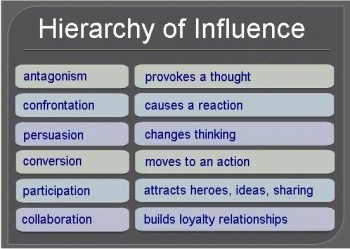
If we can agree that influence is some word or deed that changes behavior. Then plenty of influence occurred in the story I just related. I suspect that had I been privy to the whole scene in the kitchen I would have found that that single story included examples of confrontation, persuasion, conversion, participation, and collaboration. The only thing missing in this family scene would be true antagonism. Six different approaches to influence which lead to entirely different outcomes.

I’ve been reading about, thinking about, and talking to people about influence for months, because influence and trust are integral understanding to loyalty relationships. Let’s take a look at six of the usual forms of influence and the outcomes that result from them.

  1. Antagonism – provokes thought Your values are everything I believe is wrong with the world. You can’t stomach anything that I stand for. We are not competitors. We are enemies at war. Your words and actions might provoke thoughts and deeds, but what I’m thinking is how wrong you are, how to thwart you, or if I have no power, how to hide my true thoughts and feelings. An order from an enemy can influence a behavior but won’t change my thinking.
  2. Confrontation – causes a reaction You say it’s black. I know it’s white. I respond in some way — I fight back. I run away. I consciously ignore you. My response will probably change based who is more powerful. You might overpower me. I might stop responding, but it’s unlikely that you will actually change my thinking. Confrontation leads people to build a defense, to strength their own arguments.
  3. Persuasion – changes thinking You look at me and think about how what you want might benefit me. Rather than telling me, you show me how easy, fast, or meaningful it is go along with you. You’ve changed my about what you’re doing. I now see your actions from a new point of view.
  4. Conversion – moves to an action Your invitation to action is so convincing and beneficial to my own goals that I do what you ask. You’ve influenced my behavior to meet your goal. You have won my trust and commitment to an action. It’s not certain I’ll stay converted.
  5. Participation – attracts heroes, ideas, and sharing You reach out with conversation. We find that we are intrigued by the same ideas, believe in the same values, and share the same goals. Your investment in the relationship builds my trust and return investment. You invite me to join you in something you’re building. My limited participation raises my investment, gives me a feeling of partial ownership, and moves me to talk about you, your goals, and what we’re doing together.
  6. Collaboration – builds loyalty relationships We develop a working relationship in which you rely on my viewpoint. We share ideas and align our goals to build something together that we can’t build alone. You believe in my value to your project. I believe in the value of what you’re building. You have gained my loyalty and commitment. I feel a partnership that leads me to protect and evangelize the joint venture. I bring my friends to help.
Strauss_Hierarchy_of_Influence
Strauss Hierarchy of Influence

Not every campaign or customer situation will need to move to collaboration. But understanding each level will help us manage expectations allowing us to move naturally and predictably from confrontation to persuasion, so that we don’t expect the loyalty of collaboration from a momentary conversion.

Could be useful when looking to connect with that special valentine too.

How might you use the hierarchy to change the way you manage your business, your brand, your community, and your new business initiatives?

–ME “Liz” Strauss
Work with Liz on your business!!

Buy the Insider’s Guide to Online Conversation.

Filed Under: Marketing /Sales / Social Media, Successful Blog Tagged With: antagonism, bc, collaboration, confrontation, conversion, influence, influencing outcomes, LinkedIn, loyalty relationships, participation, persuasion, small business

Case Study: How to Passionately Promote Your Product AND a Cause You Love

February 14, 2011 by Liz

Double the Score

cooltext443809602_strategy

If you’ve been where I’ve been in the last year, you’ve probably seen more than a little of my friend Carol Roth. We were introduced by our mutual friend, Barry Moltz, early in 2010. Carol became my client when her book, The Entrepreneur Equation, was still a manuscript. By the time the client work was delivered, our relationship had evolved into collaboration. You may have seen us together on speaking engagements with Terry Starbucker, my business partner on SOBCon. I also had the pleasure of being part of the shoot for the pilot to Carol’s soon-to-be tv show. You can be there’s still more to come.

This proximity has meant is that I’ve been able see the planning, passion, hard work, and love that has brought that book into being — when the book wasn’t the only goal, when the opportunities and obstacles provided a wealth of distraction, and when the time to do everything was the same given to any regular human being. Yet inside that real-life path, Carol has brought her best game and today she pre-launches that book in a way that is worthy of examining for how it reaches out to do well by doing good.

How to Passionately Promote Your Product AND a Cause You Love

Some folks write books to promote their ideas, to gain authority. Some folks write them to propel their speaking and consulting business. Carol wrote this book because she passionately believes that it’s information that every entrepreneur needs to read before he or she sets out to start a business.

And with that same passion she’s gathered the ingredients and the steam to promote her book, The Entrepreneur Equation, and her favorite cause, SCORE.org simultaneously. What’s she’s doing is a fine case study in how to passionately promote a product and a cause you love …

So here’s my Valentine to her for a job well done and my Valentine to you in the form six steps that might inspire your own product launch.

  1. Build a powerful network of relationships before you need it. A leader reaches out to people who’ve been where she’s going and learns from them. She values their generosity and nurtures relationships. Carol’s been doing that since long before I knew her. That’s how she’s won the esteem of people like Alexis Neely, Les McKeown, Dave Taylor, Michael Port, Terry Starbucker, me and many more.
  2. Have a quest that resonates. Carol is on a quest to help as many entrepreneurs as possible to succeed and to provide them the tools they need to do that just. She doubled-down on her quest by partnering with SCORE.org — America’s premier nonprofit association dedicated to educating entrepreneurs and helping small business succeed nationwide. By matching each book sold with books given to SCORE, the goal is that the 13,000 mentors to America’s small businesses will have this tool to share with millions of entrepreneurs.
  3. Make your message clear. Her message is clean and clear advice for entrepreneurs– sunshine and puppies cost extra — it’s not could you be an entrepreneur but should you be an entrepreneur. Let’s make sure that small businesses succeed.
  4. Do all you can to make it easy to share. Carol’s built a micro-site, shared books, built several offers, tagged her signatures as any author might. She’s also sent emails to those special folks in her network who’ve opted in to the quest and that email is filled with samples ideas of quick ways they might pass on the news about what she’s doing.
  5. Make it satisfying to participate.
    Carol is giving away lots of cool stuff just for accepting the invitation to score for Score — an exclusive 3-part Audio Series and generous offers by entrepreneurs who are on the same quest, including a strategy session with me.
  6. Clear delivery on your promise. I’ve read the book. I know it delivers. I’ve also worked with the author and she just can’t do anything less than wonderful work. The book is packed with tools and advice to make sure that your head and your heart are both up to what it takes to ride the rollercoaster of enterpreneurship and win the race. Wouldn’t you rather know that before you invest the resources and time of your life?

Will this book launch be a success? How could it not? It’s easy, fun, and satisfying to help; it has plenty of payoff for those who do; and it promotes a meaningful cause close to all of us — helping our friends and ourselves get this country back to work — to help SCORE meet their goal of growing 1 million successful new businesses by 2017.

Happy Valentine’s Day.

Passion, Love, and Promotion aren’t mutually exclusive.

It’s about having your heart inside your head and doing well to do good.

–ME “Liz” Strauss
Work with Liz on your business!!

Buy the Insider’s Guide to Online Conversation.

Successful-Blog is a proud affiliate of

third-tribe-marketing

Filed Under: Marketing /Sales / Social Media, Successful Blog Tagged With: bc, Carol Roth, LinkedIn, Love, passion, promotion, SCORE.org

The Artillery of Marketing: A Soldier’s Perspective

February 11, 2011 by Guest Author

A Guest Post by John Durfee

cooltext443809558_authenticity

The “freedom” in Operation Iraqi Freedom didn’t start out that way. We came in looking for WMD’s and to free an oppressed people. Afterwards, we realized national security lay in the continued stability of the region and the country, which had been driven into chaos. The mission turned from a matter of finding WMDs to rebuilding a broken society and infrastructure. We turned from a fighting force to one that suddenly had to win the hearts and minds of the local people. The lessons I learned in Iraq are directly applicable to the modern day marketing, where you’re winning the trust of the customer landscape.

Blend In and Talk the Talk

A component of winning the Iraqi people’s trust was to blend in. The adage “when in Rome” comes to mind. We were encouraged to ‘nativize’ by growing out our beards and to wear local clothes like the large shawl-like shemaghs.

In the same way, you don’t want to address your customers as someone separate from their group trying to sell them something. Do research, and understand the lingo and terminology. Imagine trying to sell a surfboard. Would an avid surfboarder be more receptive to a message from a stranger who explains things dryly, or a message from someone with just as much passion and fervor as they do about it?

Nevermind the Set-Backs

No matter how hard we tried in our mission, I learned we couldn’t please everyone. We would keep trying by rebuilt roads and providing necessary protection to civilians. Yet no matter how much we tried, some locals always met us with fear, suspicion, and hostility. It was fine if they didn’t like us, just as long as they weren’t shooting at us. However, it always made me wonder the different reasons why. It could’ve been for a legitimate reason, or purely based on fear and emotional reaction from group opinion. While I couldn’t change the opinions of every person, knowing who these people were enabled us to pay extra attention to who they were affiliated with.

This lesson is just as important in a marketing environment. When doing research on public opinion, those who are most vocally against you provide a valuable source of information. They could have been a previous customer who received a broken product and who never reached the proper channels to get it repaired. Instead they held in that grudge until they had a viable way of spreading their experience (either on a product review, blog or review site, or word of mouth). They could be someone who heard from a friend of a friend about an order gone awry. Or they could be someone who provides valuable constructive criticism on how to improve your company’s brand, products, or image. In any case, It gives you a chance to reach out as well as getting a more rounded view of how your company is viewed, for both better and worse.

——

John Durfee is an Operation Freedom War veteran and a manager for Airsplat, the nation’s largest retailer of Airsoft Guns including Spring Airsoft Rifles .

Thank you, John, for your service … and for this guest post.

–ME “Liz” Strauss
Work with Liz on your business!!

Buy the Insider’s Guide to Online Conversation.

I’m a proud affiliate of

third-tribe-marketing

Filed Under: Marketing /Sales / Social Media, Successful Blog Tagged With: bc, John Durfee, LinkedIn, Marketing /Sales / Social Media

  • « Previous Page
  • 1
  • …
  • 83
  • 84
  • 85
  • 86
  • 87
  • …
  • 190
  • Next Page »

Recently Updated Posts

Is Your Brand Fan Friendly?

How to Improve Your Freelancing Productivity

How to Leverage Live Streaming for Content Marketing

10 Key Customer Experience Design Factors to Consider

How to Use a Lead Generation Item on Facebook

How to Become a Better Storyteller


From Liz Strauss & GeniusShared Press

  • What IS an SOB?!
  • SOB A-Z Directory
  • Letting Liz Be

© 2025 ME Strauss & GeniusShared