Successful Blog

  • Home
  • Community
  • About
  • Author Guidelines
  • Liz’s Book
  • Stay Tuned

Michael Jordan, The Old Spice Guy: Why Characters and Celebrities Can’t Humanize Your Brand

December 6, 2010 by Liz

A Celebrity Doesn’t Humanize a Brand

cooltext443809558_authenticity

I don’t watch TV much, but lately when I do this Hanes commercial with Michael Jordan keeps cropping up.

Does this commercial “humanize” Hanes? Of course not. It’s a traditional celebrity endorsement and if anything, it makes the celebrity look smart and the customer look informed, but not so socially adept. We may want to ibecome a bigger fan of Michael Jordan, but do we want to join a group of the guys who act like the guy talking to him?

Is the commercial really about making a relationship with Hanes or with the celebrity who wears Hanes? I say Hanes built a commercial about humanizing Michael Jordan, not Hanes.

The Old Spice Guy and Mr. Clean

Last year when the “Man Your Man Could Smell Like” Old Spice Campaign came out, everyone I knew passed on it on to someone else. We sat at lunch at SxSW sharing it on our iPhones because the clever copy and innovative camera work made it fun and worth talking about.

And then, the Old Spice Team at Wieden and Kennedy knocked our socks off when the Old Spice Man started answering comments with YouTube Videos.

But did the Old Spice Man humanize the brand? Again, I think not. What is the Old Spice Man? A celebrity work for hire? A human Mr. Clean? A character we can make a relationship with?

We’re still not making a relationship with Old Spice or the people who work for the brand.

Why Characters and Celebrities Don’t Humanize a Brand

Being human is about having humanity — a benevolent compassion for other members of the species. That’s a job that doesn’t stay on a TV screen, in a magazine, or on a website. It’s a relationship that goes both ways. It responds to questions, finds solutions, picks up the phone, answers the email, and celebrates great ideas.

As much as they add personality and glamour, even a sense of the way that people who run the brand want to relate with us, characters and celebrities can’t humanize a brand. They are cardboard cut outs of people not real people we can form a relationship with.

Here’s just a few things they don’t do.

  • They don’t listen and respond in meaningful human ways. They don’t ask us about our ideas, thoughts, wishes, needs, or the real ways we use their products. Surveys and questions are about them, not us. How do you like me? Isn’t a relationship building question.
  • They don’t act on our behalf. They don’t carry back our thoughts, ideas, and information to the people who make the products, do the marketing, and solve the problems when something isn’t working.
  • They don’t have true two-way conversations. They are paid or made to represent the brand in the same that packaging does — to underscore and represent an idea or a feeling in an outgoing direction.
  • They don’t build communities. Their work is not intended to help customers connect as people, but rather to connect customers to their products or the brand.

In other words, characters and celebrities don’t build relationships. They keep the brand conversation all about the brand. Humans who only talk about themselves, think about themselves, and work to promote themselves are considered lacking in humanity as well.

It takes real people who love their work and care about real customers, who work with real vendors, partners, and customers to reach real customer goals and solve real customer problems to humanize a brand.

Celebrities and characters don’t do that. People like @AmberCadabra @GeorgeSmithJr @ZenaWeist @vick08 @bsimi @connieburke and @LionelatDell do.

What brand do you know that’s done a great job at showing its humanity?

–ME “Liz” Strauss
Work with Liz on your business!!

Buy the Insider’s Guide to Online Conversation.

I’m a proud affiliate of

third-tribe-marketing

Filed Under: Marketing /Sales / Social Media, Successful Blog Tagged With: authenticity, bc, characters, humanization, LinkedIn, personal-branding, relationships

Will Your Customers Define Your Brand or Will You?

October 26, 2010 by Liz

(Updated in 2020)

Photo by Rodion Kutsaev on Unsplash

10-Point Plan: Build a Brand Values Baseline

Live Your Brand

Before the Internet, when we were silently niched by geographic markets the conversation with customers was one way. We wrote, televised, advertised to them. Then they read, watched, or saw our message and formed their ideas of what those messages said.

Customers decided who we are from the messages we sent.

When the Internet opened up the two-way conversation began. Now we’re finding more and better ways to listen talk, and interact with customers directly. We’re talking on blogs, Twitter, Facebook, and social sites we make just for them.

Don’t miss the opportunity in how the social business web has changed brands.

This shift in the way we interact with our customers has a significant impact on the theory of how a brand is born and who determines the character of a brand. We now have a huge opportunity to demonstrate our brand values as we claim them.

We can now define our brand with much more clarity and control than before because we can include our customers as we do. In that way we have a huge opportunity to take our brands where we want them to be. Here’s how to take advantage of this new branding power …

  • Define the core values that your brand represents.
  • Communicate that set of core values — a brand values baseline — to everyone you work with and for.
  • Check every business decision against that values baseline.
  • Celebrate and reward anyone who demonstrates your brand’s values.
  • Choose evangelists who share those values and encourage them to share their ideas.

Live your values and you’ll attract the people to your brand who value what you do. Ask the people who are doing the work what would just one thing. As your heroes and champions get more interested in the values that underpin your business, so will the people who look up to them.

A single meeting with the heroes and champions who love what you do can bring out the best in your brand in less time than a whole team from a huge consulting firm.

Have you found the way to define your brand or are you letting your customers do all of that for you?

Related
To follow the entire series: Inside-Out Thinking to Building a Solid Business, see the Successful Series Page.

Be Irresistible.

–ME “Liz” Strauss

Filed Under: Community, Marketing /Sales / Social Media, Successful Blog Tagged With: 10-point plan, brand, Brand values baseline, branding, LinkedIn, personal-branding

Aristotle Scooped My Ideas on Personal Brand

August 12, 2010 by Liz

by Patty Azzarello

cooltext466496263_leadership

“We are what we repeatedly do. Excellence, therefore, is not
an act but a habit.” –Aristotle

Consistent Behaviors

aristotlesun

I am always talking about how Brand is about consistent behaviors.

In fact, I just was interviewed by a Forbes Magazine editor for 90 minutes on this topic. Turns
out, I was scooped by Aristotle!

As Aristotle will tell you, what I am saying about branding is not a new idea.

The Big Idea

But the big idea here for me is that we build or degrade our Personal Brand every single day — in every single conversation, meeting, email, presentation, and interaction we have with others.

You are broadcasting your Personal Brand

The behaviors people experience most consistently from you, ARE your Personal Brand.

(By the way this is true for corporate brands too. Your company’s brand is granted to your
company based on your customers’ cumulative experience with all the products, services,
processes, communications, and employees that interact with customers.)

You have a personal brand today whether you know it or not.

The question is – is it what you want it to be? And are you doing anything consistently, on
purpose, to give people any particular impression of you?

Choice #1 – Build your Personal Brand on Purpose

If you want to build your Personal Brand here are the steps.

Learn what you are known for. Get some feedback from people who know you and work
with you.

  • Decide what you want to be known for. Understand if there is a gap.
  • Define some specific behaviors that support your Brand.
  • Do them on Purpose every chance you get.

.
For example if you wanted a Brand of being…

Efficient: Don’t write long emails, ever. Do present (every time) how your solutions save time and resources along with getting the desired outcome.
.

Well Connected in your industry: Don’t take on projects alone, engage your network. Do expose the virtual team you’ve created and always include externally sourced content in your communications.
.

Cutting Through Chaos and solving complicated problems: Don’t ever participate in group email debates, offer obtuse suggestions, or let issues fester. Do offer concrete ideas and close off loose ends – every day.

Choice #2 – Leave it to chance

Why now?

If you have made it this far in your career without bothering to build your Personal Brand, why
should you worry about it now?

One hazard of leaving your Personal Brand to chance is that you remain somewhat of a blank.

Even if you are generally known as “good”, when opportunities come up, if you are not known
for anything in particular so you don’t stand out very much. You don’t stand out as much as
someone who is known for something specific.

Many people are striving for more recognition, relevance, and respect. Building your Personal
Brand is a key factor in positioning yourself to attract the respect and the rewards you deserve.

Stand out more. Be more Credible.

You become a much more credible and powerful presence in your company if everyone around
you says similar, specific things about their impression of you. Your Brand becomes significant
and believable.

Your intentions do not equal others’ perceptions

It doesn’t matter what you think or feel, or intend to do. Those things only matter to you. No one
else can see them.

Others can only experience what you DO.

Another hazard of leaving your Personal Brand to chance are that you can be giving negative
impressions that you don’t intend.

For example, I remember once when I did a 360 review, I got low scores on being a good
listener. I was totally shocked, because I always considered myself to be a great listener.

What I learned when I dug in was that the few people I listened to, indeed thought I was a good listener, but the vast majority of my organization never observed me listening.

Build your Brand with visible behaviors

So to build my Brand as a Listener, I created more opportunities to listen.

I created office hours, and breakfast and lunch meetings with groups of individuals. I created a website where people could give me feedback. I requested input every time I spoke. I told people what happened as a result of getting input.

My Brand issue was not with my listening skill or intention, it was about the accessibility and
visibility of listening opportunities. I was able to build positive brand value by creating more highly visible listening opportunities on purpose.

By investing some thought and energy in building your Personal Brand on purpose you will
increase your credibility and your value.

—–
Patty Azzarello works with executives where leadership and business challenges meet. She has held leadership roles in General Management, Marketing, Software Product Development and Sales, and has been successful in running large and small businesses. She writes at The Azzarello Group Blog. You’ll find her on Twitter as @PattyAzzarello

I’m a proud affiliate of

third-tribe-marketing

Filed Under: management, Successful Blog Tagged With: bc, LinkedIn, management, Patty Azzarello, personal-branding

Be the ONLY: How to Claim Your Ground and Own It

August 9, 2010 by Liz

A Real Contribution

cooltext464169308_branding

Last week, Jeff Bezos announced plans to release a new-generation Kindle that will be even cheaper ($139) than the current generation, but will make only a few modest improvements in quality and performance. Even as analysts applauded the success of the Kindle thus far, they wondered why Bezos and his colleagues weren’t making the device much more functional, colorful, and powerful. In other words, why weren’t they taking the simple Kindle and enhancing it to go head-to-head with Apple’s iPad and other companies searching for an iPad killer?

To which Bezos offered a strategic insight about his business just as compelling as Andrea Guerra’s take on his business. “There are going to be 100 companies making LCD tablets,” he told the Wall Street Journal. “Why would we want to be [company] 101? I like building a purpose-built reading device. I think that is where we can make a real contribution.” — Bill Taylor, Do You Pass the Leadership Test, Harvard Business Review. Aug. 03, 2007

It was still the 20th Century when someone told me that I could count on these four words to always be true …

This too will change.

And since the 21st Century has arrived, those same four words have become a part of my daily reconnaissance.

Like Jeff Bezos and Bill Taylor, who wrote about him, I believe that being good at something is no longer an option. In this ever-shifting, high-noise environment, we

  • have to be the only and best at something
  • have to be the first trusted source
  • have to claim our ground and own it.

And this is more than 20th century specialization, it’s making a real contribution. It’s leadership focused to serve a distinct customer group with a clear solution. It’s irresistible service.

In the 20th century we had the advantage of geographic protection. People could only find sources as far as their shoes, their cars, and their catalogs would show them. Now the Internet has not only brought the world to their door, but Google is willing to sort it for them.

The Ground Rules to Claiming Your Ground

Apply what Jeff Bezos said to the massive opportunity that is today’s marketplace and it becomes obvious that our ideal customers are faced with overwhelming choices. The number of options for whatever anyone wants to purchase are outlandishly huge at every level: value, relationship, and cutting edge-luxury niches.

The leaders in the field have decided exactly which customers they are selling to and they signal their commitment to serving those customers on every level. Narrow your niche and you’ll still have a world of ideal customers, but you’ll be able to serve them.

apple-in-education2

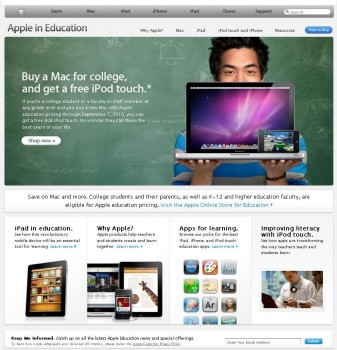
Every choice of text, image, offer, or even white space in the Apple Education website reflects their commitment to educators. That focus is key to becoming the first, trusted source to the ideal customers you want to serve. But before you can own that space you have to be able to name that space and claim it.

Three simple questions can help you identify a space that holds the best opportunity for your skill set and your brand. Let’s call them the Ground Rules.

  • Where do the rules of the game / industry / current trends favor you? Make your own game. Check where your skills cross your mission. Look for opportunities where they meet. The same computer can be positioned and packaged differently to meet the needs of a specific trend or group. We can do that too. Be the best, the most, the fastest, the only. Do you write the lightest code, offer the most unique design, or maybe tailor your service to each individual?
    Example: Let’s consider that last one. As technology moves us faster, people have less time to do what they used to do and less time to do things that are meaningful. Can you configure be the simplest, fastest solution and still an outstanding value? Can you do one outstanding thing for less cost in less time? Can you make that contribution easier, faster, more meaningful, more fun?
  • What ground works for you? Be obsessed with easy. Reach out to the customers you can reach easily. If you can’t reach the customers for your idea, partner with someone who can holds that ground …. or recongfigure your idea for the customers you can reach. Repurpose products you already have to attract new customers to you. Build for the customers who already love you.
    Example: Amazon started with readers and moved out from there. Apple moved into education by offering their computers to schools and grew new customers. Software companies extend their reach by partnering with computer companies who load their offer on new computers. Who has a list that serves the people you want to reach? Who is already within your reach now?
  • Where will you find the best rewards? Claim an audience and serve them. Don’t claim a tool meant for everyone. Tools don’t make relationships people do.
    Example: It’s better to claim service professionals moving online than to claim to sell a service to all small businesses. If you clearly claim a group, you can serve them well. They’ll tell their friends about you. Not everyone who buys a book on Amazon reads it. Some give books as gifts. Some use them to fill their book shelfs. Some intend to read and never do. It’s easier and more efficient to grow a clarified customer group than to try to grow a group from individuals who have nothing in common.
1187616_stake_a_claim


Narrow your space to your ideal customer group and your unique expertise become clearer and more defined. It’s true. Show up with the skills, expertise, integrity, and competency and deliver on what you say you do.

Once you own your ground everyone else becomes a “knockoff.” You become the barrier to entry … the ONLY. There can be only one Cirque du Soleil, only one Mac, only one SOBCon – those who follow will be facsimiles.

Look around at the winners, they claimed their ground before they owned it. Amazon claimed the world’s readers before they captured that market and now they serve readers products of every sort … including a simple Kindle that will never compete with the iPad.

What space can you claim? What unique value will you deliver to the people you want as your ideal customers?

–ME “Liz” Strauss
Work with Liz on your business!!

Buy the Insider’s Guide to Online Conversation.

I’m a proud affiliate of

third-tribe-marketing

Filed Under: Marketing /Sales / Social Media, Strategy/Analysis, Successful Blog Tagged With: bc, Bill Taylor, category of one, claim your ground, Jeff Bezos, LinkedIn, personal-branding, Strategy/Analysis

Three “Love You Loyal” Realities to Build a “Love You Loyal” Brand

April 12, 2010 by Liz

Anything Less Will Be Forgettable

cooltext443809558_authenticity

Brand, reputation, relationship the impression that people have of us and our business. We help shape and form it, but the image people take away isn’t in our control. Or is it? In some ways, what people decide about us has to do with experience we might never have been a part of. Some folks dislike all techies or all teachers. Some are biased against our age group and no actions will change that. Some are fiercely loyal to our competitor so much so that they cannot see us.

What does it take to get loyalty like that?

Three “Love You Loyal” Realities to “Love You Loyal” Brand

But with the folks who don’t know us and hold nothing against us. We have a chance to invite them into a passionate business relationship. To that well, we have to understand three critical “love you loyal” realities about you and your brand. You probably already know these intuitively, but you may not have put them all together in one place.

  1. A brand is how people think and feel about us … not what they say. People might remember what tell them or repeat what we want them to say. They might even agree with what we’ve taught them is our value base. If we invite them in, value them, ask them to contribute to it, they see the values in action, become part of what we’re building and want to protect it.
  2. People have expectations based on who they think and feel we are. People use our values to interpret our behaviors and our behaviors to interpret our values. If we share our intentions and how those intentions support our values, people make the connections that support us and help us see the unfavorable disconnects.
  3. The environment — especially other people — influences the thoughts and feelings people have about us. People feel a loyalty until someone tells a story that shakes their belief or their understanding. If we’re consistent with our shared values, state our intentions to keep them, and let folks contribute as vibrant growing part of improving on that, they’ll protect us against influences that might unravel the best of plans.

If we love our customers loyal, by knowing what we stand for and what we stand for is defined by valuing, serving, and protecting them, they will love us loyal back.

What’s one way you’ve seen a person or a company these three “love you loyal” realities into a web presence or a brand?

–ME “Liz” Strauss
Work with Liz on your business!!

Buy the ebook. Learn the art of online conversation.

Register Now!! for sobcon-vmc

Filed Under: Marketing /Sales / Social Media, Successful Blog Tagged With: authenticity, bc, LinkedIn, personal-branding

How to Promote Your Business Without Being Seen as a Smiling Shark

March 8, 2010 by Liz

Gotta Be Visible Authenticity

cooltext443809558_authenticity

The entrepreneurs and brand managers I work with both often start by asking how to use the social web. Their goal is to promote their business or their brand. The worry that seems consistently common in every first question is that they appear professional and helpful. No one wants to appear to be too aggressive in social web space.

How to Promote Your Business Without Being a Seen as Smiling Shark

When the wrong kind of promotion comes our way, it feels like we’re not being seen as people, but more like prey. Who wants to do business with someone that comes at us like a shark? No one in a marketing or sales role wants to be perceived like that.

523565_smile

I’ve found that the key to elegant and authentic promotion is being fully present in the conversation. Too often we start talking before we listen. Too often we haven’t fully considered what brought us to be interacting. Knowing who we are, what we offer, and how it fits our reader-customers before we even start a conversation can make promoting a blog, a business, or a brand as seamless as talking to a friend about how our day went.

These questions can get us to that information.

  1. Are you truly passionate and excited about it? If not, go find out how you can be. Be clear on what drives you.

    “Can I tell you why I’m so excited to be working with big companies on big ideas that connect people and change lives in ways that really mean something.”

  2. Can you articulate that passion and excitement? What words explain why you are willing to invest the time of your life building that blog, business, or brand? Be able to tell the story that connects you to what you’re sharing. People will identify with that.

    “Every day people I work with tell me that they think that what we’ve put together to connect with new business is going to be so much easier and so much fun.”

  3. Can you name and claim what you offer so that folks can attribute it you? Can you explain how your blog, your brand, or your business will change people’s lives in a clear and specifically good way? Give that a name so that the idea stick. Draw a picture with words and name that. Become the person who is the only one who provides that.

    “Folks who know how to talk about their unique value attract amazing people who want to be part of what they’re doing. Knowing what you offer is powerful.”

  4. Do you call folks to action and offer them an easy way to talk about what you’re building? Can you show them how joining you will make what they do easier, faster, and more meaningful? If you don’t tell folks how to join, be a part, they could think you don’t want them to. Gotta invite them.

    “If want you to talk about how to do that, it only takes about 45 minutes.”

  5. Do you invite people offer their experience? Do you ask folks how you might reach more people who could benefit from your brand, your book, or your product? If they offer suggestions, do you follow through?

    “If you were me, what would you differently to offer folks like more value in faster, better, more meaningful ways?”

  6. Do you ask people to talk about you? Do you give them ways they might do that, ways that make them feel proud for helping you?

    “So glad you found value, would you tell your colleagues about our work together? I’d love to help them too. We can all grow together.”

Not every questions fits into every conversation. The thing is that when we know ourselves, our business goals, how to partner and how to extend an irresistible offer, promotion gets to be as passionately authentic as the other parts of the work we do.

How do you make sure that your promotion is authentically you?

–ME “Liz” Strauss
Work with Liz on your business!!

Buy the ebook. Learn the art of online conversation.

Register Now!! for sobcon-vmc

Filed Under: Marketing /Sales / Social Media, Successful Blog Tagged With: bc, irresistible, LinkedIn, offer, personal-branding, promotion, self-promotion

  • « Previous Page
  • 1
  • 2
  • 3
  • 4
  • 5
  • 6
  • …
  • 41
  • Next Page »

Recently Updated Posts

Is Your Brand Fan Friendly?

How to Improve Your Freelancing Productivity

How to Leverage Live Streaming for Content Marketing

10 Key Customer Experience Design Factors to Consider

How to Use a Lead Generation Item on Facebook

How to Become a Better Storyteller


From Liz Strauss & GeniusShared Press

  • What IS an SOB?!
  • SOB A-Z Directory
  • Letting Liz Be

© 2025 ME Strauss & GeniusShared