Successful Blog

  • Home
  • Community
  • About
  • Author Guidelines
  • Liz’s Book
  • Stay Tuned

What Great Interviewers Ask to Always Hire the Best

August 18, 2011 by Guest Author

Guest Post
by Riley Kissel

Insight on Interviews from Stan Duncan, SVP, Westfield

People power boils down to one thing: potential. Just ask Stan Duncan Senior Executive Vice President of U.S. Human Resources and Global Head of Management for Westfield. Rome could always have been built with enough hands, but those hands needed a dream to follow and voices to guide them. In the 20-plus years that Stan Duncan has worked with human resources divisions in several multinational companies, he’s learned a thing or two about what makes a good job candidate. He’s learned which specific resources are vital to those who are ultimately hired and, more importantly, which questions to ask those candidates.

Duncan says that it’s all about asking the candidate to tell you what they want, what they have done, what will make them successful and “why.”

According to Duncan, having a prospective employee reveal what they see as their own abilities and competence is a surefire way to not only get a raw understanding of their talents and pros and cons, but also to get an understanding of their ability to adapt and their potential to last in the long term. “We aren’t looking for super-humans; in my two decades as an HR executive, I’ve yet to meet one. We want people who are talented, but most importantly, willing to grow and change as the company grows and changes, too.” I believe people who know a lot about themselves do the best selling themselves in an interview. Basically, make sure you’re introducing yourself, presenting the real you in the interview.

Duncan is certainly not shy about his two decades’ of experience as an interviewer. That was proven when he was asked what he’s learned about hiring the right people: “Doing this for 20 years certainly helps you see the big picture; it’s all about potential.” Duncan has been around long enough to see what works for the long-term and what only succeeds in the short term, and his reflections have resulted in him founding an HR model that prizes a prospective worker’s long-term potential over short-term spunk.

“Working in human resources for companies that focus on everything from career apparel, managed services, aerospace glass manufacturing to chemical agent creation has allowed me to see what always stays the same despite the change in labor practices, techniques, and strategies. Human resources are universal in that HR personnel are always seeking out that potential for a long-term employee presence once they’re hired. That’s because longevity in employment means a stronger, more developed team, which increases the likelihood that each member reaches their potential due to the longstanding support of one another.”

The beauty of Ancient Rome would never have been erected by unorganized stone cutters with no collective vision, no matter how many were hanging around looking for work, which demonstrates the power of potential. Without a guiding vision, the kind that an institution like Westfield has and HR leaders like Duncan possess, the potential of individual talent to serve something greater is often wasted. Asking the right questions and paying close attention as human resources workers is the only way to uncover that potential and make sure the talent stays around long enough to make an impact. After all, Rome wasn’t built in a day, and your company won’t be, either. Let Stan Duncan’s success show you what can be accomplished in 20 years if you put your mind to it.
————————————

Riley Kissel is a freelance writer who covers many industries with style. You can find out more about him at RileyKissel.com

Thanks, Riley, for new insights on a critical topic.

–ME “Liz” Strauss
Work with Liz on your business!!

Buy the Insider’s Guide to Online Conversation.

Filed Under: Motivation, Strategy/Analysis, Successful Blog Tagged With: bc, Interviews, jobs, LinkedIn, Riley Kissel, Strategy/Analysis

How to Market a Model-T in the 21st Century

August 16, 2011 by Liz

Understanding a Single Version Product

cooltext443809602_strategy

Whether Henry Ford actually said, “You can paint it any color, so long as it’s black,” it underscores Ford’s success at building for a mass market. He brought together an acceptable combination of consistent quality, price, and reliability to sell 15,000,000 Model-T automobiles.

It might seem that all we need to do is find our own “Model-T” and get it to the mass market. Some companies are trying to do that. The companies that succeed understand that no product can serve a mass market in the 21st century quite the way products once did.

If you’re marketing a Model-T — a single version product — in this century, here’s how to do it in the 21st Century.

  1. Build a “Model-T” with easy to communicate benefits, such as low price and reliability.
  2. Identify a clearly defined key customer group who value for those key benefits and use them for buying criteria.
  3. Study the products that this group currently buys. Identify the features those products have in common. Look beyond the features to the benefits that each feature offers.
  4. Build relationships with the “Model-T” customer group mavens — folks who offer friends detailed advice on buying products that might compete with your “Model-T.” Get to know customer evangelists for the products that the key group is currently buying.
  5. Ensure your “Model-T” product includes all of the features that key customers value and none they have no use for.
  6. Offer it at a competitive price that requires no negotiation. Negotiate takes time and thinking.
  7. Provide fast delivery and excellent service.
  8. Allow consumers to personalize it. Make product modification easy and friendly. Offer mod kits and merchandise add-ons that lets folks feel part of a “Model-T” club for owning the product.
  9. Take care with new product versions that you don’t revise out the values that developed the customer base that you’re enjoying.
  10. Consider an exclusive brick and mortar presence and a huge online selling model. A consistent product with a simple sales story works well in an online situation. Check whether direct mail is also viable for your “Model-T.”

A single version product that fits its customers perfectly can make a new market happen. The “Model-T” model still has a place in the 21st century.

Take for example the Kindle.

What products might you call the “Model-T” of the 21st Century?

Be irresistible.
–ME “Liz” Strauss
Work with Liz on your business!!

Buy the Insider’s Guide to Online Conversation.

Filed Under: Marketing /Sales / Social Media, Successful Blog Tagged With: bc, LinkedIn, Marketing /Sales / Social Media, Model-T, Strategy/Analysis

Would You Rather Have a Guardian Angel or a Devil’s Advocate on Your Team?

August 9, 2011 by Liz

We All Need A Check on Our Thinking

insideout logo

We’re in a meeting. A problem gets set on the table. We start to brainstorm solutions. Ideas are forming. You find one that seems to have potential. It looks to be simple, timely, and meaningful. Just as you’re sketching it out, someone who’s been listening jumps in before your thought’s even finished to say, “Let me play Devil’s Advocate … ”

Once upon a time — in the 16th Century — the role of Devil’s Advocate was an appointment with a specific purpose to test the argument of elevating a person’s life to sainthood.

Today, we flattened the idea, stretched the usage, and made it all but frivolous. As Tim Sanders so aptly describes …

Today, we’ve taken this to the extreme. When someone at work has a new idea about a product or a process, we take on the role of devil’s advocate before they’ve even expressed half the idea. We treat them like idiots, posing objections to them in a tone of voice that suggests, “have you even considered the obvious?” We do the same thing at home. Our kid has an idea for a business and we go into skeptic mode, shooting down her enthusiasm before the food hits the table. In every situation, we don’t improve the way the ideator thinks. Research suggests that only authentic dissent (You truly think it’s a bad idea) can provoke a better idea. When you argue for the sake of argument, you merely bolster the ideator’s conviction as well as her feelings that she’s all alone on this one.

I’m convinced that the Devil’s Advocate takes more value than he or she adds.

Why a Guardian Angel Adds More Value Than a Devil’s Advocate

When you pose your next idea, would you rather have a Guardian Angel or a Devil’s Advocate?

That might seem a clever turn of a phrase, but it’s more than that. The difference is striking. One works to win an argument. The works to contribute. Take a look at the two.

A Devil’s Advocate …

The position of Devil’s Advocate is inherently negative. The role is to find holes in the proposed idea. Arguing for the sake of arguing easily can degrade into arguing for inconsequential details or arguing to show how clever the person presenting the argument can be.

  • Psychologically sits on the opposite side of the table.
  • Argues against whatever has been proposed.
  • Asks questions to focus on risks and problems.
  • Bears no responsibility for finding answers to those questions.
  • Has a vested reason to ignore or discount valid counter-arguments.

The Devil’s Advocate breaks ideas. No value is added.

A Guardian Angel …

The position of Guardian Angel is inherently positive. The role is to find and fill holes in the proposed idea. Arguing for the possibility of what might work, while checking for risk, leads to dialogue that builds and molds ideas into useful realities.

  • Psychologically sits on the same side of the table.
  • Argues for the goal or outcome the idea proposes to meet.
  • Asks questions to focus on meaningful solutions with low risk.
  • Bears responsibility for finding answers to those questions as part of the team.
  • Has a vested reason to build on the idea or propose a better one.

The Guardian Angel strengthens ideas by adding value to them.

A Devil’s Advocate wants to save the business from harm. He or she deconstructs to identify anything that might go wrong. The quest is to stop a problem before something is lost.

A Guardian Angel wants to meet and exceed the dreams of the business and the customers. He or she deconstructs to find and fix the anything that might go wrong. It’s a quest to invent a new solution so that new ground can be won.

The Guardian Angel adds value. A Devil’s Advocate tries to ensure none is lost.
Which would you rather have on your team?

Be irresistible.

–ME “Liz” Strauss
Work with Liz on your business!!
Buy the Insider’s Guide to Online Conversation.

Filed Under: Business Life, Community, Successful Blog Tagged With: bc, LinkedIn, management, Strategy/Analysis, team-building

Be Irresistible: THE 7 Key Steps to Becoming Your Own Boss

August 1, 2011 by Liz

insideout logo

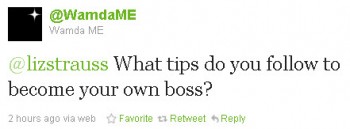
I woke early Sunday morning. I beat the sun again. I started the coffee; turned on the computer; and while they fired up, I cleaned up and fired up myself. After I poured that first cup of coffee, I sat down to see what was happening on Twitter and one interesting Tweet from @WamdaME timed at 03:49a.m. was waiting for me.

After another tweet or two, we established that WamdaME was asking about “starting your own company,” so I sent the following stream of tweets to her under the hashtag #owningit and favorited them too.

It seemed a good idea to share them here too.

THE 7 Key Steps to Becoming Your Own Boss

The seven steps I tweeted might seem to have come easily at 4:00 a.m. that morning. But every success is build on our skill set and talents — what we’re good at — and experience. Strategy and strategic thinking come naturally to me. However, I learned this strategic process by testing it constantly and doing it wrong until I found the way to “right.” After the experience of building a conference business from a blog post and a consulting business from that, I can tell you this is what works.

  1. Look over your successes to find what they have in common.
  2. Recognize the skill sets and experience that you’ve already acquired.
  3. Name the values that define you.
  4. Know how to recognize the people who believe in those same values.
  5. Get to know the people who share your values and understand their goals, dreams, and problems better than your own.
  6. Identify a problem that you enjoy solving at the crossroads of your success skill set and your values.
  7. Build a strategy to serve the people who share your values and the problem you solve for them.
    • Make it your mission to be mission critical to the mission of the people you serve.
    • Understand your position – how your size, skills, visibility, competitive place, and relationships offer opportunity.
    • Leverage conditions – find the opportunity inside every trend, cycle, shift, change in power, etc.
    • Make command decisions – commit to where you’re going, persuade the right people to help, focus on the things that move you forward.
    • Build Networks and Systems – Connect the people who help you thrive. Have an ever simpler process for serving them.

    And the most critical …

  8. Be in with your head, heart, hands, and both feet.

Offer those ideal customers (the people who share your values) the solution to the problem (something that makes their life easier, simpler, or more meaningful) and make that offer everywhere they gather in ways that are easy for them to say yes. And keep listening to their responses , tweaking your offers, and practicing your craft to give the people who love what you do more of what they love, less of what they don’t like, and something uniquely surprising and valuable that only you can bring.

Success in establishing a business grows from what has always has always made us successful — those talents and gifts that define us expressed in the ways that only we can bring them to the world — and such a deep seated commitment to an idea, a quest, a goal that we’re willing to focus all we are to make it real.

It takes commitment to become your own boss — a commitment to yourself, to the people you serve, and to the value of what you offer.

That commitment has been in every success you’ve won.
Make the commitment and you’ll become an irresistible force.

Ever had an experience like that?

–ME “Liz” Strauss
Work with Liz on your business!!

Buy the Insider’s Guide to Online Conversation.

Filed Under: Marketing /Sales / Social Media, Strategy/Analysis, Successful Blog Tagged With: bc, LinkedIn, management, Strategy/Analysis

Be Irresistible: Find the Unique Opportunity that Is Yours in Any Moment

July 19, 2011 by Liz

Ack, What Do I Do Now?!

cooltext443809602_strategy

Let’s just say it was in the last few years …
My life already had become all about working with corporations and individuals on simplifying their strategic goals. Daily I asked people questions. Sometimes the situation was about an immediate problem. Sometimes it was about far-ranging visions and goals. The questions were the same, the answers were sometimes easier to find than other times..

Five types of questions can get anyone to the best view of the opportunities in any moment:

  • Mission – Know where you are going. What is your specific and ultimate goal? Can you see it. What is your commitment to it?
  • Position – Know the unique place where are you alone are now. What is unique about where you stand in the situation? What do you uniquely bring to the table? How can your perceived weakness be turned into a strength? (if your back is against the wall, no one can come up behind you.)
  • Conditions – Know how change offers you unique opportunities. What has changed that offers an opening, an opportunity, that uniquely suits you?
  • Command Decisions – Know how to focus and sort which decisions move you toward your ultimate goal. Which opportunity moves you toward your ultimate goal? How does your response work toward making more opportunities? Which decisions will build a foundation for stronger opportunities tomorrow?
  • Networks and Systems – Know who will help you execute and how you will keep your process going. Who can help? How can you align your goals with another to make the movement faster, easier, and more meaningful for both of you? Where is the process so strong it’s invisible or so weak that it stand out?

Strategy is a framework for claiming the opportunities that uniquely our own to move forward toward a specific goal in realistic ways over time. Keeping an eye toward our end game — our mission — is only the beginning. If we recognize the unique opportunities inside every change — when we move, when circumstances move, when the people around us move — we can see a clearer way to that ultimate, specific goal.

Have you analyzed your unique opportunities lately?

Be Irresistible

–ME “Liz” Strauss
Work with Liz on your business!!

Buy the Insider’s Guide to Online Conversation.

Filed Under: Marketing /Sales / Social Media, Successful Blog Tagged With: bc, LinkedIn, mission, opportunity, Strategy/Analysis

How to Produce a Fireworks Display or Launch into Social Media Without Experience

July 5, 2011 by Liz

Our Customers Face Situations Like This All of the Time

As I uploaded the photos from this year’s fireworks show over the lighted North Bridge on the Chicago River, I began to think of the event. It’s quite a business to put on a 15-20 minute display of fireworks. As I considered the teams of people and the skills that were needed, a thought kept occurring, suppose that a client said to me …

Your charge, should you decide to keep working with us, is to pull off the best fireworks display the city has ever known!

The more I thought about the idea, the more I realized that the question I was pondering isn’t so different from what we ask new social media managers every day of the week.

5 Questions for Putting on a Fireworks Display or Launching into Social Media

A great fireworks display is the result of planning, preparation, resources, and timing. The pyrotechnical art of combining noise, light, smoke and floating materials into design that burns with colored flames and moving sparks is a display of teamwork, technique, strategy and tactics in action! And that’s just to get the display in the air!

Beyond that crowd control and the traffic are a consideration. At the event I attended, the show was visible from the lake, the river, the streets, the pier, and a double decker bridge. The distraction of fireworks while people are managing transportation could cause more than minor accidents.

No wonder the colorful, brilliant displays are symbols of celebration, which often lead to competition!

I don’t know a thing about putting on a fireworks display. I don’t know makes them work, what’s dangerous, and what’s just for show. I don’t know what things cost and don’t have pyrotechnical experts in my most intimate networks.

Yet I’m an intelligent person.I’ve run a business. I’m good at asking questions.

What follows are 5 questions I would ask to make sure that I would know I was making an intelligent, solid and outstanding investment to pull off the best fireworks display (or social media launch) the city (or the industry) has every known.

  1. The mission and the vision: What does “the best fireworks display” or “the best social media launch” look like” in it’s visible and measurable result? Before we set out on a quest, we have to know what we’re doing and why we’re doing it. I might not know how to produce a great fireworks display, but I know how I define one. Leaders take the time to articulate the vision and the mission to ensure that everyone who joins the quest is moving toward the same destination and to ensure when we communicate our vocabulary means the same things.
  2. The team: Who will bring the expertise, commitment, and the thinking to share the risk and share the benefits? Leaders reach out to people who can contribute to the thinking, not just the building. We look for folks who “get” the seriousness of the work and the fun of being part of building something no one can build alone. Start with the question, “Have you ever held a job – run a business – where if you made the wrong decision many other people beyond yourself would be hurt?” People who know their business can explain the controls they put in place to ensure right decisions and mitigate the risk. Experienced candidates can give simple explanations that show solid thinking about where the possible problems in your exact situation.
  3. The resources and quality standards: What do we need to do the job right — what adds quality and what adds cost? A wise boss once said to me, “Spend as much as it takes to do the work well and not one penny more.” When we ask about tools and resources, we can’t separate out the definition of quality.

    Quality is the customer experience, not in the builder’s standards. If the customer cannot see, feel, hear, taste, touch, smell, understand, or perceive meaning from the difference, we are not adding quality — we are adding cost.

    Read that bold paragraph again. Quality is in the customer experience.

  4. The systems and logistics: Who will own which part of the process to achieve optimal results? It’s easy to get this one backwards. Any production process needs to be talked through considering both values — the big picture order in which the stages must occur and the flexibility within each stage that allows the highest performance from the team. In any complicated production, every step has different time-goal orientations. It takes longer to produce the art than the words that might go with it. When one person’s output relies on another person’s input, it’s important to talk through the way the work flow will travel, how we’ll track it, and who will report on things that break or jam up.
  5. The time-frame: What’s a realistic time frame to get the fireworks display (or social media launch) done right, allowing flexibility for unforeseen detours? Inside any discrete event or first-time project is a new decision, a problem, or a complication that we didn’t foresee at the outset. Making room for such adventures from the beginning builds strength into the infrastructure, allows us to under promise and over deliver.

It’s only natural when we’re working on something truly exciting, that we want to get up and running. Making things happen is thrilling! However, watching things break isn’t quite as much fun. To get more of the first and far less of the second, take the time to do the planning and ask the right questions. The right questions can lead to a production that moves as seamlessly as water flowing on a summer day.

Even if you don’t know a thing about putting on a fireworks display or running a social media launch, the right questions can get to you to a successful outcome far more quickly than hoping you’ve found the right expert to do it for you. After all, it’s about a unique and spectacular outcome that serves the customer.

Did I forget any questions that you use to keep your projects in the success column?

–ME “Liz” Strauss
Work with Liz on your business!!

Buy the Insider’s Guide to Online Conversation.

Filed Under: Customer Think, Inside-Out Thinking, Successful Blog Tagged With: bc, business, Customer Think, LinkedIn, Strategy/Analysis

  • « Previous Page
  • 1
  • …
  • 3
  • 4
  • 5
  • 6
  • 7
  • …
  • 18
  • Next Page »

Recently Updated Posts

Is Your Brand Fan Friendly?

How to Improve Your Freelancing Productivity

How to Leverage Live Streaming for Content Marketing

10 Key Customer Experience Design Factors to Consider

How to Use a Lead Generation Item on Facebook

How to Become a Better Storyteller


From Liz Strauss & GeniusShared Press

  • What IS an SOB?!
  • SOB A-Z Directory
  • Letting Liz Be

© 2025 ME Strauss & GeniusShared