
Successful Blog

  • Home
  • Community
  • About
  • Author Guidelines
  • Liz’s Book
  • Stay Tuned

What Soundbyte Do People Use to Describe YOU?

June 6, 2011 by Liz

cooltext443809602_strategy

The importance of a professional personal identity isn’t hard to explain. We all want to let business contacts see us as high caliber individuals with strong positive qualities and competence. A strong professional personal identity can differentiate and position us an irresistibly attractive asset when we want to work with a most prestigious team.

But a great professional identity more than clever packaging. It’s more than a 30-second pitch on who we are. To set our personal potential into action takes self-awareness, reflection, information, conversation, consideration, reorganization, and a vision that we can translate into action.

By identifying personal and professional brand synergies, aligning your personal brand goals to your professional pursuits you can have your cake and eat it too. By identifying opportunities that serve both your personal and professional brand objectives, you can effectively multitask, utilizing the professional support and resources at your disposal while building your own brand. Dan Schawbel

It takes work to identify, understand, define, and articulate the unique value that is your personal value proposition. But it’s worth it to get the right words, the right values, and the right talents and skills to talk about when we talk about ourselves in a business context.

It’s harder yet to take that down to a shareable sound-byte that’s clear, concise, and dead on true.

What Soundbyte Do People Use to Describe YOU?

Call Tony. He can fix anything.
That Vanessa, she’s so sweet.
If you want it organized, accurate, and complete, Anne’s the one.
Ryan’s a problem solver. He’ll have this figured out in a matter of minutes.
David will give you the shirt off his back. Don’t take it. He never forgets that he gave it.

Those soundbytes, mini-descriptions, might be accurate, or they might be legend. The point is that the people talking believe and share them. The people they’re describing have communicated those traits strongly over time.

What do people share about you when you’re not around? Being able to articulate and highlight your value can define and even change what folks share with each other about who you are.

You probably have a sense of your strengths and some of your weaknesses. It’s hard to get through school and get a job without having a sense of what they might be. But few of us actually take some time to pinpoint what they are. Take the time to determine your most outstanding assets–your highest proficiencies, your core competencies. Ask yourself these questions to gather the relevant data.

  1. What am I often asked to teach others?
  2. What responsibilities are often delegated to me?
  3. What kinds of meetings and tasks am I asked to lead?
  4. What special skills and competencies do I have that others rely on?
  5. What parts of my job description would be hardest to fill?
  6. What traits make me a valuable and unique member of the team?
  7. What work isn’t work at all?

Spend serious time reflecting on each question. Reflection is how we understand what we know. You might think about one question for set time or for a few minutes at different points in a day. As you get ideas and remember things, take notes. Write down what comes to mind. When you’ve got notes on all seven, roll up what you have gathered into one single big idea — the short bio that we hear people use all of the time — something like …

Liz can articulate what could make any product irresistible and how to turn any problem into a win.

Make your big idea a statement of your unique value in ways that others can see it, can believe in it, and can share it easily.

What is the sentence that people should be saying about you?

–ME “Liz” Strauss
Work with Liz on your business!!

Buy the Insider’s Guide to Online Conversation.

Filed Under: Marketing /Sales / Social Media, Successful Blog Tagged With: bc, LinkedIn, personal-branding, value proposition

Does Your Business Embrace Technology Meaningfully?

June 3, 2011 by Guest Author

A Guest Post by
Matt Krautstrunk

cooltext443809602_strategy

As bloggers we understand how important interacting with a community on social media is for exposure. We tend to refer to social as “new media,” however when you think about it, some of the ancient social media channels (Myspace, corporate blogs) have been around for over 7-10 years now. The progress that marketers have made on social media channels has almost pushed the medium to maturity, it’s time for corporate structure to follow!

Building Social Media Into Your Corporate Culture

Social media is being used by more and more people to accomplish almost everything from a job search to answering common questions. Just to reiterate how fast social media is growing. See below: According to Econsultancy

  • Tweets grew 250% since January 2010
  • LinkedIn Users grew 100%
  • Facebook grew from 350 million users to 640 million users in one year

But in the B2B marketing industry, social media should extend deeper than just having a LinkedIn. It should be controlled internally and leveraged within each employee. Your employees can be used as vehicles to spread messages about your company’s products and services. With this obviously comes inherent risk, but since social media such a transparent vertical there should be internal social media policies in conjunction with your marketing strategy.

Social Media Policy

Companies are still trying to find a balance whether they should encourage or hide employee social media use. Everything from, the decision to associate your businesses name with employees on social media to governing social media use, social media policies can be laid out to leverage your marketing strategy internally.

For instance, some companies have requested their employees create a separate Twitter account that is strictly professional. This has two key benefits, one is the fact that businesses are able to gain awareness and engagement from each employee’s Twitter, and the other is minimizing the risks associated with standing behind an employee who tweets inappropriate personal material. Businesses should design a clear policy framework for how social media can be used to create synergies not catastrophes.

Improving Workflow

Embracing social media within your company may have some risks, but empowering employees with social media embrace can help your cause. For example allowing employees to tweet during workdays can improve morale and communication efforts. Strategically integrating tools to work within your business can give meaning to each of your departments, according to Charlene Li, analyst at Execunet (http://insights.execunet.com/index.php/comments/creating_winning_social_media_strategies/best-practices/more) , “Anyone can be influential with these tools. Salesforce.com has a new Twitter-like product and calls the people in the company using it, the “Chatterati.” “This internal social group is the connective tissue in the organization,” Li noted. “There is real value being created as people use these tools to get the job done.” Social media is a core element of these innovative companies communication technology, making their employees better, more informed workers. There is an opportunity here for collaboration in the cloud; your employees will have the ability to express opinions and suggestions easier than ever before.

One of the biggest challenges to embracing social media internally is letting go of control. Executives should embrace this technology meaningfully instead of fearing the repercussions.

_____
Matt Krautstrunk is an expert writer on document management systems for Resource Nation an online resource that provides advice on purchasing and outsourcing decisions for small business owners and entrepreneurs. You can find him on Twitter as @mattkrautstrunk

Thanks Matt! Great case for taking social media seriously.

–ME “Liz” Strauss
Work with Liz on your business!!

Buy the Insider’s Guide to Online Conversation.

Filed Under: Community, Marketing /Sales / Social Media, Successful Blog Tagged With: bc, internal community, LinkedIn, Matt Krautstrunk, social-media, tech

From Neil Patel to Ben Franklin: Do You Learn from History?

June 1, 2011 by Guest Author

Guest Post
by Riley Kissel

cooltext443809437_relationships

Old Word Wisdom Ensuring New World Success

Upon sitting back and listening to Neil Patel ( @neilpatel )discuss some of his greatest achievements and losses he didn’t skip a beat when asked what his biggest professional failure was. In fact, in Patel’s eyes, failure isn’t quite the correct word. Patel referenced a time when he lost million dollars on a web hosting business in Rockwall Texas. From that loss came something he prizes most in his profession; learning a valuable lesson. This is part of the dogma that has made Patel so successful. It’s not out of a revolutionary idea or approach but it’s his good business sense coupled with old world wisdom that’s allowed him to become a top 100 blogger and consultant for numerous Fortune 500 on SEO, and all before the age of 21.

As the co-founder of KISSmetrics and a founder of Online Poker Lowdown , a poker tip site, Patel has always valued the strength and endurance of wisdom and lessons over the fickleness of ideas. He values each triumph and failure in equal measure and upon loosing those million dollars he states that, “I learned that you don’t invest in ideas. You invest in people. Ideas can change over time, but good people will always stick it out until they can figure out how to make a business succeed.” This is just a part of the tapestry of Patel’s approach and has enabled him to climb to such great heights.

Patel attributes much of his success to the lessons that he learned as a child. In various situations he references bits of wisdom handed down to him from two of his most valued mentors: his parents. It’s been through leaning from mistakes and applying those lessons that has enabled him to be such a success. Patel states that his parents, “didn’t groom me into being a businessman, but instead they just taught me what their parents taught them”. These lessons ranged anywhere from getting the most from your money to using the resources that are available to you instead of buying something you don’t necessarily need. These lessons were basic but their efficacy has been substantial at ensuring Patel’s success in the online world.

One can’t help but notice a strong resemblance in Patel’s approach to the wisdom of Benjamin Franklin.

Where does your approach fit with what has historically built success?
——
Riley Kissel is a freelance writer who covers many industries with style. You can find out more about him at RileyKissel.com

Thanks, Riley, for simply showing how great thinking has built great success.

–ME “Liz” Strauss
Work with Liz on your business!!
Buy the Insider’s Guide to Online Conversation.

Filed Under: Marketing /Sales / Social Media, Successful Blog Tagged With: bc, Ben Franklin, LinkedIn, Neil Patel, Riley Kissel, success

Are You Seeing So Much That You’re Blind?

May 24, 2011 by Liz

Finding Your Own Leadership Path

Looking in the Right Direction

insideout logo

Last night, I shared a lovely phone call with Tim Sanders who had just arrived in Chicago after several flight delays and detours. Tim is an amazing traveler. I guess he would have to be a speaker so in demand as he is.

I used to travel like that it takes a certain mindset. To do it well, busy travelers also need to understand how to lower stress and keep our eyes on what’s important. The same is true of people who travel extensively and often.

Does that sound like you?

When I hung up the phone with Tim, I marveled at his energy and generous spirit. I got to thinking about how traveling used to affect me and what I learned that made me a better traveler and a far nicer person to work with.

Are You Seeing So Much That You’re Blind?

Working at a fast pace is much like traveling on too many airplanes. The information coming at as us fast and furious. We become machine-like in our effort to process. We see the details of what we need to navigate. The problem that I found was that I sometimes hyperfocused through to the important navigational and informational details that I was blind to the people in the picture. The people became just more data carriers to inform my goal.

That was a problem. It’s not human. We’re wired to be social not mechanical.

So the more I focused on the information, the more stressed and less social I became. With or without a real itinerary, traveling too fast made see so much I was blind to the people around me.

And when we lose sight of the people around us, they find a way to remind us that they are people not unfeeling data points. Such reminders usually aren’t fun or pretty.

So I learned how to pace my “traveling” with an appropriate amount of “space,” so that my eyes remained open to value the people I meet. Here’s what I do now regularly.

  • I look at the people I talk with.
  • I talk more about the people I’m going to see rather than the places I’m going.
  • I think of every detour, delay, and problem as a chance to meet someone and capture a new story.
  • I think of myself as a visitor in everyone else’s world.
  • I make it a point to sit silently for “recess” breaks 3 or 4 times a day — at my desk, on airplanes, in taxis.
  • DI look at the sky and trees, because it’s hard to feel overly important when I’m face-to-face with creation.

No major magic there. It’s doing what Tim calls feeding our brains, what I call keeping our heads wired to our hearts.

Either way the result is a powerful return on investing.

The more I see the people around me, the more they see good things coming out of me.

What do you do to make sure that you’re not seeing so much that you’re blind?

Be irresistible.

–ME “Liz” Strauss
Work with Liz on your business!!

Buy the Insider’s Guide to Online Conversation.

Related articles:
The Only One
Business, Blogs, and Niche-Brand Marketing

Filed Under: Marketing /Sales / Social Media, Motivation, Successful Blog Tagged With: bc, LinkedIn, relationships

When a Tire Goes Flat in Front of the Audience, Stop Driving

May 23, 2011 by Liz

This Isn’t Working

cooltext443809602_strategy

On a hot, spring day in May when I was teaching first grade, an acute classic migraine hit me smack between the eyes. I’d lived with the symptoms and studied the condition since I got the first one in grade school, I knew the causes and the effects of this cousin to epilepsy.

This nerve storm would be an award winner. The “aura” — the quiet before the migraine storm — came on with an intensity that signaled that the pain would be following on fast and furious. It also meant that I might lose the feeling my hands or start “wixing my merds,” which wouldn’t be good in this class of 36 six-year-olds who had my number.

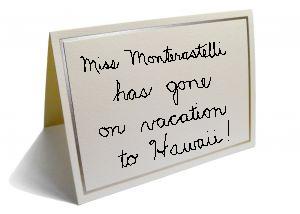
So while the kids were doing their math, I made a sign, set it on my desk, facing the class. It said I had gone on vacation.

gone_on_vacation_to_hawaii

Then I sat at my desk writing a letter to a friend about how the situation sucked.

A first-grader much like Carol Roth (@caroljsroth) came up to my desk to ask a question. I acted invisible and kept writing, as if we were on two different points in the time-space continuum.

She picked up the sign and read it to the class, “Miss Monterastelli has gone on vacation to Hawaii.” She put the sign back on the desk with some authority.

A voice from a Chris Brogan (@chrisbrogan sort of young man said, “Hey, that means we don’t have to do our work!”

Then a voice from a Amber Naslund (@AmberCadabra sort of young lady said, “Yeah but if we did that, when she gets back, she’d give us THAT look.”

So they went on with their work and I waited for my migraine medication to take effect so that I could get back to my class and back to our work.

When a Tire Goes Flat in Front of the Audience, Stop Driving

I was at presentation a while ago. The speaker was someone I’d looked forward to hearing. She not only knows her subject matter, but comes high recommended as someone who can keep an audience engaged.

As the presentation got rolling, it became apparent that she had built her presentation for a different audience. The slides were over-packed with information that didn’t apply to the people in the room. It also seemed that she had realized that too, because as she spoke her confidence waned.

She didn’t have the option of putting up a sign and building a new presentation, but she might have untangled the situation by stepping back and starting over just the same.

If only she’d stopped, stepped back, and said, “You know this is not working, let me try something else. I’m going to close my computer and start over with a few questions from you.”

The audience would have thought her a hero for saving them an hour of time wasted. The humanity and courage of setting aside her plan for them would have said volumes about her respect. What had gone haywire could have been a super win.

Instead, despite her own discomfort, the speaker chose to plow through to the end with the presentation that didn’t work.

When a tire goes flat, it’s a bad idea to keep driving. The same principle works here. If you know that what you’re doing isn’t working, stop, step back, and start over in a new way.

It’s not the plan that counts it’s the quality delivery to the audience.

Whether we’re telling, helping, or selling, sometimes we can misjudge where our heads are or what the audience needs. We can often feel it by the lack of feedback in the room. It never hurts to ask, if the group wants or needs to go another direction.
They’ll make you a hero for making it about them.

And about those first graders …

After about a half hour, I felt much better and took down the sign sign. Luckily I had been to Hawaii, because I was greeted with a long list of questions about what I’d done and seen while I was on vacation there.

Do you have a story about plowing on when you should have stopped or starting over and being glad you did?

–ME “Liz” Strauss
Work with Liz on your business!!

Buy the Insider’s Guide to Online Conversation.

Filed Under: Marketing /Sales / Social Media, Successful Blog Tagged With: bc, LinkedIn, starting over

7 Ways to an Attractive, Authentic Relationship … With Yourself

May 16, 2011 by Liz

cooltext443809437_relationships

About this time each year, new folks discover the energy, the community, and the benefits of being online.
About this time each year, folks who’ve been here often get back that “new blogger feeling.”
And some folks even start looking back at where they’ve been to figure out where they might be going.

I do all of that.

And today finds me thinking of what makes successful and lasting online relationships.
The longer I look it, the more I realize it relies on how well we relate to ourselves.

So rather than talk about how to be visible to people you want to meet, how to attract people who care about what you’re doing, why not take a minute spending time on what it takes for you to get to know you?

Top 7 Ways to an Authentic Relationship … With Yourself

If you read down this list, it’s fairly obvious that the same seven apply to relationships with other people as do to the relationship you might want to build with you. The advantage of taking the time to reflect on these seven and yourself is that knowing who you bring to those other relationships is foundational to forging something valuable and lasting at every turn.

Do you treat yourself as well as you expect yourself to treat other people?
Do you give yourself the respect that you deserve?
Do you keep your promises to yourself and value your input?
All of these will build a better relationship with yourself and with other people.

  1. Show up whole and human. Do you see yourself as a person or a worker? Do you hold yourself up to some superhuman standards? Isn’t it unfair (and maybe a little snobby) to set one standard for yourself and another for everyone around you? Show up for everyone. Give yourself the time — and the you — you would give your best friend.
  2. Talk in your authentic voice. A good part of authenticity is knowing when we’re hiding behind our history. Another good part is seeing and admitting when we’re feeling one thing and saying that we feel something quite different. Choose the authentic kind words that express who you are now and what you are feeling. Know when to share them and when to keep them near you. But trust your “self” and your voice to know the authentic life you’re living.
  3. Tell your own truth.We all grew up with “tape recordings in our heads” that contradict what we know is true about ourselves. Why do we talk as if those are the reality? Stop long enough to gather the skills you’ve built. Reflect for the time it takes to appreciate why you might want to be friends with you. Learn what it is you are uniquely good at doing and don’t be afraid to tell the truth about who you are. The world didn’t hold a meeting to decide only one kind of person can be here.
  4. Have room for folks to tell theirs too. Hear the truth when it hides inside what other folks are saying. Ask until you know, believe, and feel that you’re communicating. Make it easy for them to share what might be weighing on their heads and their hearts with you. What you’ll find by listening to their truth with all of your being is that knowing the their truth deeply enough to understand it won’t hurt you. It opens us up to accept our own humanity.
  5. Don’t try to tie ideas up in a bow. Life doesn’t come in boxes that organize well with single labels. It’s rare that one occasion will summon up only one word or emotion. Enjoy the depth and live the kaliedoscope changes. Each breath of color and dimension adds new meaning that will get shut off and cut off if you try to categorize or define every minute. We aren’t meant to define our lives so completely. We’re meant to live them.
  6. Half the show is in the comments. Now and then take a moment to stop, reflect, and collect your own opinion on who you are without outside influence. Sit with yourself in your personal invisible comment box and have a conversation about who you are and where you’re going. If you don’t like the goals and the destinations, change them. If you don’t like the design of your life, get a new one.
  7. Be helpful, not hypeful. . . . Make everything about them not you. Default to what generates energy. Help yourself by helping other people. It’s not natural for a human to be a hermit. When the dark weather settles around you, reach out to help someone who is facing a far worse climate. Don’t think about how people treat you – those who get it wrong, don’t “get” it. Be your own model of how it should work and enjoy being it.

And when you make that relationship with yourself, you’ll find you’re the kind that attracts other people. They’ll see that you value what you bring and that what you offer is real.

So go ahead, what could be wrong with being someone you like, respect, and want to be with?

Be irresistible.

–ME “Liz” Strauss
Work with Liz on your business!!

See also:
Top 10 Ways to Start Living Your Life

Buy the Insider’s Guide to Online Conversation.

Filed Under: Marketing /Sales / Social Media, Motivation, Successful Blog Tagged With: authenticity, bc, life., LinkedIn, relationships

  • « Previous Page
  • 1
  • …
  • 48
  • 49
  • 50
  • 51
  • 52
  • …
  • 174
  • Next Page »

Recently Updated Posts

The Creator’s Edge: How Bloggers and Influencers Can Master Dropshipping

Is Your Brand Fan Friendly?

How to Improve Your Freelancing Productivity

How to Leverage Live Streaming for Content Marketing

10 Key Customer Experience Design Factors to Consider

How to Use a Lead Generation Item on Facebook


From Liz Strauss & GeniusShared Press

  • What IS an SOB?!
  • SOB A-Z Directory
  • Letting Liz Be

© 2025 ME Strauss & GeniusShared