Successful Blog

  • Home
  • Community
  • About
  • Author Guidelines
  • Liz’s Book
  • Stay Tuned

7 Steps to a Vision that Grabs a Community by Its Soul

September 21, 2010 by Liz

(Updated in 2020)

10-POINT PLAN: 1.2 Articulate the Vision

CommunityPhoto by John Schnobrich on Unsplash

Why Have a Vision?

Last week, I wrote Why You Absolutely Must Share Your Vision Early and Often. Now, it’s about the how-to.

Imagine three corporations that build and sell computers for small business and entrepreneurs. Each corporation defines its business in a different way.

Brand A says: Our company is in the business of making products for consumers who need them. We do the work they can’t do and offer it at a fair price.

Brand B says: We’ve are the leader in quality, creative solutions to the complex technology problems that entrepreneurs and small business owners face today. We make it our business to know their problems and to find a way to solve them. We deliver on our promises and we’re committed to staying the best in the industry.

Brand C says: We are a network of deep and strategic partnerships with employees, vendors, partners, and small businesses leaders who work together to build products and work environments that inspire and generate creativity, competence, performance, and trust and to create jobs and solutions that build the economy now and for future generations.

Brand C is the description that connects the company to every person on the planet.

How Does Vision Attract Community?

The vision is more than the mission. It’s the destination drawn clearly so that every member of the new community can see it, understand it, speak about it with passion, and believe that it will happen. The vision is not a product devised and made by a crowd or a committee. It’s a leadership decision — the original strategy expanded with thought and design to elevate it to a higher calling.

The vision is the cause that attracts and unites the people of the community. It why they invest tireless hours and best efforts — because they are building …

  • something that makes an important difference;
  • something that no other company is building;
  • something that needs every individual’s unique contribution
  • something that no one individual could build alone.

The vision isn’t a dream. It’s a work in progress … a group aspiration in the true sense of it’s definition, breathing toward. The vision gives the community a why for why they are investing the time of their lives each day into this work. The vision is more than economic, more than profession, it is a commitment to accomplish something meaningful in the world.

7 Steps to Communicating a Vision that Grabs Folks by the Soul

If you’re looking to build a thriving business, start with a long-term, loyal internal community of employees. They will build and protect a healthy innovative culture, promote the values of the business, stay with the company, develop expertise with coworkers, and live to serve customers. What better way to build a brand than to agree upon the values that you stand for and create an environment that nurtures brand ambassadors?

It takes the right vision to attract the right people to that kind of community culture. When we meet the best people, we have to tell them about that vision, or how will they see it? Here are 7 steps to articulating a clear vision.

    1. Think contribution. Think partnerships. Re-imagine your team or your business at this highest, most useful place in the world — financially, professionally, and philosophically. Talk through what you see with people you trust until you have a image, a vision, of what that business offers to employees, partners, vendors, and customers.
      We’re inviting the highest quality people who have a stake in teaching and learning technology to join together in building products, services, and opportunities that show other people how business can work better for customers.
    2. Think ideal membership. Make the vision irresistible: smart, feelingful, and life-changing on a world-scale.
      We’re only interested in the best minds, best designs, and the best problem solvers with the highest values. We’re going to align our goals and build stable, successful, ethical business models that freely give support to fledgling business in depressed areas to create an economy that helps us all grow.
    3. Think contributions and returns. Find the words to describe it simply in ways that others can see the value of what you’re going for.
      We’re building the business that listens, learns, contributes, and invests in the people who help it thrive — it will be the business that people want to work with and for — the sort where every person makes a difference.
    4. Think recruitment. Be able to speak to the benefits of being a part.
      One benefit is that under-achievers and those who will sacrifice anything to raise the bottom line won’t want to work here.
    5. Think champions and heroes. Invite the people who see the vision to be involved in highly visible ways. Talk about what they’re doing encourage them to talk too.

The communications team has started a newletter for partners and vendors working with inner city high school enterpreneurs. Let us know if you want to volunteer.

  1. Think honest communication. Talk publicly to everyone in as many ways as you can — live your message.
    I’ll be listening to the folks who have experience where I don’t. I’ll be looking to learn from you how to do this better. That includes everyone I know.
  2. Think evangelism and growth. Invite people to pass on the vision and the invitation.
    Who else belongs here? Tell us.

It’s not the how or what of work that builds community. It’s the why. The underlying vision that unites us toward building something that we can’t build alone. A community needs leadership to set and invest that vision and so that they can feel smart, safe, and powerful in investing too.

Once the community sees the vision and realizes that leadership commitment. People who share those values will pick up the message, the tools, and the passion to contribute to the cause. The culture will grow from their actions.

Humans are wired to be deeply inspired by causes greater than ourselves. To inspire a community to invest its soul, we have to show them why we’re willing to invest our own.

Have you really communicated your vision? Are there ways you might make it clearer to the people who can help it thrive?

Related
To follow the entire series: Inside-Out Thinking to Building a Solid Business, see the Successful Series Page.

–ME “Liz” Strauss

Filed Under: Community, Inside-Out Thinking, Successful Blog Tagged With: 10-point plan, Community, internal community, LinkedIn, Strategy/Analysis, vision

7 Reasons Why Investing in an Internal Community Makes Solid Business Sense

September 7, 2010 by Liz

(Updated in 2020)

10-POINT PLAN: A Foundation of Solid Thinking

Photo by Toa Heftiba on Unsplash

A Good Business Values Customers; A Great Business Values Every Person Who Helps the Business Thrive

I once had the best job of a life-time, working for the best boss I could have ordered up in my wildest dreams. Our relationship brought out the best in each of us and that ethic was true throughout the entire company. The operation of that business was smooth, reliable, and totally centered on customers and how to serve them. In an industry that was experiencing 2-3% growth, we were doing 10 to 20 times that. Conversations were honest and thinking was naturally strategic.

We were a community on a quest.
We loved what we did and we were outstanding at doing it.

Love. Not like, enjoy, or get kick out of, but have a passion for, live for, hold in highest esteem.

Every company that wants to grow should have some of that.

Here’s how to explain the value of internal community to leadership in ways that shout ROI and make business sense.

Why a Loyal Internal Community Is Crucial to Every 21st Century Business

People perform amazing feats when they’ve got a quest, a cause, and a purpose. We rise to our better selves when we become part of a community dedicated to building something that no one of us could possibly build alone.

Why?

It’s how we’re wired as humans. We’re better when we’re inspired by deep feeling. We bring our best to whatever challenge we face. Any less is inauthentic, second-best, didn’t try, plan b, ho-hum, phone it in, stand in right field and let that pop-fly pass us by instead of saving the game . . . we might as well be out!

There’s a reason that so many folks — online, in IT, in academia, in every career — say the same thing. . . . find your passion, do what you love.

The people who understand passion and work are not promoting self-indulgence. When people do what they love they perform better, faster, and with more skill. When a community gathers around a common quest, they raise the performance bar even higher by supporting each other.

What Makes an Internal Community So Important Now?

Big brands and small businesses have been talking about building customer communities for a few years. Yet, it’s been proven that the way we treat our employees is the way they treat our customers. So, it only follows that the strongest community starts inside the business.

The high touch and high concept of community draws a company together around a single goal. What could attract and support brand evangelists better than that?

In his book, A Whole New Mind, Dan Pink points out that “high concept” and “high touch” values (design, story, symphony, empathy, play, and meaning) are as important to business success in the 21st Century as linear thinking, detailed analysis, and spreadsheets.

In this global economy, conversation and relationships matter as much as schedule and budget do.

In plain and simple words, thinking and doing what everyone always has thought and done no longer work.

It’s time align our goals and values and invest in what we do together. That’s the only way to attract the best people — employees, partners, vendors, and customers. That’s the only way to be the best.

Rather than checking our personalities at the door, why not check out what a loyal internal community can do for a business that wants to build a brand that wins the loyalty of life-long customers and fans.

7 Reasons Why Investing in an Internal Community Makes Solid Business Sense

A community challenges us to bring our best to a situation. We invest in the community and they invest in us. And in that manner, we share our goals to build something that becomes a common cause. When we bring all of who we are, full engagement of head and heart, 7 deeper values and higher outcomes show up in our work.

1. Complete presence — focus. We’re all there — the all thinking business is no longer sufficient. The business is more well-rounded and friendly to the people who help it thrive. Computers can’t smile. Computers can’t listen to the spaces between words. People conceive, design, build, buy and talk what we sell.

2. Peak performance — productivity. A computer might work every minute achieving great computation effort, but it will only be as good as the people who program it and it will never over-achieve its programming. People invest more, do more, go further for the work we love. People connect to other people who are doing that.

3. Tolerance — perseverance. We have more patience, time, and energy for problem solving when we directly reap the benefits. Peter Drucker proved that money is a disincentive … it has the most effect when it’s not there or too small. What leads folks to achieve greatness is the payoffs that a loyal community offers: support, feedback, acknowledgment, sense of purpose.

4. Value and Appeal — compelling story. To compete a product or service has to be useful and beautiful. Simple and elegant, for to the adult and the kid in each one of us. Bringing logic and emotion to a business outdistances the world view of logic alone. Competence and great execution are expected. A loyal community builds in added value in how they tell the story, how they treat the product and the customers who buy it, and how they talk about the company as a value in their lives. What’s more appealing than working with someone who’s not only good but also loves his or her job?

5. Total Differentiation — identity. An internal community develops it’s own culture and identity. The uniqueness of that common bound shines through in concept and execution. The respect of a loyal community shows in everything it does. It becomes it’s own barrier to entry. The competition can’t knock that off.

6. Fully Invested and Worth Investing In — market value. Rolling all of the above values into one, nothing beats the 360 degree investment of brains, money, and dreams all in the same direction. Any financial firm worth its salt looks for that combination when funding a small business.

7. Sense of Worth — authority. Community builds authority. We value what we earn and what we love. That value telegraphs itself. It’s contagious. Customers, vendors, and partners pick it up as well.

Can you see why it’s only sense that a strong business would move to build the most supported internal community on the planet? A fiercely loyal internal community is a secret weapon that stands on its own.

Have you ever worked for or interacted with a business that was a community of loyal fans? What was your experience of that?

Related
To follow the entire series: Liz Strauss’ Inside-Out Thinking to Building a Solid Business, see the Successful Series Page.

–ME “Liz” Strauss

Filed Under: Community, Successful Blog Tagged With: 10-point plan, Community, internal community, LinkedIn, Strategy/Analysis

The 10 Point Plan to Build an Internal Community of Brand Loyal Fans

August 31, 2010 by Liz

(Updated in 2020)

Community Starts at Home

During my years in publishing, I was a serial community builder. It seems that every job I took included “rebuild the department, refocus the vision” in the role. I’m fairly certain that those two challenges are what attracted me.

Even as a teenager, explaining the quest, translating the context, and helping folks bring their best to what they’re doing has been my natural response. I’ve always done that. Not that I’ve always done it well. Still the failures and successes of the past have taught me what moves people to trust in a vision and to join in to build something they couldn’t build alone.

So I was the one they hired

  • to rebuild the company and the strategy for growth six months after the company had laid off 40% of the previous employees.
  • to re-establish the department identity when it had grown too quickly and lost its role within the organizational process.
  • to build a cross functional team that could function with professional ease and confidence from a crew of new hires when the start up started growing.
  • to establish a winning brand and a high performance product / marketing team from a single product offer and a squad of contract workers
  • to lead an ad hoc SWAT team of 60 professionals to reconceive and bring to market a product in crisis (in 1/6 the time originally budgeted for development.)

Every one of those jobs was the best job of my life while I was doing it, because we built teams that made outstanding things happen. Who doesn’t want to work with people who are “in with both feet,” working at their best level, and having fun?

The 10-Point Plan to Build an Internal Community of Brand Loyal Fans

Now I’m working with two new clients that very topic close to my heart and my business. Both are asking how they might get their teams to “raise a barn” rather than “build a coliseum.” Both companies want a to build an internal community of brand evangelists the expands from team to team, from department to department that will spread from inside to outside their company’s “walls.”

We’re going to use traditional interviews, a social tool called a “histogram,” and tested, collaborative instructional design to build an internal community of brand loyal fans. Here’s a 10-Point Plan to build an internal community of brand loyal fans. It’s exciting to offer a program and a process that grew out of the of the working model we use every year at SOBCon.

  1. Articulate a clearly defined vision.
  2. Negotiate a leadership commitment to live that vision.
  3. Assess and benchmark the current status.
  4. Identify and enlist a core team of champions to lead the quest.
  5. Build a brand values baseline by gathering the values that drive the brand.
  6. Challenge the brand teams to condense and clarify the brand values baseline by talking them through with stakeholder and bring back less than 7 words.
  7. Align your brand values with your brand value proposition
  8. Engage the brand teams in identifying and collecting cultural stories, signs, and rituals that exemplify the values of the brand values baseline.
  9. Move the process outward training teams in — a leadership team that focuses on departmental quality and performance and communications through persuasion.
  10. Exhibit leadership commitment by investing regular time and resources to ongoing collaborative brand values conversations to build decision models, communication models, and performance / hiring standards that align with the brand values baseline.

Over the next few weeks, I’ll be writing about each step in the process. We will explore what each step is; why it’s important; how to put it into action; and how to know whether it’s working in the way you intended. Then we’ll talk about how to connect that internal community to the community of customers, partners, and vendors who help your business grow from outside.

Any questions?

READ the Whole 10-Point Plan Series: On the Successful Series Page.

–ME “Liz” Strauss

Photo by Ryoji Iwata on Unsplash

Filed Under: Community, management, Successful Blog Tagged With: brand loyal, Brand values baseline, Community, customer-relationships, LinkedIn

8 Tips on Using Twitter to Build a Powerful Business Network

June 29, 2010 by Liz

From the Beginning

cooltext443809602_strategy

More than ever, building and growing a business means becoming part of the social web. A powerful network of loyal fans means your message can be visible, heard, understood and spread with the speed and reach of the Internet.

How do you get a network like that?

I often call Twitter the world’s largest networking room, but that doesn’t do it justice. Networking rooms are physical and geographically limited. They can’t expand and contract in size. The people who visit the room are limited by those who can physically get to the location where the meeting and the room exists in space and time. And not every networking event collects the people who are interested in what we do.

Unlike that networking room, Twitter let us decide who is at our “networking event.”

8 Tips on Using Twitter to Build a Powerful Business Network

  1. Have one clear business message. Define yourself clearly as a business person. Use a photo. Write a professional bio. Name the metropolitan area you’re in. Link to a business site that tells more about you. Some folks link to a special page on their blog set up just for Twitter visitors. Add a unique background to further define yourself.
  2. Have a goal. If you want Twitter to be your relationship command center, you’ll set it up differently than if you want it to be your idea lab, your outlet store, or your customer service base. Think about that.
  3. Do the research. Check out how @DellOutlet , @ComcastCares , @TwelpForce , @AlyssaMilano , @WholeFoods , @SharnQuickBooks and others use Twitter to connect. You may not be as big as they are, but you can learn from their approach.
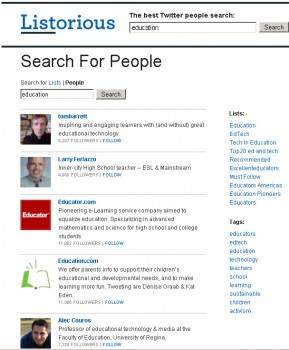
  4. Start small and listen. Visit Listorious.com
    listoriouseducation

    and TweepML to find lists of Twitter people who share your interests. Choose to follow a limited number a day. Get to know how they talk and what they talk about. When they follow you back, use that as opportunity to say hello to them in a unique and personal way.

  5. Talk when you have something that will add value to the conversation. Be helpful, not hypeful, just as you might be in person. Use the @ sign (@lizstrauss) to make sure your comment about a person or to a person gets to the person you’re mentioning.
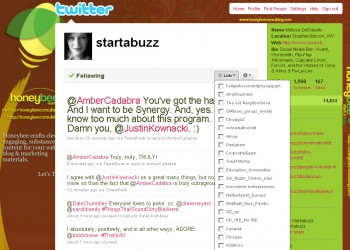
  6. Start a Twitter list.
    startabuzztwitter

    Lists draw attention to and from people. Each list can focus on one group of people. Check the lists that other folks make, see what their lists say about them. Have a core list strategy. Lists might include a handful of advisors, thought leaders in your industry, partners and vendors, key customers and clients, people in your home location.

  7. Decide early who you will follow – who you want at your networking event. Some folks follow only a few people and keep their followers limited to people in their business. Other folks look for input from a wider group.
  8. If you’re looking for clients, don’t just talk to the people who do what you do. It’s fun and safe to talk business with our peers, but the folks who hire us are the folks who don’t know how to do what we do.

Like any networking event, Twitter is filled with opportunities to meet people who want to do business. The difference is that some networking rooms are filled with people who have no business in common with us. On Twitter, we can reach out to folks who are interested in being at the same networking event as us.

–ME “Liz” Strauss
Work with Liz on your business!!

Buy the Insider’s Guide to Online Conversation.

I’m a proud affiliate of

third-tribe-marketing

Filed Under: Business Life, Marketing /Sales / Social Media, Successful Blog, Trends Tagged With: bc, Community, LinkedIn, networking, Twitter

The 3 Most Compelling Strategies for Starting a Community

May 4, 2010 by Liz

cooltext443809437_relationships

When we discover new tools, new ideas, and new people, our first inclination is to notice the differences and look for patterns there. We notice the people who dress differently from us, but the same as each other and try to figure out what they have in common. That’s how we learn the difference between all of the shades of blue and green, it’s called constructivism. It’s about “constructing” our understanding of the world.

Each of us generates our own “rules” and “mental models,” which we use to make sense of our experiences. Learning, therefore, is simply the process of adjusting our mental models to accommodate new experiences. –Constructivism

We do it well as a child, because our brains are wired to be constantly constructing and reconstructing. Once we’ve accumulated a database of knowledge, though, we’re not as good. Too often we construct new models without reflecting on the models and experiences that already serve us.

Yet if we want to build on concrete and know what we know deeply, we can’t forget what we already know.

The 3 Most Compelling Strategies for Starting a Community

Recently I’ve stepped alongside my dad’s story to look at it from the outside as a business case. In doing that I’ve come to realize that everyone — even me — has been focusing on what’s different between the online and offline cultures. Yet, to build community, it’s what’s the same that counts.

Last Friday at SOBCon, I suggested that three strategies are important to start a community that will grow. And they’re all things I learned by looking at how my dad grew his business.

  1. Pay no attention to the man behind the curtain.

    The little man behind the curtain didn’t fix Dorothy’s problem, but it wasn’t until the little man behind came out and talked to Dorothy that she started going in the right direction. A relationship happened.

    Solutions are what fuels the search engines. They’re what brings customers and keeps them. Solutions focus us and give us purpose. It used to be location, location, location, if you wanted to be found. Now it’s solution, solution, solution.

    The person who will build a thriving community online is the one who can do that offline too.

  2. Let your business have 27 surrogate parents.
    I used to say there were 27 people who thought they were my surrogate parents. When I was little, they would point to their photos on the wall in his saloon — next to mine and my brothers’ photos — and they’d tell me the stories of and the roles they played in events that happened in my father’s saloon. The walls were flickr in 3-D.

    Every dance recital and graduation, my dad would buy something like 27 tickets. After the event, those friends would meet my family at the saloon and we’d all walk over to the best restaurant in town.

    After dinner, my dad would write the name of every person who worked at the restaurant on a pad of paper and then he’s put a number by each one. When he paid, the bill he tipped all of them.

    When I got older I asked him why he did that. It had to be expensive to be so generous every time I got an A on my report card. He said, “Babydoll, they work hard. I want to acknowledge that. I’m their customer now. Some will tell their families. Some won’t. At 10pm when the restaurant closes a few will walk back over to the saloon to say “thank you” and buy a drink. That’s good too.”

    Never forget your core fans. Make them your heroes and let them see the hero in you.

  3. Raise a barn, don’t build a coliseum. Start small.

    Have you heard the story of WordPress?

    It started when Matt Mullenweg asked a simple question about a broken and neglected journaling system. He said something like, “I think we can do better than this. Does anyone want to help?”

    WordPress started in 2003 with a single bit of code to enhance the typography of everyday writing and with fewer users than you can count on your fingers and toes. Since then it has grown to be the largest self-hosted blogging tool in the world, used on millions of sites and seen by tens of millions of people every day.

    Everything you see here, from the documentation to the code itself, was created by and for the community.

    The Word Press community has become hundreds people, hundreds of WordCamps where they meet yearly, thousands of lines of code that runs tens of millions of blogs. The enterprise version of WordPress serves 21 Popular Brands and every US government agency except the TSA.

    The community that helps build WordPress learns by doing that, feels ownership, and protects what they’ve built.

    If you let them build it, bring their friends pitch in.

  4. Starting a community is as easy as 1, 2, 3 — Choose the compelling strategies and the community will feel they belong. All three add up to investing in the people you want to serve. And as Steve Farber says,

    Do what you love in service to the people who love what you do.

    What attracts you to a community?

    –ME “Liz” Strauss
    Work with Liz on your business!!

    Buy the Insider’s Guide to Online Conversation.

    I’m a proud affiliate of

    third-tribe-marketing

Filed Under: Community, Successful Blog Tagged With: bc, Community, LinkedIn

There is a Place Beyond Great Customer Service

April 20, 2010 by Guest Author

A Guest Post by Barry Moltz

cooltext443809437_relationships

Customer Service is job number one. We have heard this rallying cry within companies forever. Ironically, few of them have been able to implement it. The level of service that most businesses offer is pathetic.

However, this has been changing. With the advent of social media, customer service is now the new marketing. It has become the only sustainable competitive advantage and the current way to keep loyal customers. Advertising and company directed public relations can no longer control the conversation on what people are saying about your company and products. Small businesses have turned to social media tools to monitor what is being said about them and to get involved in that conversation. There are many well known examples of companies that are good at this such as Southwest Airlines, Peachtree, and Lands End.

However, there is now a place beyond great customer service that can even bind the loyalty your customers even more closely to your business. That place is called community.

If you look at the mission or purpose of most companies, it inevitably talks about providing a great product and excellent customer service. For example, Domino’s Pizza’s mission is

“Exceptional People On A Mission To Be The Best Pizza Delivery Company In The World’. This is part of Domino’s ‘Vision and Guiding Principles’ including these statements:
* ‘We Demand Integrity
* Our People Come First.
* We Take Great Care Of Our Customers.
* We Make Perfect 10 Pizzas Every Day.
* We Operate With Smart Hustle and Positive Energy”

However, the starting point for any small business owner is to have a great product, people and service. In order to be successful today, the owner needs to go much further.

Nick Sarillo has been running his pizza restaurants, Nick’s Pizza and Pub in the suburbs of Chicago for over 15 years. When Nick started, he wanted to have a purpose to his small business beyond offering a great product with great service. So, Nick created “Pizza on Purpose”. The mission statement that he came up with 15 years ago for his restaurants was:

“Our Dedicated Family Provides This Community an unforgettable Place; to Connect with your Family and Friends, to Have Fun and to Feel at Home”.

Notice that his mission statement does not talk about having great food or friendly people to serve the customer. Nick set out to use his restaurants to create a community where people can connect. Isn’t this the goal that we have for our social media business efforts? Nick put this in practice 15 years ago. His restaurants now support over 40 organizations in his community through fund raisers.

Nick’s small business gives something beyond great customer service. He offers a community for his customers and a way for them to connect with each other. When they are at Nick’s, they feel good about themselves, their community and his business. As a result, there is no longer a dividing line between his company and his customers. With his business, Nick has created a community which just happens to be a pizza restaurant. This is similar to Zappos, where they are not a company that sells just shoes, but a company that delivers great service regardless of their product.

There is no way to create more loyal fans than for them to be part of your community and have them raving about you. Forget creative marketing. Forget great customer service. Go to the place called community and your business will have its most sustainable competitive advantage: The raving loyalty of its customers.

___
Barry Moltz is a Author & Speaker who loves technology and writes about service and small business at Barry J. Moltz You’ll find him on Twitter as @barrymoltz

Thanks, Barry. Customer service with deep ties to the community is truly the competitive advantage. I’m so with you on that!

–ME “Liz” Strauss
Work with Liz on your business!!

Buy the ebook. Learn the art of online conversation.

Register Now!! for sobcon-vmc

Filed Under: Customer Think, Marketing /Sales / Social Media, Successful Blog Tagged With: Barry Moltz, bc, Community, customer-service, LinkedIn

  • « Previous Page
  • 1
  • 2
  • 3
  • 4
  • 5
  • 6
  • …
  • 13
  • Next Page »

Recently Updated Posts

Is Your Brand Fan Friendly?

How to Improve Your Freelancing Productivity

How to Leverage Live Streaming for Content Marketing

10 Key Customer Experience Design Factors to Consider

How to Use a Lead Generation Item on Facebook

How to Become a Better Storyteller


From Liz Strauss & GeniusShared Press

  • What IS an SOB?!
  • SOB A-Z Directory
  • Letting Liz Be

© 2025 ME Strauss & GeniusShared