Successful Blog

  • Home
  • Community
  • About
  • Author Guidelines
  • Liz’s Book
  • Stay Tuned

Tailoring Twitter: Get Busy Folks to “Get” Twitter in 2 Minutes Flat!

April 18, 2011 by Liz

I’m Too Busy for Twitter

insideout logo

Last I worked the social media station for McGraw-Hill Education at the National Conference of Teachers of Mathematics, a gathering of about 9,000 attendees. As it happens this attendee group is math teachers, school superintendents, math tutors, and people who build products for, consult with, and sell products to the education industry. Every administrator, every teacher, every editor, designer, consultant, sales rep, and presenter I spoke with has a huge job — days filled with helping others gain expertise and find knowledge, breaks and evenings filled with planning how to do that more effectively.

Sounds a lot like every client, customer, web publisher, manager, and business person I know.

I bet you know a few people like that too.

And I bet you’ve heard these words more than once, “I’m too busy for another social network.”

Here’s how I was able to change that view for over 90% of the folks with whom I spoke in less than 2 Minutes Flat!

How to Get Busy Folks to “Get” Twitter in 2 Minutes Flat!

My purpose for being at the event was to show every version of busy people how Twitter can make their jobs easier, faster, and more meaningful. Naturally, I’d start by asking questions and listening. The conversation would go something like this.

“Are you on Twitter?”:

“No. I’m too busy. I don’t have a smartphone. I don’t need another social network.”

“Oh, don’t I get that. Time is so important to all of us. By the way, you do this on your computer, whenever you feel like it. There’s no obligation to show up. Will you give me two minutes to show you how I think Twitter will make your job easier?”

“Okay I’ll listen for two minutes.”

“Let’s start with your job. What is your role in the world of mathematics?”

Then I’d point to a Twitter screen loaded to a hashtag … in the is case it was #mathchat And say, “let me show you what’s happening here.”
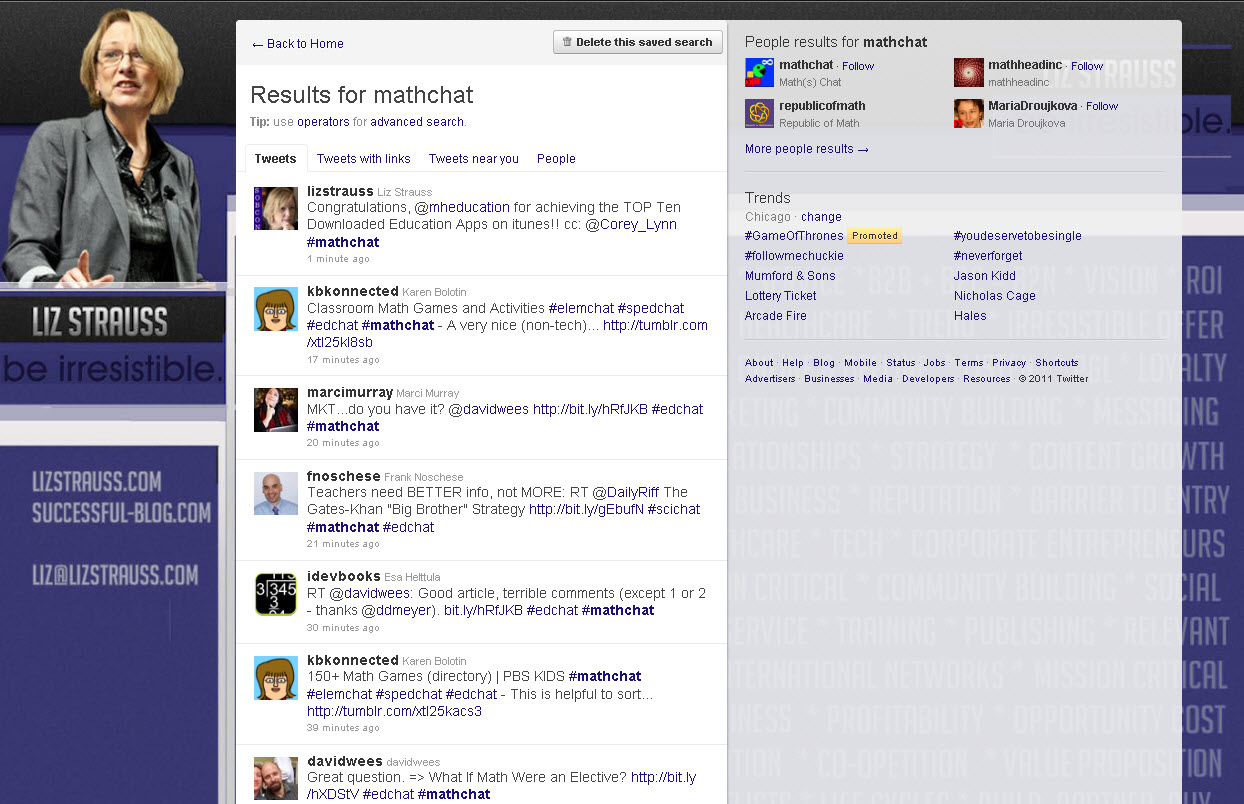
mathchat

[click to enlarge image.]

I’d go on …

“All day long people who care about math post resources, questions, answers, ideas, insights, best practices and they tag them with this hashtag #mathchat so that other math folks can see them.”

I’d fire off a few examples and point to some in the stream, such as

  • The teacher who asked “Is anyone at a school that’s giving students iPads, I’m wondering how that works.”
  • Here’s two activities for the classroom.
  • Here’s an article on how a teacher made Calculus the most popular class in the school.
  • Look at that! There’s an event for middle school teachers in your state next month.
  • Yesterday I saw a tweet from a teacher who was looking for a video on nanotechnology for his students.
  • And did you see the Tweet right there, where @mheducation is offering their Math Apps for free during this conference? .
  • When I asked the question on #mathchat, why might a math person want to use Twitter, they said

    • So you don’t feel alone.
    • To get ideas.
    • To ask questions and get answers.
    • To get insights and best practices.
    • To connect with math people all over the world.

“And don’t worry about time. You don’t HAVE TO be there. Twitter is like this conference exhibit, the resources are available when you need them. They don’t come bother you. You go visit them when you can.”

The other things that’s really cool is that every week for one hour math people from all over the world meet at the same time under this #mathchat hashtag to talk math in real time — it’s like a mini math conference every week online — you can just listen in or talk and make friends who do what you do.

That’s when I handed them a sheet with the information from these two blog posts.

Tailoring Twitter: Does Your Twitter Profile Attract the Right People?

and

Tailoring Twitter: Building a Powerful Network that Fits You Perfectly

and some information on how to find a list of the most popular hashtags in their industry.

Now you see how a single hashtag can get right to the deep value of Twitter for almost anyone one.

How can you use this to tailor Twitter — to make it faster, easier and more meaning — for the folks you know?

Be Irresistible!

–ME “Liz” Strauss
Work with Liz on your business!!

Related:
Tailoring Twitter: Does Your Twitter Profile Attract the Right People?
Tailoring Twitter: Building a Powerful Network that Fits You Perfectly
Tailoring Twitter: The ROI of Curating Content on Twitter


Filed Under: Business Life, Marketing /Sales / Social Media, Successful Blog Tagged With: bc, hashtags, LinkedIn, teaching twitter, Twitter

Are you a mentor?

April 14, 2011 by patty

by Patty Azzarello

cooltext466496263_leadership

screen-shot-2011-04-13-at-33805-pm

.

Who, me?

I remember when I first joined HP, I was notified by my manager that I was to attend a meeting with HR to discuss mentoring.

I went in thinking, “Boy, I could really use a mentor. I am new here, and this is a big company. A mentor could help me learn about other parts of the company and help me build my network.”

I was stunned in dis-belief when I realized that they were recruiting me to BE a mentor.

At this point in my career I had no idea what I had to offer. In fact, I was pretty nervous. “I’m going to get found out…. My mentee is going to report me as being a useless mentor”.

I tried to humble my way out of this responsibility, because I was afraid to fail, and because I wasn’t sure I had time to be a mentor. (Interesting to note how I thought I had time to work with a mentor, but not the other way around…)

I failed to avoid it!

I left that meeting as an official mentor awaiting an assignment of my first mentee. I was given a brief pamphlet about mentoring, which I don’t recall having learned anything from, and I was off to the races.

Two main reasons people don’t mentor

1) They don’t feel like they have something to offer.
2) They don’t think they have enough time.

Let me talk about both of these.

1. You DO have something to offer

What I learned from my mentees surprised me. They would come and talk to me about what was happening in their jobs, and I would share stories about similar things that I did. (I can’t emphasize enough that it did not feel like I was sharing anything of value.)

I was amazed when they would come back and say, “Thank you so much, I did what you said and it worked wonderfully!” When they repeated back to me what they had learned and what they had done, I was staggered to find out that those stories had been so useful.

The reason this happens makes sense once you think about it.

The things you already know seem obvious to YOU.

So you don’t think they are valuable or impressive. They don’t seem fascinating or important — precisely because you already know them!

But the things you know are indeed fascinating and important to others — all the people who don’t know what you know!
And you don’t have to know how to be a mentor, you can just start.

No matter where you are in your career you can be a mentor to someone.

There is someone who can benefit from what you know. And they will do better from having the encouragement of someone who thinks them worthy of investing in.

I have been a mentor ever since. I have found it to be a huge source of learning and inspiration. I always learn stuff from the people I mentor.

2. You have enough time

When I was at my busiest as an executive, I would relish my mentoring appointments.

It was like having a vacation in my schedule for an hour. Every other hour I was on the hook to solve problems, negotiate, mediate, make difficult decisions, sell something, invent something… When I had a mentoring appointment, it was a lovely break from my own job. I was not going to end that meeting with bigger problems or more to do.

But the more important part is that you feel better about your job when you help someone else. You feel more in control. You feel less overwhelmed.

If you feel like you have no time, when you give a little time to help someone else, you realize that you do have time. It actually makes you feel less overwhelmed if you give time to help someone else.

How to become a mentor

If you are mentoring today, bravo, and thank you from the world at large.
If you are not, volunteer.

Here are some ideas:

1. If you have relationships with your manager’s peers, go to them and say, “I am not currently mentoring anyone but would like to. Is there someone in your organization who would benefit?” By the way this does not hurt your credibility with your manager’s peers! But that’s not the primary reason to do it.

2. Make the offer to someone in HR. Ask if there are any high performers one or two levels down that would benefit.

3. Make the offer to your neighbors. Perhaps they have children entering the workforce.

4. Strike a deal with your peers to each mentor someone in the others’ organization. You’ll also get the benefit of getting smarter about the business. You’ll get a steady stream of information from another part of the business, from another level, which you don’t normally interact with. This is gold.

There is really no downside.

Be a mentor!

Join me for a Special Interview with Tim Sanders

I moved this blog topic up to align with my upcoming interview with Tim Sanders about his new book Today We are Rich.

Of the many valuable lessons in this book — the concept that having something to give makes you rich– is a common thread, whether it is time, money, gratitude, help, positivity, or just spending the energy to move something forward.

Please join us for an inspiring conversation on Wednesday April 20 at 9am Pacific Time.
You can register here.

You can also download Tim’s free eBook ahead of time:

screen-shot-2011-04-13-at-33318-pm

(by the way, for every click to download, Tim sends a donation to the Smyles foundation to educate at-risk children)

What have you learned as a mentor?

Have you been a mentor? What did you think of the experience? Share your stories in the comment box below!
—–
Patty Azzarello is an executive, author, speaker and CEO-advior. She works with executives where leadership and business challenges meet. Patty has held leadership roles in General Management, Marketing, Software Product Development and Sales, and has been successful in running large and small businesses. She writes at Patty Azzarello’s Business Leadership Blog. You’ll find her on Twitter as @PattyAzzarello. Also, check out her new book Rise…

Successful-Blog is proud affiliate of

third-tribe-marketing

Filed Under: management, Successful Blog Tagged With: bc, Business Leadership, LinkedIn, Mentoring, Patty Azzarello

Life Under A Rock Promotes Productivity?

April 13, 2011 by Guest Author

cooltext455576688_blogging

By Terez Howard

Do you ever find yourself furiously typing at your computer, scripting blog posts, guest blog posts, website pages and the like, and you haven’t been attuned to what’s going on in the world? When I say that, I don’t mean to say that you don’t keep tabs on major current events. Instead, you find yourself so immersed in your work that you haven’t taken the time (or had the time, for that matter) to stay abreast on the trends in your niche.

That’s how I feel right now.

Life under the rock isn’t that bad

That’s what I said. I don’t mind being under a rock. It’s quiet. I get a whole lot accomplished. I don’t have to really deal with anyone because I’m working on my own personal projects. It’s really not that bad.
Here are some of the things I have noticed about life under a rock, engrossed in my work:

  • Increased productivity. I don’t just sit in front of a computer screen and randomly surf the Internet. I have a job to do that is close to my heart, and I’ve shut off nearly everything else to achieve it.
  • Super strong determination. I WILL succeed. I have decided that I am not allowing any outside influences to thwart my goals.
  • Sharpened skills. I have been writing and writing and researching and writing. I feel that my art has improved.

In a way, I prefer life under a rock.

I do enjoy people. I’m no introvert. But there’s something to be said when all you have to contend with is writer’s block, research options and sentence structure. No bad attitudes. No annoying behaviors. Nothing to deal with that I cannot control.

That said, I feel like an outsider to the blogging world.

It’s dark under the rock

Even though life under a rock can be a productive experience, it can leave you missing some things. For instance, I haven’t been able to regularly keep up with any other bloggers. Sure, I catch a post here and there. But I miss reading their regular work. I haven’t even gotten to stay up-to-date with my favorite bloggers, the people whose information I admire and treasure.

Also, and most shocking to me, I have had to turn down work. (This statement is shocking to me because not so long ago, I didn’t imagine I would be one of those freelancers that had a booked schedule).

I only have so many hours that I have allotted to my writing work, and I will not exceed my limit. I Don’t Want to Be Rich. I want to do what I love, but I want to have time for the people I love. I have chosen to trade time with my family for time that I could have used to make money.

Uncovering the rock

I want to reasonably spend most of my work time under my rock with my personal writing projects and at least some time out of the rock, connecting with the bloggers and other professionals I’ve met. I suppose the best solution is a schedule. I’ve used my schedule to plan out my time under the rock. Now, I need to schedule time out of the rock.

It can be an overwhelming task — reading blogs, commenting, tweeting, etc. It all takes time. How do you allot time to stay out of life under a rock?

—-
Terez Howard operates TheWriteBloggers, a professional blogging service which builds clients’ authority status and net visibility. She has written informative pieces for newspapers, online magazines and blogs, both big and small. She regularly blogs at Freelance Writing Mamas. You’ll find her on Twitter @thewriteblogger.

Thanks, Terez!

–ME “Liz” Strauss
Work with Liz on your business!!

Filed Under: Successful Blog, Writing Tagged With: LinkedIn, Productivity, Terez Howard

Tailoring Twitter: Building a Powerful Network that Fits You Perfectly

April 12, 2011 by Liz

Finding People to Spread the News

insideout logo

Every minute we spend on our business is one that helps it grow … or not.
The idea is to connect to all of the people who help us thrive — colleagues, customers, vendors, partners, family, friends — people who want to see our business growing faster, more easily, and with more meaning.

Those people who already know us and love what we’re going are the network, the beating heart, that holds us up and spreads our message to the right people in the very best way. Having a powerful network of fans means our message is seen, heard, understood and spread with the speed and reach of the Internet.

How do you get a network like that?

I often call Twitter the world’s largest networking room, but that doesn’t do it justice. Networking rooms are physical and geographically limited. They can’t expand and contract in size. The people who visit the room are limited by those who can physically get to the location where the meeting and the room exists in space and time. And not every networking event collects the people who are interested in what we do.

Unlike that networking room, Twitter let us decide who is at our “networking event.”
How do we find that first group of friends that we invite to our Twitter networking event?

Building a Powerful Twitter Network that Works for You

Before you build a network, think about the people you want to attract. Who are the people who support what you’re doing and naturally pass it on? Those are the folks you want to attract. Be irresistible for them. Think too about the people who would rather not participate in your success, the people who see you as what you’re not, look things over to see that you’re not attracting them.

When we focus on serving the people who trust our abilities and love what we do, they tell their friends about it. If we work to convert people who don’t trust our abilities and value our service, they look for reasons that we’re not doing what they think we should do.

Concentrate on reaching that first group with the best you can offer.

Know What You Offer

  • Know and share who you are. Have one clear business message. Define yourself clearly as a business person. Use a photo. Write a professional bio. Name the metropolitan area you’re in. Link to a business site that tells more about you. Some folks link to a special page on their blog set up just for Twitter visitors. Add a unique background to further define yourself.
  • Research the ways you might connect. Check out how @DellOutlet , @ComcastCares , @TwelpForce , @AlyssaMilano , @WholeFoods , @SharnQuickBooks and others use Twitter to connect. You may not be as big as they are, but you can learn from their approach.
  • Know and share why you’re there. Manage expectations. Let people know from the beginning the way you intend to serve their needs. If you want Twitter to be your relationship command center, you’ll set it up differently than if you want it to be your idea lab, your outlet store, or your customer service base. Decide before you start.

Find the People Who’ll Value that

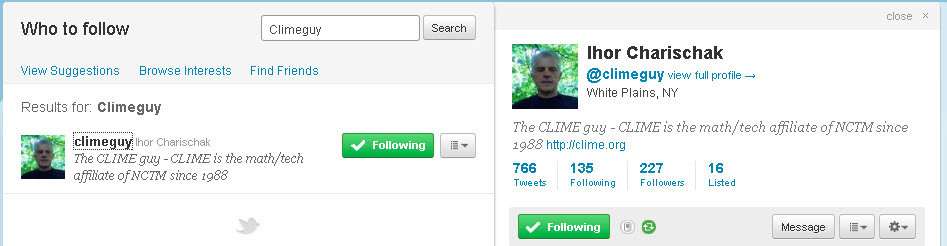
  • Start small with friends and their friends. Start by following the friends you already have. Look for people in your industry by using the Who to Follow option at right in the black bar at the top of your Twitter.com page.
    [click to enlarge]

    who to follow nav

    which will take you here. [click to enlarge]

    climeguy

    I’m going to a conference for the National Council of Teachers of Math (NCTM). When I started following folks who know the conference, I met a man who works for CLIME –The CLIME guy – CLIME is the math/tech affiliate of NCTM since 1988 http://clime.org After visiting his page to read his tweets, I knew I wanted to follow him.

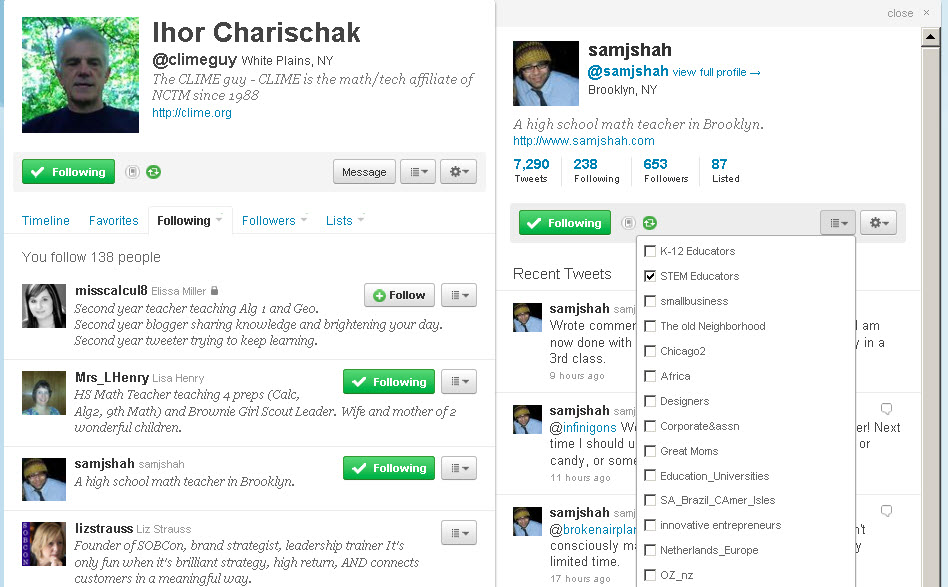
    Then I took a look at the people @ClimeGuy follows and I found @samjshah. [click to enlarge]

    climeguyprofile1

    So I checked his profiles, read his tweets, and listed Sam in my list of STEM educators (Science Technology Engineering and Math Teachers) so that I could keep up with what Sam is talking about.

  • Check the curated lists and the hashtags to find who and what your heroes find relevant. Choose to follow a limited number a day.

    Tweeps make lists to follow whole conversations by a group of people that the value around a common thread. For example I have a list of Twitter people who commented on blog in 2005. I use it to check in on what my more experienced friends are talking about. You can check my lists from my profile page.

    You can check everyone’s curated lists by exploring sites like Listorious.com which collect the Twitter lists. [click to enlarge]

    listoriouseducation

    and Sulia (once called tlists to more channels of of Twitter people who share your interests.

    and Use the search function at hashtags.org to find and follow tweets that people mark with a hashtag such as #edchat. Or use Search.Twitter.com to go quickly to a hashtag you might already know.#nctm (the name of a conference) or #mathchat (the name of topic of interest.) See who’s sharing insights and information that you find relevant and follow them.

  • Listen before you join in. Get to know how they talk and what they talk about.
  • Following both ways allows you to have private conversations. When quality people follow you back, use that as opportunity to say hello to them in a unique and personal way. When new folks follow you first. check their profile and follow them back if you want to start a relationship. You have to be following both ways to share a private conversation via direct message. Direct message is how Twitter people share information they don’t want to share publicly.
  • Add value to the conversation. Be helpful, not hypeful, just as you might be in person. Use the @ sign (@lizstrauss) to make sure your comment about a person or to a person gets to the person you’re mentioning.

    Some things you might Tweet about and how to Tweet them.

    • Tweet to share an insight or something you’ve observed.
      The more I leave room for my soul to breathe, everyone around me gets nicer.
    • Tweet to respond to what someone said.
      @lizstrauss having margin in life is a good thing huh and not living right up the edge of the paper as someone once told me
    • Tweet to start a conversation by saying hello and asking a question..
      Good morning, Twitterville. How will you make someone’s life better today?
    • Tweet to share information or content using hashtags – especially when you can promote your friends.
      The free Entrepreneur Expo starts tomorrow, featuring our very own @starbucker http://bit.ly/em06Gp #sobcon
    • Retweet to pass on content by J_Bender using the RT button
      J_Bednar Jason Bednar [RT] by kjpmeyer
      “All the biggest miracles take place in classrooms. Nothing happens without teachers.” S. Frears quoted by Charlotte Danielson. #NAESP11
      The above Retweet would look like this if she had typed it — and we can edit / add to it!.
      I agree 100% RT @J_Bednar: “All the biggest miracles take place in classrooms. Nothing happens without teachers.” S. Frears
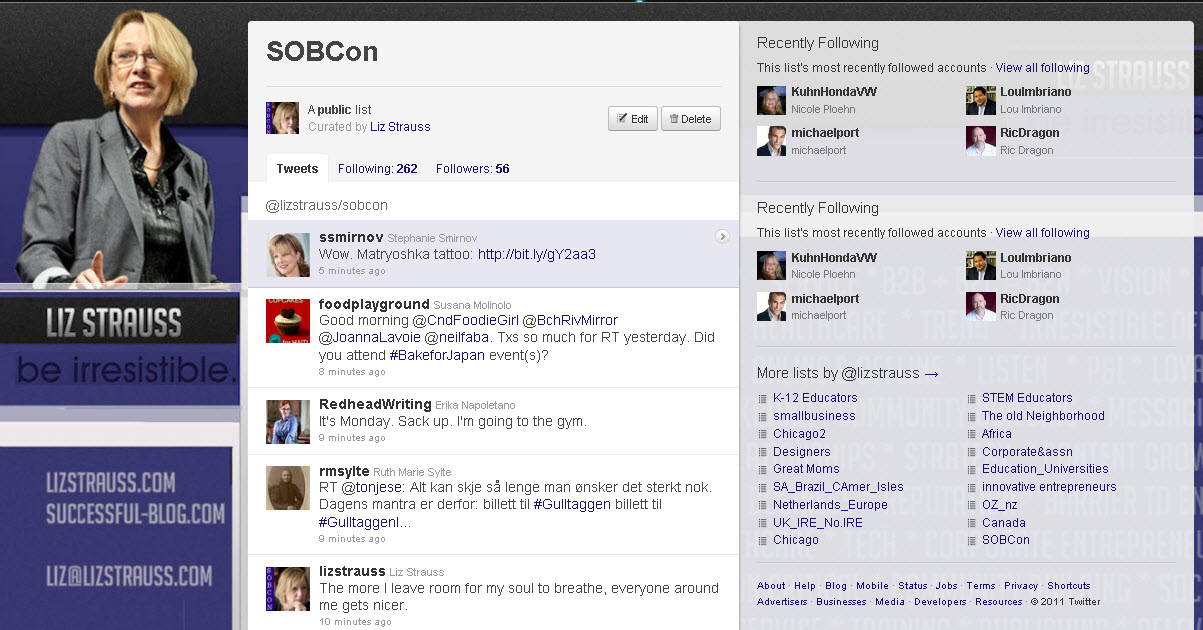
  • Start your Twitter list. This is my SOBCon list — people who attend our yearly business event – SOBCon.
    sobconlist

    Lists draw attention to and from people. Each list can focus on one group of people. Check the lists that other folks make, see what their lists say about them. Have a core list strategy. Lists might include a handful of advisors, thought leaders in your industry, partners and vendors, key customers and clients, people in your home location.

  • Decide early who you will follow – who you want at your networking event. Some folks follow only a few people and keep their followers limited to people in their business. Other folks look for input from a wider group.
  • If you’re looking for clients, don’t just talk to the people who do what you do. It’s fun and safe to talk business with our peers, but the folks who hire us are the folks who don’t know how to do what we do.
  • Like any networking event, Twitter is filled with opportunities to meet people who want to participate, engage, and be a part of what we’re doing. The difference is that some networking rooms are filled with people who have no business in common with us. On Twitter, we can reach out to folks who are interested in being at the same networking event as us.

    Have you figured out other other ways to tailor the Twitter experience to fit your best reason for being there?

    –ME “Liz” Strauss
    Work with Liz on your business!!

    Related:
    Tailoring Twitter: Does Your Twitter Profile Attract the Right People?
    Tailoring Twitter: Get Busy Folks to “Get” Twitter in 2 Minutes Flat!
    Tailoring Twitter: The ROI of Curating Content on Twitter

    Filed Under: Marketing /Sales / Social Media, Successful Blog Tagged With: bc, build a powerful network, hashtags, LinkedIn, lists, Tailoring Twitter, tweets

    Tailoring Twitter: Does Your Twitter Profile Attract the Right People?

    April 11, 2011 by Liz

    Beginner’s Guide to Twitter – Profile

    Is Twitter Working for You?

    insideout logo

    Imagine.

    You are sent or invited to a huge conference or the world’s largest networking event. What a opportunity! People from every industry all over the world are gathered talking and sharing what they do and how they do it. But there’s thousands maybe millions of them who all seem to do know what to do. The opportunity is overwhelmingly huge.

    You stop to look around yourself and realize that you’re only one you.

    How do you get from being a one to being part of the group? How do you find that part of the group that is the best fit for you? That huge opportunity requires the ability to sort and navigate what looks like an almost infinite group. How will you find or gather the group that will make the easiest, fastest most meaningful?

    How Do You Tailor Twitter to You

    This guide to Twitter is for people who are new. It’s also meant for “Tweeps” who know that their Twitter isn’t doing as much as it might do. If you got on Twitter without a strategy. If you’re are feeling like no one sees or hears you. Start from the ground up to tailor Twitter to you and people who would value what you do.

    Let’s visit your Twitter account with a look toward attracting and reaching out to the people you’d want to make relationships with in the World’s Largest Networking Room.

    Networking is all about connecting. It’s natural for people to feel more comfortable connecting to other folks who

    • who know the kind of people they like to talk to
    • who share something about who they are.
    • who offer value that’s easy to see
    • who show generosity and start a conversation to learn more about other people rather than to “sell” themselves.

    On Twitter it helps to know why we’re there – what kind of people you want to meet and talk with. It’s easier to find and attract those people in the world’s largest networking room if we think about them in how we put together everything they see, read, and know about us.

    The Profile

    Just as you decide to what to wear to a gathering at Joe’s Pizza and BrewPub might be different than what you wear to the Ritz Charity Gala, your profile is what you wear into the Twittersphere. What you say in your profile reveals what you value and respect. It’s not about you, it’s about the people you want to connect with.

    Click on anyone’s twitter name and you’ll land on their profile page. If I click on your name, what does your profile page say about you?

    • The avatar: Everyone wants to know who we’re talking to. Does your avatar look like you? Does it show as you might look while talking to the people you want to connect with?
    • The Bio: We’re all broader and deeper than the 160 characters that fit in a Twitter bio.

      Did you think about the people you want to form relationships with while you were assembling it? If you want to connect with other moms and dads, mention your family and your kids. If you want to talk to CEOs, mention your business and what makes your business worth getting to know.
    • The link: We’re all interested in more about the people we know. Do you link to something that tells more about you — your blog, your LinkedIn profile, your about.me page? Is what you’re linking to the same place that the people you want to form relationships with would choose?
    • The timeline of your Tweets: What we tweet and retweet reveals a lot about who and what we value. 0 tweets makes me wonder why you’re silent at a networking event.

      What % of your timeline is only about you? What % is @mentions in which you raise other up? Do you curate and offer content from sources other than your own? If we want people to listen to and participate in our conversation, it helps to think about them and make our messages relate to them deeply.

    • The Following / Follower Ratio: Newbies and spammers follow thousands more people than the number of people who follow them back.

      The ratio of Following to Followers offer insight into whether you are listening or talking. If your ratio is 2/1 or higher (following 2, you’re likely to be broadcasting — talking but not listening. You might also be listening, but you’re not responding. If your ratio is 1.5 you or less, you are likely to be listening as well as talking. If your ratio is less that 1.5, your followers are likely to be listening to you. Find new people to follow knowing that others will look at the ratio as a way of determining whether you’re a broadcaster or a communicator.

    • The Background: The default background is like inviting someone home to a free hotel room. Nothing about it shares anything about you.

      Changing to one of the offered backgrounds is easy. Go to Settings > Design and find one you like that might be attractive to people you’d like to talk with. Uploading a favorite photo or simply changing the color takes little time but shows that you’ve invested even a few minutes in making the space your own.

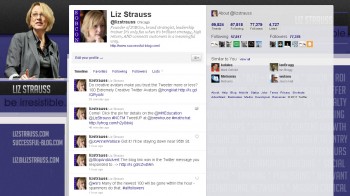
    All together a Twitter profile can offer a picture of someone worth trusting and getting to know. What you put there and what you tweet can lead me to connect with you, learn more about you, explore your expertise. It can be what leads to a relationship in which we swap stories, strategies, and knowledge gathered. A great profile draws the interest of people who value what you do and disinterest people who don’t. Here’s what mine says about me.

    Liz on Twitter


    Or it can make me wonder whether you’re a spammer.

    possible bot or spammer-profile

    Visit your own profile page to consider these questions. If it belonged to a stranger, how much confidence would you have in making a relationship? Would you trust that the person behind the page is real? Would you risk a conversation with him or her? Would trust his or her recommendations? Does your Twitter Profile page attract people you want it to meet — people who value what you do?

    More tomorrow on Tailoring Twitter to Build the Network to Support You.

    Be Irresistible.

    –ME “Liz” Strauss
    Work with Liz on your business!!

    Related
    Tailoring Twitter: Building a Powerful Network that Fits You Perfectly
    Tailoring Twitter: Get Busy Folks to “Get” Twitter in 2 Minutes Flat!
    Tailoring Twitter: The ROI of Curating Content on Twitter

    More on Twitter profiles:

    How to Write a Twitter Bio that Attracts More Followers by @blueskyresumes
    Twitter Avatars as Personal Branding by @ahockley
    The Top 7 types of Twitter avatars by @10000words
    20 Twitter Bios that Demand Attention by Iron Shirt Media Blog.
    How to Write a Great Twitter Bio to Get Targeted Followers by @salmajafri
    What is Your Following/ Follower Ratio? @Gauravonomics

    Buy the Insider’s Guide to Online Conversation.

    Filed Under: Marketing /Sales / Social Media, Successful Blog Tagged With: bc, LinkedIn, Twitter Profile

    Cool Tool Review: Proxlet – Your Rescue for Twitterchats

    April 8, 2011 by Guest Author

    A Guest Post by Leo Widrich

    cooltext451585442_tools

    Last Sunday was my first time to participate in #blogchat a weekly held Twitterchat and boy was it an amazing experience conversing with @lizstrauss and @mackcollier. It boasts great personalities each week helping you to answer any Social Media and blogging related questions.

    For long I was quite reluctant to join in Twitterchats as I felt I would overwhelm my followers for the time the chat was going on with my tweets.

    Fortunately I finally found a solution I can offer, since staying away from this massive amount of great insights at #blogchat is definitely not an option.

    It is a nifty Twitter App called Proxlet.

    proxlet

    What does Proxlet do?

    Facebook has a very useful “Hide this post” option integrated. Proxlet gives you this exact same thing, only for Twitter.

    Using proxlet, you can temporarily hide certain things on Twitter which clutter your timeline or aren’t currently the core thing of your interest.

    How to best use it?

    Proxlet fortunately takes the “hide this” feature a step further and allows you to explain in a very detailed manner which area of tweets you want to block.

    • You can block Apps you don’t want to show up in your Timeline. For example am using it for both foursquare and paper.li since I feel they don’t add enough value.
    • You can also stop certain individual users temporarily, for example because they are at a conference and you are not really interested in their tweets at that point.
    • Another way to make use of Proxlet is to block certain hashtags from showing up in your timeline.

    What is the best part of Proxlet?

    The best part of proxlet is that it works not only at twitter.com, but can also be used for your favourite Twitter clients such as Twitter for Iphone, Tweetdeck and others.

    Someone approached me that he couldn’t take the load of my #blogchat tweets and Proxlet turned out to be a superb solution for both of us. He could continue following me, yet was freed of those unwanted tweets in a short space of time.

    What are your thoughts on Proxlet (http://proxlet.com) ? Have you had a similar problem yourself before too? Please let me know below.

    Leo Widrich writes Tips for Twitter on his blog. You can visit his website, Bufferapp, or find him on Twitter as @leowid.

    _________

    Thanks, Leo, for checking out proxlet for us!

    –ME “Liz” Strauss
    Work with Liz on your business!!

    Buy the Insider’s Guide to Online Conversation.

    Filed Under: Business Life, Content, Successful Blog, Tools, Trends Tagged With: bc, Leo Widrich, LinkedIn, tools, Twitter

    • « Previous Page
    • 1
    • …
    • 77
    • 78
    • 79
    • 80
    • 81
    • …
    • 190
    • Next Page »

    Recently Updated Posts

    Is Your Brand Fan Friendly?

    How to Improve Your Freelancing Productivity

    How to Leverage Live Streaming for Content Marketing

    10 Key Customer Experience Design Factors to Consider

    How to Use a Lead Generation Item on Facebook

    How to Become a Better Storyteller


    From Liz Strauss & GeniusShared Press

    • What IS an SOB?!
    • SOB A-Z Directory
    • Letting Liz Be

    © 2025 ME Strauss & GeniusShared