Successful Blog

  • Home
  • Community
  • About
  • Author Guidelines
  • Liz’s Book
  • Stay Tuned

Let Your Human Out: Build Connections With Your Small Business Marketing

September 16, 2011 by Guest Author

A Guest Post by
Stacey Acevero

Online marketing is really based on relationships, but living in a virtual world
where people can talk to one another, buy from one another and follow one another
without ever having to make a face-to-face connection can de-humanize the
marketing process.

If your marketing efforts aren’t generating the results you hoped for, try these 3
ways you can come out from behind your corporate cage and strengthen the bond
between you and your consumers.

1. Introduce the faces behind your brand.

Imbed video of conversational interviews with your management and staff
in online press releases, on your website and on your social channels. You
can also provide photos and profiles of the employees who will be the official
tweeters and bloggers for your company.

A study by The Next Web found that Facebook updates with photos receive
300 percent more engagement. Capture that increased engagement by
having your employees post on your Facebook page, tweet, like, comment

and communicate through LinkedIn using their corporate photos and
profiles.

2. Highlight corporate events on your Facebook page

Give followers an opportunity to see the best in your employees by uploading
videos of corporate philanthropic events. For example, members of your
staff might volunteer at a 5K run for the American Heart Association. Have
them all wear company shirts and showcase their presence at the event.

You can also invite employees to submit videos of their personal
philanthropic projects. Establish a monthly employee volunteer spotlight
column to introduce people in your company who are making a difference in
their community.

3. Respond to ALL comments

Businesses big and small are learning that the effect of a negative comment
can be hugely destructive. In fact, a recent study by InsideView found a
negative review on YouTube, Facebook or Twitter can cost a company 30
customers.

So it makes sense that companies respond quickly to negative comments.
This is where a human touch can ease ruffled feathers. Your reaction should
be personal and compassionate. Sometimes providing a sense of humor
can diffuse situations as well – invest time and training for the person who
will be the face of your brand in the midst of criticism on your social media
platforms.

However, it’s almost worse to receive a positive comment via your social
media channels and not respond. If someone has gone to the trouble to
say something good about your brand, thank them and then engage them
further. They may be open to letting you retweet, share and incorporate
their feedback into your press releases, website or email marketing.

Businesses and buyers are two intelligent species that can live in harmony together.
It takes a commitment to creating relationships and a willingness to continue
conversations.

Add a human touch to your online marketing strategies and your business will move up the evolutionary chain.

—-
Author’s Bio: Stacey Acevero is Social Media Manager for Vocus/PRWeb. Public Relations, SEO, marketing, small business and social media nerd. U.S. Air Force auxiliary 2nd Lieutenant and Mission Scanner. Organizer and sponsor of charity events. You can find Stacey on Twitter as @sacevero

–ME “Liz” Strauss
Work with Liz on your business!!

Buy the Insider’s Guide to Online Conversation.

Filed Under: Business Life, Marketing /Sales / Social Media, Successful Blog Tagged With: bc, LinkedIn, Marketing /Sales / Social Media, small business, Stacey Acevero

5 Focus Strategies to Seize the Right Opportunity Right Now!

August 29, 2011 by Liz

The Signal to Noise Issue Isn’t Only On the Internet

cooltext443809602_strategy

Has it happened to you that you’ve invested your best strategy into landing a chance — an introduction, a project, small job for a potential client. Now is your moment! You can move forward your mission, change your position, take advantage of the changing conditions this chance affords you to leverage your expertise into new rewards and new experiences.

Even on a small scale a new opportunity ripe with potential can set off a world of thinking that undoes our ability to get down to what needs doing. We find ourselves over researching, procrastinating, contemplating the future, and social networking to see what others have done who have had the same experience.

The signal to noise ratio ratio on the Internet may be a distracting influence, but nothing undermines our ability to seize the opportunity right in front of us more than the signal to noise ratio that we allow in our heads.

What We Do That Undoes Us

In faster than you can fragment a computer, we fragment our heads and convince our hearts that they’re not a part of what we’re doing. We get busy with thoughts past and future and irrelevant arguments about what we could, should, or might be doing. Does any of this sound the least bit familiar? We fill our heads with

  • how we’re the wrong person to do this.
  • how we’re much better suited to be doing what we’re always doing. .
  • how people won’t respond well to what we end up doing.
  • how while we do this we might be missing other exciting opportunities.
  • how our results have backfired or fallen flat in the past.
  • And the big one …

  • how boring, uninteresting, long, hard, difficult, not fun, time-consuming and beyond our abilities we’ll find this new opportunity — among the 23,067 other reasons we might have for not doing it.

All of which are centered in the past or the future, not the current reality.

5 Focus Strategies to Seize the Right Opportunity Right in Front of You Now!

How do you know that you’ve got the right opportunity? A well-chosen opportunity is a match of our skills with enough challenge that we’re the perfect halfway between anxiety and boredom. We’ll need to stretch just a little bit, learn a few things as we’re doing it, but that will keep our concentration.

If you’ve chosen the right opportunity, the key is to focus and to stay completely in the moment. NOW is the only moment and the opportunity is the only the focus. Here’s how to do that successfully.

  1. Focus in on seeing the project finished. As Tim Sanders says and my experience agrees with, when our brains know that we plan to succeed, our subconscious releases the chemicals we need to help us do that. Call it flow or in the zone, but it’s the optimal experience. In order to get there, we have first have to know exactly what the task is. Every task you successfully finished had as many roadblocks and snags as those you left by the ditches. The difference in your successes was that you knew, you had decided you would finished and that became your first point of focus.
  2. Focus on the process and resources you need to do it well. In your mind plan through the process and see yourself doing it. Break that process into stages and determine what resources you need to complete each piece of the process. Bring the resources you need to where you will need them. Get serious about dedicating a true workspace to the project.
  3. Focus on making that opportunity a priority.Decide how much time you will dedicate to moving it forward every day and allow yourself no excuses. Include time for rests, rewards, breaks, and some play away from it — but don’t let the play be more important than the opportunity you’re ready to seize right now.
  4. Focus on working in the moment. Keep every step of completing the process in the NOW. Don’t relate to past successes, except to move this process forward. Don’t think about future rewards until it’s over. Don’t let other things interrupt you.
  5. Focus on how any opportunity can be the vehicle you need to learn what you should be learning. Love the faults and flaws of the project. Challenge yourself to value everything that you wouldn’t normally like doing. Find the fun in the most mundane tasks and huge overwhelming challenges. Turn every bit of the opportunity into a smaller, exciting opportunity of its own.

If you can master those five strategies, the payoff for you will be huge and long lasting. You’ll find that your life is more in control because it’s more focused, less hurried. The things you’ll be doing will be more efficient because you’ll be choosing to focus on doing only one of them at a time, which means it will get your concentration and best thinking.

Listening will be easier and you’ll be more likely to know what to ask and what to listen for.. Fewer communication problems will be happening. You’ll find yourself easier to work with and other people will agree with that assessment. Your confidence will rise.

Work will be more enjoyable and you may find that you like doing more kinds of work than you ever thought you would. Proof of concept is that what I’ve written here is exactly what I did when I didn’t want to write this blog post. And I had a blast doing it.

It’s really just a matter of turning down the signal to noise ratio in your mind. Are you ready to seize the opportunity right in front of you now?

Be irresistible.
–ME “Liz” Strauss
Work with Liz on your business!!

Buy the Insider’s Guide to Online Conversation.

Filed Under: Productivity, Strategy/Analysis, Successful Blog Tagged With: bc, focus, LinkedIn, opportunity, Productivity, small business

Bid for the Presidency…Tweeted? What Does that Mean to YOU?

June 17, 2011 by Guest Author

Guest Post
by Riley Kissel

On May 11th, House Speaker Newt Gingrich announced he’s running for President of the United States. According to CNN, he officially announced his intentions to run via the popular social networking site, Twitter.

Anyone who takes their online marketing seriously needs to pay attention to the 2012 election starting now. Political action at the national level was always executed with the intent to cast the biggest net possible, similar to business advertising, but those tactics are changing. In traditional politics the customers transcend all market “types”. There’s a particular focus put on the means to reach everybody all at once through television or radio, because votes can come from anyone, kind of like how money can leave anyone’s pocket and go into your business. But today’s political arena is focused on strike force access to niche markets through social media, with the expectation that these strikes will go viral and the effort will be more cost effective than alternative mass-media means. Your entrepreneurial arena is undoubtedly the same.

President Barack Obama is estimated to raise $1 billion dollars for his re-election campaign. This number is unprecedented in presidential politics, but it won’t be for long. President Obama’s comparatively enormous war chest is the result of his presidential efforts back in 2008. Obama was the first national politician in American history to utilize the power of social media and social networking effectively. Nearly half of that figure was attained through donations of $200 or below made online. It wasn’t that Obama pulled the right strings, it’s that his team saw the possibilities of these online marketing techniques when opponents hadn’t yet. Never again will a serious presidential contender not have Twitter and Facebook accounts.

What about You?

Consider then, what this says about the future of social media marketing as it applies to your business. I’m assuming you don’t have presidential ambitions, but you can still relate. If no competitor is Tweeting or updating a Facebook status, why aren’t you? If they are, you need to right away. It’s going to be hard to compete against someone who can instantly notify their customers of sales when all you have are weekend coupons. Find an online marketing consultant who can help you get started. Once you’re active in social media, it’s time to utilize it effectively. Big announcements need to be made on it. Subscribe to competition and do a little (perfectly legal) espionage. These are important tasks to achieve when you’re getting your social network foot in the door, and consultation will help.

Television was perhaps the most important communications invention of the last century. People often forget that it wasn’t until the Nixon-Kennedy debates of 1960 that the world began to understand the potential of its power to influence and persuade. The Internet will no doubt be the most important piece of communications technology for at least the first half of this century. Don’t wait to let its power start working for you.

——
Riley Kissel is a freelance writer who covers many industries with style. You can find out more about him at RileyKissel.com

Thanks, Riley, for simply showing how great thinking has built great success.

–ME “Liz” Strauss
Work with Liz on your business!!

Buy the Insider’s Guide to Online Conversation.

Filed Under: Marketing /Sales / Social Media, Successful Blog Tagged With: bc, LinkedIn, Riley Kissel, sales, small business, social-media, Strategy/Analysis, Twitter

Tailoring Twitter: The ROI of Curating Content on Twitter

April 25, 2011 by Liz

What You Share Defines You

insideout logo

Last year, I started experimenting with curating content on Twitter. I had three good reasons. I realized that

  1. Twitter was no longer an extension of blog, but had become it’s own thing. Like a new summer home where I met a new neighborhood of people, many of them didn’t know my background, my skillset, my expertise, or my interests. A twitter bio doesn’t do much to fill in that.
  2. The weekly link post on my blog “The SOB Business Cafe” wasn’t as useful today as a filter as it once had been. Not every great post is evergreen enough to wait until Friday for sharing. And a single post collect such things needs to be targeted and niched well with a title that brings home their value. Rearranging that slot in that way would be turning it into a totally new thing. I had other ideas about using that space to feature members of the community.
  3. Becoming a blogger had given me a way to keep up the writer’s discipline of writing every day — a habit that had built my skills and served me for decades. The idea of curating great content would give a way to keep up the writer’s discipline of reading great content every day — a habit that would build my skills and keep me current in an ever changing business environment.

To say it paid off would be an understatment. While reading for articles to share, I found new thoughts to consider and new ideas to write about. And like blogging, curating content on Twitter taught me more about relationships, social skills and building a network than I might ever have expected.

Here’s how I did that …

Build a Stronger Network by Curating Content On the Go

Don’t think for a minute that I’m exaggerating about the “minutes a day” part. I curate content during commercials on TV and while I’m waiting for people to meet me in a restaurant. At the risk of sounding like Dr. Seuss …

I curate in the morning.
Breaking out save articles without warning.
I curate on a break.
I curate eating cake.
I curate near the lake.
Sometimes I save an article to read and curate while I wait
for a meeting, a phone call, an appointment, or blogger date.
I curate especially during commercial breaks …

Two Ways to Curate on the Go

Actually, I’m not quite as obsessed as all that. But I do curate in the minutes that I used to just sit. Here are two ways I do that.

  1. When someone shares a great article on Twitter that I don’t have time to read right then, I send the that article to my Instapaper account. When I find I have a few minutes to read a bit, I have a queue of articles that already have my interest waiting to be read. I share the ones I think serve my audience interests and needs.
  2. I also have a list of publications — standard publications in my niche, writers who say thought provoking and useful things, and outliers who connect ideas in interesting ways. I’ve collected them into sets of bookmarks. About once a week I visit their websites to see what they’ve been talking about and share what I find to be the most useful of their content.

Sometimes I tweet what I find at that very moment. Often I schedule the content I curate so that I don’t binge tweet. I also think about when an article might be most useful to folks. So I try to post articles that require more reading time at night, how-to and building articles or on the weekend, and ways to perform better at work during the week. [I use Tweetdeck to schedule these curated tweets and the only tweets I schedule are curated tweets.]

The ROI of Curating Content on Twitter

The discipline of reading regularly and curating what I prized had more ROI than I’d ever have guessed. Naturally I got closer and more up-to-date with great content, but the return was far more than that. Here are the direct benefits that were a result of investing a few minutes whenever I had the time.

  1. The content I curated defined me more clearly and differently to the people who follow my Twitter Stream. This single reason is huge. Don’t just be the “sales guy” be the “sales guy who’s up on the latest news and issues.”
  2. That content began attracting people who want to read the content I curate. I am pre-selecting the Internet for them. Twitter used to be the back door to my blog. Now that new audience sometimes starts at Twitter and then goes to my blog to check out what I’m about.
  3. When I keep what I curate consistent in content and quality, I find people share it often with comments and RTs.
  4. When I credit the Twitter name of the person who wrote the article — rather than the magazine or blog — it often starts a relationship between us that wasn’t there before I tweeted that person’s work. Some of those relationships have now moved offline to collaborations. A couple of nice interviews have resulted and some upcoming coverage for an event is happening because of those relationships.
  5. Offering great content from 8-12 other sources a day also makes it easier to share what’s good on my own blog without seeming a self-promotional jerk.
  6. I’ve become far more familiar with the “personality” of the publications in my niche. I developed a good sense for each publication’s strengths, standards, and content preferences. i’m still surprised to find how infrequently some of the huge publications on the web update their content.
  7. Curating content has kept me from staying stuck in the conversation fishbowl that can happen when we only talk with our friends. I’ve learned new points of view, new tools, new techniques, and new strategies from the articles I’ve read.

The ROI of curating content on twitter is the influence gained from incrementally staying in sync with the tools and the culture while still listening to the mainstream point of view. Those bits and articles that we take in from Twitter bring the latest from the self-sorted group. Those we seek out from traditional media bring the outside view. On the edges of each and in between them is where the new thoughts come through.

Curating content gets us to listen too.

The more we listen, the more we know. The more we know, the more we notice. The more we notice the more we can use to figure out what we need to know next.

How can you curate content to tailor Twitter — to make it faster, easier and more meaningful — for the folks who follow you?

Be Irresistible!

–ME “Liz” Strauss
Work with Liz on your business!!

Related
Tailoring Twitter: Does Your Twitter Profile Attract the Right People?
Tailoring Twitter: Building a Powerful Network that Fits You Perfectly
Tailoring Twitter: Get Busy Folks to “Get” Twitter in 2 Minutes Flat!

Filed Under: Business Life, Marketing /Sales / Social Media, Successful Blog, Writing Tagged With: bc, curating content, LinkedIn, ROI, small business, Twitter

Hierarchy of Influence: What Achieves the Results You Need?

February 15, 2011 by Liz

Six Ways to Influence and Their Outcomes

cooltext443794242_influence

When our son was barely five years old, he was a shy child who lived by his own timetable. He had his own ways of doing things. If you wanted his attention, your best bet was to make eye contact and simply explain what you what you had to say.

It was during that year, that his grandparents came to visit us in Austin. Together as a family, we planned several outings to enjoy the city and our favorite restaurants. One evening, the whole group was getting ready to go dinner and our son was still playing — not getting ready. This circumstance stressed out three of four adults in his company. Suddenly one, then two, then all three of them were using loud firm voices to tell a child, half their size, to “Get upstairs to change in to clean clothes, immediately!!”

The child froze like a deer in the headlights.

The mom in me responded with like to like. In firm and loud voice, I said, “Who are you to gang up on a little kid like that? Get away from here!”

The three adults moved into the kitchen and spoke quietly to each other.
I took the little boy by the hand. “I said let’s go upstairs and find what you’ll wear to dinner.”

When we came downstairs ready to go to dinner, I walked into the kitchen and apologized for my outburst. In return I got three calm apologies that also said I was right to intervene on the child’s behalf.

Not every attempt at influence gets the outcome we’re going for.

Which Actions Achieve the Outcomes You Seek?

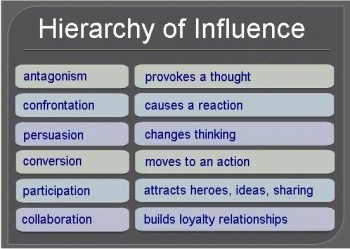
If we can agree that influence is some word or deed that changes behavior. Then plenty of influence occurred in the story I just related. I suspect that had I been privy to the whole scene in the kitchen I would have found that that single story included examples of confrontation, persuasion, conversion, participation, and collaboration. The only thing missing in this family scene would be true antagonism. Six different approaches to influence which lead to entirely different outcomes.

I’ve been reading about, thinking about, and talking to people about influence for months, because influence and trust are integral understanding to loyalty relationships. Let’s take a look at six of the usual forms of influence and the outcomes that result from them.

  1. Antagonism – provokes thought Your values are everything I believe is wrong with the world. You can’t stomach anything that I stand for. We are not competitors. We are enemies at war. Your words and actions might provoke thoughts and deeds, but what I’m thinking is how wrong you are, how to thwart you, or if I have no power, how to hide my true thoughts and feelings. An order from an enemy can influence a behavior but won’t change my thinking.
  2. Confrontation – causes a reaction You say it’s black. I know it’s white. I respond in some way — I fight back. I run away. I consciously ignore you. My response will probably change based who is more powerful. You might overpower me. I might stop responding, but it’s unlikely that you will actually change my thinking. Confrontation leads people to build a defense, to strength their own arguments.
  3. Persuasion – changes thinking You look at me and think about how what you want might benefit me. Rather than telling me, you show me how easy, fast, or meaningful it is go along with you. You’ve changed my about what you’re doing. I now see your actions from a new point of view.
  4. Conversion – moves to an action Your invitation to action is so convincing and beneficial to my own goals that I do what you ask. You’ve influenced my behavior to meet your goal. You have won my trust and commitment to an action. It’s not certain I’ll stay converted.
  5. Participation – attracts heroes, ideas, and sharing You reach out with conversation. We find that we are intrigued by the same ideas, believe in the same values, and share the same goals. Your investment in the relationship builds my trust and return investment. You invite me to join you in something you’re building. My limited participation raises my investment, gives me a feeling of partial ownership, and moves me to talk about you, your goals, and what we’re doing together.
  6. Collaboration – builds loyalty relationships We develop a working relationship in which you rely on my viewpoint. We share ideas and align our goals to build something together that we can’t build alone. You believe in my value to your project. I believe in the value of what you’re building. You have gained my loyalty and commitment. I feel a partnership that leads me to protect and evangelize the joint venture. I bring my friends to help.
Strauss_Hierarchy_of_Influence
Strauss Hierarchy of Influence

Not every campaign or customer situation will need to move to collaboration. But understanding each level will help us manage expectations allowing us to move naturally and predictably from confrontation to persuasion, so that we don’t expect the loyalty of collaboration from a momentary conversion.

Could be useful when looking to connect with that special valentine too.

How might you use the hierarchy to change the way you manage your business, your brand, your community, and your new business initiatives?

–ME “Liz” Strauss
Work with Liz on your business!!
Buy the Insider’s Guide to Online Conversation.

Filed Under: Marketing /Sales / Social Media, Successful Blog Tagged With: antagonism, bc, collaboration, confrontation, conversion, influence, influencing outcomes, LinkedIn, loyalty relationships, participation, persuasion, small business

SOB Business Cafe 01-07-11

January 7, 2011 by Liz

SB Cafe

Welcome to the SOB Cafe

We offer the best in thinking — articles, books, podcasts, and videos about business online written by the Successful and Outstanding Bloggers of Successful Blog. Click on the titles to enjoy each selection.

The Specials this Week are

Business Insider
First, only 8% of American adults use Twitter. This is more evidence that, despite its enormous popularity among tech and media folks–and its massive global user numbers–Twitter has yet to go mainstream.

Second, fully half of these Twitter users basically never listen to a word anyone else says. In other words, half of Twitter users use Twitter as a sort of digital closet that they go into once in a while to mutter to themselves, with no one else listening.

Read more: http://www.businessinsider.com/twitter-usage-2010-12#ixzz1AH3h8pV0

THE TRUTH ABOUT TWITTER: Half Of Twitter Users Never Listen To A Word Anyone Else Says

Top Rank
I know the right thing to do is talk about social strategy and broader level considerations before getting into the tactical details and specific tasks. Sometimes showing minute by minute examples of what a Community Manager does is jumping the gun for a new discussion on social media but it might be the only way to reach those that will perform the new role. Think of it as bottom up social media strategy if you have to. The more front line and middle managers that “get it”, the more powerful winning executive support will be.

What Does a Community Manager Do? Take a Glimpse.

Cloud Ave
Yet in 2010 I noticed the impact that Technology/Brand Evangelists are having on their companies. I noticed how they’re using social media to create real sales opportunities. I noticed how they’re creating exceptional buzz around their brands that was once the domain of the world’s largest media powerhouses.
And I noticed why Robert Scoble exemplifies this phenomenon.

Bottom line: These Evangelists are creating real shareholder value. Allow me to make the case.

Does Every Company Need a Robert Scoble?

eMarketer
“Bringing Facebook profile data into retail sites makes sense because it influences consumers when they are close to conversion,” said Jeffrey Grau, eMarketer principal analyst and author of the new report “Social Commerce: Personalized and Collaborative Shopping Experiences.” “In contrast, many consumers on Facebook are mainly socializing with friends and further removed from making purchase decisions.”

The Future of Social Shopping

Ask Spike
The one point that I would like to make is this: the words are gone. And ultimately, don’t you want your icon – your company – your brand – to be so well-known and ubiquitous THAT YOU DON’T NEED YOUR COMPANY NAME in your logo any more?

A Quick Word about the Starbucks Logo

Smashing Magazine
The performance of a website including a background video depends significantly on the speed of the user’s internet connection. Video backgrounds certainly do not fit in every setting; they wouldn’t be meaningful in online magazines or blogs. However, they can work really well in entertainment and certain corporate settings which are supposed to communicate artistic qualities, exclusivity, branding or even high quality standards.

Creative Use Of Video in Web Design: Background Videos

Related ala carte selections include

Adrian Chan at gravity7

Social Media Personality Types

View more presentations from adrian chan.

Sit back. Enjoy your read. Nachos and drinks will be right over. Stay as long as you like. No tips required. Comments appreciated.

–ME “Liz” Strauss

Buy the Insider’s Guide to Online Conversation.

I’m a proud affiliate of

third-tribe-marketing

Filed Under: SOB Business, Successful Blog Tagged With: bc, Great Finds, LinkedIn, small business

  • « Previous Page
  • 1
  • …
  • 41
  • 42
  • 43
  • 44
  • 45
  • …
  • 73
  • Next Page »

Recently Updated Posts

Is Your Brand Fan Friendly?

How to Improve Your Freelancing Productivity

How to Leverage Live Streaming for Content Marketing

10 Key Customer Experience Design Factors to Consider

How to Use a Lead Generation Item on Facebook

How to Become a Better Storyteller


From Liz Strauss & GeniusShared Press

  • What IS an SOB?!
  • SOB A-Z Directory
  • Letting Liz Be

© 2025 ME Strauss & GeniusShared
