Successful Blog

  • Home
  • Community
  • About
  • Author Guidelines
  • Liz’s Book
  • Stay Tuned

Have You Found the Great Leader in You?

December 2, 2011 by Guest Author

A Guest Post by
LaRae Quy

cooltext443809602_strategy

Good Leadership Begins with You

Everyone talks about developing good leadership skills. The truth is that the only person who can really teach you how to be the best leader is . . . you.

It’s tempting to rely on an expert to show you how to mine the hidden truths about good leadership. The bookshelves are stuffed with leadership assessments and techniques. They can all add value but they cannot answer the most important questions: Who are you and what do you believe?

No expert can tease those answers out into the open except you, no matter how much money you spend or how hard they try. A lack of self-awareness and self-knowledge produces a leader who is grounded only in the latest model or theory—a little like switching religion when the going gets tough or when something better comes along.

Models and Theories

I wrote a blog a few weeks back that talked about how I used different strategies as an FBI agent to surround the foreign spies I was trying to recruit to work for the U.S. government. An individual commented and asked why I didn’t use a leadership model that is currently very popular in training circles.

In actuality, there is nothing wrong with the leadership model he mentioned, but he missed the point because anytime you’re dealing with people, models and theories can only guide a leader so far. At some point, good leadership comes out of what is inside of you.

To paraphrase the venerable Jim Collins, if you’re a leader who doesn’t know who you are and what makes you tick, you will never move from good to great.

I relied on sound theories and dependable models when leading a team, but I distinguished my investigation from the others in the pack by drawing from my personal strengths. I’m not talking about the strengths that come from a skills assessment—I’m talking about the strength of character that girds and sustains us when we’re not sure where else to turn to or who else to trust. This is the type of self-awareness and self-knowledge that is our true north in any situation.

The admonition to become more self-aware can create a point of stickiness because many leaders can be self-absorbed. This is the opposite of what I’m talking about. A leader who is self-aware has not only accepted their weaknesses, they’ve faced them head on and have learned how to manage them as well. There is no room for fantasies or ego.

The heart of good leadership is connecting with others so they will follow us. Like the Wizard of Oz, people will only follow a promise for so long before they pull back the curtain to get a good look at who is behind it. Don’t let them see an empty suit.

The Key Areas for Self-Awareness

People are diverse and complex which is why it’s hard at times to accurately interpret our reaction to different situations. Here are key areas for self-awareness and self-knowledge:

Personality

  • Remember that it does not change as you age
  • Spot ways it impacts the way in which you interact with others
  • Identify your strengths and assets
  • Recognize your weaknesses and vulnerabilities
  • Create opportunities that allow you to thrive
  • Minimize situations that trigger the less desirable personality traits

Personal Values

  • Make a list of values that are important to you.
  • Prioritize the following values: honesty, self-awareness, listening to others, attentiveness, spirituality, authenticity, gratitude, trust, gentleness, humility, courage, self-knowledge, self-discipline, patience, integrity, forgiveness, compassion, charity, freedom, generosity, peace, joy, hope, and decisiveness.
  • Think of times they have provided direction in your life
  • Identify how you keep sight of your most important personal values in the busyness of your day-to-day activities

Patterns

  • Recognize that you are a creature of habit and are predictable in your response to the unknown, the unexpected, and the uninvited events in your life
  • Identify the patterns that emerge in those responses
  • Distinguish between the patterns that are beneficial and those that interfere with your effectiveness and productivity.
  • Pinpoint the patterns that help you succeed and minimize those that impede your progress.

Emotions

  • Identify the emotions that reveal themselves most often
  • Name the ones that rarely reveal themselves
  • Recognize the triggers for negative emotions
  • Make an association between your emotion and your behavior
  • Consider that awareness of your emotions leads to greater control over them

Good leadership begins with you. You will always be the best expert on you—no matter how much you pay a consultant or coach.

How can you begin to reflect on your daily experiences to gain more self-awareness and self-knowledge? Do you want to make that commitment even if it means you’ll need to eliminate something else? What external factors will help you be faithful to the process? What doubts do you have about digging deeper into understanding yourself better?

What are your questions about reading the leader in you?

—-
Author’s Bio:

Larae Quy

LaRae Quy was an FBI agent, both a counterintelligence and undercover agent, for 25 years. She exposed foreign spies and recruited them to work for the U.S. Government. Now she explores the unknown and discovers the hidden truth via her blog Your Best Adventure. You can find her on Twitter as @LaRaeQuy

Thanks, Larae!

—-

Be irresistible.

–ME “Liz” Strauss
Work with Liz on your business!!

Buy the Insider’s Guide to Online Conversation.

Filed Under: Successful Blog Tagged With: bc, LinkedIn, management, personality identity, Strategy/Analysis

15 Ways to 365 Days of Gratitude

December 1, 2011 by Rosemary

A Guest Post by
Rosemary O’Neill

cooltext443809558_authenticity

365 Days of Gratitude

Now that the turkey leftovers are just about gone, it’s tempting to start hanging holiday decorations and move on. But we should cultivate an attitude of gratitude all year long. It’s one of the best ways to separate human-centered businesses from the robot army. Humans care about elevating others; robots only care about processing bits and bytes.

Here are 15 simple (but concrete) ways to show appreciation online.

  1. Give a Klout +K – you can debate whether Klout means anything or not, and CEO Joe Fernandez has said that +Ks don’t directly contribute to a higher score, but it sure feels nice when someone gives you a +K, especially in a relevant topic area.
  2. Facebook Like – an oldie but a goodie, some people obsess over their number of “likes,” so it’s a nice way to give a pat on the back.
  3. Follow or subscribe – following someone on any social network or subscribing to their feed (blog or status updates) means you are interested in what they have to say. What better way to show you care?
  4. RT or Mention on Twitter – the ReTweet is the highest compliment you can give someone on Twitter, and it contributes to their Klout score, so double score! Mentioning someone, in status updates or comments on other networks is like name-dropping. Often the object of the name-drop is notified, and most people enjoy being recognized publicly.
  5. #FollowFriday – this one has had its ups and downs, but done correctly, a nice FollowFriday on Twitter can be a nice perk for someone. I think Gini Dietrich does it best; she picks one person, writes about him/her on her blog, Spin Sucks, and then Tweets it out. It’s meaningful, succinct, and likely to result in more followers.
  6. LinkedIn Recommend – for a business connection, a nice recommendation for the individual or for their products/services is a great way to say thanks. It’s like getting a gold nugget in the mail!
  7. Empire Avenue buy or recommend – if your contact is on Empire Avenue, buying some shares or giving an endorsement or recommendation is a nice recognition.
  8. Google +1 – this is a very important one. When you give a Google +1 to a person’s content, it shows up in search results, and it means that their content is more likely to continue showing up in your search results going forward. That’s power.
  9. Twitter or Klout list – it’s pretty easy to set up lists in Twitter and Klout, and it’s a way to publicly pull the cream of the crop to the forefront. Would you like to be included in a list of “Smart People” or “People Who Inspire?” Yeah, me too.
  10. Paper.li inclusion – this is another service that has supporters and detractors, but I always feel a nice boost when someone includes my feed in a Paper.li or any other of the aggregator services (Storify too).
  11. Comment on their blog – this is where the action is. Offering an intelligent comment that contributes to someone else’s blog is a sincere compliment.
  12. Blog roll – kick it old school; honor someone by including their blog in your “links” list. Ever heard of “link juice?” It’s hard to come by, and a much-appreciated gift.
  13. Thank on Quora – if you participate on Quora (and it’s a great place to get answers directly “from the horse’s mouth”), the best thank you is a “thank you.” When you give a thanks, the person is notified.
  14. Reply to a forum topic – it takes courage to stop lurking and start a topic in a busy forum. When you choose to reply, and add your own thoughts to the conversation, you are supporting the orginal poster and the community itself.
  15. Comment “like” – several blog commenting systems support “likes” now, so you can select particular comments and single them out for praise.

My suggestion is to start every day by handing out a few of these, without any expectation of return. A day that starts with gratitude is already a success.

_____

Author’s Bio: Rosemary O’Neill is an insightful spirit who works for social strata — a top ten company to work for on the Internet . Check out their blog. You can find her on Twitter as @rhogroupee

Filed Under: Marketing /Sales / Social Media, Motivation, Successful Blog Tagged With: bc, gratitude, LinkedIn, networking, Strategy/Analysis

The Five Questions to Leverage Your Unique Position

November 29, 2011 by Liz

Start with Knowing Where You Are

insideout logo

Strategy is a about making and leveraging new beginnings from wherever you sitting right now. The very nature of strategy is unique to who or what you are. In other words, it’s not a plan that is go grand it good apply to anyone.

Statements like these that I’ve read on too many corporate strategic powerpoints are not strategies …

  • Become a thought leader in our space.
  • Raise our brand awareness.
  • Leverage our customers to own more market share.

These are broadly written descriptions of possible goals.

A strategy is a practical system to advance achievement. True strategy focused on leveraging opportunity consistently and fluently in the direction of growth.
Strategy is uniquely formed from knowing where we stand and what we own.

Strategy begins by understanding where you stand and bringing all of who and what you are to where you want to go.

Knowing where you’re going is irresistibly attractive. Who’d want to follow you if you don’t know where you’re going to go?

So, to get get from here to there, you need to have a goal — a vision on the horizon that you’re willing to commit your best resources to achieving. You’ll need a team of great people to support you — belief and influence will attract the best people to participate in your mission to reach that vision.

But first, you have to know where you are before you go.

Getting from here to there is impossible if you don’t know where here is.

Your unique position defines how to leverage strategic opportunities that yours alone.

The Five Questions to Leverage Your Unique Position

To build a true strategy a person or business has to begin with where you stand and a clear picture of where you want to go. It’s hard to get there from here, if you haven’t figured out where here is. These five questions will help define your unique strategic position.

  1. What drives you to your mission and your goal? Know why you do what you do. No person, no business accomplishes great things alone. Frodo had his friends. Batman did too. Your mission clarifies your position and the field on which you’re playing. It’s the higher calling that attracts the right team who want to move things forward with you.
  2. What do you already own? The strategic of owning nothing can mean the lower risk of nothing to lose. Do you have a spark, a spirit, a culture, a process, a system, a model, a location, a concept, a team that works for you?
  3. What position on the playing field do you uniquely hold by why of the ground, the talents and the values that are your own? If your back is against the wall, no one can sneak up behind you. Distract, Divide, Decide the rules that work for you. Choose the most natural rule of opposites put it to work for you. If the industry cares about sales, care about follow through. If the industry cares about flash and glitz go minimalist. Make having your back against the wall the new the black — the envied position to choose.
  4. What is your role that serves others better than anyone else can? Be driven to make nothing about you. Nothing beats listening to the people who love you to help them with their dearest quest. Use your position to get to know who loves you and to raise the best of them closer to their goals.
  5. How will you combine these to decide how every competitve offer is irrelevant? What does your team bring that no other team can offer — that no other team could reproduce? What’s the WOW of just interacting with you?

Being good at execution or at picking a direction won’t get us to that winning goal. Understanding the strategic advantages of every position, even the worst one you might imagine, that allow us to make the small adjustments and leverage the advantages that the folks who need the “sure winner,” who can’t risk, can’t see, or can’t move fast enough to leverage. Knowing and constantly reassessing your position is as important as knowing your goal.

Have you found the leverage in your position yet?

–ME “Liz” Strauss
Work with Liz on your business!!

Buy the Insider’s Guide to Online Conversation.

Filed Under: Successful Blog Tagged With: bc, LinkedIn, opportunity, position, Strategy/Analysis

Ideas & Infographs: Decisions, Decisions … How Do You React?

November 28, 2011 by Liz

by Mihaela Lica

cooltext443809602_strategy

Decisions Require Intelligence

When it comes to making big decisions, that can often make or break your business, it can be tempting to just go with your gut instinct, Isn’t it? After all, it’s your business and you know it better than anyone, right? Who’s better qualified to make a decision than you? And then, most of you out there have learned how hard this mentality bites too.

In actual fact, the “gut instinct” approach is fraught with hazards, that is, unless your gut instinct is Homeric – the stuff of legend. Face it, people have tendency to let their imaginations run away with them – we have all these plans and ideas and we can picture everything in our minds working out perfectly, accordingly – even in the most dire situations. Our judgment can so easily become clouded, as we get excited and think too far ahead of ourselves. Consequently, we make rash decisions that usually backfire on us.

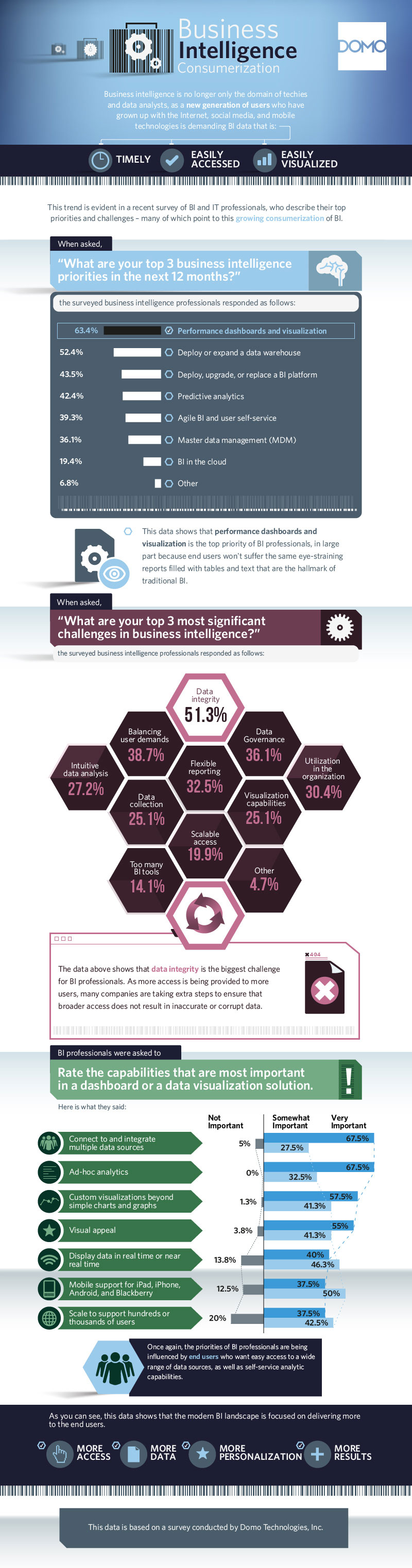
So, decision making big or small, requires intelligence. No, not you turning into Albert Einstein, but the kind of business intelligence that can be gleaned ever more effectively in our digital work and playground here.

[Click the image to see the infograph full size.]

Business Intelligence Consumerization

Created By DomoTechnologies, Inc.

Business intelligence is far more accessible now, than ever before. As the above infographic courtesy DOMO (http://www.domo.com/what-we-do/additional-resources/8/82#featured) above shows, business intelligence, in the form of highly visualized and easily accessible data, is quickly becoming a vital resource for internet entrepreneurs. Check this out.

Having access to business intelligence is critical to your success. Unless you have a crystal ball, you simply cannot predict the outcome of those key decisions, no matter how well you might think you know your business and your consumers. The message is loud and clear – don’t act impulsively, get the facts first. That’s what everyone else is doing – so think about competing.

—-

Author’s Bio:

Mihaela “Mig” Lica founded Pamil Visions in 2005 where she uses her hard won journalistic, SEO and public relations skills toward helping small companies navigate the digital realm with influence and success.

You can find Mig on Twitter as @PamilVisions

Thanks, Mig!

–ME “Liz” Strauss
Work with Liz on your business!!
Buy the Insider’s Guide to Online Conversation.

Filed Under: Marketing /Sales / Social Media, Successful Blog Tagged With: bc, decisions, DOMO, Infographic, LinkedIn, Strategy/Analysis

Haven’t You Got Smaller Fish to Fry?

November 23, 2011 by Rosemary

A Guest Post by
Rosemary O’Neill

cooltext443809558_authenticity

If you’re a small business or a consultant, Fortune 500 clients are a rush. Impressive logos can adorn your sidebar, you can impress your grandma with how successful you are, and credibility is yours. However, it’s very important to treat every customer as if they are your “marquee” client.

And here’s a secret:

The small fry customers aren’t used to being treated like a VIP, so they are easier to delight.

Here are a few more reasons why the small fish deserve TLC:

  • Small fry grow up to be big – that lower-tier administrator you’re dealing with may get a promotion or move to another company and suddenly be the decision-maker.
  • The neighbor effect – the woman who runs that small business could refer you to her neighbor, who is VP of Something Important at a Fortune 500.
  • Large quantities of small fry make a steady revenue stream – if you’re reliant on the good graces of a few big companies for your revenue, you’re in a precarious position.
  • Smaller organizations can be easier to deal with – it’s much easier to get access to the decision-maker at a smaller organization.

Never burn bridges – if you try every day to delight everyone who comes in contact with your business, including the “nobodies” with no money to spend, you are building goodwill equity that comes back to you when you least expect it.

If you pay close attention, your individual small fry will build into a net-bursting haul.

_____

Author’s Bio: Rosemary O’Neill is an insightful spirit who works for social strata — a top ten company to work on the Internet. Check out their blog. You can find her on Twitter as @rhogroupee

Filed Under: Customer Think, Marketing /Sales / Social Media, Successful Blog Tagged With: bc, Customer Think, customer-service, LinkedIn, Rosemary O'Neill, Strategy/Analysis

5 Inspiring Lessons Entrepreneurs Can Learn from Steve Jobs

November 4, 2011 by Guest Author

A Guest Post by
Rahil Muzafar

cooltext443809602_strategy

What Lessons Will You Keep?

By the time this post goes live, millions of words would have already been said, written and discussed about Steve Jobs – the man behind 21st century’s technological revolution. I don’t think any words coming from me would justify the greats of this man. Therefore, I prefer to talk about his inspiring words rather than of the man himself. No words can fill the void he left behind, and because he is a legacy that lives on in his work, I find it a necessity to discuss about his professional feats and their impact on us.

Until earlier, I admit, I was naive enough to think of him as just the CEO of Apple Inc. Never did it cross me that this man was a genius; that he did not only give the world some pretty usable devices, he also made sure his customers became die hard loyalists to Apple. How did he do it? What did he believe in? These are answers that can be found right in his words. Being an entrepreneur there were some amazing words that I found to be not only inspirational but also very practical for people who are looking to make it big. Here’s what I am talking about.

“But Apple really beats to a different drummer. I used to say that Apple should be the Sony of this business, but in reality, I think Apple should be the Apple of this business”

Lesson: Create Your Own Identity

Inspiration should not be mixed with derivation. You should be inspired by the greats – yes; but you should never want to “imitate them”. This is exactly how Apple created its unique identity through the looks, the functionality, and even the internal features of its products. You will not find an Apple product that tries to impersonate another product. There’s always something very distinctive in all of their products. Note that the focus here is not just on unique design or looks, rather on a unique imagination and approach to your business. You don’t become a “great” by mimicking some “great”.

“For you to sleep well at night, the aesthetic, the quality, has to be carried all the way through.”

Lesson: Never Compromise on Product Quality

If quality isn’t your priority, forget about getting customer loyalty. This quote is applicable to all professions coming from all walks of life. Be it engineering or designing, every product must satisfy the eyes of the customer. When a customer’s aesthetic sense gets lured, there will be a natural curiosity to know more about the product. If your service/product satisfies both the customer’s eyes and the purposes, you can put your feet up and relax because you are on solid grounds.

“I didn’t see it then, but it turned out that getting fired from Apple was the best thing that could have ever happened to me. The heaviness of being successful was replaced by the lightness of being a beginner again, less sure about everything. It freed me to enter one of the most creative periods of my life.”

Lesson: Do Not Let Failures get in the way

Let’s face it. Being an entrepreneur and a visionary is not easy. And who knows this better than Steve Jobs! Being fired from your own company is a devastating experience, even more than experiencing some financial loss. But this is what makes the “man” so special, he didn’t give up (Started another company, and just kept going) He was back within a year and ever since he became the epitome of company’s success. Lesson for us, never lose confidence in your abilities even when others are writing you off. There are times when you’ll fail in a grand manner, but that’s what entrepreneurship.

“And it comes from saying no to 1,000 things to make sure we don’t get on the wrong track or try to do too much. We’re always thinking about new markets we could enter, but it’s only by saying no that you can concentrate on the things that are really important.”

Lesson: Focus on Your Niche

The problem with following a success story is that it leaves no room for originality. The moment a business gets successful, euphoric optimism settles in. You start thinking of endless possibilities and try to put your foot in everywhere. This is where focus decentralizes and the business goes awry. Apple was a global leader in manufacturing systems; smart computing systems. The company did not try to be what it was not; it did not try to jump from market to market. All it did was to focus on improvising its core products and making sure people get systems that have never been manufactured by companies before. When you learn to devote time, energy and efforts into developing, enhancing and updating every part of your niche business, you are bound to be successful. Being haphazard in your approach can never get your business the strength, the success or even the attention it deserves.

“Being the richest man in the cemetery doesn’t matter to me. Going to bed at night saying we’ve done something wonderful, that’s what matters to me.”

Lesson: Money should not always be the Sole Purpose

Many wouldn’t agree with me, but money should not be the “only” motivation for you to do anything. It’s true that money is naturally every man’s goal, but you should also realize that the world’s best feelings don’t have anything to do with the richest man; rather it comes from being able to do something which is close to your heart. Entrepreneurs need to look beyond the objective of being profitable. And don’t get disappointed when the cash flow is not as good as expected, because the disappointment might result in bad decisions in a desperate attempt to be financially successful. If you keep money as the sole objective, you will miss many occasions to celebrate.

Rahil Muzafar

—-
Author’s Bio:

Rahil is an SEO expert, and writes on topics related to Internet Marketing. He’s working for smartpress.com that offers quality sell sheet printing service

Thanks! Rahil!

–ME “Liz” Strauss
Work with Liz on your business!!

Buy the Insider’s Guide to Online Conversation.

Filed Under: Marketing /Sales / Social Media, Strategy/Analysis, Successful Blog Tagged With: bc, LinkedIn, Rahil Muzafar, small business, Strategy/Analysis

  • « Previous Page
  • 1
  • 2
  • 3
  • 4
  • 5
  • …
  • 18
  • Next Page »

Recently Updated Posts

Is Your Brand Fan Friendly?

How to Improve Your Freelancing Productivity

How to Leverage Live Streaming for Content Marketing

10 Key Customer Experience Design Factors to Consider

How to Use a Lead Generation Item on Facebook

How to Become a Better Storyteller


From Liz Strauss & GeniusShared Press

  • What IS an SOB?!
  • SOB A-Z Directory
  • Letting Liz Be

© 2025 ME Strauss & GeniusShared