Successful Blog

  • Home
  • Community
  • About
  • Author Guidelines
  • Liz’s Book
  • Stay Tuned

My ass just tapped me on the shoulder.

November 20, 2009 by Guest Author

Todays guest post is from Julie Roads.

Julie Roads of Writing Roads is a professional copywriter (specializing in blog, social media and web writing) and a book & blog ghostwriter. You can find her at Writing Roads (her writing blog), Soc Media 101 (how-tos and tips for beginners) and The Daily Norm (a collection of interviews with abnormally magnificent people about their normal, daily lives).

tap on the shoulderI’m standing on the other side of the abyss, the good side. And I wanted to let you all know that the ground here is high and dry, nearly heady.

Because I read your comments carefully – and because, as far as I can tell, we’re both human – I’m going to guess that at one point or another you’ve stood on the scary side of the abyss just like I did before I got to the cushy side.

You wanted to do something, you needed to do something…but the canyon that stood between you and accomplishment just looked too damn big, wide, menacing. Impossible, you said. And sat down.

My alarm goes off at 4:30. I jump out of bed and look out the window. It’s snowing. I smile smugly at the snow. Bring it, I think smugly. Pull on my layers of Capilene, my bright orange hat, my running shoes. And head out for an eight mile run before I go to work.

This used to be my norm. Miles run, laps swum, heart pounded, sweat drenched – before the sun rose.

And then my body abruptly took on new super powers forms of exercise: first, it grew another human being; then, it made milk. Needless to say, my body was preoccupied with performing miracles. Too busy to hit the trails or the pool.

But, last spring, something changed. My ass literally tapped me on the shoulder and said, ‘Um, I’m thinking we should shift things back into high gear…you?’

Which is when I realized that I was standing on that cliff. On the scary side of the abyss. I had a lot of reasons why I couldn’t take the leap:

  • I’m too old.
  • My body forgot how.
  • Once you get past a certain point, it’s just pointless.
  • I don’t have time.
  • I’m so frickin’ tired.
  • Have you seen my parents? (I love them and they’re beautiful, but they don’t have super model bodies. I’m just sayin’.)

In the middle of this tirade, I ran into a good friend who had just finished a long rollerblade, and she told me, “It gets you right here”, and she grabbed her butt. “Makes it burn,” she said. And my ass took notice. And, then it tapped me on the shoulder again. I took the bait. I didn’t think, just started to move again.

I had really believed all of my reasons why I couldn’t do this, but they just weren’t true. Bodies are amazing – they snap back in a way that is extraordinary. Minds do too. My ‘get up and go’ tape started playing again, as if I’d simply hit play again after a long moment with the pause button down. We both quickly forgot how long that moment had been.

Now, it’s been five months. And someone recently told me that my belly looks the same as it did when I was 16. Is that really true? Um, ish. Is it a miracle? Nah. I just think that I got way too comfortable on the pitiful side of the abyss. Too shlumpy to realize the infinite possibilities hanging out across the way.

Sometimes life feels like a series of cliff dives – scary, exhilarating, progressive. The above experience being just one of my abysses. For you, it might be finally going to law school, having a baby, getting up on that karaoke stage, or – drumroll, please – writing (creatively, professionally, bloggingly).

Whatever it is, I’ll save you a seat on the other side. Believe me, if you don’t already know, the view is fabulous.

Image credit: Scampercom

Filed Under: Motivation, Successful Blog Tagged With: bc, creative writing, how to write, self, self-doubt, self-esteem, self-improvement, Writing

How Do You Transition or Repurpose Content for the Web?

October 13, 2009 by Liz

Don’t Endow Me

Power Writing Series Logo

Anyone who has had to give a demonstration, deliver a report, or teach a class knows the importance of tuning the information to the audience. Anyone who been to a class that involves learning software knows that students is likely to include folks new to the subject and the most savvy experts who want to refine their skills.

Sharing information with people is easier, more efficient, and more meaningful …

  • when we’re speaking one-to-one and can tailor the information to that individual.
  • when the people receiving the information offer feedback about the information they’re receiving.
  • when we know the experience of the people who are receiving the information.
  • when all of the people who are receiving the information are from the same culture, speak the same first language, are at the same functional level, have the same skills, and relate to the topic the same way we do.

It’s hard to do these when we’re working with a group that is all in the same room. This problem becomes even more difficult on the web. Here, we’re tasked to share information meaningfully when we’re in a new genre and blind to the audience. We’re writing for an unknown number of people who could be from anywhere and know absolutely nothing on our subject or have significantly more experience than we do.

How Do We Write Meaningful Content for People We Can’t See?

Writing for the web gets easier when we realize the words carry a different load than words in print. Words online are lit and hit the eye differently. People access them with a different intent. It’s a different experience to read a device than to read a book. It’s different experience to read and respond to a blog than to read a newspaper and write an email back.

I’ve been repurposing content and publishing online and offline since the 20th century. Here are some tips about transitioning and writing content for the web.

  • Titles Are Invitations. The title of this post tells you exactly what you get by reading it. Had I more metaphorically called this Snapshots of Web Writing, you might have thought this would feature pictures and writing samples. Use a title to attract people who want exactly the content that will be under it.
  • Brevity is Beautiful. Fifty-one word sentences and half-page paragraphs don’t work with the backlighted, fast-paced format of the web. Attention in harder to keep in this visual venue. Long sentences lose their meaning before we get to the end of them. Long paragraphs have the same effect. Easy to read can still be intelligent … To be or not to be. is possibly the most easily read graduate level sentence ever written. Short words are powerful tool.
  • Subheads Are Relevancy Signposts that Show Respect. When we break up content with subheads, we give people a chance to know what’s coming next. Readers have so little time. When we offer a simple subject that telegraphs the idea in the next section, we allow them an option to choose whether to skip ahead. Who wouldn’t appreciate that to having to crawl through unwanted information searching for what we really need?
  • Everyone likes to learn. No one likes to be taught. Often we take our responsibility to share information so seriously that we undercut our own effectiveness. We stand at the podium hoping it will give us expertise so that our words will be heard. If we step away from being the “sage on the stage,” and instead take on the role of the “guide at the side,” we can share what we’ve learned rather than tell what we know.
  • Write for one person who wants to know what you know. It’s easy to get overwhelmed by writing to a diverse group. Think individuals and include yourself. It’s WE — the audience and me — not me and them. We write more effectively when we consider what we’d want to learn. Write for someone intelligent and savvy as yourself, who wants to know or be reminded of what you know.

Great titles, short paragraphs, small words, subheads for navigation, a learner’s voice, and content leveled and chosen by you as a partner with the audience <-- that's a formula for transitioning content to the web. Have you repurposed content for the web? What have you found works best? --ME "Liz" Strauss Liz can help with a problem you're having with your writing, check out the Work with Liz!! page in the sidebar.

I’m a proud affiliate of

Teaching Sells

Filed Under: Blog Comments, Marketing /Sales / Social Media, Successful Blog, Writing Tagged With: bc, LinkedIn, repurposing-content, Writing

Provocative vs. Genuine

August 6, 2009 by Guest Author

sealionI’ve been thinking about the difference between being provocative and being genuine lately.

We all read stories or see ads that are “provocative.” They are fun to read and see from time to time. But I wonder… do you trust a provocative story or would you prefer genuine writing?

There have been a few blog posts going around this week about being provocative in your blogging, marketing or overall strategy. I read that being being provocative has value in challenging people and pushing them to think.

Sure, I can agree with that.

Another blog I read suggested, “Being provocative isn’t about being controversial. It’s about being ahead of your time, solving problems in new and interesting ways, and creating awesome brands and products.”

But what does the word “provocative” really mean, I wondered. Here’s one definition that seems to be generally accepted: “Making people angry or excited: deliberately aimed at exciting or annoying people.”

Being provocative to me means trying to get people to react emotionally, quickly, instead of giving them something to think about, and respond to in time. It can mean prodding someone’s emotions instead of challenging the way they think.

If you were talking to a person face-to-face and you could tell they were being “provocative” or controversial just to get a reaction out of you, how would you feel? Would you feel challenged intellectually, or emotionally annoyed?

Every now and again I catch myself getting incensed by something I read which *I* know is “wrong.” I start a post and am writing away but I stop myself because what I am in fact doing is reactionary. I’m not carefully considering the points put forward and formulating an intelligent response.

That could very well be because in many provocative ads or blog posts there are few ideas to think about, only phrases to react to. I’ve read that writing like this is like the loud person at a party who swears a lot and is “controversial” just because he or she has nothing intelligent to say.

Do you read “provocative” blogs and enjoy “provocative” marketing strategies because you are enriched or learn from them, or do you just enjoy the controversy?

By Kathryn Jennex
www.kathrynjennex.com

Filed Under: Successful Blog Tagged With: bc, blogging, Marketing /Sales / Social Media, social-media, Writing

Ask Letterman … What's Not to Love About a List?

May 26, 2009 by Liz


Lists

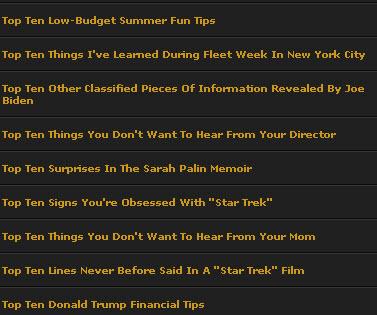
Have you noticed how much of our information has become lists — TV, magazines, the interwebs love lists? The ten most amazing, most marvelous, most something this or that . . . is ingrained in every media. Even children’s learn-to-read books have started to favor lists. David Letterman has the best of them … click the image to check them out.

Here’s a list that lists why lists have taken center stage in the world of content.

  • Lists are easy to build.
  • They don’t require segues or transitional phrasing.
  • They don’t require deep research or extensive fact checking.
  • Most lists match the average attention span of a bus ride, coffee break, or other infosnack.
  • Lists can be built in a fraction of the time a piece of depth might take.
  • Lists are very bottom-line oriented.
  • A quality list is . . . what you see is what you get.

Lists are the sound bytes of print. They’re easy, quick, and often useful. The writer makes a point and readers move on feeling satisfied that they’ve heard something complete and whole — without too much work.

What’s not to love about that? Hmmmmm.

–ME “Liz” Strauss
Work with Liz!!

Buy the ebook. Learn the art of online conversation.

Filed Under: Marketing /Sales / Social Media, Successful Blog Tagged With: bc, LinkedIn, lists, Writing

Great Headlines on the Web Always Win … Except When They Don't

May 18, 2009 by Liz

how to blog series

Got Traffic? Want Traffic?
Why Do the Clickers Come?

If you’ve been studying How to Get Literally Everyone’s Attention on the Internet, you probably know that headlines count.

An attention-grabbing headline is everything. Whether it is something completely original and novel, ultra-specific and geared towards a niche, or just incredibly compelling, good headlines on the Web always win.

They always win, except when they don’t.

A great headline will get traffic and attention, but what sticks? What turns a click into a subscriber? Strong businesses are built on strong relationships. What transforms a clicker into someone who hangs around?

It starts with with the reason the clickers came. People come to a website for information, entertainment, and communication / engagement. When they click through on that headline they’re looking for one or more of those three.

Our greatest achievement in building a Web site is helping a person achieve his or her goal. During our research our biggest discovery proved to be that navigation and content work best when they are wed tightly together. “It seems that you can t really separate content and navigation” says Jarod Spool, “without losing something important in the process.” How to make your Web site fast and usable

If folks who click find something that delivers on that promise in that headline they stay and possibly return. If not, they feel thwarted and leave. Here are five things you can do to make it more likely they get what they came for.

Five Ways to Deliver to the Clickers Who Follow a Headline to Your Blog …

  1. Deliver what your headline promises.
  2. Deliver it in short paragraphs using subheads surrounded by lots of white space so that people have room to think and breathe.
  3. Deliver it without making folks jump over ads or through hoops to get to the prize that the headline promises.
  4. Deliver it by recognizing the people who take time to comment.
  5. Deliver it by making it easy for folks to stay..

The most important thing is deliver — do what we say we’re going to do.

It’s not the click that doesn’t come that’s a loss. It’s the click that comes to find that we’re not what we suggested we would be. A great headline followed by something less doesn’t win. It doesn’t even finish.

Great headline, lame blog post — you’ve been there. What’s your response when you end up on one of those?

–ME “Liz” Strauss
Work with Liz!!

Buy the ebook. Learn the art of online conversation.

Filed Under: Blog Basics, Marketing /Sales / Social Media, Successful Blog Tagged With: bc, blogging, business-blogging, Content, How-to-Blog, navigation, Writing

What William Tully Said … About Great Writers and Great Bloggers

December 6, 2008 by Liz

A community isn’t built or befriended,
it’s connected by offering and accepting.
Community is affinity, identity, and kinship
that make room for ideas, thoughts, and solutions.
Wherever a community gathers, we aspire and inspire each other intentionally . . . And our words shine with authenticity.

Who Influences the Way that You Write?

We study writing. We can read the work of great writers we admire. We ask for the advice and help of those who’ve mastered some skill, but in the end, all of that advice and input is influence not a handbook. Every blogger and writer finds his or her voice without much help. We practice until we discover which rules work for us. A great writer, a great blogger, gets to be one by doing to it.

Here’s what William said . . .

1. why are ‘great writers’ typically associated with fictional stories?
2. is writing not a form of art left to the eye of the beholder?

I’m told that Hemingway is a great writer… What about Orson Scott Card, Bill Bryson, or even the one writing this blog or this comment?

I agree that we (as writers) should be reading great writers, yet I completely disagree at the same time. For example, I have a very unique style of writing… The style is simply a reflection of how I speak and teach. Same pauses, inflections, and YELLING… sometimes.. Yet the last thing on my list is to sit down and read some Shakespeare, simply because the style is absolutely nothing I can relate to.

Douglas Adams (Last Chance To See) is perhaps the single book with a writing style that I can COMPLETELY relate to and respect. Now, is he a great writer? Certain circles, he is a respected author. This book? Relatively unknown. Bill Bryson is another author, who in my opinion, is absolutely brilliant!

I guess I’m not entirely sold on reading great writers helps with great writing. I think having a grasp of your chosen language is key, and just simply reading is key. I would sooner read something by a great THINKER than a great writer…

William Tully from a comment on April 5, 2007

A successful and outstanding blogger said that.
–ME “Liz” Strauss

Filed Under: Successful Blog, Writing Tagged With: bc, Logical-Emotion, William-Tully, Writing

  • « Previous Page
  • 1
  • …
  • 7
  • 8
  • 9
  • 10
  • 11
  • …
  • 15
  • Next Page »

Recently Updated Posts

Is Your Brand Fan Friendly?

How to Improve Your Freelancing Productivity

How to Leverage Live Streaming for Content Marketing

10 Key Customer Experience Design Factors to Consider

How to Use a Lead Generation Item on Facebook

How to Become a Better Storyteller


From Liz Strauss & GeniusShared Press

  • What IS an SOB?!
  • SOB A-Z Directory
  • Letting Liz Be

© 2025 ME Strauss & GeniusShared