Successful Blog

  • Home
  • Community
  • About
  • Author Guidelines
  • Liz’s Book
  • Stay Tuned

SOB Business Cafe 06-29-07

June 29, 2007 by Liz

SB Cafe

Welcome to the SOB Cafe

We offer the best in thinking–articles on the business of blogging written by the Successful and Outstanding Bloggers of Successful Blog. Click on the titles to enjoy each selection.

The Specials this Week are

Seth’s Blog knows the way to get us to want to be friendly with the folks who work the fast food counter.

Rochambeau the front line


Smart Wealthy Rich understands what we should be doing.

Give Them A Good Reason To Click And Read (And Subscribe)


Monk at Work is pointing out things in our heads again.

Attachment, Love, and The Idea Fairy


Lorelle comes through at tthe Blog Herald with a new view to the new Google algorithm’s look at how we care for our content.

SEO Tips: Increase Page Rank By Revitalizing Your Old Posts


Dawud Miracle shows a glass overflowing with links for in true Starbucker tradition.

What Do You See When You Look Through The Glass?


Jibber Jabber has a series of secrets to tell.

Day 1: My Blogging Secrets


Related ala carte selections include

Who wouldn’t want to say something about this story and the blue balls?

Scoble Awaits iPhone, Plays with Ball of Whacks


Sit back. Enjoy your read. Nachos and drinks will be right over. Stay as long as you like. No tips required. Comments appreciated.

Have a great weekend!

–ME “Liz” Strauss
Filed Under: SOB Business, Successful Blog Tagged With: bc, Great Finds, LinkedIn, small business

Head, Heart, and Sailboats

June 29, 2007 by Liz

I’ve been thinking about head, heart, and sailboats.

Head and heart. Some days I like one more than the other. Some days it’s smarter to think. Some days I find it’s better to follow where my feelings lead me.

On days I am my head, I make my life about the work. I can perfectly clear my desk. I can venture forth with the most elegant strategic plan. Be ready to think quickly, if you take me on. I’m not as one-dimensional as some folks might have you think. After all, not everyone gets complimented quite this way by a friend.

I’ll analyze a problem to reach a brilliant, logical solution . . . in seconds flat. When I do, no person will be within the range of my 20/40 vision. I’ll see the people, sure, but they’ll be human data in the thinking chain.

No wonder I get headaches.

On days I am my heart, I can make my life about the people and beauty of the world. I see the wonder of a smile that fills a voice when a person discovers a new thought. I see the sun rise in glorious colors that make a sky no artist could possibly paint. The options and ideas assault me joyously like water falling as I stand laughing at the the marvel of being alive and drenched.

I imagine away bad weather and fill a hall-full glass half-again over the top. I can hear a symphony in my head and when I want I can make it go away. I can stop time, stress, and bad things me too. Generosity is without thinking. Life is magical.

Of course, the without thinking part is a bit of problem now and then.

On the days I am both, I lean from head to heart and back. I let my life tell me when to list which way.

Sailboats that list in concert with the wind have grace and flexibility, even in a rough storm. Sailboats that lean too far take on water. That’s wrong there. The water is supposed to stay beneath the boat . . . in the sea.

Head and heart together is balance, part holding on and part letting go. Lean too far toward one and the connection won’t work. It’s like sailing — the wind has some control. When I lose my trying and self-consciousness to make room for life, a day becomes adjusting my sails with the wind.

This weekend I’m going to be a sailboat.

Head and heart has to be lived to be learned.

Liz

Filed Under: Motivation, Successful Blog Tagged With: bc, head-and-heart, Ive-been-thinking

3. The Head Types

June 28, 2007 by Liz

Enneagram Series by Mark McGuinness

Having introduced the three Enneagram Heart types in my last post, I’ll now move on to the three thinking or ‘Head types’.

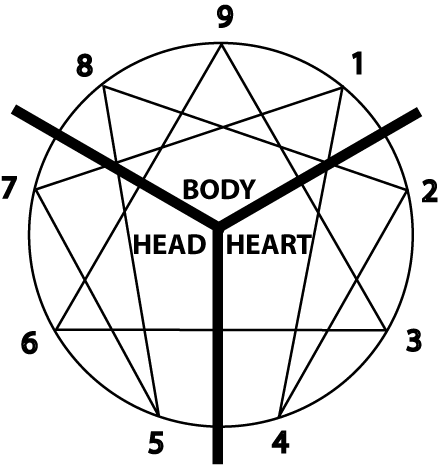
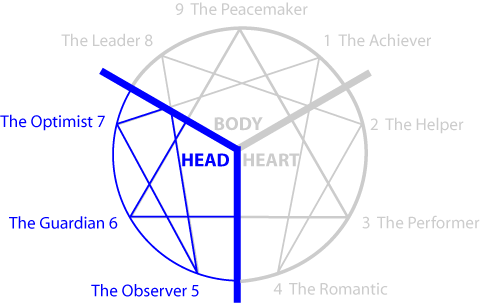
The minimum you need to know about the Enneagram symbol is that it is divided into three parts, representing the three ‘centres’ or types of intelligence in human beings – emotional, mental and physical. Another way of looking at the three centres is to see them as corresponding to different types of action – relating, thinking and doing.

Enneagram - The Head Types


In this post I will outline the three ‘Head’ types – types Five, Six and Seven. These types’ strength lies in their mental intelligence – their ability to think clearly, to penetrate deeply into a subject or to create new options for action.

It’s important to remember that no types are better or worse than the others. Each type has strengths and weaknesses, opportunities and obstacles. And the Enneagram is not about putting people in boxes – we all have the potential to occupy any position on the Enneagram, and in different situations we can take on the characteristics of any of the nine types.

Type Five – The Observer

Type Five has a gift for focused concentration and deep thought, able to analyse a problem, topic or situation and reach carefully reasoned conclusions. Fives take their identity from their status as guardians of knowledge and founts of wisdom. Because of their patient ability to explore a subject in depth, they become authorities on whatever they set their mind to. Problems arise when thinking becomes a substitute for action, and when they get so used to ‘living in their heads’ that they lose touch with their own feelings and become insensitive to others.

The stereotype of the Five is the ivory tower intellectual, but they are not necessarily academics – they are the deep thinkers and reserved characters to be found in any walk of life, the ones most likely to take a step back from a situation and give it considered thought.

At their best Fives are wise teachers, generous with their learning and eager to help others. They are able to set aside their own prejudices and examine the data impartially, often reaching an original conclusions that it is hard to contest. They know the joy of learning for its own sake, regardless of trappings such as qualifications or high status positions. They are able to balance deep thought with a healthy awareness of their own feelings and deeply felt connections to those around them.

At their worst Fives are cold and distant, cutting themselves off from others and withdrawing into a world of abstract thought. The respected authority becomes a boring know-all, highly sensitive to any perceived slight on their status as the fount of all wisdom. The thirst for knowledge turns into an obsessive collection of data, without regard for its utility or relevance. Lost in a world of abstract thought, they lose touch with their real feelings and can compensate through compulsive or addictive behaviour. The dark side of The Observer is the paranoid Pedant.

We all experience point Five when we become so absorbed in learning about a topic that we experience a deep pleasure in marshalling all the facts and seeing meaningful patterns emerge – and maybe feel slightly superior to those who haven’t looked into it so deeply?

Type Six – The Guardian

Type Six is a hard-headed thinker who applies practical intelligence to securing the wellbeing of a group – such as a family, circle of friends, team, company or country. Sixes take their identity from their position as loyal members of the group. Because of their ability to spot danger and put the group interest first they are dependable team players. Problems arise when their identification with the group leads to an ‘us and them’ mentality and they become suspicious of ‘outsiders’.

The stereotype of the Six is the policeman or security guard, prepared to put their life on the line for the status quo, but they can be found as loyal members of any kind of team – such as those in business, sport, the military, politics or the family.

At their best Sixes are loyal, trustworthy guardians whose ‘sixth sense’ for danger is placed at the service of their community. They are able to keep a clear head even when alert for danger, and see potential threats in perspective, responding appropriately. They are happy to work tirelessly in the background, without the need for special recognition. They are wise enough balance their identification with their group with a healthy respect for others and their differences, and extend a warm welcome to strangers.

At their worst they are suspicious and volatile, quick to accuse and slow to trust or forgive. Their alertness spills over into paranoia. Both Fives and Sixes experience paranoia, with the difference that Fives are typically paranoid about themselves as individuals, Sixes on behalf of the group. Tormented by anxiety, they see everyone as a potential threat – ‘insiders’ are potential traitors, ‘outsiders’ are viewed with prejudice and can even be persecuted. The dark side of the Guardian is the paranoid Bigot.

We all experience point Six any time we feel part of a team and experience the sense of everyone pulling together to achieve a common goal – and maybe start to see ‘outsiders’ as ‘the opposition’?

Type Seven – The Optimist

Type Seven has a gift for looking on the bright side of life and thinking up exciting new options. Sevens see themselves as ‘the life and soul of the party’. Whether at work or play, they take it upon themselves to lighten the mood and help others to see the glass as half-full (and just waiting for a top-up). Because they are so good at infecting others with their enthusiasm they are charming company and usually surrounded by a group of friends. Problems arise when their optimism leads them to gloss over difficulties and makes them afraid of facing up to the darker side of life.

The stereotype of the Seven is the bon viveur and party animal, and there’s no denying most Sevens have a taste for the finer things in life – but their optimism can also be applied to serious technical, business or life problems, where they can be relied upon to bring a solution-focused mindset and plenty of practical creativity.

At their best Sevens are delightful people, the first names on the list when invitations are going out and the last to leave at the end of the evening. They are concerned with others’ pleasure as much as their own, and will go to considerable lengths to ensure that everyone has what they need for a good time – all the while insisting that ‘it’s my pleasure’. They are also wise enough to acknowledge problems when they arise, and to apply their intelligence and creativity to finding workable solutions.

At their worst Sevens cling to pleasure, sometimes to the point of addiction, as a way of avoiding difficulties and shirking their responsibility. Delight in the good things in life becomes a sense of entitlement, and they react angrily when others refuse to play the game and indulge their whims. Formerly charming, they can be bitterly critical and hurtful of their ‘so-called friends’. The dark side of the Optimist is the selfish Hedonist.

We all experience point Seven when we are filled with an irrepressible sense of the joys of life and its possibilities, and an eagerness to share these with others – and maybe when we know it’s time to face up to our responsibilities, but want to keep playing just a little longer?

Questions

  • Do you recognize yourself in any of these descriptions?
  • Can you think of an example of someone making an outstanding contribution by playing to the strengths of the Five, Six or Seven?

Part 4 in Enneagram — a Brief Introduction, The Body Types, will appear Monday, July 2, at about this same time.

_____________
Mark studied the Enneagram as part of his training as a psychotherapist. He has used it for his own personal development and in his work with individuals, families, and organizations. Mark McGuinness’ business Wishful Thinking, is a specialist coaching and training service for creative businesses such as design studios, ad agencies, film and TV production companies, computer games developers, architect’s practices and fashion designers.

Thank you, Mark,
–ME “Liz” Strauss

Related:
See the complete series listing at Series: The Enneagram – a Brief Introduction

Filed Under: Personal Branding, Successful Blog Tagged With: bc, enneagram, Mark-McGuinness, the-head-types, wishful-thinking

Strategy: How to Get Maximum Benefit from Complex Link Lists

June 28, 2007 by Liz

More Than What One Link Shows

Strategic Plans logo

Yesterday I offered a list of blog promotion guides that are current and relevant. One could get lost, overwhelmed, or just plain bored going through all of the links contained inside the 20 of them.

Yet, it’s good practice and a great exercise to know the territory . . . to have an overview of the range of techniques and tactics folks suggest, support, and champion. Having an efficient way to cull through such a list can save time and help us see more than just what each link has to offer on its own.

Here’s how I’d use that list and any complex link list to get maximum benefit.

  1. Look over the list, before you read. What do you notice about the titles? What do you notice when you quickly click each link without reading a word? What do you predict you will find when you look further?
  2. Read through the list with an eye to the playing field. How many bloggers say the same thing? What ideas are entirely new? Note ideas that interests you.
  3. When you finish, reflect on your predictions and note the unexpected things you found.
  4. Decide which strategies work well with your blog and your readers’ needs.
  5. Make a plan for how you’ll introduce new ideas in a way that won’t disrupt what you already do.

We often do what our friends do to solve our problems. Those answers can serve us well, be all right, or not work at all. It’s so much stronger to arrive at a plan with the longer view — knowing the playing field. Even when that view is not scientific, it’s still informative. What we learn gets stored.

Negotiating a long link list of information is like driving a complicated route to a never-visited meeting spot. When we plan our route we’re more likely to reach our desired destination without wearing ourselves out.

Hope this helps.

–ME “Liz” Strauss
If you’d like Liz to help you find your strategy, click on the Work with Liz!! page in the sidebar.

Related
The 5-Point Strategy to a Powerful Network
Money Strategy, a Dead Horse, and Folks
Would You Change 3 Things You Think to Get to Your $Million Dream?

Filed Under: Links, Strategy/Analysis, Successful Blog Tagged With: bc, blog-post-lists, blog-promotion, Linking, Links, reading-strategies

Change the World: Turn the You into We

June 28, 2007 by Liz

The Reverend’s Speech

changetheworld8

The difference I’m about to explain is so subtle I don’t know whether I can explain it well in a short bit of text. I’ve been working on this as a writing post, as a relationship post, and now finally, I’ve put it with the Change the World series. The story is about sensitivity to the way use words and how those words affect how we see the world, each other, and our place in it. That the reverend was speaking of changing the world is a coincidence that I hope won’t distract. . . .

At to my son’s college graduation in May, I listened deeply to the commencement speech. It took a lifetime to get to the moment — my son’s lifetime. I listened as he might. I listened as a parent who knew what his education cost. I listened as a writer who watched the audience from a wonderful vantage point. I listened as a blogger for words I might share in a Change the World post.

The well-known Reverend who gave the commencement address had two things going for him. He’s the editor of a national magazine, and he’s well practiced at inspirational speaking.

The message the reverend brought was well-written and deeply felt. It was meant, I think, to be about hope as an action. I heard him say these sentences.

Hope is not a word. Hope is choice.

I was engaged in where this would go. Yes, I thought.

Then he spoke of sad things in the world and how we accept and tolerate those situations because we believe that we cannot change them. He used the pronoun we.

Unfortunately, when he spoke of the future and changing what is framed it inside the wrong pronoun. He changed the pronoun to you. Forgive me as I paraphrase what he said. Please know that I’m being true to the message that came across.

You can choose not to tolerate . . .

You can choose not to accept . . .

I wondered what happened to we.

I couldn’t help but think of the graduates on this day they had looked forward for so many years. Maybe I’m overly sensitive. I could be too protective. But I think he could have had a more powerful inspirational impact had he considered the people he was trying to inspire.

You see, the reverend spoke from a podium high upon a stage. He was talking to graduates who sat in chairs listening as they had for most their school careers.

You can stop tolerating situations in which children don’t have enough to eat . . .

In that context, it was almost as if he had given them one more assignment dressed up in inspirational words. This time there would be no grade, no classroom or email support. The test would be the shape of the world.

If only, he had chosen the pronoun “we.”

We can stop tolerating situations in which children don’t have enough to eat. . .

The assignment would have become a shared cause.

The reverend could have changed the world, could have changed how those graduates saw their role, with just one word.

We can change the world — just like that.
–ME “Liz” Strauss

Filed Under: Liz, Motivation, Successful Blog Tagged With: bc, Change-the-World, you-and-we

2. The Heart Types

June 27, 2007 by Liz

Enneagram Series by Mark McGuinness

Having introduced the Enneagram system of personality types in my last post, I’ll now start to describe the individual Enneagram types.

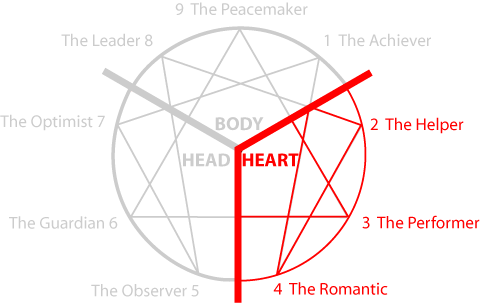
The minimum you need to know about the Enneagram symbol is that it is divided into three parts, representing the three ‘centres’ or types of intelligence in human beings – emotional, mental and physical. Another way of looking at the three centres is to see them as corresponding to different types of action – relating, thinking and doing.

basic-enneagram-groups

In this post I will outline the three ‘Heart’ types – Two, Three and Four. These types’ strength lies in their emotional intelligence – their ability to relate to others and their own emotions.

It’s important to remember that no types are better or worse than the others. Each type has strengths and weaknesses, opportunities and obstacles. And the Enneagram is not about putting people in boxes – we all have the potential to occupy any position on the Enneagram, and in different situations we can take on the characteristics of any of the nine types.

N.B. The names of the Enneagram types given here are not definitive – different teachers use different names, and some just refer to the types by number.

Enneagram The Heart Types

Type Two – The Helper

Type Two is skilled at reading others’ emotions in order to understand and meet their needs. Twos take their identity from their ability to help others. Generous to a fault, they can be relied up to step forward and take care of others when needed. Their giving can take many forms – time, attention, energy, experience, influence or money. Problems can arise when they start to give in order to receive something in return – whether material or emotional.

The stereotype of the Two is the kindly old grandmother or self-sacrificing carer, but Twos can also take on the role of the ‘power behind the throne’ of an influential person.

At their best Twos understand the joy of service. They are happy to give without seeking a reward in return, since making a difference to another’s life is what brings them pleasure. They find fulfilment in the act of giving, without clinging to the image of the ‘generous person’. There is nothing neurotic in their generosity, since they are wise enough to balance what they give to others with taking care of their own needs.

At their worst Giving becomes a form of manipulation, of making others feel indebted to them and returning the ‘favour’. Unable to acknowledge their own needs directly, they use emotional pressure to meet them indirectly, often without realising what they are doing. It is not enough for them to help someone else – they crave praise for their generosity and want to be recognised as a ‘special’ indispensable person. If they do not get this, they can criticise other and complain of their ‘ingratitude’. The dark side of the Helper is the self-appointed Martyr.

We all experience point Two any time we help someone else and experience the pleasure of seeing their face light up with happiness – and maybe a twinge of anticipation to see whether they have noticed our generosity?

Type Three – The Performer

Type Three is skilled at reading others’ emotions in order to influence them. Threes take their identity from their ability to win praise and recognition from large numbers of people, or of the most influential people. Because they always have one eye on the public perception of their actions, they become consummate performers at whatever they choose to focus on. Problems can arise when they become so attached to their public persona that they lose touch with their own real feelings and start to deceive both themselves and others.

The stereotype of the Three is the actor, showbiz performer or politician, but they can be found in almost any walk of life – such as the highest-profile manager, doctor, writer, salesperson or fitness instructor.

At their best Threes are the embodiment of excellence. They deliver a wonderful performance in every sense, and their impressive style is backed up by substantial achievement. They experience joy in the performance itself, without undue concern for their public image. They are able to distinguish between reality and illusion, and to balance public adulation with awareness of their own feelings and honest acceptance of their shortcomings.

At their worst Threes are addicted to the limelight and will stop at nothing to bolster their self-image. Cut off from their true feelings, they cling to the external trappings of success and are ruthless with anyone who threatens their position, sometimes resorting to underhand methods to discredit them. To others they look deceptive – all ‘spin’ and no substance – but they have been believing their own press for so long that they hardly notice the deception. The dark side of the consummate Performer is the plausible Liar.

We all experience point Three any time we perform a task particularly well and receive praise and recognition – and maybe the temptation to play to the crowd and bask in the limelight?

Type Four – The Romantic

Type Fours are highly sensitive to their own emotions, able to introspect deeply and to express these feelings in original ways. Fours take their identity from their sense of being true to themselves and following their own path in life, whatever the prevailing wisdom or fashion. Because of their ability to tap deep wells of emotion, they can create powerful works of art or take unusual and memorable paths through life. Problems arise when their introspection tips over into self-absorption and they start to lose touch with the realities of life around them, including the feelings of others.

The stereotype of the Four is the Romantic artist or poet, but their originality is not always expressed through artistic channels – they can be the black sheep or dark horse with a distinctive approach to any profession or life situation.

At their best Fours can inspire others with their originality and bring a magical, almost otherworldly quality to whatever they do. Whether artists or not, in their work they create something striking and meaningful that resonates deeply with those whom it touches. Instead of being attached to their own feelings, they take pleasure in expressing them and touching others’ hearts. They are able to balance self-awareness with a healthy respect for others’ feelings and the reality of the world around them.

At their worst they become so absorbed in their inner world that they lose touch with reality and become self-obsessed. Melancholy – never far away – turns into depression and they wallow in negative feelings. They become bitter against a world that ‘doesn’t understand’ them and angrily reject suggestions that they need to take their head out of the clouds and deal with the realities of life. Others see them as self-indulgent and start to lose patience with their negativity. The dark side of the Romantic is the neurotic Depressive.

We all experience point Four when we feel something so strongly that we have a vivid sense of the beauty and preciousness of life, so that no force on earth will persuade us to go against our true feelings – and maybe the temptation to milk the feeling for all its worth?

Questions

  • Do you recognize yourself in any of these descriptions?
  • Supposing you met someone who seemed to be at point Two, Three or Four – how could you ‘speak their language’ to make them feel at ease and relate to them on their own terms?

Part 3 in Enneagram — a Brief Introduction, The Head Types, will appear Thursday at about this same time.

_____________
Mark studied the Enneagram as part of his training as a psychotherapist. He has used it for his own personal development and in his work with individuals, families, and organizations. Mark McGuinness’ business Wishful Thinking, is a specialist coaching and training service for creative businesses such as design studios, ad agencies, film and TV production companies, computer games developers, architect’s practices and fashion designers.

Thank you, Mark,
–ME “Liz” Strauss

Related:
See the complete series listing at Series: The Enneagram – a Brief Introduction

Filed Under: Personal Branding, Successful Blog Tagged With: bc, enneagram, Mark-McGuinness, the-heart-types, wishful-thinking

  • « Previous Page
  • 1
  • …
  • 737
  • 738
  • 739
  • 740
  • 741
  • …
  • 1050
  • Next Page »

Recently Updated Posts

The Creator’s Edge: How Bloggers and Influencers Can Master Dropshipping

Is Your Brand Fan Friendly?

How to Improve Your Freelancing Productivity

How to Leverage Live Streaming for Content Marketing

10 Key Customer Experience Design Factors to Consider

How to Use a Lead Generation Item on Facebook


From Liz Strauss & GeniusShared Press

  • What IS an SOB?!
  • SOB A-Z Directory
  • Letting Liz Be

© 2025 ME Strauss & GeniusShared