Successful Blog

  • Home
  • Community
  • About
  • Author Guidelines
  • Liz’s Book
  • Stay Tuned

Know Your History To Shape Your Future

May 20, 2010 by Guest Author

cooltext455576688_blogging

By Terez Howard

We all have a story to tell. Some naturally have more interesting stories than others, while the great story tellers have a way with words, even if their tales are not particularly earth-shattering. What we experienced in the past and experience at present, whether it directly relates to our niche or not, makes its way into our blogs.

But what is a blog? If you’re reading this, you have some idea. My husband recently asked me how the term blog got started. This definition is for him and anyone like him who would like to know the etymology of the word.

William Safire put it so well back in 2002. He wrote this: Blog is a shortening of Web log . It is a Web site belonging to some average but opinionated Joe or Josie who keeps what used to be called a ”commonplace book” — a collection of clippings, musings and other things like journal entries that strike one’s fancy or titillate one’s curiosity. What makes this online daybook different from the commonplace book is that this form of personal noodling or diary-writing is on the Internet, with links that take the reader around the world in pursuit of more about a topic.

That 8-year-old definition still applies to the present blog. It isn’t just about writing a journal. It’s about making a difference.

You have to know where you came from to know where you’re going.

That old adage has been recited to me many times. What does it mean to bloggers as a group? According to Safire, a blog would “strike one’s fancy or titillate one’s curiosity.” When I read this, I wondered whose curiosity he was speaking of? The blogger’s or the reader’s?

It should be both. A blog is meant to be shared and get an audience involved in a subject. You write what you know. You write what you love. You write what you hate. But more basically, you write what you find is interesting, and you hope that others will be interested, too.

How do you keep people interested?

Let’s go back to our history. Safire said bloggers should “take the reader around the world.” One way to keep your audience interested is by guiding them through the world wide web with links that explore your topic deeper.

Bloggers can link to the following:

  • Other people’s blog posts related to your topic.
  • Your own related blog posts.
  • Websites of businesses, communities and people you mention in your posts.
  • Your other blogs.
  • Your own websites.
  • Videos relating to your content, by you or someone else.
  • Audio downloads that explore your topic further, by you or someone else.

You can place these links at the beginning or end of your posts, depending on the link. You can have a designated page for these links, such as one that includes links to your other websites. You also can put links in your right or left panel, so they’re easily accessible to visitors.


When your blog thoroughly provides answers to readers through content and external links, your audience will look to you as an expert in your niche. They will come back for more.

Now that you know your history as a blogger, how will that knowledge affect your future in blogging?

—
Terez Howard operates TheWriteBloggers, a professional blogging service which builds clients’ authority status and net visibility. She regularly blogs at Freelance Writing Mamas . You’ll find her on Twitter @thewriteblogger

Thanks, Terez!

–ME “Liz” Strauss
Work with Liz on your business!!

Filed Under: Successful Blog, Writing Tagged With: bc, blogging, LinkedIn, Terez Howard

Cool Tool Review: Aquent & crowdSPRING

May 20, 2010 by Guest Author

Todd Hoskins Reviews Tools for Small Business

cooltext451585442_tools

Todd Hoskins chooses and uses tools and products that could belong in a small business toolkit. He’ll be checking out how useful they are to folks who would be their customers in a form that’s consistent and relevant.

Cool Tool Review: Aquent & crowdSPRING
A Review by Todd Hoskins


(Disclosure: I currently work with Aquent)

The free agent revolution predicted by Fast Company more than a dozen years ago never fully happened. The rising costs of healthcare, along with our collective drive for security as a result of war and economic turmoil made many people choose employment rather than a life of freelancing.

For reasons of choice or necessity, there are still a lot of independent workers looking for the right gig. Large businesses often will use contractors to provide flexibility, cost savings, or to rent skill sets they do not have. Small businesses should use freelancers more often.

I recommend a couple companies that match talented people with organizations in need of help: Aquent and crowdSPRING.

Aquent has been in business for 24 years. With offices around the globe, and specialized practices in online marketing, interactive design, user experience, traditional marketing, and graphic design, they find the best people either offsite or locally to fit your culture and need.

picture-8

It works this way. You have a project, or perhaps someone is taking a one month vacation. You contact Aquent. They assign an agent who will select some candidates from their talent pool based on budget, skill set, and working environment. You interview one or a few, and make a choice. Aquent pays the talent and bills you. The whole process can take less than a week.

For a small business, this gives you access to the most talented designers and marketers for a time period and cost that you dictate, without needing to screen a bunch of people or take on a full-time employee.

crowdSPRING offers logo, graphic design, and writing services, with a much different approach. You post the project on their site, including deadline and a price. Then you wait for the creatives to submit their entries. In addition, crowdSPRING has one of the best small business blogs out there. They are smart people, now with a network of over 60,000 freelancers.

picture-9

Summing Up – Is it worth it?

Enterprise Value: 4/5 – Revive the Free Agent Revolution. There is great talent ready to help. Compelling alternative to paying agencies to do execution work.

Entrepreneur Value: 5/5 – A 2 week SEO engagement, site redesign, or copy rewrite can make a big difference

Personal Value: 2/5 – if you’re a freelancer, these companies can help you

Filed Under: Successful Blog, Tools Tagged With: Aquent, bc, crowdspring, freelancing, LinkedIn, Todd Hoskins

Beach Notes: Catch the Wind

May 16, 2010 by Guest Author

by Guest Writers Suzie Cheel and Des Walsh

Photo of outriggers, Coolangatta Beach, Queensland, Australia, by Des Walsh

kirrakytes500

One Sunday afternoon, walking on nearby Kirra Beach, we came across a group of kitesurfers, or kiteboarders. It was a blustery day, with the wind whipping up the waves. It was fascinating to see how, to get the kites in the air their owners had to exert a huge amount of energy and strength. Then once the kite was up the wind gave it dramatic power. The board rider’s task then was basically to manage and steer, but it seemed the kite and the wind were in control of the speed and direction.

Business analogy? Starting a business we have to expend a lot of time and energy. Our goal will be to get our business to a point where it can “catch the wind” of the market, with us then having to steer and manage, but ideally without all the huge effort we expended to get started.

Suzie Cheel & Des Walsh

Filed Under: Motivation, Successful Blog Tagged With: bc, Beach Notes, Des Walsh, Suzie Cheel

Cool Tool Review: Dabbleboard

May 13, 2010 by Guest Author

Todd Hoskins Reviews Tools for Small Business

cooltext451585442_tools

Todd Hoskins chooses and uses tools and products that could belong in a small business toolkit. He’ll be checking out how useful they are to folks who would be their customers in a form that’s consistent and relevant.

Cool Tool Review: Dabbleboard
A Review by Todd Hoskins

The dreaded dial in . . .

I had a colleague who referred to virtual meetings as “pajama business.” It is only within the last few years that we have gained the luxury of clipping toenails during a CEO update, or making egg salad during a development team scrum. The gain in freedom has often been offset by a loss in engagement. When I can’t see your smirk, or feel your trepidation, or witness your enthusiasm, I am less connected to you, my client or co-worker.

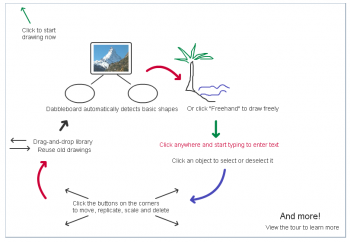
A few weeks ago I reviewed Prezi, my favorite tool for visualizing a presentation. There are plenty of collaboration tools out there for bridging the visual divide in virtual meetings, from screen sharing to video conferencing. This week I want to highlight a simple digital whiteboard called Dabbleboard that can encourage participation, and aide the visual learners and thinkers among us (like me).

The visual component of any meeting is important. Dan Roam received considerable attention a couple years ago for solving problems and selling ideas in pictures in his book The Back of the Napkin. Dabbleboard provides the necessary functionality to place a blackboard or napkin in front of anyone with whom you want to share.

For a sales pitch, a site redesign, a strategy meeting, even reviewing financials – all of these situations improve with pictures and shapes. A different part of our brain gets activated and you’ll keep the attention of your people or prospects.

picture-7

I have also tried Scriblink, which worked fairly well. Both tools offer chat, real-time sharing, and phone conferencing. I like Dabbleboard’s personal image library – you can reuse graphics you’ve made. I also like their commitment to their users, evidenced in their blog and the creation of a toolkit.

A Pro (paid) version is available that includes customization, permissions, data portability, and security. If you’re going to create highly confidential drawings, you may want to pay the monthly fee. Discounts are also available for not-for-profits and educators.

Summing Up – Is it worth it?

Enterprise Value: 3/5 – Adobe and Microsoft lack the whimsy of Dabbleboard

Entrepreneur Value: 4/5 – excellent, though the UI could be better. AlmostMeet in beta (Please, please change the name).

Personal Value: 2/5 – great for school projects

Filed Under: Business Life, Successful Blog, Tools Tagged With: bc, Dan Roam, LinkedIn, Scriblink, Todd Hoskins

4 Headline Types that Grab Attention Immediately

May 13, 2010 by Guest Author

By Terez Howard

How to blog series
cooltext455576688_blogging

One Blogging Secret That Everyone’s Telling You

I have something to tell you. You’ve heard it before. You know it’s beneficial to every blog. The great bloggers write about this regularly and practice what they preach.

Attention-grabbing headlines. There, I said it. Secret’s out. or it’s been out for years.

4 Headline Types that Grab Attention Immediately

When I worked for the newspaper, my editor told us that our headlines had to tell our readers something. Sounds simple enough, right? It is pretty straightforward.

I wrote the following story back in 2005: “Katrina victims in Chester tell their story of survival.” I could have written “Hurricane story.” My now five-year-old headline told readers what to expect from my story and why they would want to read it. My second, obviously bland headline example doesn’t tell you anything. It sounds like a fictional piece on a hurricane’s journey through an area.

Your headline needs a voice. While it doesn’t have to be a summary of your entire blog post, it should give your readers a taste of what to expect.

What kinds of headlines should you write? Here are four:

Raise a question

You can specifically ask a question, but your headline does not have to be a question. Rather, readers will ask themselves a question and want to know the answer.

For instance, my headline for today: “One Blogging Secret That Everyone’s Telling You.” What secret? Why’s it a secret if everyone’s telling me? Who’s telling me? These are the questions my headline raises, and I provide the answers in my blog.

So when you write a headline that raises a question, be sure to provide a satisfactory, thorough answer to your audience.

Include a list

“101 Blogging Topics That Will Keep Readers Coming Back In Hundreds”

Once again, readers know what to expect, that when they click on your post, they will see a numbered list, from 1 to 101. Why do lists make wonderful headlines? Bloggers will tell you how the search engines love numbers and how numbers are memorable to readers. These points are true, but not my focus.

From a blogger’s standpoint, lists are easy to write. As a writer, a list organizes my thoughts for me from 1 to whatever. From a reader’s standpoint, lists are easy to read. You expect a comprehensive, systematic piece of information.

Make a how to

People love a good how to. I love how-to’s. I followed a how to count calories and lose weight story and shed 10 pounds.

Tell your readers exactly what they will be able to do if they follow your how to. A how to headline does not have to be so basic, though. It could be a “How to not…” or a how to do something metaphorically, like “How to pop eyes with your headlines.”

Be compelling – Make it urgent

What makes you want to click on a blog post? It piques your interest. With the three aforementioned types of headlines, each and every one should be compelling. It kills me that bloggers spend their time writing a well-researched, thoroughly engaging post and don’t give any time to the headline. It’s an afterthought.

That doesn’t mean you can’t write your headline last. That’s a fine idea and preferable to many bloggers. I tend to write my headline first and tweak it as I write make it fit the entire post. Do what works for you, just so you give time to your headline.

Your headline is your appetizer. It prepares your audience’s appetite to the main course. Does your headline induce hunger? Hey, sounds like a headline!

What do you do to write an attention-grabbing headline?


—

Author’s Bio:
Terez Howard operates TheWriteBloggers, a professional blogging service which builds clients’ authority status and net visibility. She regularly blogs at Freelance Writing Mamas. You’ll find her on Twitter @thewriteblogger


Thanks, Terez!
–ME “Liz” Strauss

Filed Under: Blog Basics, Content, Successful Blog Tagged With: bc, blogging, business-blogging, headlines, How-to-Blog, LinkedIn, Terez Howard

Cool Tool Review: GiveForward & ChipIn

May 6, 2010 by Guest Author

Todd Hoskins Reviews Tools for Small Business

cooltext451585442_tools

Todd Hoskins chooses and uses tools and products that could belong in a small business toolkit. He’ll be checking out how useful they are to folks who would be their customers in a form that’s consistent and relevant.

Cool Tool Review: GiveForward & ChipIn
A Review by Todd Hoskins

It’s difficult to ask for money. Whether it’s making a pitch to an investor, raising funds for a cause, or getting through a personal financial crisis, it’s uncomfortable and humbling to look someone in the eye with open hands and say, “Please.”

I missed out on a class trip to England years ago because I couldn’t sell enough pizza discount cards. Door-to-door pleading was not as effective as I hoped, so I went to school while my schoolmates went to Buckingham Palace. Lesson learned. Money is more easily earned.

Thank you, Tim Berners-Lee for the Internet, which in addition to providing knowledge, community, and a living for many of us, the WWW makes fundraising a whole lot simpler.

There are two primary reasons a business would want to raise funds online. First, as an alternative to sourcing angel investments. Grandpa and your rich friend Gretchen could indeed be angels, giving you the head start to get a business up and running, or reach the next phase of growth. In the world of peer-to-peer financing, Prosper has been democratizing business investments for over four years now. If you have friends and family who support your initiative, why not avoid the cost and hassle of interest rates and term sheets?

The second reason a business would get into fundraising is to bring awareness and money to a cause. It’s a good business practice (and human practice) to be charitable. Donating time and/or funds to a community development project, for example, ties a business to the community. It’s also appropriate to announce, “We care about this. Want to help?”

There are two tools I recommend that can help you ask for help. GiveForward and ChipIn are both simple and inexpensive, serving slightly different purposes.

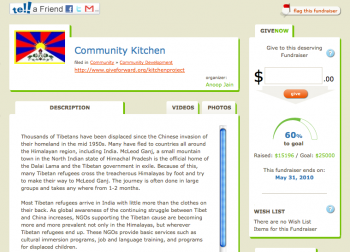
GiveForward features a page. ChipIn features a widget. If you need to tell a story, make a case, provide some background, and allow comments, then GiveForward is the right choice. If you’re hoping to receive single donations in the hundreds or thousands of dollars, GiveForward is going to provide more peace of mind to the donor.

picture-42
ChipIn is better used for “crowdfunding,” encouraging your reader base or network to chip in a few dollars. It works with PayPal. The widget is not pretty, but it’s very visible on your blog or site.

Summing Up – Is it worth it?

Enterprise Value: 2/5 – some custom development would be appropriate for larger businesses

Entrepreneur Value: 3/5 – show your passion, whether it’s for your business or a cause

Personal Value: 4/5 – for soliciting or researching donations, sites like GlobalGiving and GiveForward are important

Filed Under: Tools Tagged With: bc, ChipIn, GiveForward, LinkedIn, Todd Hoskins

  • « Previous Page
  • 1
  • …
  • 75
  • 76
  • 77
  • 78
  • 79
  • …
  • 109
  • Next Page »

Recently Updated Posts

Is Your Brand Fan Friendly?

How to Improve Your Freelancing Productivity

How to Leverage Live Streaming for Content Marketing

10 Key Customer Experience Design Factors to Consider

How to Use a Lead Generation Item on Facebook

How to Become a Better Storyteller


From Liz Strauss & GeniusShared Press

  • What IS an SOB?!
  • SOB A-Z Directory
  • Letting Liz Be

© 2025 ME Strauss & GeniusShared