Successful Blog

  • Home
  • Community
  • About
  • Author Guidelines
  • Liz’s Book
  • Stay Tuned

Teams: How to Make Quality the Signal above the Time and Money Noise

December 28, 2010 by Liz

(Updated in 2020)

Photo by Marvin Meyer on Unsplash

10-Point Plan: Train Self-Managing Teams with an Outstanding Bias Toward Quality

Show Me in the Contract Where It Assures the Work Will Be Good

Spend enough time in business you hear the saying, “Fast, Quick, and Good, Can’t have all three!” or some version of it. In my business it was Quality, Schedule, Budget, Pick Two!”

I watched and wondered for years what made this algorithm work. Observation proves that without constant surveillance it consistently comes out the same.

Schedule and Budget win out over Quality.

Quality is hard to define, protect, and keep. It’s high touch, high concept, by it’s very nature qualitative and subject to discussion. Schedule and budget are right there, out loud, down on paper easy for everyone to measure and see.

In a business endeavor, every member of a team knows exactly how late, how much over budget some effort might be, but few can agree how much it has slipped on quality.

If we’re talking about products, it’s hard enough judge the quality gap — that’s the job of the product team.
But suppose we’re talking about quality leadership, quality thinking, quality communication, quality relationships, or living out a quality social media strategy?

How Do You Keep the Noise of Time and Money from Killing Quality?

Quality leadership does the quality thinking that forms the quality decisions. It’s quality communication that builds long-term quality relationships. That kind of quality is at the foundation of any team endeavor that succeeds. It’s also the at the core of any quality social media strategy.

Whether we’re talking to employees, customers, or volunteers, it’s important that we telegraph with every nuance of our brand that quality will always be the signal above the noise of time and money. Because quality is about them.

How do we build an outstanding bias toward quality into the fabric of our organization and our teams? Use the same steps we used to build a brand-values baseline and if you can, invite help from that same core team.

  • Start with the heroes and champions from the core team. Whenever change is the goal, look for the folks most predisposition to embrace the change and invite them first.
  • Put the problem before the change makers — about 12 people in three teams. When they have gathered first challenge the teams to define quality as a definition of thinking, leadership, communication, relationships, and process. Have them come to one definition for their team.
  • Ask that core group of change makers how to tackle the problem Ask them how to bring quality to be the highest signal above the noise on their team.
  • Listen and record their answers. Think of it as a list of possibilities, not necessarily a brainstorm, but more like an offer of possible tactics to try in their natural habitat.
  • Review the list and ask the group to sort it. Choose three categories. Possible categories might be leadership-based ideas, communication-based ideas and process-based ideas.
  • Ask each team to discuss one of the three lists they’ve made. Suggest that they discuss how well the idea might work over time with their coworkers, how it might need to be changed, and whether it needs outside input. Allow teams to add or remove ideas. Explain that they’re looking for one or more ideas that have merit — enough power and value that the team believes they could persuade others to put the idea into action.
  • Invite the teams back to the group to present the ideas that they believe have merit. Challenge the teams to persuade the rest of the room to take on their call to action.
  • Allow the listening teams to give their response and to offer their opinion on how easily they might be able to persuade others to join in to the proposed quality challenge. Work together to help reword and rework any that have value, but need a more powerful argument.
  • Decide on the most effective quality-enhancing changes that are most natural to the organization.
  • Build a strategy on how to introduce them to the larger group. Will it be peer-to-peer training? Will it be a meeting? Will it be a proof of concept that the small group tries and then demonstrates success?
  • Then, choose a way that everyone can measure the success of the attempt to change behavior to a more quality-based way of work. Set a date to meet again to report back, consider how things worked, and adjust the call to action or the process.

Research has proven we go where we look and we change what we measure. If we want our bias toward quality in thinking, leadership, communication, and relationships to grow, we have to look at, measure and talk about them in the same ways we do schedule and budget. If we want quality to be the signal above the noise, we have to invest our schedule and budget in making it so.

People look at what we do — not what we say — to know what we believe.

How do you prove to your employees, customers, and volunteers that quality is above the noise of time or money?

READ the Whole 10-Point Plan Series: On the Successful Series Page.

Be Irresistible.

–ME “Liz” Strauss

Filed Under: Content, Marketing /Sales / Social Media, Successful Blog Tagged With: 10-point plan, LinkedIn, quality, relationships, teams, trust

Retweet or Race to the Finish: 3 Steps to Influencing Action

December 27, 2010 by Liz

Not Just a Call, but Real Action

cooltext443794242_influence

You want people to retweet you?

Whatever the action, a retweet, a call to arms, or a race to the finish, enlisting a folks to move in the same direction to follow our passionate action requires that we follow some simple acts of our own. Consider these three steps and and the following equation the next time you want to influence people move to act on your behalf.

The three steps to influencing action are simple, but also harder than they look:

  1. Give people a big reason — important, urgent, and about teamwork — filled with meaning that is bigger than helping you do what you want..
  2. Show them how fulfilling the mission will benefit them and make them proud to have been a part.

    Request for RT = benefits for Requestor and the requestor’s people.
    RT http://mysite.me because we need 100 fans to help our school.

    Request for RT = benefits the Retweeter and many other people.
    RT http://kidzrd.com/ & Get a thank you from a kid who’s learning to read & a link in Reading Heroes List

    Which request would be more likely to move you to action?

  3. Make it easy to be a part. Whatever the action, hoard the hard labor, and offer the hero parts.

As with any quest in which we want to move people to action …

The rules are fueled by the spirit of leadership — the belief that we can build something important and urgent together that we can’t build alone. It’s our team on a relay race. It’s giving the reason that we want to run the race and are willing invest our best to go for the win.

679px-southern_12_stage-02_1988

The math is simple.
Meaningful reason + proud feeling of sharing = a message that goes wide.

It doesn’t take training in calculus to work through this equation. It takes a true sense of humanity and human relationships. Any caring person can get to that.

What do you find is crucial to moving people to action in what you do ?

–ME “Liz” Strauss
Work with Liz on your business!!

Buy the Insider’s Guide to Online Conversation.

Successful-Blog is a proud affiliate of

third-tribe-marketing

Filed Under: Marketing /Sales / Social Media, Successful Blog Tagged With: bc, LinkedIn, RT, Strategy/Analysis, Twitter

What Is the Most Crucial Element of Influence?

December 21, 2010 by Liz

The Outcomes We Achieve

cooltext443794242_influence

Every person has influence. What what we say, and how we act has an effect on how others think, feel, and behave. As a writer, an observer, and manager, I’ve watched and studied how people respond to what we do, what we say, and what they see.

As every parent and pet owner knows, sometimes the outcome we’re going for — a change in belief or behavior — isn’t the outcome we achieve. Our intent, our feelings toward an audience are only one side of the equation. How that audience interprets our words and deeds determines the change in belief or behavior that might result.

Our influence is highly affected by context.

  • The world view of the people we might influence. An individual’s emotional associations and beliefs can filter how people interpret our intentions, our words, and actions. A person who believes all learning must be their own experience will ignore a warning to avoid a dangerous part of town. A person who has only had bad experiences with people from our “group” may fight against any message we offer.
  • The value those people put on their relationship with us. Filters such as the halo effect and other cognitive biases, such as wishful thinking, can change how our message is processes and received.

We don’t control how other people think, what they feel, or how they interpret what they hear and see.

Though we may carefully consider and choose the most generous way to communicate and interact within those those contexts, the audience will choose their interpretation of that interaction. The same authentic, highly influential, collaborative message to one audience will be a disingenuous, controversial, alienating rebuff to another audience. We see that all of the time in the world of politics.

The most crucial element of influence is understanding what the audience and what the already believes. If we want to influence people, to move them to an important action, to change their core beliefs, we need to know the audience, listen to their world view, champion their cause, and honor their reality. Lasting influence is a trust relationship built through time and shared experience.

How do you champion the audience you want to reach?

–ME “Liz” Strauss
Work with Liz on your business!!

Buy the Insider’s Guide to Online Conversation.

I’m a proud affiliate of

third-tribe-marketing

Filed Under: Marketing /Sales / Social Media, Motivation, Successful Blog Tagged With: audience, bc, influence, LinkedIn, Marketing /Sales / Social Media, relationships

Tom Peters, the Chihuahua Story, and the Effect of Your Influence

December 20, 2010 by Liz

cooltext443794242_influence

Tom Peters, Influence Quote and the Retweet

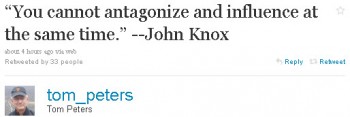
Recently on Twitter, author, speaker, professional agitator, and my personal hero, Tom Peters (@Tom_Peters) quoted John Knox with this tweet:

tom_peters

I retweeted it.

Three Wise Men Respond

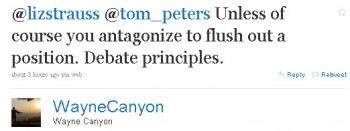
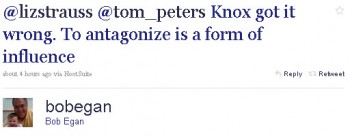
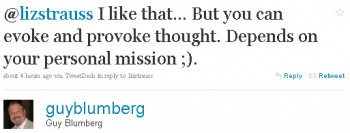
Three gentleman responded with interesting comments as you can see.

waynecanyon


bobegan

guyblumberg

That got me thinking about influence again and how the experts define it.

Wikipedia and What Is Influence?

I spent a few hours reviewing what I knew and researching more about influence, its definitions, and its synonyms to arrive at the most basic idea that connects them.

Influence is the power to change behavior or beliefs.

Wikipedia shares a wealth of information across domains on what influence is …

Sphere of influence (astrodynamics), the region around a celestial body in which it is the primary gravitational influence on orbiting objects
Sphere of influence (astronomy), a region around a black hole in which the gravity of the black hole dominates that of the host bulge
Social influence, in social psychology, influence in interpersonal relationships

In terms of social influence, they point to compliance, identification, and internalization. From what I see, the science of influence limits the change to be that which evokes a positive result.

Social influence occurs when an individual’s thoughts, feelings or actions are affected by other people. Social influence takes many forms and can be seen in conformity, socialization, peer pressure, obedience, leadership, persuasion, sales, and marketing.

Like the three who commented on my retweet, I agree, our words and acts have influence beyond what’s described here. Antagozing can influence beliefs or behaviors. Sometimes we influence without knowing it. Sometime our influence can bring about unexpected responses.

The Chihuahua and the Effect of Your Influence

We can set out to have influence or gain influence. We can see how our actions influence behaviors and belief systems. We can mislead ourselves into believing we have influenced in one direction, when in fact we have done no such thing. The intent of our influence does not guarantee the outcome.

Which leads me to the story of the chihuahua.

The Story of the Chihuahua

110319_chihuahua_5

A man renovated his house, tearing out the entire kitchen. Every fixture, appliance, and bit of the original room was removed. He started over with four walls, one window, and the door to the backyard. During the winter rebuilding the kitchen floor was down to the concrete foundation.

The man and his wife had a chihuahua and the one thing the man hated was taking the dog out to the backyard to pay its call to nature, especially in the winter. So the man covered a huge corner of the torn-up kitchen with a rubber mat and some newspaper; put a dog bowl there; and he allowed the nervous little pet to do his “duty” there.

When the spring came, the kitchen was finished complete with very expensive new hardwood flooring. It was no longer acceptable for the tiny dog to stay in the kitchen when nature was calling. The man made a plan to change the dog’s behavior.

Every time the dog messed the kitchen floor, the man would stick the chihuahua’s nose in the mess and then toss the dog out the back door or out the open kitchen window.

The chihuahua did change its behavior. After it “went” on the floor, it jumped out the window.

Sometimes we mistake, misinterpret, and totally miss on seeing our influence. The man changed the dog’s behavior, but it wasn’t the change the man had been going for. All of the predictable outcomes of our influence aren’t always obvious.

Silence doesn’t always mean agreement. Changed behavior doesn’t always mean a change in thinking. Sometimes we influence a change in behavior that goes in a direction other than we’re thinking.

No one is really without influence. we all have the power to move another person to change a belief or behavior. The most influential watch what how influence works in their own lives and learn from that. As my friend, Chris Brogan demonstrates exactly how he does that when he discusses ways we can improve our influence. It’s the quality of our thinking, the concern for the listener, and care in our delivery, that makes our influence move a thought or action in the direction we hope.

What examples of “chihuahua story influence” have you seen in business?

–ME “Liz” Strauss
Work with Liz on your business!!

Buy the Insider’s Guide to Online Conversation.

Successful-Blog is a proud affiliate of

third-tribe-marketing

Filed Under: Marketing /Sales / Social Media, Successful Blog Tagged With: bc, influence, LinkedIn, relationships, Strategy/Analysis

Thanks to Week 269 SOBs

December 18, 2010 by Liz

muddy teal strip A

Successful and Outstanding Bloggers

Let me introduce the bloggers
who have earned this official badge of achievement,

Purple SOB Button Original SOB Button Red SOB Button Purple and Blue SOB Button
and the right to call themselves
Successful Blog SOBs.

I invite them to take a badge home to display on their blogs.

muddy teal strip A

andreas-balancing-act
blind-influence
careerwise
my-storyboard-life
new-adventures-of-an-old-sid

They take the conversation to their readers,
contribute great ideas, challenge us, make us better, and make our businesses stronger.

I thank all of our SOBs for thinking what we say is worth passing on.
Good conversation shared can only improve the blogging community.

Should anyone question this SOB button’s validity, send him or her to me. Thie award carries a “Liz said so” guarantee, is endorsed by Kings of the Hemispheres, Martin and Michael, and is backed by my brothers, Angelo and Pasquale.

deep purple strip

Want to become an SOB?

If you’re an SO-Wanna-B, you can see the whole list of SOBs and learn how to be one by visiting the SOB Hall of Fame– A-Z Directory . Click the link or visit the What IS an SOB?! page in the sidebar.

–ME “Liz” Strauss
Filed Under: Blog Comments, Marketing /Sales / Social Media, Motivation, SOB Business, Successful Blog, Writing Tagged With: bc, blog-promotion, SOB-Directory, SOB-Hall-of-Fame, Successful and Outstanding Blogs

7 Ways to Be Sticky with Millennials

December 17, 2010 by Guest Author

A Guest Post by Patricia Martin

cooltext443809437_relationships

Let’s be honest. There’s so much information out there about marketing to Millennials that it can get confusing. That’s why I leapt at the chance to undertake a research project for Steppenwolf Theatre Company, based locally here in Chicago. For those of you who might not know them, Steppenwolf’s founders include Gary Sinise, John Malkovich, Laurie Metcalf and Joan Allen. They asked me to interview CMO’s of world-class brands to find out what they were doing to woo Millennials. To my surprise, each and every executive I spoke to, from Google to Red Bull, eagerly shared their secrets.

The wisdom they shared comes from several years of experimentation and leans heavily state-of-the-art social media strategies. Results? Wrap your mind around this: Ford Fiesta’s blogging agents campaign earned it an unprecedented 64 percent brand awareness among the target prior to the vehicle launch. That’s without spending a dime on traditional advertising.

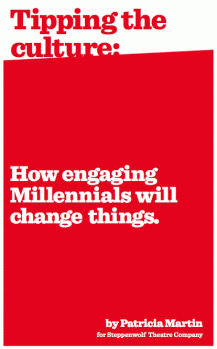
tippingtheculture

The following 7 tips for making your brand irresistible with Millennials, or “sticky”, are taken from the FREE eBook that I wrote with Steppenwolf. The book distills the lessons these brands have learned…and now share with you.

#1: Surprise and delight

Overall, young people prefer to discover new things, rather than being “told” what’s interesting. Spontaneity is pleasurable.

Suggestion: Invite them on the spur of the moment to be your guest, or give them a token of appreciation out of the blue for engaging with your brand.

#2: Create a feedback loop

Young cultural consumers crave meaningful interactions. Attractive brands invite dialogue, and then show they are listening by being responsive. Twitter, Facebook, and comment replies facilitate this.

Suggestion: If you ask for their input, make sure there is some kind of feedback loop. Post results of surveys, email or direct tweet a follow-up “thank you” or otherwise credit their contributions. Failing to recognize a contribution from a Millennial feels like unrequited love.

#3: Invite people to share

Teams and tribes, friends and family groupings—Millennials like to team up. Host contests that require them to create content or collaborate in some way. Offer tools or apps to self-organize. Facebook is a self-organizing platform.

Suggestion: Seed group events. Offer discounts or special status to mavens to share with their inner circle.

#4: Justify the purchase

Price is a consideration for this age group. They will spend, but the product alone may not be enough. It’s not just about offering a discount, but providing a value-related benefit.

Suggestion: Offer a discount, special premium, sneak-peek experience. Incent, invite, hug them with a free fan T-shirt.

#5: Embrace the remix culture

Well educated and living in a post-modern culture, little is new for them. Fusing genres, technologies, and art forms not only lends an element of surprise, it also energizes the experience with the spirit of experimentation.

Suggestion: Don’t be afraid to switch gender roles, create hybrids, and involve cross-disciplinary collaborations to borrow vintage icons and wed them to the digital culture.

#6: Emphasize humanity

Millennials are idealists. Many of them who consume culture also crave intimacy. They embrace ideas and organizations that represent a grander purpose, and they prefer that these ideals have spokespersons with whom they can relate or admire.

Suggestion: Ask for a comment: “Ever felt like that?” Consider auditioning guest bloggers who fit your brand’s psychographic profile. It’s fine to give them some guidelines. They will likely consider it a cherished credential.

#7: Stay sticky with reusable content

Keeping up with the content demands of self-expression—blogging, tweeting, and maintaining fresh content on Facebook walls-—makes this generation hungry for content they can reuse. They need fodder for the Facebook pages and tweets. Give it to them.

Suggestion: Stock your sites with pithy quotes, quick-hit ideas, photos, and videos that make people come back to you or your site for something: a download, application,
comment, or vote. Then stand back and watch it go viral.

For many more tips in this spiffy eBook, download it as a PDF, or as an
ePub for your reader, iPad or iPhone. It’s a quick and easy 32-page read of invaluable
secrets from top brands.

Find out now how top brands are Tipping the Culture.

—–
Patricia Martin is a speaker, author, consultant and researcher on the consumer culture. You’ll find her at
Patricia-Martin.com Her twitter name is @PatriciaMartin

Thanks, Patricia! Every time I read your work, I find out something new about people. I love that!

–ME “Liz” Strauss
Work with Liz on your business!!

Buy the Insider’s Guide to Online Conversation.

I’m a proud affiliate of

third-tribe-marketing

Filed Under: Marketing /Sales / Social Media, Successful Blog Tagged With: bc, consumer culture, LinkedIn, Millennials, Patricia Martin

  • « Previous Page
  • 1
  • …
  • 55
  • 56
  • 57
  • 58
  • 59
  • …
  • 174
  • Next Page »

Recently Updated Posts

The Creator’s Edge: How Bloggers and Influencers Can Master Dropshipping

Is Your Brand Fan Friendly?

How to Improve Your Freelancing Productivity

How to Leverage Live Streaming for Content Marketing

10 Key Customer Experience Design Factors to Consider

How to Use a Lead Generation Item on Facebook


From Liz Strauss & GeniusShared Press

  • What IS an SOB?!
  • SOB A-Z Directory
  • Letting Liz Be

© 2025 ME Strauss & GeniusShared