Successful Blog

  • Home
  • Community
  • About
  • Author Guidelines
  • Liz’s Book
  • Stay Tuned

Tailoring Twitter: The ROI of Curating Content on Twitter

April 25, 2011 by Liz

What You Share Defines You

insideout logo

Last year, I started experimenting with curating content on Twitter. I had three good reasons. I realized that

  1. Twitter was no longer an extension of blog, but had become it’s own thing. Like a new summer home where I met a new neighborhood of people, many of them didn’t know my background, my skillset, my expertise, or my interests. A twitter bio doesn’t do much to fill in that.
  2. The weekly link post on my blog “The SOB Business Cafe” wasn’t as useful today as a filter as it once had been. Not every great post is evergreen enough to wait until Friday for sharing. And a single post collect such things needs to be targeted and niched well with a title that brings home their value. Rearranging that slot in that way would be turning it into a totally new thing. I had other ideas about using that space to feature members of the community.
  3. Becoming a blogger had given me a way to keep up the writer’s discipline of writing every day — a habit that had built my skills and served me for decades. The idea of curating great content would give a way to keep up the writer’s discipline of reading great content every day — a habit that would build my skills and keep me current in an ever changing business environment.

To say it paid off would be an understatment. While reading for articles to share, I found new thoughts to consider and new ideas to write about. And like blogging, curating content on Twitter taught me more about relationships, social skills and building a network than I might ever have expected.

Here’s how I did that …

Build a Stronger Network by Curating Content On the Go

Don’t think for a minute that I’m exaggerating about the “minutes a day” part. I curate content during commercials on TV and while I’m waiting for people to meet me in a restaurant. At the risk of sounding like Dr. Seuss …

I curate in the morning.
Breaking out save articles without warning.
I curate on a break.
I curate eating cake.
I curate near the lake.
Sometimes I save an article to read and curate while I wait
for a meeting, a phone call, an appointment, or blogger date.
I curate especially during commercial breaks …

Two Ways to Curate on the Go

Actually, I’m not quite as obsessed as all that. But I do curate in the minutes that I used to just sit. Here are two ways I do that.

  1. When someone shares a great article on Twitter that I don’t have time to read right then, I send the that article to my Instapaper account. When I find I have a few minutes to read a bit, I have a queue of articles that already have my interest waiting to be read. I share the ones I think serve my audience interests and needs.
  2. I also have a list of publications — standard publications in my niche, writers who say thought provoking and useful things, and outliers who connect ideas in interesting ways. I’ve collected them into sets of bookmarks. About once a week I visit their websites to see what they’ve been talking about and share what I find to be the most useful of their content.

Sometimes I tweet what I find at that very moment. Often I schedule the content I curate so that I don’t binge tweet. I also think about when an article might be most useful to folks. So I try to post articles that require more reading time at night, how-to and building articles or on the weekend, and ways to perform better at work during the week. [I use Tweetdeck to schedule these curated tweets and the only tweets I schedule are curated tweets.]

The ROI of Curating Content on Twitter

The discipline of reading regularly and curating what I prized had more ROI than I’d ever have guessed. Naturally I got closer and more up-to-date with great content, but the return was far more than that. Here are the direct benefits that were a result of investing a few minutes whenever I had the time.

  1. The content I curated defined me more clearly and differently to the people who follow my Twitter Stream. This single reason is huge. Don’t just be the “sales guy” be the “sales guy who’s up on the latest news and issues.”
  2. That content began attracting people who want to read the content I curate. I am pre-selecting the Internet for them. Twitter used to be the back door to my blog. Now that new audience sometimes starts at Twitter and then goes to my blog to check out what I’m about.
  3. When I keep what I curate consistent in content and quality, I find people share it often with comments and RTs.
  4. When I credit the Twitter name of the person who wrote the article — rather than the magazine or blog — it often starts a relationship between us that wasn’t there before I tweeted that person’s work. Some of those relationships have now moved offline to collaborations. A couple of nice interviews have resulted and some upcoming coverage for an event is happening because of those relationships.
  5. Offering great content from 8-12 other sources a day also makes it easier to share what’s good on my own blog without seeming a self-promotional jerk.
  6. I’ve become far more familiar with the “personality” of the publications in my niche. I developed a good sense for each publication’s strengths, standards, and content preferences. i’m still surprised to find how infrequently some of the huge publications on the web update their content.
  7. Curating content has kept me from staying stuck in the conversation fishbowl that can happen when we only talk with our friends. I’ve learned new points of view, new tools, new techniques, and new strategies from the articles I’ve read.

The ROI of curating content on twitter is the influence gained from incrementally staying in sync with the tools and the culture while still listening to the mainstream point of view. Those bits and articles that we take in from Twitter bring the latest from the self-sorted group. Those we seek out from traditional media bring the outside view. On the edges of each and in between them is where the new thoughts come through.

Curating content gets us to listen too.

The more we listen, the more we know. The more we know, the more we notice. The more we notice the more we can use to figure out what we need to know next.

How can you curate content to tailor Twitter — to make it faster, easier and more meaningful — for the folks who follow you?

Be Irresistible!

–ME “Liz” Strauss
Work with Liz on your business!!

Related
Tailoring Twitter: Does Your Twitter Profile Attract the Right People?
Tailoring Twitter: Building a Powerful Network that Fits You Perfectly
Tailoring Twitter: Get Busy Folks to “Get” Twitter in 2 Minutes Flat!

Filed Under: Business Life, Marketing /Sales / Social Media, Successful Blog, Writing Tagged With: bc, curating content, LinkedIn, ROI, small business, Twitter

Beach Notes: Stretching

April 24, 2011 by Guest Author

by Guest Writers Suzie Cheel and Des Walsh

stretching

Limbering up. Surfer doing his stretches before hitting the waves.

How will you stretch yourself today?

Suzie Cheel & Des Walsh

Filed Under: Motivation, Successful Blog Tagged With: bc, Beach Notes, Des Walsh, Suzie Cheel

Thanks to Week 287 SOBs

April 23, 2011 by Liz

muddy teal strip A

Successful and Outstanding Bloggers

Let me introduce the bloggers
who have earned this official badge of achievement,

Purple SOB Button Original SOB Button Red SOB Button Purple and Blue SOB Button
and the right to call themselves
Successful Blog SOBs.

I invite them to take a badge home to display on their blogs.

muddy teal strip A

bane-planet
the-glamorous-life
leading-by-example
perspectives
scobleizer

They take the conversation to their readers,
contribute great ideas, challenge us, make us better, and make our businesses stronger.

I thank all of our SOBs for thinking what we say is worth passing on.
Good conversation shared can only improve the blogging community.

Should anyone question this SOB button’s validity, send him or her to me. Thie award carries a “Liz said so” guarantee, is endorsed by Kings of the Hemispheres, Martin and Michael, and is backed by my brothers, Angelo and Pasquale.

deep purple strip

Want to become an SOB?

If you’re an SO-Wanna-B, you can see the whole list of SOBs and learn how to be one by visiting the SOB Hall of Fame– A-Z Directory . Click the link or visit the What IS an SOB?! page in the sidebar.

–ME “Liz” Strauss

Filed Under: SOB Business, Successful Blog Tagged With: bc, blog-promotion, SOB-Directory, SOB-Hall-of-Fame, Successful and Outstanding Blogs

Cool Tool Review: Buffer – Get More Done on Twitter with 1 Simple App

April 22, 2011 by Guest Author

A Guest Post by Leo Widrich

cooltext451585442_tools

While writing this headline, I was a bit worried. Getting things “done” on Twitter can easily be misunderstood. After all Twitter is a place to build connections and meet with great new people. Optimizing things on Twitter has to be done with particular care I think.

Let me therefore introduce you to Buffer – a new Twitter App I have been using a lot recently which does two very important things for me:

  • It integrates seamlessly with my work flow and lets me share on Twitter in a consistent and time saving manner.
  • It doesn’t turn me into an “auto-bot” throwing tweets around without any connection to my followers.

How does Buffer work?

The core functionality of Buffer (http://bufferapp.com) is super simple. All you do is you throw a few tweets in your Buffer and the App then schedules these Tweets for you throughout the day. That’s it.

How will I get more done?

The great thing about Buffer is that you can add lots of tweets in at one point without fiddling with individual scheduling. Also you won’t ever overwhelm your followers with too many tweets in a row.

The way I use it is like this. As Buffer comes with a browser extension (Chrome, Safari, Firefox), you can add tweets to your Buffer from any page you are on.

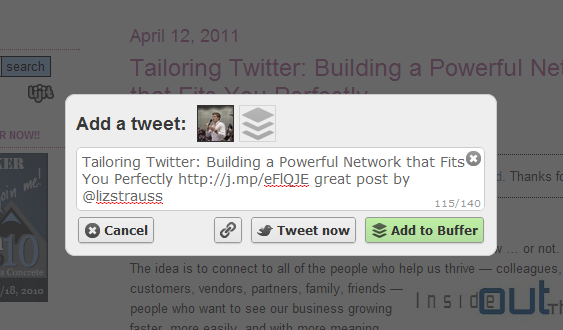
On top of this you can even add tweets from inside Google Reader, which is a big winner for me. Whenever I like an article I hit the Buffer icon and add it to my Buffer. Here is how this looks with one of Liz’s posts:

pic-1


Add tweets from anywhere on the web.

Make your Tweets truly unique

Now, there is even one more functionality I want to mention here, which allows you to make your tweets really stand out from the rest.

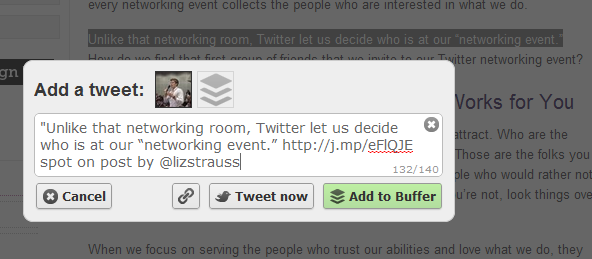
Whenever you read an article and find a good line, just highlight the text and then hit the Buffer icon, here is what happens:

pic-2

Make your tweets unique

Timing of your Tweets

By default Buffer will send out your tweets well spaced out over the day, so you will never have too many tweets sent in a row, flooding your followers with tweets.

Of course you can always go back to your home account, click “settings” and adjust the timing to your needs. You can add more daily tweeting time slots or decrease them. Oh and as of recently there is also a “Tweet Now” function.

Add tweets to your Buffer from your mobile

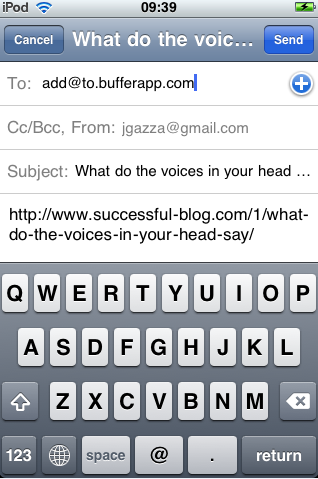
What also comes in very handy is the option to add Tweets to your Buffer from your mobile. Whilst browsing an article you can simply hit the “mail link to page” or similar button.

Then you add in add@to.bufferapp.com and voila you have one more tweet scheduled where the link is automatically shortened and the title is in the page:

pic-3

Caption: Add to Buffer from your Mobile

Wrap Up

Even though Buffer is such a simple tool, it helps me a great deal to stay on top of Twitter. I can add tweets from anywhere with just one click and will make sure to add all the great articles I am coming across each and every day.

I have also started to use the mobile function whilst waiting in a queue or whilst sitting on the Bus and it is a great time filler, which actually gives me some results

.

I hope you give Buffer a go. Would love to hear your views about it below.

Leo Widrich writes Tips for Twitter on his blog. You can visit his website, Bufferapp, or find him on Twitter as @leowid.

_________

Thanks, Leo, for checking out bufferapp.com for us!

–ME “Liz” Strauss
Work with Liz on your business!!

Buy the Insider’s Guide to Online Conversation.

Filed Under: Successful Blog, Tools Tagged With: bc, buffer app, Cool Tools, LinnkedIn

When people steal your ideas…

April 21, 2011 by patty

by Patty Azzarello

cooltext466496263_leadership
screen-shot-2011-04-20-at-51019-pm

Look at MY great idea…

It’s really frustrating when someone steals your ideas or work.

1. You say something in a meeting, no one reacts, but then later someone else repeats the exact same thing and suddenly gets all the credit.

2. You achieve a breakthrough or invent something, share it with others, then find that someone else is presenting the idea as their own.

3. You deliver a bunch of great work to your boss, the he puts his name on it and doesn’t mention you when presenting it to others.

It’s at a minimum super-annoying, if not downright unethical.

So what do you do about it?

I am an advocate of staying on the high ground. I have done this in my career when someone else absorbs my work with no credit to me.

1. Take advantage of the difference between talking and doing

When someone re-packages your idea and gets all the glory, it is my experience that they are now out of moves. People who have to steal good ideas don’t typically have the capacity to do anything about them — they max out at recognizing and repeating a good idea.

It can be fun to ask them, OK, so what will you do next to make this happen? While they are giving a shallow, hand-waving, “we’ll need more input, or put it to committee” kind of answer, just take control of the next step.

You be the one to develop the idea to the next level and take decisive action on it. Create a communication plan around the action and the outcomes.

You will get known for the important part – doing something. And the moment in the meeting when he stole your idea will fade into the background. Also take some comfort in the fact that others recognize this idea-parroting behavior too.

2. You are supposed to make your boss look good

I remember the first time my boss absorbed a big project of mine. He put his name on it and the CEO thanked him for the amazing job. I was invisible. I was crushed. This was early in my career.

Later I recognized that you are supposed to make your boss look good.

But you need to make sure that between you and your boss, it’s clear the work was yours.

Write up a case study of what you did to be included in your next review. Document how things were when you started, what you did, and what the outcomes were. Document the benefit your boss received.

If it’s all true you are not doing anything controversial. You are just letting your boss know you are happy for him to have the glory publicly, but expect him to acknowledge your work, and not walk all over you.

Sometimes this is inadvertent, and your boss is actually happy to give you the credit publicly. Ask your boss if you can join him and do part of the presentation. Ask your boss to keep you visible. Tell him that this visibility with his peers will help you deliver the next set of outcomes that he needs (that will also make him look good).

3. Don’t confront in public

Whether it’s your boss or your peer that stole your work, don’t do the confrontation in public. If it’s a peer have a private meeting where you say something like:

I am pleased that you were able to run with my idea. I have documented my work for my boss and his peers in other organizations, so that they may also benefit from this idea.

Let them know that you have let other people know behind the scenes where the work really comes from. They will be less likely to continue to advertise their ownership of it, when they realize that lots of people other than you know the real story.

4. You can’t stay invisible. You need to talk about it.

One big reason I see that people get their ideas stolen is that they are not comfortable talking about them.

I know one person who was repeatedly given opportunities to share an invention, and because he did not enjoy public speaking, he didn’t do it. Someone else stepped in to do the presentations and ultimately the idea became credited to the person doing the talking.

Communicate about your work

You need to stand up for your ideas, your work and your team. When you do something good, you need to make sure that you create positive visibility for that work with the people who care about it.

By staying invisible you are just inviting your ideas and your deserved recognition to be stolen by others.

What about you?

How do you share your ideas? What do you do when some takes credit? Please leave your thoughts in the comment box below.

—–
Patty Azzarello is an executive, author, speaker and CEO-advior. She works with executives where leadership and business challenges meet. Patty has held leadership roles in General Management, Marketing, Software Product Development and Sales, and has been successful in running large and small businesses. She writes at Patty Azzarello’s Business Leadership Blog. You’ll find her on Twitter as @PattyAzzarello. Also, check out her new book Rise…

Successful-Blog is proud affiliate of

third-tribe-marketing

Filed Under: management, Successful Blog Tagged With: bc, LinkedIn, Patty Azzarello, Team dynamics

The Book List: Relationships Made Easy for the Business Professional and The Corner Office

April 20, 2011 by teresa

The Book List: a weekly series by Teresa Morrow

I’m Teresa Morrow, Founder of Key Business Partners, LLC and I work with authors & writers to help them with their online book promotion and marketing. As part of my job I read a lot of books (I love to read anyway!).

The books in The Book List series will cover a range of topics such as social media, product development, marketing, blogging, business, organization, career building, finance, networking, writing, self development, and inspiration.

‘Relationships Made Easy for the Business Professional’ by Dr. David Fraser

relationships-made-easy-for-the-business-professional

David Fraser gets it! The struggle out there is the projection of the struggle in here. We can’t begin to heal the world until we heal in here.
Stuart Hepburn, NLP Trainer

In addition to being a good ‘read through’ this book is great to dip into when searching for some insight into what may be holding you back – there is a wealth of great content to help increase personal effectiveness.
Ian Laird, Managing Director NiTech Solutions Ltd.

About the Book*:
The ability to relate to other people is the most critical skill a person can ever have – at work, at home or anywhere else – and strong people skills simply make everything else easier. With the right approach, developing relationship expertise is an easy route to success and one of the few reliable and enduring ways we can improve our lives. But we need to take the task seriously.

Drawing on practical psychology, Neuro Linguistic Programming (NLP) and other wisdom from various philosophies, as well as first-hand experience of organizational life, David Fraser, Ph.D. offers a systematic, practical and intelligent approach to achieving success with other people. Packed with real-life examples and tried-and-tested steps to take, this book is for business professionals who want to develop their interpersonal relationship skills as a key strength.

In his “very positive, helpful and enlightening” and ultimately “uplifting” book, the author sets out the 12 essential areas of interpersonal insight and growth: (1) Attention to others; (2) Attitude; (3) Self-control; (4) Tuning in to people; (5) Personality; (6) Connection; (7) Values – working with what matters; (8) Language; (9) Self-awareness; (10) Attention to yourself – clarifying what you really want; (11) Balance; and (12) Love – the power of care.

The author includes with honesty a flavor of his own learning journey, and in the words of his readers, the result is “accessible and relevant,” “simply fascinating stuff,” and “very easy and interesting to read.”

Here are a few summary points I would like to share with you from each step in the book:

~ Persuasion, assertiveness, and logic aren’t in themselves the answer.
~ We can have a systematic approach to relationship skills using NLP as the basis.
~ The meaning of any communication is indicated by the response it gets.
~ Listen mindfully for maximum attentiveness.
~ Our habitual choice of visual, auditory, kinesthetic, and auditory-digital thinking affects our lives and our relationships much more than we probably realize.
~ We unconsciously filter the information we receive and have different preferences about what we filter for.
~ Remember: about seven percent of the meaning of what we say is conveyed in the words themselves. The rest of the message is in our voice and other non-verbal communication.
~ We delete, distort, and generalize information going from our own internal thoughts to what we actually say.
~ We project onto other people things about ourselves, good and bad, as they do on us

About David*:
Dr David Fraser has a track record of pioneering new approaches to old problems. He has delivered major projects for government and private sector clients in complex and challenging situations and set up a number of entrepreneurial ventures. He is a company director and Chartered Engineer with a First Class Honours degree and a PhD from Glasgow University and an MBA from Strathclyde University.

He is a qualified commercial mediator and a Neuro-Linguistic Programming (NLP) Master Practitioner and has trained with leading proponents of these disciplines. David has taken a particular interest in the skills we use to relate to other people, continuing this study over a number of years and through the highs and lows of professional and personal life.

David applies his unusual blend of expertise as a project manager and facilitator to support disparate groups working together in complex circumstances, including major collaborative projects and matters of national importance. He has also found the approach set out in Relationships Made Easy for the Business Professional to be extremely helpful in his home and family environment. David runs workshop and coaching programs for both organizations and individuals.

With his breadth of knowledge, an engineer’s talent for organizing systematic and reliable solutions, and an ability to write in an interesting, direct, and readable way, David is well positioned to address the age-old problem of how to build effective relationships with other people.
David lives with his wife and three children in Glasgow, Scotland.

You can order a copy of ‘Relationships Made Easy for the Business Professional’ online at Amazon. *this information came from Amazon.

Next, I would like to introduce you to a book on the business book list on Amazon: ‘The Corner Office: Indispensable and Unexpected Lessons from CEOs on How to Lead and Succeed’ by Adam Bryant.

‘The Corner Office: Indispensable and Unexpected Lessons from CEOs on How to Lead and Succeed’ by Adam Bryant

This book came out recently on the new releases (business) list on Amazon.

“The Corner Office is a modern management masterpiece. Adam Bryant distills and weaves together hundreds of gems from some of the most successful and intriguing executives on the planet. The result is one of the most delightful, readable, and useful business books I have read in years.”–Robert Sutton, Professor of Management Science and Engineering, Stanford University, and bestselling author of Good Boss, Bad Boss

“Compelling advice for the aspiring executive.… The conversational format makes these valuable lessons easy to comprehend and digest, and readers are left with a new understanding of leadership–why it’s important, how these experts have worked to attain it, and how they can do the same.”—Publishers Weekly

About the Book
Bryant, deputy national editor of the New York Times and writer of the “Corner Office” feature in the paper’s Sunday Business section, offers compelling advice for the aspiring executive. With interviews with more than 75 CEOs and other top executives at companies of all sizes, he compiles insights on such questions as what does it take to lead an organization? what are the keys to achieving the highest levels of success? Business luminaries like the CEO of Disney, the COO of Qwest Communications, the CEO of Continental Airlines, a vice chairman at Wal-Mart, and the founder of Zappos speak thoughtfully about team creation, keeping the mission on target, management, employee relationships, the importance of feedback, and the creation of an efficient corporate culture. The conversational format makes these valuable lessons easy to comprehend and digest, and readers are left with a new understanding of leadership—why it’s important, how these experts have worked to attain it, and how they can do the same. (Apr.)
(c) Copyright PWxyz, LLC. All rights reserved.

About Adam*:
Adam Bryant, the deputy national editor of The New York Times, has been a journalist for more than two decades. He was a business reporter for The New York Times during the 1990s, covering a variety of industries and topics, including airlines, aviation safety, executive compensation and corporate governance. He joined Newsweek in 1999 as a senior writer, and was promoted to business editor. After six years at Newsweek, he returned to the Times as an editor in the business section, where he oversaw coverage of the collapse of the Detroit auto industry, among other stories.

Adam was the lead editor for two prize-winning series: “Driven to Distraction,” about the dangers of cellphone use behind the wheel, which won the Pulitzer Prize for National Reporting in 2010, and “Toxic Waters,” about water pollution, which won a number of awards.

In March 2009, Adam started the weekly “Corner Office” feature in the Times’ Sunday Business section, and it quickly attracted a large and loyal audience for its insights about leadership and management from prominent leaders. For his book, The Corner Office, Adam studied the transcripts from more than 70 interviews, and looked for patterns, broader themes and lessons. He wove together their candid and wise insights into a book that offers timeless advice on how to succeed, manage and lead.

Adam lives in Westchester County, New York, with his wife and two daughters.

*courtesy of book website and/or Amazon

You can purchase a copy of ‘The Corner Office’ at Amazon.

Filed Under: Business Book, Business Life, Successful Blog Tagged With: Adam Bryant, bc, Business Book, Business Leadership, business relationship books, Dr David Fraser, successful leadership

  • « Previous Page
  • 1
  • …
  • 214
  • 215
  • 216
  • 217
  • 218
  • …
  • 959
  • Next Page »

Recently Updated Posts

The Creator’s Edge: How Bloggers and Influencers Can Master Dropshipping

Is Your Brand Fan Friendly?

How to Improve Your Freelancing Productivity

How to Leverage Live Streaming for Content Marketing

10 Key Customer Experience Design Factors to Consider

How to Use a Lead Generation Item on Facebook


From Liz Strauss & GeniusShared Press

  • What IS an SOB?!
  • SOB A-Z Directory
  • Letting Liz Be

© 2025 ME Strauss & GeniusShared