Successful Blog

  • Home
  • Community
  • About
  • Author Guidelines
  • Liz’s Book
  • Stay Tuned

Haven’t You Got Smaller Fish to Fry?

November 23, 2011 by Rosemary

A Guest Post by
Rosemary O’Neill

cooltext443809558_authenticity

If you’re a small business or a consultant, Fortune 500 clients are a rush. Impressive logos can adorn your sidebar, you can impress your grandma with how successful you are, and credibility is yours. However, it’s very important to treat every customer as if they are your “marquee” client.

And here’s a secret:

The small fry customers aren’t used to being treated like a VIP, so they are easier to delight.

Here are a few more reasons why the small fish deserve TLC:

  • Small fry grow up to be big – that lower-tier administrator you’re dealing with may get a promotion or move to another company and suddenly be the decision-maker.
  • The neighbor effect – the woman who runs that small business could refer you to her neighbor, who is VP of Something Important at a Fortune 500.
  • Large quantities of small fry make a steady revenue stream – if you’re reliant on the good graces of a few big companies for your revenue, you’re in a precarious position.
  • Smaller organizations can be easier to deal with – it’s much easier to get access to the decision-maker at a smaller organization.

Never burn bridges – if you try every day to delight everyone who comes in contact with your business, including the “nobodies” with no money to spend, you are building goodwill equity that comes back to you when you least expect it.

If you pay close attention, your individual small fry will build into a net-bursting haul.

_____

Author’s Bio: Rosemary O’Neill is an insightful spirit who works for social strata — a top ten company to work on the Internet. Check out their blog. You can find her on Twitter as @rhogroupee


Filed Under: Customer Think, Marketing /Sales / Social Media, Successful Blog Tagged With: bc, Customer Think, customer-service, LinkedIn, Rosemary O'Neill, Strategy/Analysis

Motivational Triggers: Ninja Secrets to Increasing Conversions

November 22, 2011 by Guest Author

By Pawel Reszka

cooltext443809602_strategy

Uncovering Your Readers’ Hidden Motivations

No matter what anyone tells you, selling isn’t easy. There’s no magic formula that says, “Put this product in front of this group of people, say this specific thing and you’ll get sales” – despite what all of the long form sales letters floating around the internet would have you believe. Instead, it’s up to you – the blogger – to figure out the right combination of product selection, positioning and advertising copy that will lead to sales or conversions on your site.

To do this, you’ll need to uncover your readers’ hidden motivations. You need to know what makes them tick, what gets them motivated and what types of information or products can’t they get enough of. Once you have this information, you’ll find it much easier to choose the right products and target the most effective emotional triggers to maximize your blog’s profits.

So to get started, the first thing you’ll need to do is to understand more about how your audience thinks. Getting to know your audience members is crucial for a couple of reasons – not just to encourage more sales. Understanding who your audience members are will help you to choose the best content to post to your site to encourage repeat visits, as well identify the products they’re most likely to be interested in.

As Liz said in a past post on knowing your audience on the site:

The more you know and understand about your audience the better job you’ll do at giving them what they’re looking for. As well, there are other benefits; your writing will come easier, you’ll better communicate your ideas, you’ll stress less and you’ll enjoy it more.

Whether you’re just starting out as a blogger in your niche or you’ve got extensive experience in the field, the following are a few of the things you can take into consideration when getting to know your audience members:

  • Demographic information – As readers leave comments on your posts, do they appear to be primarily male or female? Young or old? Does the quality of their comments suggest anything about their education levels? By painting a picture of your audience members in your mind, you’ll be able to extrapolate some of their concerns, fears, interests and passions.
  • Primary interests – Do your readers tend to respond more frequently to one type of post over another? For example, if you get more comments on your “how to” posts than your personal development posts, you might conclude that your audience is interested in more practical, applicable advice than nebulous, indistinct recommendations.

By paying attention to these types of information, you should start to get a general idea of who your audience is. But while this is important, it’s also only half of the battle. The key is to use this information to successfully tailor a sales message for your unique visitors, based on what you’ve identified as their primary fears and motivators.

Suppose you’re blogging in the personal finance niche and find that you have a large following of single mothers. While you won’t be able to make assumptions that apply to every single one of your readers, you can make some generalizations that can guide your product selection and positioning.

For example, it’s probably safe to assume that many single mothers worry about making ends meet and about what would happen if they were suddenly unable to take care of their children (whether due to death, illness or disability). From a personal finance standpoint, products that help these mothers manage their bills or set up the legal and financial safeguards that ensure their children will be cared for in the event of an emergency could be hugely appealing.

Making assumptions about your audience in order to identify the best products and/or services to pitch to them is important, but the final step in the process is to tie everything together with emotional triggers. An article from Entrpreneur.com on common and effective emotional triggers identifies the following 10 factors to consider while building your product copy:

  • Fear
  • Guilt
  • Trust
  • Value
  • Belonging
  • Competition
  • Instant Gratification
  • Leadership
  • Trend-setting
  • Time

Here’s how to use these emotional triggers in your sales messages:

Fear – As seen in our earlier example about the concerns of single mothers, fear can play an incredibly powerful role in getting people over their objections to buying. While the fears of running out of money and of children being left on their own are major fears, even something as simple as the fear of missing out on something – as emphasized in your sales copy – can encourage conversions.

Guilt – If you’ve ever seen a charity commercial entreating you to “Donate Now” to alleviate suffering, you know how powerful a motivator guilt can be. Use this emotion in your sales copy by emphasizing something that the reader isn’t yet doing well (but that could be remedied with your product).

Trust – As a blogger, you’ve likely built a rapport with your readers over time, which may make them more likely to trust the product recommendations you make, based on the relationship you share. Just be careful not to abuse this trust by making your sales pitches carefully for products that you truly believe in.

Value – Everyone wants to feel like they’ve gotten the best deal possible, which is why you see customers buy name brand products off the grocery store shelves when they have a coupon – even if the store brand product is still cheaper overall! Emphasize the value of your product or service by comparing it to comparable options, quantifying money saved or including bonuses that increase the perceived value of your offering.

Belonging – Facebook and Twitter are two powerful examples of our need to belong to a social network. You can use this motivation to your advantage by offering the people who purchase your products or services special perks that set them apart as part of an exclusive “members club”.

Competition – The classic “Keeping up with the Jones” scenario highlights the hidden competitor that lurks within each of us. If your audience is especially conscious of status and image, simply suggesting that owning your product or buying your service will make friends and neighbors jealous will cause sales to skyrocket.

Instant Gratification – Buying lights up the pleasure centers of our brain, and this effect is enhanced when the product is immediately available for consumption. Whenever possible, make some (or all) of your product available digitally so that it can be accessed right away in order to play to this emotional trigger.

Leadership – If your niche consists of experienced industry personnel, you’ll find that the desire to differentiate ones-self and be seen as a leader is a powerful motivating factor. In this case, use your sales copy to highlight how your products will make these readers feel powerful and authoritative in their personal or business lives.

Trend-setting – Younger audiences or those who are particularly susceptible to brand messages often respond well to sales messages that position products or services as “trend-setting”. Look no further than the Apple iPod, Gucci bag or Vibram Five-Fingers to see how influential trend-setting brands can be.

Time – There’s no one out there that couldn’t use more time, but busy professionals and parents are two groups in particular that look to time savings as a key selling point. Emphasize how your product or service appeals to this trigger and you should see a corresponding increase in conversions.

Again, it may take some time to gain a good enough understanding of your audience that you’re able to identify the hidden motivations and feelings your readers are experiencing. However, with continued effort, you’ll be able to pair the correct products with the right emotional triggers and increase your site’s profitability dramatically.

—-

Author Bio:

Pawel Reszka is the founder of Affhelper.com, a blog where he shares tips and strategies on how to make money online. He talks about blogging, affiliate marketing, and content marketing. Check out his short guide to making money with blogs where he shares some great tips for beginners.

Outstanding information, Pawel! Thank you.

–ME “Liz” Strauss
Work with Liz on your business!!

Buy the Insider’s Guide to Online Conversation.

Filed Under: Marketing /Sales / Social Media, Motivation, Successful Blog Tagged With: affliliate selling, bc, LinkedIn, online selling. Pawel Reszka, sales

What’s the YOU in What You Do?

November 21, 2011 by Liz

Your Strategy Is Uniquely Yours Alone

cooltext443809602_strategy

I spend most of my days thinking about, reading about, writing about and talking about strategy for individuals, small businesses, and huge corporate brands. When you look closely at what I do, it will soon become apparent that like snowflakes that every strategy is uniquely different and in that way they’re all the same.

True strategy draws from who you are, where you’ve been, what you know, what you’ve experienced, and decisions you’ve made. So even though an individual, a small business, and a huge corporation might all have the same vision, mission, and goals. The opportunities that come to them are as different as who they are and what they know.

A solid brand is like your character. Build on who you are, not on a strategic plan.

It’s a serious risk to invent a brand that isn’t you or the values that your business is built upon. What happens when you do is that the brand becomes a bad facsimile of what you really are. And sooner or later the true you leaks out in some way — you don’t live up to what you invented.

You can’t write my blog post. You can’t give my talk. You can try to copy me, but you’ll always be a copy.
The value in what you do you is your own version of the way you do things.

I can’t be Copyblogger Chris Brogan, Oprah, or even my own mother, but I’m one heck of a Liz Strauss.

The closer we get to understanding who we are and what we value, the more people trust us to show up in ways that we say. They see, feel, and respect that we are living what we’re saying and they know they can trust that. It resonates with others when we ARE who we ARE, not just how we act.

And within us, our businesses and our corporation, the integrity and confidence of know who we are offer rich context that telegraphs itself to anyone who hears any one of us talk or anyone talk about us..

Don’t reinvent yourself. Don’t re-engineer new ways of reaching out.
Reconnect to your values and be what the best version of you is about.
That’s how you’ll attract the people who share those value with you.

It’s the YOU in what you do that makes the brand, the business, and the team work the way it does. No one can compete with that. People can join in, adding to the story and enhancing the mission.

The you in what you do is the ultimate barrier to entry. It attracts opportunity, but defies replication.

Read that sentence again. Information, products and services are all over the world and all over the Internet, but there’s only one YOU. No one can do, see, think or add the difference you make in exactly the same way you do. Anything that isn’t you … isn’t your brand – it’s discounting your true value and values.

That unique YOU is the part that people love, protect, stay loyal to, and bring their friends to experience.

You are the value. You are the difference.

Have you figured out what’s the YOU in what you do?

Be irresistible.

–ME “Liz” Strauss
Work with Liz on your business!!

Buy the Insider’s Guide to Online Conversation.

Filed Under: Successful Blog Tagged With: bc, LinkedIn, mission, personal-branding, vision

What Does Your Online Profile Say About You?

November 18, 2011 by Guest Author

A Guest Post
by Jason Nash

cooltext443809602_strategy

Assets, Identity, Online Presence

One of the most important factors to consider when searching for a job, establishing your social network, or simply protecting your assets and identity is your online presence. In today’s society, our names are spread all throughout the internet. The majority of Americans can type their name into a search engine and find information from their Facebook page, their LinkedIn account, their Twitter followers, and their websites or blogs. Additionally, most computer users have information spread throughout the internet in the form of website hosting profiles. As beneficial as these networks are, it is also important that we take the time to “clean up” our internet presence both in the amount of information and the content.

Facebook is one of the most commonly visited sites on the web today. Not only do friends use the site for social networking, but businesses are now using Facebook to contact clients. Employers also utilize it to find out more information about applicants education, work history and social habits. One of the best things you can do to improve your virtual appearance is to make sure that your profile sends a positive message about yourself.

Consider what language you use and how much information you give about yourself. Many people choose to only make their profile visible to friends, making identity theft much less likely. Many people also pay attention to who your friends are. If you have friends you are no longer in contact with, it is best to delete them from your friends list so they will not shed a negative image on your own profile.

Twitter is one of the newest forms of social networking. While “following” friends and “being followed” can be a lot of fun, it is extremely important to be mindful of who is following you. Twitter users can be prime candidates for identity theft, and should always be aware of how much information they are posting. It is also wise to keep your Twitter profile updated so that potential employers and friends see up to date information.

LinkedIn is primarily a business network that allows workers to connect to colleagues in various businesses and industries and establish a network to obtain recommendations. Because this network can be such a valuable business connection, it is a good idea to take the time to go through the “People You May Know” section and find additional connections. Once again, it is also wise to consider how much information you put on your public profile. Make sure people can identify whether or not they know you, but keep personal information available only to friends.

Finally, consider how much information you put on websites and blogs. While website hosting can be an extremely useful tool for sharing information with friends and clients, many web users do not take the time to adequately edit or protect their information. Many users will share highly personal information concerning their family, their location or even their financial situation without taking the necessary precautions to prevent identity theft. They may also share opinions that may not be desirable for employers or coworkers to view. Many websites and blogs have an option that allows only those who are invited to view the site. Other can keep a tally on how many viewers there are and who specifically is visiting. These tools can ensure safety and protection of personal information.

Using social networking tools can be a great asset in today’s highly electronic society. By taking the time to sift through your information and “clean up” your online presence, you can have the best networking experience possible.

—-
Author’s Bio: The article is from Jason Nash from keybrokersocial.com Jason writes about technology, social media and online marketing strategies and follows brands online and off as part of his work.

Thank you, Jason!

–ME “Liz” Strauss
Work with Liz on your business!!

Buy the Insider’s Guide to Online Conversation.

Filed Under: Marketing /Sales / Social Media, Personal Branding, Successful Blog Tagged With: bc, Jason Nash, LinkedIn, online presence

FIRST, GIVE UP CONTROL

November 17, 2011 by Rosemary

A Guest Post by
Rosemary O’Neill

cooltext443809558_authenticity

It’s so easy to get caught up in trying to control every detail of your business. But if you’re trying to be real, be human, then control is all an illusion.

Part of being human is being messy, unpredictable, and wrong sometimes. Part of being a human-centered business is accepting messiness, being OK with unpredictability, and admitting when you are wrong.

There’s a scene in the Steve Martin movie Parenthood where the grandma compares life to a rollercoaster—you can either be terrified or thrilled by the ups and downs. And it’s the same way in business. When a deal doesn’t go your way, or a key employee decides to leave, or the power goes out at your data center (yeah that happens), you get to choose how to react. Choose grace and humor, and everybody wins.

Here are three ways to enjoy the rollercoaster:

1. Surround yourself with others who are thrilled.

2. Fasten your seatbelt (be sure you are as prepared as you can be, with options).

3. Remind yourself every day that the only thing you can control is your own attitude.

1.2.3. Go!

_____

Author’s Bio: Rosemary O’Neill is an insightful spirit who works for social strata — a top ten company to work on the Internet. Check out their blog. You can find her on Twitter as @rhogroupee
Filed Under: Motivation, Successful Blog Tagged With: bc, Leaderhsip, LinkedIn, Rosemary O'Neill

Are You Up for a Social Win-Win That Might Even Win?

November 16, 2011 by Guest Author

A Guest Post by Nikki at Zooppa

cooltext443809602_strategy

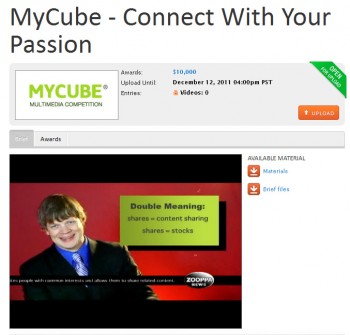
Zooppa’s MyCube Multimedia Competition

Social Media has become part of our daily lives. Our day feels incomplete when we are not able to go online to tweet or check your Facebook. So we, at Zooppa, are having a cool contest to introduce you to a brand new social media network centered on content sharing. MyCube is the place online where you can find people who share your passion and exchange photos, videos and/or conversation.

Create a 30-to-60-second video (by December 12,2011) that tells the story of how you or someone like you can use MyCube’s “social content exchange” to connect with people who share their passion.

It is a win-win situation. You have nothing to lose.
You make something to add on to your portfolio.
You showcase your creativity and share it with other creative people.

You get a chance to win some cash. —>>> $10,000 in prizes!!!

Plus, the experience itself is worth your time.

For more details, visit: MyCube Video Contest Brief Watch the video and read the brief.

If you’re already connected to some folks who share your passion, bring them with you, build something together, and connect even further!!

Use the cash you win to celebrate, make more videos, or donate to your favorite cause.

Invest a little creativity … gain connections to people who care about what you do!
It’s a win-win and it might even win!

Who wouldn’t be up for that?
—-
Author’s Bio: Nikki works for Zooppa.com, the people-powered brand strategy company.

–ME “Liz” Strauss
Work with Liz on your business!!

Buy the Insider’s Guide to Online Conversation.

Filed Under: Marketing /Sales / Social Media, Successful Blog Tagged With: bc, LinkedIn, MyCube, Zooppa

  • « Previous Page
  • 1
  • …
  • 55
  • 56
  • 57
  • 58
  • 59
  • …
  • 190
  • Next Page »

Recently Updated Posts

Is Your Brand Fan Friendly?

How to Improve Your Freelancing Productivity

How to Leverage Live Streaming for Content Marketing

10 Key Customer Experience Design Factors to Consider

How to Use a Lead Generation Item on Facebook

How to Become a Better Storyteller


From Liz Strauss & GeniusShared Press

  • What IS an SOB?!
  • SOB A-Z Directory
  • Letting Liz Be

© 2025 ME Strauss & GeniusShared