Successful Blog

  • Home
  • Community
  • About
  • Author Guidelines
  • Liz’s Book
  • Stay Tuned

How to Defuse Customer Skepticism and Cynicism

October 15, 2010 by Guest Author

A Guest Post by Scott P. Dailey

image001-jody-mcnary

Want to eliminate the healthy skepticism your customers have of you and instead be seen as a trusted servant? Terrific. Here’s what you do: don’t give them cause to be skeptical. Trust me, they’re skeptical. Real skeptical. Mark Twain once said the wisest people are also the most cynical. That’s your target audience. Cynics – every last one of them. Don’t blame them either. It’s our fault they’re that way. Years of forcing ourselves on them has created doubters of most of our potential buyers. I’m the same way and if you’re smart, so are you. Frankly, I like being skeptical and cynical. Healthy doses of both arm me to buy smarter, shop carefully, invest intelligently – in life and in business. I can sniff out a phony and I don’t hang with them. Your prospects can sniff just the same. They’re diligently watching as much for the BSer as they are the best buy. [More…]

Being honest isn’t achieved in telling the truth alone. Being honest has an end point. Be truthful. There’s a difference between being honest and behaving truthfully. Let your actions, not merely your words, speak of your truthfulness. Truthful actions have no vanishing line. They just go on and on, resonating with your audience well after you’ve stopped yapping. Make your contribution to the networking landscape count to the skeptical buyer that’s questioning your motives. If your networking efforts are fraught with hurried, self-promoting drivel, think again before inserting yourself into the fray. If you know you’re being disingenuous and let’s face it, you do know, then what are the odds we know too? Here, let me help you with this one: the odds are extremely high.

Deputize yourself.

Do your part to clean up the sales noise found in networking and prospecting circles. On or offline, the rules are the same. Mean it! Make selfless contributions to talks, meetings and mixers. Shape and guide the conversation, not your latest opt-in initiatives. If you do this well, people will want to know what you do and what you sell and never because you forced it upon them using absurdly urgent sales tactics. Authenticity is a commodity in sales, your transparent attempt to bait me is not.

Patience, Patience, Patience

Proving to prospects that you’re not full of it takes time. After all, you’re starting out with people who suspect you’re motivated by your sales goals alone and believe nothing matters more to you. So the prospect is ready for you to strike fast – while the proverbial iron is hot. Etc, etc. Blah, blah, blah. Borrrrr-iiiiiing.

Business relationships, like those you share with your spouse, partner, brother or mother, require time to develop. This is not news to us. Yet often, I see salespeople and business owners go for the quick close and forgo the opportunity to build repeat business through authentic bonding rituals. Prove you’re interested by forgetting what you sell and instead, talk with your prospect, not at him or to him. Imagine the pleasure derived from business conversations had through conversing about stuff other than your business. Ironic, right? Try it. You’ll be surprised how effective a salesperson you become the moment you stop trying to sell your stuff. Again, ironic.

Have you ever pushed too much, too far, too fast? Maybe you got this right the first and every time. How do you dispel the myths that the sales process must include a pushy pitch?

—–

Scott P. Dailey is a Web designer, copywriter and network administrator. Recently Scott launched ( http://scottpdailey.com ), his social media blog that makes connections between social networking etiquette and the prevailing human social habits that drive on and offline business engagement patterns. You can connect with Scott via Twitter at @scottpdailey.

Creative Commons License photo credit: Jody McNary Photography

Thanks, Scott!

–ME “Liz” Strauss
Work with Liz on your business!!

Buy the Insider’s Guide to Online Conversation.

Successful-Blog is a proud affiliate of

third-tribe-marketing

Filed Under: Business Life, Customer Think, Motivation, Successful Blog Tagged With: bc, Customer Think, LinkedIn, sales, Scott P. Dailey

Cool Tool Review: RightSignature

October 14, 2010 by Guest Author

Todd Hoskins chooses and uses tools, products, and practices that could belong in an entrepreneurial business toolkit. He’ll be checking out how useful they are to folks in a business environment.

Cool Tool Review: RightSignature
A Review by Todd Hoskins

The hassles of finalizing a contract: hard copies, scanners, fax machines, signatures, documents, and FedEx. There are costs involved, both in time and dollars, but there is also that universal experience (excluding attorneys perhaps), of the “Yes! We’re almost done!” coinciding with, “Oh no. Not this again.”

RightSignature is a great example of a company that has fully explored the implicit pain points in this standard process, and addressed them with a fully functional, simple, and intuitive product.

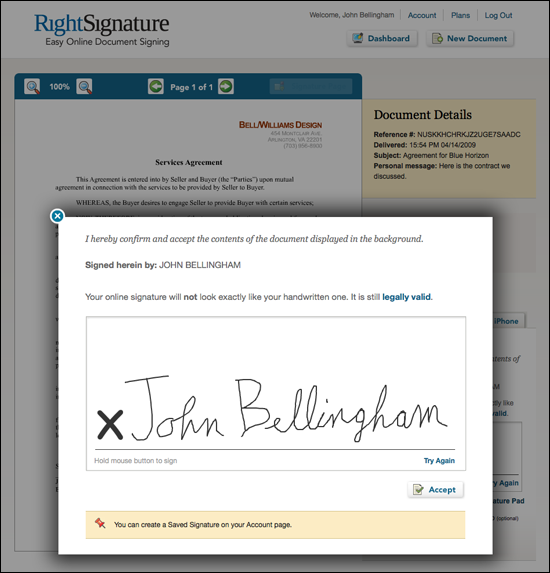
“Digital signature” technology is cumbersome, especially when it requires one to go through extensive procedures just to authorize an approval. RightSignature does not force anyone to set up an account. An email arrives in the inbox, then the signee scribbles their autograph on the mousepad. RightSignature’s technology is in full compliance with US and EU e-signature legislative acts, which confirm the legality of electronic signatures.

rightsig

The feature set is impressive, with webcam photo authentication, biometric authentication, SSL encryption, Freshbooks integration, iPhone and BlackBerry signing capabilities, tools to track progress, and support for the most important file formats. It is missing SalesForce integration, which competitor DocuSign has, but every other aspect of the process is covered.

Plans range from $14 to $250 per month.

Summing Up – Is it worth it?

Enterprise Value: 5/5 – API access with Gold Subscription

Entrepreneur Value: 5/5 – Don’t depend on Adobe alone. Cool, easy, and priced fairly.

Personal Value: 1/5 – Not yet. But someday.

Let me know what you think!

Todd Hoskins helps small and medium sized businesses plan for the future, and execute in the present. With a background in sales, marketing, leadership, psychology, coaching, and technology, he works with executives to help create thriving individuals and organizations through developing and clarifying values, strategies, and tactics. You can learn more at VisualCV, or contact him on Twitter.

Filed Under: Successful Blog, Tools Tagged With: Adobe, bc, contracts, digital signature, DocuSign, RightSignature, Todd Hoskins

How NOT to ask for a raise

October 14, 2010 by patty

by Patty Azzarello

cooltext466496263_leadership
how-to-ask-for-a-raise

When I was in my early 20’s I learned an important lesson.

I was working in a start-up company and had gone 3 years without a raise.

The wrong way…

I went to the CEO and asked for a raise.
He said, Why?

Among other things, I said that I had been working for 3 years without a raise, and that I had taken on more and more responsibility over that time, and that I always delivered and often exceeded expectations. I told him it was becoming un-motivating to feel I was working so hard and not moving forward in pay, and peers in other companies were making more money than I was…

He said, I don’t’ care. It’s not my problem. I only care about what the cost is to replace you, and I could replace you for your salary or less – so no raise.

Your job is a contract with your company

You don’t get a raise for good attendance, or because you feel like you deserve one.

You earn a raise by increasing the value of your contribution.

And if you want to get that raise, you need to re-negotiate your contract on terms that are relevant and valuable to your company, not based on what you want or need. And you have to ask.

1. YOU Drive the process

If you are uncomfortable having this conversation with your boss either get comfortable with it, do it anyway, or don’t be disappointed if you get overlooked.

Know that you are at a disadvantage by not having this conversation.

It is vitally important that you and your boss share a common view of your performance and your expectations for promotion and compensation, even if your boss does not drive this discussion.

Of the 20-something years I worked in a corporation for a boss, I did my own performance review 17 times, just to make sure that there were never any disconnects.

2. Understand how you and your role are perceived

It is important to know if you are perceived as a high, average or low performer. Don’t ever guess about this. There should never be any surprises about this. Find out.

Even in an economy where there are not a lot of raises going around, you still need to be communicating with your boss about your performance and what it is worth, so when there is money, you have done all the groundwork.

Also make sure you know how much your ROLE is valued by the company. For example you don’t want to be the superstar performer leading the support team for an obsolete product. You may be great, but need to move into a higher valued role to get a raise.

Once you confirm that you are a high performer then go on to build your case for what you want. If you are not perceived as a high performer – fix that first. Understand what it takes, and focus on adding value, before you start asking for things.

3. Discuss your raise as part of a business outcome

The basic premise here is:
If I do this, what is it worth to the company?

Here are some things you can say:

  • Last year, this is what I accomplished and this is my current compensation.
  • I would like to raise the bar for the upcoming year, and deliver more value to the company.
  • And If I were to add these additional business outcomes, exceed these goals, etc, would that be worth more to the company? How much more?
  • What business outcome would I need to accomplish that would be worth this level of pay, or this promotion?
  • Can we agree that if I deliver this, you will give me that?

4. Follow up on the specfics…

  • 9 months ago, we agreed on performance objectives which if accomplished would
    result in increased compensation.
  • I believe I have delivered on all of these and then some, and I also took on this additional project which has benefited the company by increasing our margin on this product line.
  • Do you agree? Can I get your feedback on my accomplishments? … (Assuming it’s very positive then…..)
  • Will you be increasing my compensation for next year, per our agreement?

If the answer is, No, for some reason outside performance, you need to get a next agreement.

As long as you keep focused on business outcomes, you are on the high ground.

  • If your hands are tied right now, I would like to understand the timeline of what is possible, and if it’s not a raise, is there [stock, bonus, promotion, etc.] that could be possible?
  • I’m very motivated, but I think you can understand that at some point this level of performance will be hard to keep delivering if it is not recognized by the company, what do you advise?
  • You have my commitment to keep delivering for you, but I can you help me understand what I can expect over time in terms of the company being able to hold up our prior agreement about my performance and compensation?

And my personal favorite…

  • If you were in my position, how long would YOU keep performing at this level with my current compensation?

What has worked for you?

If you have examples of how you or your people have asked you for raisies, and what works and backfires — please share in the comment box below!

—–
Patty Azzarello works with executives where leadership and business challenges meet. She has held leadership roles in General Management, Marketing, Software Product Development and Sales, and has been successful in running large and small businesses. She writes at Patty Azzarello’s Business Leadership Blog. You’ll find her on Twitter as @PattyAzzarello

Successful-Blog is proud affiliate of

third-tribe-marketing

Filed Under: management, Successful Blog Tagged With: bc, LinkedIn, Patty Azzarello, pay raise, promotion, salary increase

Social Media Book List: If I’m So Smart, Where did All My Money Go and Blog Marketing

October 13, 2010 by teresa

A Weekly Series by Teresa Morrow

I’m Teresa Morrow, Founder of Key Business Partners, LLC and I work with authors by managing their book promotion and publicity. As part of my job I read a lot of books (I love to read anyway!).

This week I will be highlighting two books; one author I am currently working with ‘If I’m So Smart, Where did All My Money Go>’ by Doug Warshauer and one book on the social media Amazon list ‘Blog Marketing: The Revolutionary New Way to Increase Sales, Build Your Brand, and Get Exceptional Results’ by Jeremy Wright.

The books I discuss in the Social Media Book List Series will cover a range of topics such as social media, marketing, blogging, business, organization, career building, finance, networking, writing, self development, and inspiration.

‘If I’m So Smart, Where Did all My Money Go?’

by Doug Warshauer

Doug Warshauer's book If I'm So Smart, Where did All My Money Go?

Book Review by Kirkus Review—-
A realistic, detailed guide to planning for your financial future.

Warshauer was a small business forecaster by trade, skilled at incorporating the myriad of financial factors that make up the universe of a small company and projecting their expenses and profitability. In a burst of insight, he decided to apply those same methods on a more intimate scale. He has thus come up with an excellent set of guidelines in the hopes of ensuring a stable financial future for individuals and families.

The plan—five big steps composed of 18 smaller steps—is very sensible, and each bears Warshauer’s hallmark: accounting for the different life goals that each person or family will have. He begins by explaining how much of our net income should be saved, spent on homes and auto, and even spent on clothing. He provides a numerical guideline for each area, insisting that if spending in one category goes up, it must drop in other areas.

These short-term goals segue into long-term planning, such as the decision to save for public school versus private, and how to understand how much each family will need for retirement. These insights take the book one step deeper than the average financial-planning instructional. The book is also unique in that Warshauer presents the rules for financial success in the form of a story. Joe, one of the main protagonists, is a generic young adult who spends more than he’s earning, and thus decides to attend one of the author’s financial seminars.

Other characters include single mothers and young parents. The fiction structure is loose, basically just a tool to help the author dispense his financial rules in a way that keeps readers engaged. Naturally, the dialogue itself tends to get tedious, as seminar attendees ask dry questions about finance, but on the whole it’s more readable than a strictly nonfiction manual.

A helpful introductory guide to financial planning for singles and families looking to get the most out of their money.

About the Book*:

How do you achieve a balanced financial life and lasting wealth?

Conventional advice does not teach people how to balance conflicting demands from living expenses, credit cards bills, mortgages, college funds, and retirement investments. Finally, there is a book that does.

“If I’m So Smart, Where Did All My Money Go?” is an engaging look at ten diverse characters who each face different financial challenges. In this story of a personal finance seminar, you will meet the following people:

* Joe, a 23 year-old college graduate who already finds himself with $20,000 of credit card debt, and wonders if he has done permanent damage to his financial future,
* Eric and Sally, a couple in their 30s who bought a home at the peak of the market and who fear they could lose all of their equity,
* Andrea, a 40ish single mother whose living expenses make saving for college and retirement seem an impossible dream,
* Mitchell, a 55 year-old with two children on the verge of college, who wonders how he will ever be able to retire.

They, and others, each learn how to best achieve their own personal objectives: how to save and invest money for cars, homes, college, and retirement.

By following these examples, you will learn how to apply the lessons to your own life. After reading this story you will have learned:

* Exactly how much YOU need to save for your Home, College, and Retirement
* How to prioritize YOUR savings goals
* Exactly how much YOU can afford to spend on everything: your house, your car, food, clothing, and entertainment
* Which debt YOU should pay off and which you should keep
* Whether YOU should buy a home or rent one
* When YOU should invest in stocks and when to choose safer investments

You will learn to balance each of your financial objectives in order to achieve all of them. Most important, you will develop a level of confidence in your financial future that you never imagined possible.

About Doug Warshauer*:

Doug Warshauer is the founder of Kessler Warshauer Ventures, a highly successful private equity investment firm. He developed the techniques presented in this book by modeling the prospects of hundreds of businesses. Here, for the first time ever, he makes these techniques available to families to help them better manage their money. Doug holds an MBA from the Kellogg School of Management, an MA from New York University, and a BA from the University of California, Berkeley. He lives in the Chicago area. Follow along each week with Doug’s financial strategies or ask him a question on his blog, www.DougWarshauer.com.

You can purchase a copy of ‘If I’m So Smart, Where did All My Money Go?’ online at Amazon or on his website, Doug Warshauer.
*courtesy of book website and Amazon

A book on the social media list on Amazon is ‘It’s Not Just Who You Know’ by Tommy Spaulding.

Blog Marketing

Blog Marketing by Jeremy Wright

“Blogs will soon become a staple in the information diet of every serious businessperson . . . . Blogs offer an accelerated and efficient approach to acquiring and understanding the kind of information all of us need to make business decisions.”
— John Battelle, Business 2.0

About the Book*:

With an exclusive look inside Google, Disney, Yahoo, IBM, and others, this book shows how your company can use blogs to raise its visibility and transform internal communications

All companies, large and small, know that reaching customers directly and influencing–and being influenced by–them is essential to success. Blog Marketing shows marketing and PR professionals as well small business owners how to do just that without spending a lot of money. Readers will learn how to tap into the power of blogs to create a direct line of communication with customers, raise the company’s visibility, and position their organizations as industry thought leaders.

In Blog Marketing, leading blogging consultant Jeremy Wright explains how and why companies of all types blog and reveals strategies for effectively interacting with customers. You’ll find out how authentic feedback from customers can lead to potential new marketing strategies, innovative new product ideas, and new concepts that will completely transform your business.

Get an exclusive look at some phenomenally successful companies currently taking advantage of blogs including Microsoft, Sun Microsystems, Google, Disney, General Motors, and others, and find out how you can reap the rewards in your own organization.

Blog Marketing is filled with real-world examples of how blogging can

* Extend company branding
* Create positive experiences with your customers
* Provide real feedback on your company and its products
* Transform the way your company does business
* Simplify a variety of project management tasks
* Impact the bottom line

The business world is undergoing profound changes, redefining marketing, public relations, and customer communications. If you aren’t inviting this change into your own business–and keep in mind, your competitors are–then the writing is on the wall. No matter what your business, blogging is essential to your success, both now and in the future.

About Jeremy Wright*:

Jeremy Wright is an author and business consultant with a passion for blogging, communications, time management, and anything else that makes people’s lives easier. He has spoken at dozens of conferences and worked with a wide range of companies — from Fortune 500s to home-based businesses — to understand the power of blogging and online marketing. His blog, Ensight.org, is read by more than 250,000 people every month.

*courtesy of book website and Amazon

You can purchase a copy of ‘Blog Marketing’ on Amazon.

I truly hope you will check out these books and please comment and let me know your thoughts on them.

Filed Under: Business Book, Business Life Tagged With: bc, Doug Warshauer, Jeremy-Wright, personal finance books, social media books

How To Adjust Your Blog According To Your Visitors

October 13, 2010 by Guest Author

cooltext455576688_blogging

By Terez Howard

I don’t do this as much as I should, but I think there comes a time when every blogger needs to take a trip to Google Analytics.

If you don’t have it installed on your blog, get Google Analytics now. This helpful tool lets you know how many visitors are checking out your blog, where they come from, how long they stay on a certain page and much more. But what do you do with that information?

Personally, I take a look at Google Analytics once per week. The two main points I examine are the number of visitors and where they come from. I know I can and probably should be doing much more with my Google Analytics account. First, in my defense, I plan to. Secondly, every blogger has to start somewhere. We can’t know it all at once. So, you beginner bloggers, this is for you.

How many visitors?

That’s probably a top concern for countless bloggers. We want to see the numbers climb from day to day. If you’re blog is like mine, it looks more like a polygraph chart.

A couple weeks ago, I noticed a trend. Wednesdays and Thursdays got the highest number of visitors. So what?

I thought to myself, What can I do with that information? I decided to put interviews and informational posts on those two days because I think those two varieties of posts would benefit my audience the most.

If you notice one day seeming to have a higher number of visitors than others, then maybe you should revamp your blogging schedule to suit your audience’s needs. Prior to inspecting my analytics, Tuesdays and Wednesdays were what I thought would be hot days. Adjustments were needed, and it wasn’t a strain at all to switch things up.

You came from where?

When I first started my blog, I thought that I would get all my visitors from my business website. The reason I started a blog was to show potential clients my writing style. So it seemed logical that they would be clicking through from my business website. Boy was I wrong!

The majority of my traffic is direct. That means a person types in my URL directly. People that come from my business website ranks seventh. Before that, I see referrals from a couple other blogs (ahem, this one), Feedburner and my e-mail.

This tells me to get involved with more blogs. Promote more information from other bloggers because I just might get more traffic to my own blog. Of course, my sole aim in expressing an interest with other bloggers is not just to benefit myself. Primarily, I want to help others.

Did you hear that? Put others ahead of yourself.

Give it time

If you have a new blog, don’t pay much attention to Google Analytics for a while. It usually takes a couple months until you start seeing any type of routine. Even then, your visitors might seem erratic.

Also, don’t let Google Analytics rule your blog. The numbers might tell you one thing when your gut is telling you another. Trust your instincts and watch how it works. Take risks. If your ideas fall flat, brush yourself off and try something new. Failure is another step to success.

How do you readjust your blog to your suit your visitors?

—
Terez Howard operates TheWriteBloggers, a professional blogging service which builds clients’ authority status and net visibility. She has written informative pieces for newspapers, online magazines and blogs, both big and small. She regularly blogs at Freelance Writing Mamas. You’ll find her on Twitter @thewriteblogger.

Thanks, Terez!

–ME “Liz” Strauss
Work with Liz on your business!!

Filed Under: Successful Blog, Writing Tagged With: blogging, LinkedIn, Terez Howard

Jack Welch on Candor and Liz Strauss on High-Trust Culture

October 12, 2010 by Liz

Lack of Candor Is a Killer

cooltext443809437_relationships

Right at the top of the interview with Jack Welch (former Chairman and Chief Executive of GE) at the World Business forum, he spoke about leadership in many ways. The most interesting to me was his conversation about his famous policy of “Rank and Yank.”

When Jack first took over GE in 1981, America was facing high unemployment and high inflation. GE had 178 people in strategic positions and 3 business showing losses for 20 years. Welch became known as “Neutron Jack” because of the tens of thousands of positions he cut. But that single campaign left the company and the remaining employees with a streamlined organization prepared for future growth.

Hard choices and candor were his management tools. Welch is passionate and straightforward about candor in business. “I would call lack of candor the biggest little dirty secret in business, ” Welch says in his book, Winning. It “basically blockes smart ideas, fast action, and good people contributing all the stuff they’ve got. It’s a killer.” Jack’s deifnition of the difference between candor and abrasiveness is the corporate level from which the words are said. From higher up it’s candor, from lower levels it’s called abrasiveness.

I agree with Jack, nothing can break down trust (and build fear) more than lack of candor — inconsistent truth. People get fired when no one has said a word to them about their performance being less than it might be to be “great.” Then they wonder why no one told them the truth.

At GE, Jack held his managers to a policy of Rank and Yank — that every manager had to rank his or her employees and fire the bottom 10% once a year. When speaking on that at the WBF, Jack Welch seemed to have moved from firing those who might improve to retraining them. In this one minute interview, Jack explains who to keep and retrain and who to let go.

Here’s another one-minute interview with Jack on integrity, learning, and mentorship.

At the World Business Forum, Jack was clear and cogent on what makes a winning team. “You get the right players in the right positions and you will win.” Jack spoke of mentors and leaders and managing from the top, at one point delivering my favorite quote of the two-event.

“Fear as a management tool is dead.”

Jack and I are so aligned in that single statement.

How to Build a High Trust Culture

Fear cannot exist in the same space as trust. Here are a few of my best practices on how to wipe fear out of your organization. Ironically, in this grassroots social business world, developing a high trust culture a process that builds its roots from the to.

  • Leaders build a values system that resonates with everyone who helps the business thrive. This happens when leaders let go titles to be human, get their hands dirty, and invest their hearts as well as their heads outside of themselves — the higher cause of the business.
  • Incorporated core human values into your value proposition. Repeat both the same sentence every time you speak — to every audience.
  • Talk, walk, and live the truth online and offline, inside and outside the company. Trust is the hard truth spoken gently. Leaders are charged with defining the reality under which we serve the cause. Make it easy to see, hear, and understand what is valued and what is not.
  • Invite ideas and diverse thinking. Explore those ideas and thoughts that are different from our own.
  • Celebrate and reward people who live the values as well as the performance goals of the company.
  • Invite people outside the business who exemplify the same values and performance ideals to participate, engage in, learn from, and add to the culture and community you’re building.

Watching Jack it’s easy to see that the world is his natural habitat. He lives his values and feels no need to apologize for what he believes. He knows his losses, learns from them, and makes them part of his repertoire of strengths. It’s a irresistible combination of humanity and leadership.

And that sort of candor is easy to trust.

How will you contribute to building a culture of candor and trust in any business or any size?

You’ll find Jack as @Jack_Welch on Twitter — He does his own tweeting.
Read more about the World Business Forum 2010 at WBFNY.com and WBFNY-bloggershub

Be irresistible.

–ME “Liz” Strauss
Work with Liz on your business!!

Buy the Insider’s Guide to Online Conversation.

I’m a proud affiliate of

third-tribe-marketing

Filed Under: Community, Successful Blog, Trends Tagged With: #wbf10, bc, Jack Welch, LinkedIn, Organizational-behavior, training, trust

  • « Previous Page
  • 1
  • …
  • 332
  • 333
  • 334
  • 335
  • 336
  • …
  • 1050
  • Next Page »

Recently Updated Posts

The Creator’s Edge: How Bloggers and Influencers Can Master Dropshipping

Is Your Brand Fan Friendly?

How to Improve Your Freelancing Productivity

How to Leverage Live Streaming for Content Marketing

10 Key Customer Experience Design Factors to Consider

How to Use a Lead Generation Item on Facebook


From Liz Strauss & GeniusShared Press

  • What IS an SOB?!
  • SOB A-Z Directory
  • Letting Liz Be

© 2025 ME Strauss & GeniusShared