Successful Blog

  • Home
  • Community
  • About
  • Author Guidelines
  • Liz’s Book
  • Stay Tuned

William Tully Shows Us How in Canadian Living Magazine

May 30, 2007 by Liz

One of the Best on Blog Basics

Successful and Outstanding Blogger, William Tully, is featured today in Canadian LIving Magazine. His article on How-to Blog is one of the finest written on the web. It’s informative, entertaining, and best, it makes (what can be) confusing topics clear in a minimum of words. I’ve not seen a better short segment on comments and trackbacks written for nonbloggers. The whole article shows his expertise. Click the logo to go there.

Canadian Living logo

If you’re trying to explain blogging to someone, after you share your metaphor. This article is a great next step. It has just the right amount of information and links to give a helpful start without overwhelming the reader.

YEA, Bill!

–ME “Liz” Strauss

Related
The Metaphor Project: What’s Your Blogging Metaphor?

Filed Under: Blog Basics, SOB Business, Successful Blog Tagged With: bc, Blog Basics, Canadian-Living, Logical-Emotion, William-Tully

5 Type Tweaking Tricks for a Sunday Afternoon

May 27, 2007 by Liz

Tweaking IS Fun, Type Is Meant to Be Read

Blog Tweaks Logo

It’s Sunday. The five minutes of Chicago spring is over. A young blogger’s fancy turns to thoughts of baseball and tweaking a blog. The easiest thing to touch and change in a template is the font size and style. Change a number and whoosh! we’ve got a new look. It’s so easy, that sometimes we do it without attention to how all of those changes work when we put them together.

Our readers live with the result. Sometimes it’s fabulous, sometimes not so much.

5 Type Tweaking Tricks for a Sunday Afternoon

Tweaking type is art of the highest form . . . um . . . or to say it another way, the look of our blog can need some serious tweaking. If we put it together without giving attention to the big picture, or if it’s time to freshen things up to get back in fashion, a few tricks, some perspective will do wonders to move us to a clean, readable, and magnetic result.

Choosing fonts and tweaking them is a form of expression. Taking the time to do it right, previewing as we go is critical, but so is knowing the basics of how people interact with type. Here are some tricks to give special attention to the type fonts on a blogs.

  1. Look out for too many typefaces and type fonts Try to keep to two type families please — three at the most. With a range of sizes, that should be enough to meet all of your type needs. More than that and eyes don’t know where to go or how to focus. Designers know that it’s less distracting to keep the number low — simple is elegant.
  2. In like manner, stick to 3 colors for your type and design. It’s hard enough to find 3 colors that go together well. Colors are more distracting than type fonts. Use a color generator tool to get a palette that defines colors that are made from the same base. If you have a photo in your header some color palette generators will actually pull colors right from it. This will help you avoid colors — red is one, bright blue is another — that can vibrate on dark backgrounds which can motion sickness to occur — seriously.
  3. When working with type, be as makthematical as you can. Make your h1, h2, h3, and h4 (if you use them) heads scale down in equal mathematical increments. The naked eye might be able to tell the difference between 1% em or 1 pixel, but a tension will occur that makes your blog feel slightly out of whack when people look at it.
  4. Define your type area to a readable width. A type area so wide I need to drive to read across and then need to drive back to continue on will wear out my eyes in no time. The width should get narrow as the type gets smaller, so that readers can find their way back to the next line.
  5. Keep your type in blocks. When you lean back and look at your overall blog, your type should hold together in bigger type blocks. For example, the post title, post and all of the after matter should hang as one item, despite the fact that they are many different parts. Adjust the space between the parts until the entire post looks to be a single unit. That will help readers actually see your blog in the way you have written it.

If you spend time today tweaking the type on your blog, these are five points to be vigilant about. Blogs with these problems slow us down as readers. When the reading is slow, we perceive it as work. Soon enough we move on to something that seems more fun.

Great type is like the shine on your shoes. It adds appeal and takes your brand up a notch. It’s a quiet way to let readers know that you care a whole lot about their experience.

–ME :Liz” Strauss
Check out the Work with Liz!! page in the sidebar.

Filed Under: Blog Basics, Design, Successful Blog Tagged With: bc, Blog Basics, blog-tweaks, Design, fonts, type

10 Essential Needs of a Thriving Community

April 29, 2007 by Liz


Where We Could Be Who We Are

2016-11-07 012 (2)

When I was kid I used to hide out in my room or in the basement to play music and dance, or paint all afternoon. If my friend, Craig, was around we’d do the same, find a place where we could be who we are without the world telling us what to do.

We were just two, but were a community of like-minded thinkers. When the other kids came over, we were more.

How to Make Room for a Community

I don’t think anyone can build a community. Community is an idea, a feeling, an agreement. It’s sweet and tenuous and only lasts as lightly and long as it is respected. It’s an investment, that it takes time and patience. When I came here I knew a little bit about how to do it, but learned most of what I know from the folks who come to visit.

10 Things about Making Room for a Community

  1. A community needs a high-trust environment. A high-trust environment means being there when folks need a friend or a teacher. It means having a vision and set of principles that they can count on being the same tomorrow.

  2. A community has plenty of room for folks to be who we are. When we’re with friends we don’t have to self-conscious or guarded. In a community, I like the way you see me. No one puts people in boxes or steps on their feelings.

  3. To grow a community, be a guide alongside — not the sage on the stage. Set aside the instruction manual writing. Stop teaching your friends and start learning iwth with them.

  4. Have conversations that are about them. Ask how they’re doing, what they’re doing, why they’re doing it and then listen. When you’re done. Listen again.

  5. Reach out to everyone, every chance that you get. When someone says “hello,” answer “how can I help?”

  6. Look for reasons to start conversations. Invite people in. When someone visits make that person a friend.

  7. When you hear a story about another person, put your own name in the story before you choose to believe it.

  8. Know that folks make mistakes and that some do so on purpose. Know which mistakes are the ones that won’t work in your community and make sure that you never allow them. Dislike the act, not the person.

  9. Talk about things that are fun, engaging, and refreshing to talk about. Give people a chance to play once in a while.

  10. Keep your head and heart together and always about the people who visit.

Those are the basics of making room for a community. It’s a lot like opening your mind and inviting people to be who they are.

–ME “Liz” Strauss

Filed Under: Blog Basics, Community, Successful Blog Tagged With: bc, blogging, Community

What Do You Call a Meme that Isn’t a Meme?

April 23, 2007 by Liz

Yes, Virginia, There Is Such a Thing

I get tagged A LOT by memes. Some are fun. Some are not. Some hit me as downright silly.

Don’t get me wrong. Some are quite fun to write and fun to read. Some are educational and informational. Some, however, suck eggs and are the epitome of egotistical kerfuffle.

Lately memes have looked less and less like a fun way to answer questions, and more and more like a way to boost a Technorati rank. That got me wondering just what a meme is. I was sure that a meme had something to do with ideas and culture.

What is a Meme Anyway?

In his book, The Selfish Gene: 30th Anniversary Edition–with a new Introduction by the Author, Richard Dawkins coined the term, meme, (rhymes with dream) to mean an idea that can replicate and evolve to spread through the culture. Memes are basic idea units that move, mutate, and adapt. They are the cultural equivalent of genes.
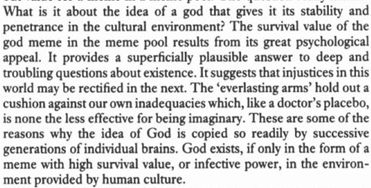
Beyond the personal belief about God is the idea of god as a cultural meme. Dawkins explained that God exists culturally. Here’s the page where Dawkins explained what he called the “god meme” and why it survives.

The Selfish Gene, by Richard Dawkins, p. 193

How Do Memes Spread?

Memes mutate, crossover from generation to generation. adapt, and change. They spread in ways more subtle than blog posts and tags that branch out by five times five.

It’s suggested that memes survive the same as genes — through natural selection. Six conditions can effect the ability of a meme to spread.

  1. Experience If a meme correlates with your experience you are likely to spread it.

  2. Pleasure or Pain If a meme has caused a feeling of pleasure or pain, you are more likely to remember it and to pass it on.

  3. Fear/Hope If a meme promises a future, a threat, a cause, a philosphy, a reward, or great benefit, you are more likely to believe it and spread it.

  4. Censorship If a meme is censored, it can be destroyed.

  5. Economics If those with money exhibit a preference for certain memes, those memes will have an advantage, will be imitated and spread.

  6. Distinction The memes of leaders, intelligent people, and celebrities will spread more easily.

I suppose one could argue that blogging is a meme. But I’d have to say those blog posts that link back and tag five people forward would have to be memetic mutations.

I like the ones that tell more about the blogger . . . but I can’t get my head around calling them memes anymore. Anyone have suggestion about how to introduce a meme to rename the things that we have misnamed as memes?

How’s that for a problem?

–ME “Liz” Strauss

Liz is speaking at at SOBCon 07.

Filed Under: Blog Basics, Bloggy Questions, Successful Blog Tagged With: bc, Memes, Richard-Dawkins, SOBcon-07, sobevent.com, the-Selfish-Gene

Blog Promotion: How to Write for People and Search Engine Spiders

November 28, 2006 by Liz

Blog Promotion by Writing Well for the Web

New Blogger Logo

Writing online serves two audiences — people and search engine spiders — those little crawly bots that move from link to link indexing information that ranks my pages. People are my readers. People are also the users who search for information. Spiders locate the content for search engines to index and serve up when people go searching for information. Keeping those facts in mind helps me handle the balance between the people and the coded arachnids that search out quality, relevant content to serve them.

The best blog promotion is to write well for the web. I keep my focus on people and give a nod to spiders by following these basics.

Write for People

    I write for people. I use my own voice. I write with the way people read as my guide.

    I read over my work as a reader would. When I read what I’ve written listen as a person would hear the message.

    I look for words, phrases, errors, and overly-long sentences that would get between readers and my message. I also have a proofreader check things behind me. If you find something, she’s not been here yet.

After the work is “people-ready,” I go over it another time for my secondary audience –- those search engine spiders. I make sure the spiders don’t trip and have plenty to eat.

Feed Spiders

    Spiders like to eat keywords. I make sure they find some in titles and subheads and key sentences. I don’t mind a bit of repetition.

    I avoid the word “here” as link anchor text. Spiders place more value on outgoing links when the anchor text shows how they are relevant.

    I add related articles. Spiders like to know how my pages relate to each other, and they like to have those pages to serve up when someone is searching for a related idea.

    I link out or trackback to quality blogs.

These last crumbs to feed spiders didn’t really change the content. So I give the piece a final read, fix what I find, and hit that publish button.

Readers are happy because they get my best writing. Spiders are happy because people get my best writing — that means the people will use their search engine again.

–ME “Liz” Strauss

Related
6+1 Traits of Search Engine Relevant Content
Search Engines & People Care about Anchor Text in Links
Blog Construction–What’s Your Function?

Filed Under: Blog Basics, SEO, Successful Blog, Writing Tagged With: bc, blog-promotion, search-engine-spiders, SEO, Writing

Blogs Aren’t Books — Not Everyone Starts Reading on Page 1

November 11, 2006 by Liz

Entry Pages Count

Customer Think Logo

Do you think about your blog as if it’s a book?

Do you have a hidden assumption that everyone reads the front page first, because that’s what you do?

Every page of a blog offers an open door and a place for readers land. Search engines send traffic to pages deep into the archives. Old bookmarks do too.

Next time you check your stats, note the entry pages — where visitors land when they arrive. Then visit the popular entry pages yourself. Take a long look. Do they look up-to-date? Is the information still correct? Was your writing as good then as it is now? It doesn’t hurt to check to be make sure that the place is still spruced up and talking nice. Every entry page is a first impression of your blog, your business, and your brand.

Investing in your landing pages to make them inviting and informative can have as much impact for those incoming readers as any front page does.

How do you use your stats to make your blog more friendly to your readers?

–ME “Liz” Strauss
Need a clone or a manager to help clean up your blog? Check out the Work with Liz!! page in the sidebar.

Related article
Speed Reader — Not the Same One
Great Find: Blog Promotions Using Stats

Filed Under: Blog Basics, Successful Blog Tagged With: bc, Customer Think, entry-pages, Perfect Virtual Manager, reading-stats

  • « Previous Page
  • 1
  • …
  • 15
  • 16
  • 17
  • 18
  • 19
  • …
  • 26
  • Next Page »

Recently Updated Posts

Is Your Brand Fan Friendly?

How to Improve Your Freelancing Productivity

How to Leverage Live Streaming for Content Marketing

10 Key Customer Experience Design Factors to Consider

How to Use a Lead Generation Item on Facebook

How to Become a Better Storyteller


From Liz Strauss & GeniusShared Press

  • What IS an SOB?!
  • SOB A-Z Directory
  • Letting Liz Be

© 2025 ME Strauss & GeniusShared