
Successful Blog

  • Home
  • Community
  • About
  • Author Guidelines
  • Liz’s Book
  • Stay Tuned

Reach Out and Touch Someone with Your Company’s Blog

August 17, 2011 by Thomas

In the small business blogging world, there are good blogs and there are not so good blogs. That being said, how would you rate your blog?

As a small business, what is your goal behind having a blog in the first place? Do you use it as an opportunity to promote your company’s products and services? Is it more of a forum for you to get things off your chest or talk to other business owners? Or is it just something you felt you had to have given your competitors have one?

Like many small businesses that sport blogs, the initiative to grow the blog is often there, but the time doesn’t seem to be. What ends up happening is the blog takes a back seat to other more important matters, the content becomes stale, and next thing you know you have a blog whose hits become less and less.

Growth is Possible

If your company’s blog is collecting dust on the Internet, there are means by which to grow it and enhance your company’s online profile.

Among the initiatives to employ are:

  • Who is my audience? – If you haven’t already answered this key question, you’d better. You can spin your wheels on your blog if you don’t know the answer to this question. In order to make your company blog stand out, you need a niche, something that sets you apart from the competition;
  • Determine the time factor – It is important as a business owner with a company blog to determine how much time and effort will go into it. If you have a marketing person/team in place, the blog typically falls to them. If not, and you are the one primarily responsible for the blog, set time limits each week as to how much time will go into the blog;
  • Good copy is imperative – Whether you are writing your company’s blog or a staff member is it is imperative that it offers good copy. Your content needs to be interesting, useful and timely. Make sure that the blog provides both current and potential customers with information that peaks their interest, is important to their lives and is up to date. Also, keep the blog postings relatively short, given that the time demands on readers are greater than ever;
  • Just as important as good copy is, your blog needs a clean look. How many blogs have you visited where the design is cluttered, hard to follow and looks like a kindergartner laid it out? If you’re not a design guru, find someone who is so that the blog looks and acts professional;
  • Reach out to others – Another key is linking to other blogs and commenting on other’s posts. When you scratch someone’s back, they will hopefully do the same in return;
  • Respond to comments – In the event you are getting comments on your blog, by all means respond to them. This shows the reader that you are engaged in the conversation brought by others, along with getting you noticed more throughout the blogging community;
  • Know your metrics – If you’re writing a daily or weekly blog but not checking the statistics, what’s the point? Company bloggers want to know how many people are clicking on the blog, what demographics do they represent, when are they clicking on the blog etc. Find the right analysis program to track your numbers and see what your traffic reports look like.


While these are just a few of the areas you should zero in on, remember, YOU control the look and sound of your company’s blog.

Don’t expect the company blog to itself bring in a ton of revenue, but look at it more as a component of your overall strategy to reach out and touch someone, in this case, customers.

Photo credit: thefosburyflop.com

Dave Thomas is an expert writer based in San Diego, California.  He writes extensively for an online resource that provides expert advice on purchasing and outsourcing decisions for small business owners and entrepreneurs at Resource Nation.


Filed Under: Content, Design, Successful Blog Tagged With: bc, Blog, copy, customers, LinkedIn, metrics

Take Readers on Your Travels

August 10, 2011 by Thomas

You love to travel and want to put pen to words, be it before summer ends or down the road.

If you’ve thought of creating a travel blog, it is probably easier than making your travel plans, packing up the suitcase, and making sure you have a good time.

In order to craft a good travel blog to draw in readership on a regular basis, have a few basics in place.

Content, Content, Content

First, review different travel portals online to see how others do it, what to avoid, and what niche you may be able to fill that readers could be missing.

Whether your travels take you not too far from home or halfway around the world, the goal of any quality travel blog is to make readers feel like they’re along for the ride with you.

In order to have your blog followed regularly, the first and most important aspect is providing regular content.

While you’re probably not going to be able to afford to travel every month (unless you do it for a profession), a blog that is sparingly updated stands much less of a chance of gaining a regular following.

The next and most obvious factor is having a clean looking blog that is grammatically correct, flows nicely, has attractive pictures, and makes the reader feel like they’re part of the journey.

While your writing tone should be informative and to the point, don’t make it out to be an instruction manual. We travel for the simple purpose of getting away and enjoying new experiences or rekindling old memories, so keep the tone of the blog enjoyable.

It sounds rather obvious, but it is important to maintain a travel journal during your journeys so that you can look back and pinpoint items to a rather exact science. Hopefully your travels involve lots of fun activities, so recording them for posterity will make it easier when you begin to blog.


Adventures in Life

When traveling down the blogging road, be sure to engage your readers in your adventures. If your readers comment or ask questions about your journeys on the blog, be sure to respond in kind.

Another plus to writing a travel blog is that it can lead to new friendships with others who also like to set sail on new adventures. In some instances, you might actually find new travel partners to share journeys with. Sharing blogging information is also a plus, as travel bloggers can promote each other’s sites, therefore leading to more readers.

While travel bloggers should not expect to make a fortune or even any money early on with their sites, there is potential to profit from one’s journeys.

Assuming that your travel expenses are not going to come easily, making some money off of a travel blog can help assist in covering some of those costs.

In closing, a travel blog should be done in order to convey your travels to others and share the good times that traveling can bring.

Update the blog regularly, engage in conversation with readers, and make the experience one that is fun and doesn’t seem like a job.

If you follow those basic rules, your travels and writing about them will be a vacation.

Photo credit: freetraveltime.com

Dave Thomas is an expert writer on items like call center services and is based in San Diego, California.  He writes extensively for an online resource that provides expert advice on purchasing and outsourcing decisions for small business owners and entrepreneurs at Resource Nation.
Filed Under: Blog Review, Content, Successful Blog, Writing Tagged With: bc, Blog, conversation, readers, travel

Cool Tool Review: Proxlet – Your Rescue for Twitterchats

April 8, 2011 by Guest Author

A Guest Post by Leo Widrich

cooltext451585442_tools

Last Sunday was my first time to participate in #blogchat a weekly held Twitterchat and boy was it an amazing experience conversing with @lizstrauss and @mackcollier. It boasts great personalities each week helping you to answer any Social Media and blogging related questions.

For long I was quite reluctant to join in Twitterchats as I felt I would overwhelm my followers for the time the chat was going on with my tweets.

Fortunately I finally found a solution I can offer, since staying away from this massive amount of great insights at #blogchat is definitely not an option.

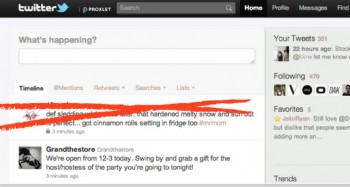
It is a nifty Twitter App called Proxlet.

proxlet

What does Proxlet do?

Facebook has a very useful “Hide this post” option integrated. Proxlet gives you this exact same thing, only for Twitter.

Using proxlet, you can temporarily hide certain things on Twitter which clutter your timeline or aren’t currently the core thing of your interest.

How to best use it?

Proxlet fortunately takes the “hide this” feature a step further and allows you to explain in a very detailed manner which area of tweets you want to block.

  • You can block Apps you don’t want to show up in your Timeline. For example am using it for both foursquare and paper.li since I feel they don’t add enough value.
  • You can also stop certain individual users temporarily, for example because they are at a conference and you are not really interested in their tweets at that point.
  • Another way to make use of Proxlet is to block certain hashtags from showing up in your timeline.

What is the best part of Proxlet?

The best part of proxlet is that it works not only at twitter.com, but can also be used for your favourite Twitter clients such as Twitter for Iphone, Tweetdeck and others.

Someone approached me that he couldn’t take the load of my #blogchat tweets and Proxlet turned out to be a superb solution for both of us. He could continue following me, yet was freed of those unwanted tweets in a short space of time.

What are your thoughts on Proxlet (http://proxlet.com) ? Have you had a similar problem yourself before too? Please let me know below.

Leo Widrich writes Tips for Twitter on his blog. You can visit his website, Bufferapp, or find him on Twitter as @leowid.

_________

Thanks, Leo, for checking out proxlet for us!

–ME “Liz” Strauss
Work with Liz on your business!!

Buy the Insider’s Guide to Online Conversation.

Filed Under: Business Life, Content, Successful Blog, Tools, Trends Tagged With: bc, Leo Widrich, LinkedIn, tools, Twitter

Be Irresistible: 10 Steps to Consistently Develop Highly Viral, High ROI Products

March 8, 2011 by Liz

How Good, Great, and Elegant Is a Product that No One Uses?

insideout logo

Yesterday while I was talking with @MichaelPort about solid.ly the software system he’s developing to support his Book Yourself Solid System. He told me about a conversation he had with venture capitalist who asked him, “What makes you think you can move from writing books into developing software?” I was taken by the perfectness of his answer. It was something like …

“I’m hiring the best people to do the development, but I know and care about the people who will be using it.”

That lead us into a discussion of what a product developers job is.

I spent almost 3 decades developing products for teachers — books, CD-Roms, websites, videos, audios, and others. During that time, I learned a lot about how products were made — what works, what doesn’t, and that the great idea that hasn’t made it to the market probably isn’t there NOT because someone hasn’t already thought of it, but because

  • it’s too expensive,
  • too labor intensive — to build or to use
  • or no one really wants it.

If I can’t afford it, don’t have time to use it, or don’t want it, it doesn’t matter how elegant, great, clever, cutting-edge, award-winning or beautifully you produce it.

10 Steps to Consistently Develop Highly Viral, High ROI Products

But the most crucial thing I learned as product person was that no matter how much I thought about my products, I had to think about my customers more. My role wasn’t to produce great products, but to produce great products people wanted to buy and use. Those are the products that folks buy again and tell their friends about. Here’s the secret I discovered …

It’s not my brilliance that makes a product irresistible. It’s not the awards the product might win that makes a products go viral and gain loyal long-term fans. It’s understanding my role as the product person is to know, love, and serve the customer.

Most of my intelligent customers could do or learn to do what I do.
But if they did what I do, they wouldn’t have time to do what they do.
My job is to make the customer’s life easier, faster, more meaningful and, if possible, more fun.

We turned around a failing company by developing highly viral, high ROI products by getting as close as we could to our customers. Here’s a few ways to do that before you even start planning that product execution …

  1. Know and live with the people you’re building for. Talk to the people you want to use what you’re building. Live in their natural habitat. Know the issues of their lives. Know the little things that bring joy to them. Know the prickly things that they don’t even realized irritate them daily. Know the influencer group of your customer group. Know the folks who understand both groups intimately and best. Invite the most interested from all three groups into your process as participants not just advisors.
  2. Use measurements appropriately. Data supports how people do things but rarely gets down to the why they do or the patterns of what moves them emotionally. When you think you know something, then, test and measure it. Don’t build a profile of customers through measurement only. Think about what companies would get wrong about you if they only used the quantitative data and scores from your medical check ups and school reports about you, without ever finding out about your personality.
  3. Respect the products that your customers are already using. Don’t fall into the trap of only seeing the faults of what’s already out there. That product you see so many flaws in has already solved a huge number of problems for your customers or they wouldn’t be using it. If it’s so bad, why does it have 100,000 or a million people using it? Ask people what they love about it. Be careful not to build something that takes away something they’ve made a part of what they’ve come to enjoy and they’re regularly doing. Lose what they hugely love and it won’t matter if you offer something that fixes a minor irritation.
  4. Start with a small offer built to your highest standards. Respect your customers’ time. Make the first release your best work, not a beta test. If you know your customers, if you’ve lived with them and invited them into the the development process, you know what works for them. Deliver it. Don’t play with their time or ask them to work out the bugs for you. That’s your job. If you want to attract the best, be the best.
  5. Simplify until there is no learning curve. Simple is not only elegant. It allows us to focus on why we got the product not learning the product first. Apple has mastered this. They can put the entire manual for using a product in a pamphlet that no one reads because we can pick up the product already knowing how to use it.
  6. Get paid for your product. Free samples are fine. Free products are not. The model of building things for free costs those who build products more than we might think. We release things unfinished at standards less than our best. We don’t build the appropriate support or service into them and we ask too much from our “free” customers who take us for granted. We work with people on promises. We lose money, reputation, and if nothing else, time we don’t have. Ever seen a tweet the equivalent of, “I’d gladly pay for Twitter if they’d guarantee service.”
  7. Systematically and strategically build your customer base as you build your product line. We no longer need to build a huge department store and fill it will products to prove we exist. We don’t need to stress our resources, cash, or infrastructure like that. Release one product that does one thing well for one audience. Let that product and that customer base finance the next. One customer group well served is better than 12 products less well defined — and one product is easier to market and easier for our friends and networks to share on our behalf. Know, love and serve that first group and they’ll tell their friends. They’ll also tell you what they want next and what group of their friends are your next best bet.
  8. Learn the life cycle of your product and know when to revise. Every product has a life cycle. It seems the way of the Internet to let the product die a slow death. Know how long that product is likely to sell well, then just after the peak selling point, carefully revise it to add new features. Once you’ve got a history to rely on do this on a predictable schedule. If your product life cycle is 9 months to a year. Plan your next revision at 11-12 months. Be careful not to revise out the features that customers love and not to add features they don’t care about. Look to make your product even easier, faster, and more meaningful at doing what it does. .
  9. Release new products on a predictable schedule. High tech companies might be slaves to the fast-changing conditions, but not every company is. If you can provide a predictable release schedule get fully behind that. It will build discipline into your infrastructure and your process. Predictability also builds trust. Customers will come to know that they can look forward to something knew from you when they’re planning their budgets. .
  10. And go back to Step 1 by getting to know your customers even better after they buy from you. Think of that first purchase as the first date in a long-term relationship. Value the customer who’s already shown a commitment above all others. Respect them by giving the best offers to them, not to the “potentially new” customers who haven’t been listening to you. .

These 10 steps work. I know because I’ve used them successfully and two well-respected financial guys have put their names on that fact.

It takes two things to win a loyal and growing customer base,

  1. products customers truly want that live up to their promise
  2. and more opportunities to get those kinds of products from a business they can trust..

Simply being that business who knows, loves, and serves their customers better than anyone else can save those customers the time of having to look in other places when they need what you offer. Who wouldn’t value that?

Have you had any experience with a company that consistently builds highly viral, High ROI products.

–ME “Liz” Strauss
Work with Liz on your business!!

Buy the Insider’s Guide to Online Conversation.

Successful-Blog is a proud affiliate of

third-tribe-marketing

Filed Under: Business Life, Content, Successful Blog, Writing Tagged With: bc, high roi, LinkedIn, Product strategy, vial product

Teams: How to Make Quality the Signal above the Time and Money Noise

December 28, 2010 by Liz

(Updated in 2020)

Photo by Marvin Meyer on Unsplash

10-Point Plan: Train Self-Managing Teams with an Outstanding Bias Toward Quality

Show Me in the Contract Where It Assures the Work Will Be Good

Spend enough time in business you hear the saying, “Fast, Quick, and Good, Can’t have all three!” or some version of it. In my business it was Quality, Schedule, Budget, Pick Two!”

I watched and wondered for years what made this algorithm work. Observation proves that without constant surveillance it consistently comes out the same.

Schedule and Budget win out over Quality.

Quality is hard to define, protect, and keep. It’s high touch, high concept, by it’s very nature qualitative and subject to discussion. Schedule and budget are right there, out loud, down on paper easy for everyone to measure and see.

In a business endeavor, every member of a team knows exactly how late, how much over budget some effort might be, but few can agree how much it has slipped on quality.

If we’re talking about products, it’s hard enough judge the quality gap — that’s the job of the product team.
But suppose we’re talking about quality leadership, quality thinking, quality communication, quality relationships, or living out a quality social media strategy?

How Do You Keep the Noise of Time and Money from Killing Quality?

Quality leadership does the quality thinking that forms the quality decisions. It’s quality communication that builds long-term quality relationships. That kind of quality is at the foundation of any team endeavor that succeeds. It’s also the at the core of any quality social media strategy.

Whether we’re talking to employees, customers, or volunteers, it’s important that we telegraph with every nuance of our brand that quality will always be the signal above the noise of time and money. Because quality is about them.

How do we build an outstanding bias toward quality into the fabric of our organization and our teams? Use the same steps we used to build a brand-values baseline and if you can, invite help from that same core team.

  • Start with the heroes and champions from the core team. Whenever change is the goal, look for the folks most predisposition to embrace the change and invite them first.
  • Put the problem before the change makers — about 12 people in three teams. When they have gathered first challenge the teams to define quality as a definition of thinking, leadership, communication, relationships, and process. Have them come to one definition for their team.
  • Ask that core group of change makers how to tackle the problem Ask them how to bring quality to be the highest signal above the noise on their team.
  • Listen and record their answers. Think of it as a list of possibilities, not necessarily a brainstorm, but more like an offer of possible tactics to try in their natural habitat.
  • Review the list and ask the group to sort it. Choose three categories. Possible categories might be leadership-based ideas, communication-based ideas and process-based ideas.
  • Ask each team to discuss one of the three lists they’ve made. Suggest that they discuss how well the idea might work over time with their coworkers, how it might need to be changed, and whether it needs outside input. Allow teams to add or remove ideas. Explain that they’re looking for one or more ideas that have merit — enough power and value that the team believes they could persuade others to put the idea into action.
  • Invite the teams back to the group to present the ideas that they believe have merit. Challenge the teams to persuade the rest of the room to take on their call to action.
  • Allow the listening teams to give their response and to offer their opinion on how easily they might be able to persuade others to join in to the proposed quality challenge. Work together to help reword and rework any that have value, but need a more powerful argument.
  • Decide on the most effective quality-enhancing changes that are most natural to the organization.
  • Build a strategy on how to introduce them to the larger group. Will it be peer-to-peer training? Will it be a meeting? Will it be a proof of concept that the small group tries and then demonstrates success?
  • Then, choose a way that everyone can measure the success of the attempt to change behavior to a more quality-based way of work. Set a date to meet again to report back, consider how things worked, and adjust the call to action or the process.

Research has proven we go where we look and we change what we measure. If we want our bias toward quality in thinking, leadership, communication, and relationships to grow, we have to look at, measure and talk about them in the same ways we do schedule and budget. If we want quality to be the signal above the noise, we have to invest our schedule and budget in making it so.

People look at what we do — not what we say — to know what we believe.

How do you prove to your employees, customers, and volunteers that quality is above the noise of time or money?

READ the Whole 10-Point Plan Series: On the Successful Series Page.

Be Irresistible.

–ME “Liz” Strauss

Filed Under: Content, Marketing /Sales / Social Media, Successful Blog Tagged With: 10-point plan, LinkedIn, quality, relationships, teams, trust

4 Headline Types that Grab Attention Immediately

May 13, 2010 by Guest Author

By Terez Howard

How to blog series
cooltext455576688_blogging

One Blogging Secret That Everyone’s Telling You

I have something to tell you. You’ve heard it before. You know it’s beneficial to every blog. The great bloggers write about this regularly and practice what they preach.

Attention-grabbing headlines. There, I said it. Secret’s out. or it’s been out for years.

4 Headline Types that Grab Attention Immediately

When I worked for the newspaper, my editor told us that our headlines had to tell our readers something. Sounds simple enough, right? It is pretty straightforward.

I wrote the following story back in 2005: “Katrina victims in Chester tell their story of survival.” I could have written “Hurricane story.” My now five-year-old headline told readers what to expect from my story and why they would want to read it. My second, obviously bland headline example doesn’t tell you anything. It sounds like a fictional piece on a hurricane’s journey through an area.

Your headline needs a voice. While it doesn’t have to be a summary of your entire blog post, it should give your readers a taste of what to expect.

What kinds of headlines should you write? Here are four:

Raise a question

You can specifically ask a question, but your headline does not have to be a question. Rather, readers will ask themselves a question and want to know the answer.

For instance, my headline for today: “One Blogging Secret That Everyone’s Telling You.” What secret? Why’s it a secret if everyone’s telling me? Who’s telling me? These are the questions my headline raises, and I provide the answers in my blog.

So when you write a headline that raises a question, be sure to provide a satisfactory, thorough answer to your audience.

Include a list

“101 Blogging Topics That Will Keep Readers Coming Back In Hundreds”

Once again, readers know what to expect, that when they click on your post, they will see a numbered list, from 1 to 101. Why do lists make wonderful headlines? Bloggers will tell you how the search engines love numbers and how numbers are memorable to readers. These points are true, but not my focus.

From a blogger’s standpoint, lists are easy to write. As a writer, a list organizes my thoughts for me from 1 to whatever. From a reader’s standpoint, lists are easy to read. You expect a comprehensive, systematic piece of information.

Make a how to

People love a good how to. I love how-to’s. I followed a how to count calories and lose weight story and shed 10 pounds.

Tell your readers exactly what they will be able to do if they follow your how to. A how to headline does not have to be so basic, though. It could be a “How to not…” or a how to do something metaphorically, like “How to pop eyes with your headlines.”

Be compelling – Make it urgent

What makes you want to click on a blog post? It piques your interest. With the three aforementioned types of headlines, each and every one should be compelling. It kills me that bloggers spend their time writing a well-researched, thoroughly engaging post and don’t give any time to the headline. It’s an afterthought.

That doesn’t mean you can’t write your headline last. That’s a fine idea and preferable to many bloggers. I tend to write my headline first and tweak it as I write make it fit the entire post. Do what works for you, just so you give time to your headline.

Your headline is your appetizer. It prepares your audience’s appetite to the main course. Does your headline induce hunger? Hey, sounds like a headline!

What do you do to write an attention-grabbing headline?


—

Author’s Bio:
Terez Howard operates TheWriteBloggers, a professional blogging service which builds clients’ authority status and net visibility. She regularly blogs at Freelance Writing Mamas. You’ll find her on Twitter @thewriteblogger


Thanks, Terez!
–ME “Liz” Strauss

Filed Under: Blog Basics, Content, Successful Blog Tagged With: bc, blogging, business-blogging, headlines, How-to-Blog, LinkedIn, Terez Howard

  • « Previous Page
  • 1
  • …
  • 11
  • 12
  • 13
  • 14
  • 15
  • …
  • 28
  • Next Page »

Recently Updated Posts

Is Your Brand Fan Friendly?

How to Improve Your Freelancing Productivity

How to Leverage Live Streaming for Content Marketing

10 Key Customer Experience Design Factors to Consider

How to Use a Lead Generation Item on Facebook

How to Become a Better Storyteller


From Liz Strauss & GeniusShared Press

  • What IS an SOB?!
  • SOB A-Z Directory
  • Letting Liz Be

© 2025 ME Strauss & GeniusShared