Successful Blog

  • Home
  • Community
  • About
  • Author Guidelines
  • Liz’s Book
  • Stay Tuned

Always Give People More Than They Bargained For

November 1, 2011 by Guest Author

A Guest Post by
Lou Imbriano

I grew up in East Boston in a three-decker dumbbell tenement building. My grandparents lived on the first floor and we lived on the third floor. We spent a lot of time on the first floor with my grandparents and ate dinner there practically every night. My grandmother was a seamstress and worked piecework in Boston, and my grandfather worked construction, tended bar, and worked at Suffolk Downs race track as a pari-mutuel teller. He juggled all of these jobs to make ends meet, and needed all three because of the seasonality of the work. What he really wanted was to own his own breakfast place and sandwich shoppe.

When I was about 9 or 10, he scraped together enough money to rent a store near the square and purchase all of the items needed to get things going. I used to walk to the store every chance I got to watch him in action. He loved making food for people and seeing them enjoy every bite. The shop wasn’t a cash cow, but he took great pride in it, and enjoyed owning his own place. One day, I noticed that a couple of firemen were there getting sandwiches and my grandfather told them it on was on the house. Another day, I saw him do the same for a couple of policemen, and then one day I saw him not charge a very popular business man in the city.

So one day, when we were alone, I asked my grandfather why he gave away sandwiches to certain people. Why didn’t he charge them? He sat down with me and said, “Louis, it’s a very small price to pay for their loyalty.” He proceeded to tell me that those folks were out in the community and people trusted them, so when they talked to folks about lunch, they will think of his store and mention it fondly. He also said that, especially with the police and firemen, if there was an emergency, they will be quick to respond, because of how nicely we treated them. Being a naïve child, I asked, “Isn’t it their job to respond quickly?” He agreed that it was, and that they probably would anyway, but by treating them nicely and with respect, the likelihood was that they would pay a little extra attention to us, and the store.

My grandfather further explained, “You see Louis, everyone thinks that if you give people what they bargained for, you have been fair and done your job. But, there is more to it than that. If you give people more than they bargained for, and the better of the deal, they will always think of you first, and they will always speak positively about your business.” My grandfather never went to college, never studied business, never got a masters, but he had a PhD in people. My grandfather’s words and actions stuck with me and his demeanor when interacting with customers strikes a chord even to this day.

When we opened TrinityOne, we threw a huge launch party for 800 people in the Castle at the Park Plaza Boston. It was quite a gala event with all of the bells and whistles. When we were planning the event, the head of security for the venue was laying out all the rules, regulations and protocols for the night, and stated that we had to hire a police detail with two officers. I immediately said to him, “Hire six.” He pushed back and said, “But you only need two.” I repeated, “Hire six; it’s a small price to pay for everything to run smoothly.” And it did. I have my grandfather’s wisdom to thank for that and many other similar instances. His words are always present: “Always give people more than they bargained for.”

—-

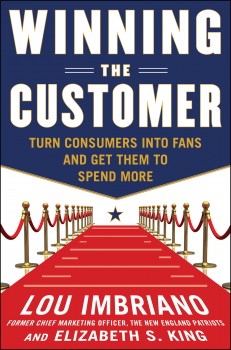
Lou Imbriano, the Vice President and Chief Marketing Officer of the New England Patriots football team from 1997-2006, is President and CEO of TrinityOne, a marketing company specializing in creating strategy for corporations to maximize revenue generation through building customer relationships and custodians of the brand. Formerly a radio and TV producer, he has appeared on numerous radio and television programs. Lou has been profiled on Forbes.com as one of their “Names You Need to Know” and has written multiple columns for the Sports Business Journal. Lou, who teaches sports marketing at Boston College, is based in Boston, MA and is the author of the newly released Winning the Customer. Lou can be found at LouImbriano.com

–ME “Liz” Strauss
Work with Liz on your business!!

Buy the Insider’s Guide to Online Conversation.

Filed Under: Customer Think, Marketing /Sales / Social Media, Strategy/Analysis, Successful Blog Tagged With: bc, Customer Think

Do You Rely on Analytics to Tell the Whole Story?

October 28, 2011 by Rosemary

A Guest Post by
Rosemary O’Neill

cooltext443809602_strategy

The Tools Only Get You Halfway There

Many tools offer to help you analyze your customer community, so that you can capture the elusive “ROI.” These tools evaluate a multitude of data points, including number of followers, likes, blog comments, retweets, etc., to come up with the success equation. Small businesses can be overwhelmed by the sheer magnitude of starting from zero in all of these social categories.

However, I propose that numbers only get you halfway there. The other half is composed of humanity. Information like, “dog’s name,” “has 3 kids,” “is insanely into photography.” The reason that is often left out in the cold is because it’s hard to automate that kind of connection. That type of information is only really gleaned from a steady stream of interactions over a long period of time. And many of us don’t invest the time to build up that data.

There’s an old-school sales trick that says when you walk into someone’s office, you look around and take note of the family pictures, fishing trophies, or other personal items on the desk. Those can be used to start conversations and begin building a connection…”hey, I went to UVa too!” If you want to build up your humanity data, you need to do the digital version of that; i.e., take note of the human information that is available online.

I’m not suggesting cyberstalking in a creepy way, but if your customer is sharing his/her interests publicly, it’s fairly easy to build on that. Here are some concrete ideas:

  • Build a web of connections, via Twitter, LinkedIn, or other networks
  • Promote your customers’ projects and content
  • Work on expanding the ways you connect—if it’s all digital, try the phone. If you’ve always emailed, try finding them elsewhere.
  • When you respond, try to read-up first. If your customer is reaching out to you on your FB page, why not show them you know them. Same with Twitter followbacks.
  • Find ways to allow your customers to be “whole people” in your community, include an area for off-topic socializing. And allow your reps to be human too.

The bonus is that, by including human data, you also build in “delight,” as people recognize that they’re being noticed. And that’s priceless.

—-
Author’s Bio: Rosemary O’Neill is an insightful spirit who works for social strata — a top ten company to work on the Internet. Check out their blog. You can find her on Twitter as @rhogroupee

Thank you, Rosemary! People like you are easy to remember and fun to do business with! 🙂

–ME “Liz” Strauss
Work with Liz on your business!!

Buy the Insider’s Guide to Online Conversation.

Filed Under: Strategy/Analysis, Successful Blog, Tech/Stats Tagged With: Analytics, bc, LinkedIn, Rosemary O'Neill

How to Strategically Pull High-Opportunity from High-Risk Danger

October 25, 2011 by Liz

What Separates Opportunity from Risk?

cooltext443809602_strategy

For me, growing up the youngest child came with a huge set of challenges. Courtesy of my two big brothers, I faced daily occasions to show or say that “I might be smaller, but I can hold my own on this proverbial dance floor.”

No matter where we are in the birth order learning to talk, walk, eat, read, ride a bike, swim, and cross the street are challenges that most of conquer as we find our identities. Conquering the challenges of social interactions and the personal particularities of our families, friends, teachers, teammates, bosses, clients, and customers add to the list. We learn those too watching, listening, attempting, adjusting, and eventually mastering.

Most challenges take the appropriate mix and measure of experience, personality, and motivation.

Challenges also motivate by the way they make something happen. They offer a way to gain ground or to conquer new skills and learning. The most exciting challenges are the ones in which risk may be there, but failure simply isn’t considered. On the other hand, taking on an unseen risk can be a ready-made failure.

What separates high opportunity from high risk danger?

High Opportunity, Low Risk Challenges

Long before we get to school, we’ve conquered plenty of learning. All learning is a series of incrementally increasingly difficult challenges that we conquer. We move forward and upward one step, one concept, one skill at time, repeating and relearning at slightly more challenging and more complex levels.

A well chosen challenge — like learning to walk when we’re ready — inspires the determination to scale mountains, ford rivers, navigate detours, roadblocks and fences to reach the ultimate successes. That challenge is a matter of finding success with total disregard to the possibility of failure. Falling down is simply a time to start again. Opportunities that offer sort of scaffolding builds skills, knowledge, and confidence with a possibility of failure but essentially no risk beyond loss of the time involved.

When they’re constructed naturally, learning challenges are high opportunity and low risk.

How to Strategically Pull High-Opportunity from High-Risk Danger

Risk and challenge are not opposite conditions. They often coexist in the same business proposition. We can define high-opportunity challenge as a difficult task matched to our skill set and experience that brings a reward such learning, advantage or new ground with it. If undertaken strategically, risk in that is limited. To limit that risk, we need to understand how gets dangerous.

What is risk anyway?

Risk is underlined and defined by cost. Risk means I might lose something dear that I value. I might give up something I can’t recover. I might find I am without something that I love, need, or desire.

The risk is not defined by solely by failure – (unless success is the something dear I value). Defining risk is defining what could be in jeopardy if we move forward.

With the right skills and conditions, the risk of a challenge is lower, but whether we see that depends on our mindset, skill set, personality, and experience. A realistic pessimist who has recently hit hard times might see risk everywhere. An idealistic optimist who has yet to fall down might be blind to the risks of the path he or she is proposing.

A strategic understanding of risk is sounder than seeing risk everywhere or being blind to it.

How to pull high opportunity from high-risk danger

We can mitigate the risk and test the challenge presented by any business proposition by evaluating the key strategic variables. Here’s how to do that.

  • Proposition: Define the business proposition in a concrete fashion. Give it measurable parameters — We will release the first offer consisting of [product description] that will [value and value proposition] by [time] to [audience] using [resource] to accomplish that with a return of [expected audience / market / $$ growth].
  • Position: Mitigate risk by finding the strengths in your unique position — your size, relative market share, audience awareness, reach, core competencies — and the advantages that come from these. Look for glaring risks in your position that are uncontrollable. Can you turn any of them into working advantages or strengths? For example, if you back is against the wall, you don’t need to monitor or protect that direction.
  • Conditions: Lower risk by letting condition support your success. Can you leverage the climate or cycles within your industry to support what you’re proposing? Is there a growing trend that you might align with to increase your growth?
  • Benchmarks and Decisions: Lessen danger by building in benchmarks at key decision points. How can you break the proposition into several “go/no go” stages? What is the risk of each one? Can you build an alternate outcome for the “no go” choice at each stage?
  • Systems and Relationship Networks: Structure the proposition to ensure scaffolded learning and gradually increasing investment. Can you build your customer base while you build your product or service? Can you test release to build to the customer’s tastes? How do you stage the development infrastructure to be financed by the first releases of the product or with strategic relationships? Set up systems to constant test for the hidden opportunities, and subtle differences from original expectations. See the patterns and respond to them.

Is it possible to risk at 30,000 feet and still fly with a safety net? I don’t think so. If you never risk, you never change. If we only take on low-risk challenges, will we ever learn the art of pushing the envelope, finding the edge of the universe, defining a industry leading purpose?

Find the risk that fits your calling, releases your spirit, and shows you know where you are going.

Would a risk of that nature be a risk at all?

Maybe there is no such thing as high-risk danger when you follow your instincts, evaluate the strategic variables, understand your unique position, leverage the conditions, worry out the secret chances, set up the systems, stage your decisions and incorporate key strategic relationships. The rest is mindset.

High opportunity is about moving forward. A high-risk danger is about not moving backward.

How do you pull high opportunity from high-risk danger?

Be irresistible.
–ME “Liz” Strauss
Work with Liz on your business!!

Buy the Insider’s Guide to Online Conversation.

Filed Under: Strategy/Analysis, Successful Blog Tagged With: bc, LinkedIn, risk management, Strategy/Analysis

Finding a Job After College: What They Don’t Tell You In School

October 7, 2011 by Guest Author

A Guest Post by
Amy

cooltext443809602_strategy

Tons of Jobs Out There for Me?

Last year, I graduated with a Bachelor of Science in Business Administration with distinction and a 3.8 GPA. As a marketing major, I was always told that there were “tons of jobs out there for me” and that employers were “looking for my set of skills” so I wasn’t very concerned about the job hunt ahead of me.

I started looking for a job during my final semester, and when no offers for interviews came I figured it was because I wasn’t available yet and I would have to graduate first.

After graduation, I moved to a larger city and started to focus solely on my job hunt. I would apply for 10 to 15 jobs each day, but many came back with a rejection email because I didn’t quite fit the skill set needed. Most of my applications went without a response at all. I started to feel discouraged after a few weeks thinking that I wouldn’t be able to find employment. After all, the unemployment rate is rising, and I had much less experience than others in my field.

After a while, I finally got my first interview request. I was completely myself and felt comfortable during the first round, which resulted in a request for a second interview. However, I got nervous during that second interview and got a rejection email the next day.

In my second job interview, I decided not to let anything keep me from being myself. I got through both rounds of interviews with flying colors and was offered the job. However, the hours were long, the pay was low, and I would be knocking on doors selling a product. While those qualities may have been alright for someone else, I wanted something a little different. After careful consideration, I turned down that job.

On my way to my third interview, I was already planning on where I would drop off more resumes on my way home. I knew very little about the company and it was impossible to find their website online. But I knew as soon as I walked in the door that this was the place for me. This place had flexible hours, good pay, great atmosphere, and wonderful people to work with.The interview lasted five minutes and I knew I would accept any job they offered me. Turns out, third time is the charm.

After my three month long job search, I feel that I have grown a little wiser. The job hunt is frustrating for anyone, whether they are just coming out of college or in the middle of their career. Along the way, these are the points I have found that may help you find your perfect job.

  1. Don’t be discouraged – Anything you are feeling during your interview will read all over your face. Smile and be yourself. This way, your employer won’t be expecting “interview you” when you walk in the door on Monday.
  2. Keep throwing darts – Keep applying for anything that seems remotely interesting. If you throw enough darts, eventually one will stick.
  3. Look for something different – Don’t just look for a specific position. For example, most marketing majors start looking for marketing jobs, but most of those job listings online are for door to door or over the phone sales people. Again, this may be what you are looking for, but sometimes your skills may call for something else. While looking online, search for keywords like “entry level” if you’re looking to advance, “writing” if that’s what you enjoy, or simply browse the different job listings in your area. There may be something there that you would have never looked for in the search box.

    Don’t forget to visit the actual websites of companies where you think you would like to work. Some of them may not be using a website like Career Builder or Monster.com, and some smaller companies may be using Craigslist because it is less expensive. Also, look in places you may not have thought of at first. Hand in resumes to businesses around your home. Actually giving them the resume in person will probably make you more memorable to the person hiring for the company.

  4. Interview them too – While you are in your interview, make sure you are asking questions too. You need to make sure this job is right for what you want in your life as much as they need to make sure you are fit for the job.
  5. Relax – It may take some time, but something will happen if you work hard enough.

What tricks do you have for finding a job after college?

—-
Author’s Bio:
Amy Gardner writes financial topics including small business credit cards. Amy welcomes your comments.

Thanks, Rachel. Even the seasoned pros at home need reminders like these!

–ME “Liz” Strauss
Work with Liz on your business!!

Buy the Insider’s Guide to Online Conversation.

Filed Under: Strategy/Analysis, Successful Blog Tagged With: bc, interviewing, job hunting, LinkedIn

Is There Light at the End of the Tunnel for U.S. Businesses?

October 5, 2011 by Thomas

According to a report released Oct. 5, from Automatic Data Processing Inc. (ADP), U.S. companies brought on more workers in September than the previous month, however the number was not enough to put a dent in the large unemployment numbers nationwide.

While the ADP report brought some encouraging news, two separate reports unveiled the same day noted that layoffs increased rather dramatically last month, while service companies are not hiring additional employees despite the sector’s relatively stable growth.

Looking back at the brighter report, ADP and Macroeconomic Advisers LLC report that private-sector employers added 91,000 positions in September, an increase of some 2,000 jobs from the previous month. The government’s official jobs report is slated to be released on Oct. 7.

Is Minimal Growth Better than None at All?

While the news is somewhat encouraging in that the country appears at this point to be dodging another recession, the recent report also demonstrates that growth is coming in very minimal numbers at best, providing us with weak growth at best.

While everyone is looking for any signs of growth, we shouldn’t be deceived by the numbers.

Much like when gas prices are inflated to high levels, drivers think they’re getting a deal when they pay less for gas, the bottom line being it is still $1 or $2 above what they paid the year before. Improvement, but much better is possible.

As for expanding on the down side, a report from Challenger, Gray & Christmas points out there were sharp increases in layoff announcements for September, with businesses planning to cut some 116,000 jobs, more than double the August report and the worst in more than two years. The biggest cuts came among the government and financial sectors.

What is Your Business Doing to Grow?

With the recent numbers showing a mixed bag, has your company been impacted either positively or negatively when it comes to job growth lately?

For many companies, especially smaller businesses, growth has been hard when you throw in the added costs for health care that many employers have been dealing with. While the government has tried to throw some incentives in the direction of small business owners, a fair number of them have either stood pat on hiring or even laid off where they felt it necessary.

If your small business is contemplating hiring, do you plan on? –

  • Waiting until after the holidays?
  • Waiting until you see better jobs numbers and additional incentives from Washington?
  • Waiting until next year’s presidential election is over?
  • Waiting to see if health care costs come down?

Lots of questions still remain for many small businesses, many of whom are playing the waiting game.

Photo credit: gaebler.com

Dave Thomas, who has authored a number of articles regarding business phone service writes extensively for www.business.com an online resource destination for businesses of all sizes to research, find, and compare the products and services they need to run their businesses.

Filed Under: Business Life, Strategy/Analysis Tagged With: bc, business growth, layoffs, LinkedIn, recession, small business, workers

How to Choose the Easiest, Fastest, Most Meaningful Next Move

October 4, 2011 by Liz

THEN We Will …

cooltext443809602_strategy

During the Q&A of his interview at SOBCon NW, I asked Rick Turoczy (@Toruczy) of the Portland Incubator Experiment, “What seems to be the single problem that most startups encounter?”

Rick’s response was telling. He said that the young companies he worked with were clear on their vision and their mission. They knew were they were going … Where they got stuck was figuring out the first small step to get there.

Are you surprised by that? I’m not.

The act of paying attention to what relates to our mission and vision gets us attuned to the wide range of options that could relate to our end goal.

We think of our goal as THEN.
THEN we’ll be there.
THEN we’ll have what we’ve earned.
THEN we’ll know.

We can’t know what things will be THEN, but we know all we need to know about now.

But strategy is a function of NOW.
What is our position NOW?
What are the conditions NOW?
What is the opportunity NOW?

How to Choose the Easiest, Fastest, Most Meaningful Next Move

Choosing that next step often seems a problem. We listen. We follow links through our networks and systems. If our minds and hearts are open, we find a world filled with possibilities. We pay attention to learn as much as we might. We gather up information, ideas, and options. Then comes the moment to move. We get stuck in too many possibilities. Big ones, little ones — which to do?

To head in our best direction, we have to do the opposite of listening and paying attention. NOW that we’ve gathered the immediate information, it’s time to pull it in. It’s time to narrow and focus. It’s time to choose the best possible easy move to advance now. The small opportunity that fits us most naturally is the one that easiest, fastest, and most meaningful to reaching our biggest, most important goal.

Here’s how to choose the easiest, fastest, and most meaningful next move:

  1. Use your vision and mission to set your direction. Have a clear sense of where you want to be and why you want to be there.
  2. Use the information you’ve gathered by listening and paying attention to know your position — where you are now. Tell yourself the truth. Every position has advantages. Yours has advantages unique to you.
  3. Study the information you’ve gathered to understand the conditions under which you’re working. Look for openings that lead in the direction you want to go. You, your team, and your mission fit perfectly into openings right next to you. Look to do more for the people who love what you’re doing. Invite them to help you figure out what would be the easiest next small thing for you to do.
  4. Identify the easiest small opportunities and openings that move you forward by using these criteria. They will be those that
    • Align with your long-term goals.
    • Match with your values and culture.
    • Leverage what you and your team have already accomplished — skills, talents, and successes.
    • Make changes work for you.
    • Disperse the work to many best sources. (Do that thing you can get started and pass on so that another person is working while you work on the next one.)

Look for the position adjacent to the one where you’re standing. The best new positions look only slightly different than the position where we are right now. By moving into that slightly new position — serving the closest friends of our customers or adding a new flavor to the same offer — we built strength on what we already own. By keeping an eye on our vision at the same time as we make these tiny moves, we not only keep focus, but also bring our community of customers with us in a logical, predictable fashion that is easy to invest in, because it’s easy to trust.

Each small decision creates new opportunities that are unique to our position and the skills we bring. In that way, we create a path that is ours and impossible to replicate with authenticity.

We do what we are rather than are what we do.

How do you filter and narrow your options when you choose your next move?

Be irresistible.

–ME “Liz” Strauss
Work with Liz on your business!!

Buy the Insider’s Guide to Online Conversation.

Filed Under: Marketing /Sales / Social Media, Strategy/Analysis, Successful Blog Tagged With: bc, creating opportunity, limiting options, LinkedIn, making decisions, most important goal, Strategy/Analysis

  • « Previous Page
  • 1
  • …
  • 8
  • 9
  • 10
  • 11
  • 12
  • …
  • 48
  • Next Page »

Recently Updated Posts

Is Your Brand Fan Friendly?

How to Improve Your Freelancing Productivity

How to Leverage Live Streaming for Content Marketing

10 Key Customer Experience Design Factors to Consider

How to Use a Lead Generation Item on Facebook

How to Become a Better Storyteller


From Liz Strauss & GeniusShared Press

  • What IS an SOB?!
  • SOB A-Z Directory
  • Letting Liz Be

© 2025 ME Strauss & GeniusShared