Successful Blog

  • Home
  • Community
  • About
  • Author Guidelines
  • Liz’s Book
  • Stay Tuned

Inside out vs. Outside In: Choosing the Right Approach for Your Online Business

May 13, 2011 by Guest Author

A Guest Post by
Rahil Muzafar

cooltext443809602_strategy

Which Is Best for Your Business?

When you are looking to setting up an online business (or any other business for that matter), there are two, totally different approaches that you can choose from, commonly known as “Inside Out” and “Outside In” approach.

Going Inside-Out:

You should know that you are taking the “Inside Out” route when you are trying to build on a business plan that you ‘think’ is profitable. Normally, it’s not a plan that you have laid out after careful research and assessment, but merely an imitation of what other successful businesses are doing. In other words, you try to get hold of a plan, which has worked for someone else, and then try to replicate the exact same model while hoping for the similar success (or should we say, hoping against the hope).

Choosing Outside In:

On the other hand, an online entrepreneur with “Outside In” approach will start from the market, or customers to be more precise. They will start from trying to decipher what exactly the customers want, and then finding a way to bring exactly that product or service on table. Therefore, it wouldn’t be wide off the mark if we say that a business with “Inside out” approach is basically a follower, whilst a successful “Outside in” approach will make you a trendsetter, which is an accomplishment in itself.

However, when we look at all of those new businesses popping up in the cyber world, we will see that more businesses are taking the Inside out approach, whilst very few are daring to opt for the Outside In. But before we disapprove of those businesses, let’s have a well-rounded discussion about the pros and cons of both these approaches.

Finance and Budgeting:

As you can make out from the aforementioned descriptions, Inside out approach is more feasible when it comes to finances and budgeting, for the reason that you can easily go through different “success stories” and choose the one that suits your budget.

On the other hand, Outside In will require a more flexible budget, because your main objective is to fulfill the customers’ need and come up with a product or service that doesn’t fall short of their expectation. In an Inside Out approach, you will be more concerned about your own resources and restricted while taking business decisions, whereas Outside In approach wouldn’t even allow you to start until you have arranged for enough resources that will let you deliver a good enough product.

Risk:

Outside In might come across as the more risky one, but then high profits are always a product of risky ventures. Besides, you are not really shooting in the dark. This approach merely requires you to try and comply with the customers’ demands, so it is far from being a gamble but a well calculated risk, which will eventually pay off.

Convenience:

Inside out approach is clearly the easier route, especially on internet, where replicating a business is fairly simple and doesn’t require much thinking. Lured by this handiness (that later turns out to be a trap), many people invest their time and resources in copying some successful business, which is precisely the reason why we see so many failures in the cyber space. In contrast, outside in requires research, lots of thinking, creativity, and problem solving skills to set the wheels in motion … quite difficult but then long term success is never an easy feat.

Long Term vs. Short Term:

Inside out doesn’t always end as a failure, but even when you’ve achieved something, that is going to be a relatively short term success. You might seize some profits but you will hardly make it big, and as Dale Carneigi once wrote “The surefire boat never gets far from the shore”. Outside In is the approach that promises long term success, mainly because you are required to continuously get back to the customers and adjust your business according to their demands and requirements.

Security:

Inside out businesses are the most vulnerable in the wake of some adversities like recession, or maybe in case of Internet businesses, an update in Google’s algorithm. Outside in businesses are less susceptible because they always have their eyes on the external factors and they are ready to fine tune well in advance of some inevitable change.

Which approach have you seen used most often?

Rahil Muzafar

—-
This post was contributed by Rahil, who is currently working for sell a Marriott timeshare and cancel wyndham timeshare .

Thanks! Rahil!

–ME “Liz” Strauss
Work with Liz on your business!!

Buy the Insider’s Guide to Online Conversation.

Successful-Blog is a proud affiliate of

third-tribe-marketing

Filed Under: Business Life, Successful Blog Tagged With: bc, business strategy, LinkedIn, Muzafar, Rahil

A Good-Bye from Terez

May 11, 2011 by Guest Author

By Terez Howard

Passion, Reason and Success: An Impenetrable Triad

cooltext455576688_blogging

“If passion drives you, let reason hold the reins.” — Benjamin Franklin

In the blogging business, do you think that passion should make your business decisions? Probably not. But should it be the motivating force behind your work? No harm there.

I have a confession to make. I have a passion. That passion has been alive for 5 years. During that time, I’ve read, researched and learned a plethora of information. I’ve hungered for more information and found myself starved. I desired to give people what I had been craving. More information.

I spent a few months writing more than 35,000 words on the topic of black natural hair. I spent April designing a website and compiling all of this information into an organized manner to give other naturals a whisper of the information we yearn for. This whisper will transform into a shout because my passion still burns and will grow.

What does this mean for me?

I’m not going to go into great detail about why I decided to write about natural hair. I’m not going to tell you my personal story with natural hair because I doubt that you care. What I want you to know is that this passion of mine has taken hold of my time and energy. Since I’ve always been one to keep my writing business hours at a part time level, that means letting some things go.

My guest blogging here is one of those things. Jael Strong too will cease guest blogging and focus on pursuing creative writing, her passion.

What does this mean for you?

Maybe nothing.

But, it might make think about evaluating your circumstances, including your work schedule and productivity. Are you working your passion? If you are, are you spending enough time to develop it? Are you spending too much time on it? Are you being reasonable?

Benjamin Franklin put it so well. “If passion drives you, let reason hold the reins.”

Please be honest with yourself. There’s no sense in lying to yourself.

As for me, if you’re interested in the natural hair scene, you will see me around.

If not, know that I’m very grateful to have been here. Thank you, Liz, for the opportunity to know you and learn from your great wisdom. Thank you, readers, for checking in, commenting, tweeting and driving me to success.

And yes, I do think I’m successful, even though I’ve just recently started this endeavor.

I believe in what Pablo Picasso once said, “Action is the foundational key to all success.”

—
Terez Howard operates TheWriteBloggers, a professional blogging service which builds clients’ authority status and net visibility. She has written informative pieces for newspapers, online magazines and blogs, both big and small. She regularly blogs at Freelance Writing Mamas. You’ll find her on Twitter @thewriteblogger.

Thanks, Terez, for sharing yourself and your insights on my blog!

–ME “Liz” Strauss
Work with Liz on your business!!

Filed Under: Business Life, Successful Blog, Trends, Writing Tagged With: blogging, LinkedIn, Terez Howard

How to Turn a #Fail Position into a #Win

May 9, 2011 by Liz

Whisperer

cooltext443809602_strategy

Anyone who’s spent time with me knows that the combination of hotels, airplanes, and my llergies is likely to be disastrous for my voice. Don’t get me wrong some folks are grateful that they finely get a chance to get a word in edgewise, but even they wish I was being quiet by choice. It’s been a problem for as long as I can remember. Back in the 1990s, the executive team where I worked used to put together a betting pool around our biggest conference to pick the exact day and time my voice would abandon me and I would become a whisperer for a few hours.

At SOBCon this year, it happened at the most inappropriate time.

My important talk of the event was scheduled for the afternoon that I lost my voice.

Doing Right Things, Wishing, and Asking the Wrong Questions

It made me worried and cranky to think that I might be letting down a roomful of people I so admire. It made me disappointed in myself that I wasn’t going to be able to deliver the value I’d worked on to deliver. And I’ll admit it took the wind out of sails to think that I couldn’t bring it back. (I’ve since mastered the art of regaining my voice – ha! – so I’ll not be there again.)

I did right things …
I took my allergy meds as directed.
I stopped talking — well whispering — as much as I was able.
I drank tea with lemon and honey.
I mainlined honey after that.
… ineffective right things.

For about three hours, I thought of what I might do to deliver in that last session.
I kept thinking of our friend, Glenda Watson Hyatt, who once wrote to me, “I know why I blog, Liz. Why does blogging do for you?” She knows what it’s like to have so much to give locked in her head. I was wishing her with me, wishing her technology to turn my thoughts into communication, but that wasn’t to be had.

In my head, I kept asking questions …
What can I do to make this situation better?
Who can I ask to help?
How can I get my voice back?
… the wrong questions.

… but the answers all came back as less than what I wanted to deliver. less in this case was even less than missing my best. It was a fail not a win. The people in the room deserved a win.

Then it struck me that how I was looking at the problem was what was keeping it a problem.

How to Turn a #Fail Position into a #Win

I’ve often had amazing people around me who give me great advice — my mom, my dad, yeah my brothers, VanFossen, Starbucker, Roth, and many others, including a guy named Fred. I started thinking about things they’d told me at times like the one I was in.

  • You’re always cooking up brilliant strategies for other people. Be brilliant for yourself! – Lorelle VanFossen
  • Do you remember that Sesame Street skit “which of these things is not like the others”? — Carol Roth
  • Decide what you want to do and you’ll have all of the help you need. — Terry “Starbucker” St. Marie
  • I love your brain! — That guy named Fred.
  • Call me back, I hung up on you by mistake

That’s when I literally turned a full circle, tilted my head, and looked again.

After hours on the wrong questions, the right question came.

How could I turn having no voice into a strength?

My brain started conspiring.
My eyes lit with mischief.
My feet started dancing with enthusiasm.

I went into the main room,
asked someone to hand me a flip chart and a marker,
and returned to the side room to write 27 pages.

Those 27 pages became a keynote titled “Not Speaking is the New Black by the Event Whisperer and Friends”

And ironically, as I wrote my thoughts filled with meaning, my voice came back … probably because I realized I didn’t need it to share what was in my head.

Terry asked 28 people from the room to participate by reading one page aloud to the room for all of us. If you follow the link above you’ll see what it said, but that’s not the point of this post.

The point of this post is that

No matter what you think is working against you.
No matter what you think is your weakness or your lack.
It’s the way you’re looking at it that’s holding you down.

Step back, do a complete turnaround, tilt your head, and look again.

You can turn that #fail position into a #win.

I bet you’ve done that at least once. I’d love to hear your story.

Be irresistible.
–ME “Liz” Strauss
Work with Liz on your business!!

Related:
Not Speaking IS the New Black

Buy the Insider’s Guide to Online Conversation.

Filed Under: Business Life, Motivation, Successful Blog Tagged With: bc, LinkedIn, sobcon, Strategy/Analysis

Home Sick? 7 Productivity Tips So You Don’t Get Sick of Working at Home

May 6, 2011 by Guest Author

A Guest Post By Ripley Daniels

cooltext443809602_strategy

So, you’ve been given the opportunity of working from home and the excitement of skipping your daily commute, navigating office politics and being chained to your cubicle have all but completely overtaken you. You are free to work from home and be productive without the confines of an office environment. For the first few months, all is well as you love falling out of bed in your favorite pajamas only to stumble a few feet into your home office. The freedom and autonomy is absolutely priceless. A few months later, the isolation begins to set in. You miss the office chatter and the scheduled breaks with your co-workers. There’s something unnatural about spending several hours a day in front of a computer screen with no one to interact with.

If you find yourself running into the issue of restlessness, isolation and depression while working from home; there is no need to worry. Like with anything new, you must learn to adapt to your new work environment. Follow these seven simple steps and you will be whizzing through your work day in no time.

pic1_homesick_rdaniels
  1. Set up or maintain a regular work schedule. Nothing causes anxiety more than not having an organized daily routine which is what the traditional office environment automatically creates. In order to get into a happy, healthy work rhythm, you must create a work schedule that is realistic and doable and then stick to it. If you are used to starting work at 9AM and shutting down for the day at 5PM, this should be the work routine that you commit to while working from home.
  2. Allow yourself an hour break for lunch and a few small breaks throughout the day. Just as it is legally mandated that employees take lunch breaks and small breaks, you must follow the same guidelines or run the risk of burning yourself out. It is nearly impossible to work eight hours or more without stepping away from your desk so don’t feel pressured to slave away in front of your computer because you’re no longer officially on the clock. Set your lunch time and breaks at the same time every day so you can keep a regular schedule.
  3. Get outside and get active. Living a sedentary lifestyle is harmful to your health, sanity and confidence. When you are required to sit in front of a computer while working from home, it can be easy to forget the importance of fresh air and exercise and sunshine. When you do take your lunch break or small periodic breaks, try and get outside for a walk or to make a leisure call to friends/family. Take advantage of your new work environment and fit in some exercise via an exercise DVD or take a mid-day work out class at the gym on your lunch break.
  4. Set up Skype or Google Chat so you can maintain contact with your fellow co-workers while working from home. Telecommuting can be an isolating experience but with the help of social media and various programs, you can stay in touch with your co-workers as if you were right back in your cubicle or office. This is also a good way to keep your socialization skills sharp as telecommuting can easily dull your sensibilities from the lack of human interaction.
  5. Set goals for yourself both professionally and personally. Unlike a traditional job, a telecommuter has the opportunity of enhancing both their work life and personal life at the same time. You have the ability of using your breaks to complete various projects around the house which also serves as a mental break from your daily work load.
  6. Attend industry events and conferences so that you can stay current on the latest technology, products, services and inventions within your field. There is nothing worse than falling behind in your position because you’re working from home and no longer have access to the same information regarding classes or programs. Just because you are a telecommuter doesn’t mean that you can mentally check out and not deliver outstanding work performance.
  7. Step away from your desk at the end of each business day and don’t look back. If your schedule is 9AM-5PM, you should resist working past your scheduled hours as you will soon find that your energy levels, confidence and productivity will all drastically be affected. Turn your computer off and shut down your home office during the evenings and weekends so that you can maintain some semblance of a normal work/life balance.

Do you have other tricks you use to keep your business well and working?
_____________
Ripley Daniels is an editor at Without The Stress, a passport, travel visa and immigration advisory firm located in Los Angeles.

Thanks, Ripley, for your insight into the problems that are unique to working at home!

–ME “Liz” Strauss
Work with Liz on your business!!

Buy the Insider’s Guide to Online Conversation.

Filed Under: Business Life, Productivity, Successful Blog, Trends Tagged With: bc, LinkedIn, Productivity, working-at-home

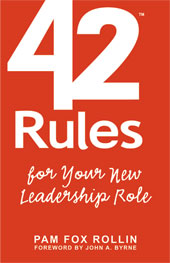
The Book List: 42 Rules for your New Leadership Role and The Little Book of Leadership

May 4, 2011 by teresa

The Book List: a weekly series by Teresa Morrow

I’m Teresa Morrow, Founder of Key Business Partners, LLC and I work with authors & writers to help them with their online book promotion and marketing. As part of my job I read a lot of books (I love to read anyway!).

The books in The Book List series will cover a range of topics such as social media, product development, marketing, blogging, business, leadership, organization, career building, finance, networking, writing, self development, and inspiration.

’42 Rules for your New Leadership Role’ by Pam Fox Rollin

42rules-your-leadership-role-mid

“Pam gives us that rare gem of a book—the perfect blend of proven tactics solidly grounded in the latest research. 42 Rules for Your New Leadership Role offers smart, busy leaders the proven mindsets and
practical to-do’s to make their strongest start as they rise in the leadership ranks. She also provides great tips on leading change across your organization. Refer back to the book often, and take every
chance to hear Pam speak about leadership.”
Sharon L. Richmond, Director, Change Leadership Center of Excellence, Cisco Systems

“Pam and I met 10 years ago when we started our coaching company. Since inception Pam has been one of our most effective and loved coaches. Her clients love her because of how she helps them reach
the heights they were capable of. 42 Rules for Your New Leadership Role represents the best of what she has learned over the years. Buy this book, and expect it to change your life!”
Scott Blanchard, Executive Vice President, The Ken Blanchard Companies

Book Excerpt

Now that you’re stepping up to a new leadership role, you’re far less likely to receive useful guidance than earlier in your career. This holds true whether you are in your first manager role or an experienced leader joining top executive ranks. I find this problem is especially acute for new Directors and VPs. You’ve been hired at these levels for your track record, so people assume you know what to do.

However, just because you were successful in your last role doing or managing marketing, accounting, engineering, or whatever you did, doesn’t mean you know how to make a strong start at your next job.

One-quarter of senior executives promoted from within fail in the first 18 months; one-third of outside hires fail. Many flame-outs can be traced to missteps during their first quarter. More importantly, for the 60–75 percent of leaders who survive into the second year, their effectiveness and trajectory are powerfully affected by choices made as they start.

If you’re like the technology leaders, marketing executives, and top teams I coach, you might notice how easy it is to become so caught up in fighting fires that you forget to shut off the gas. Or, you suspect you’re lousy at certain aspects of leadership, so you ignore them and hope they won’t bite you. Or, maybe you never learned the rules in the first place! Leadership is an apprenticeship craft. With the trend toward more “flat” organizations, your boss may be stretched so thin that he/she can barely advocate for your team, let alone mentor you. Welcome to your new leadership role—you have a bigger job, in a tough climate, with very little support!

I wrote 42 Rules for Your New Leadership Role to fill that gap.

Based on two decades of coaching senior leaders, helping executive teams craft strategy, and guiding Stanford MBAs, I describe a proven set of approaches to teach you what you’ve yet to learn, remind you of what you already know, and inspire you to become the best leader you can be in this job…and your next…and your next.

As you read this book, take what I say as a starting point for your own good thinking. Adjust what you find here to serve your team’s needs, the market conditions, the cultural context, your goals, and your personal leadership approach.

The intense learning curve and unfamiliar environments of a new job make it difficult for your brain to consider options and make decisions as well as you usually do. When brains are overloaded, people tend to rely on what they’ve done before, even when that didn’t work very well or is out of place in the new context. Ironically, this tunnel vision and rigidity is especially true of leaders who have experienced success—people like you who have been promoted or recruited for a new role.

So use this book to prompt what you want to do at each phase of your start. Ask yourself what from this material will be useful to you in the week ahead. See what results you’re getting, and come back to this process at the end of the week. Consider the rules, make up your own mind, act, observe, and reflect. Repeat. Succeed.

About Pam*:

Pam Fox Rollin coaches executives to succeed at the next level. She specializes in helping functional leaders who are taking on broader roles with greater strategic opportunity and management responsibility. Pam is also known for expert work with assessments (personality, leadership, 360s) and for designing and facilitating unusually productive leadership offsites. Her company, IdeaShape Coaching & Consulting, advances leaders and teams at top and emerging Silicon Valley and Bay Area companies in biotech, technology, and consumer products. Before founding IdeaShape in 1999, Pam consulted with Bain & Company and Accenture; her MBA is from Stanford, where she often serves as a Guest Fellow, helping top MBA candidates develop their leadership skills.

You can order a copy of ’42 Rules for your Next Leadership Role’ online at Amazon. *this information came from Amazon.

Next, I would like to introduce you to a book on the business book list on Amazon: ‘ The Little Book of Leadership: The 12.5 Strengths of Responsible, Reliable, Remarkable Leaders That Create Results, Rewards, and Resilience’ by Jeffrey Gitomer.

‘The Little Book of Leadership by Jeffrey Gitomer

This book came out recently on the new releases (business) list on Amazon. You can also check out my recent blog post on this blog about his book, Social Boom.

The Little Book of Leadership: The 12.5 Strengths of Responsible, Reliable, Remarkable Leaders That Create Results, Rewards, and Resilience (Hardcover)
“As with Gitomer’s other books, this one is packed with bite-size gems that are worth living by, and learning from… this time on leadership. One of the core tenets he starts with is discussing how leadership must be earned (and how to get there), by one’s actions and not just conferred respect via position. He makes you look inside yourself to see where you’re providing authentic, likable leadership in a way that hits home.

Like his other books, all of which I’ve read at least a few times (thanks for the ribbon in these, too, a nice touch to keep ’em from getting dog-eared), this one makes you think about how others perceive you. And how to build a personal leadership philosophy, backed by actions, attitudes, belief and effective communications with others, that really makes sense.

Above all else, I like this book because it models how to develop personal responsibility for providing leadership (which in a way we all need to study, to be leaders of our families, in communities, as entrepreneurs, as well as formal managers and execs), and the checklist of activities and “things to keep in mind when leading others” that can make a big difference.

On a last note, I will say I’m very glad Gitomer’s gone beyond just sales training to correctly teach and show us all about how to develop a winning attitude, how to communicate and brand/position ourselves effectively, how to lead successfully and live a life worth living. He’s always been a great role model — thanks Jeffrey for all you’ve done for us. It’s sincerely appreciated. And much-needed in these dark times… you’re a beacon. Thanks.”
Kenneth Calhoun – Amazon Reviewer

About the Book
A new and impactful book on leadership from the perspective of leaders

What makes a leader relevant? It’s not their place of employment, job title, experience, or status in life?it’s their resilience. The true measure of any leader is his or her ability to react based on past experience and gut feelings, respond in real time to current circumstances, and then to recover quickly and move on with new lessons learned. The Little Book of Leadership combines classic style with the latest innovations to challenges the reader to self-evaluate every facet of their leadership, coaching, and communication abilities in order to better formulate what actions can be taken to improve their natural skills. Ideas and answers are provided for every challenge.

* Chapters include information about the 12.5 leadership strengths: From insights to legacy and every element in between. Morale, Attitude, Resilience, Opportunity, Guts, Measurement, Coach, Celebration, Next-level, and Lost Secret of Leadership
* Foreword by Dr. Paul “Doc” Hersey, creator of Situational Leadership
* Other books by Gitomer: The Sales Bible: The Ultimate Sales Resource, Revised Edition, also by Wiley, The Little Red Book of Selling (Bard Press) The Little Gold Book of YES! Attitude (Pearson)

Whereas other books rely on theory or philosophy, The Little Book of Leadership takes leadership into the real world of business, providing proven methods for becoming a successful leader.

About Jeffrey*:
AUTHOR. Jeffrey Gitomer is the author of The New York Times best sellers The Sales Bible, The Little Red Book of Selling, The Little Black Book of Connections, and The Little Gold Book of YES! Attitude. All of his books have been number one best sellers on Amazon.com, including Customer Satisfaction is Worthless, Customer Loyalty is Priceless, The Patterson Principles of Selling, The Little Red Book of Sales Answers, The Little Green Book of Getting Your Way, The Little Platinum Book of Cha-Ching!, and The Little Teal Book of Trust. Jeffrey’s books have appeared on best-seller lists more than 750 times and have sold millions of copies worldwide.
*courtesy of book website and/or Amazon

You can purchase a copy of ‘The Little Book of Leadership’ at Amazon.

Filed Under: Business Book, Business Life, Successful Blog Tagged With: 42 Rules for your Next Leadership Role, bc, Jeffrey Gitomer, leadership books, Pam Fox Rollin

Tailoring Twitter: The ROI of Curating Content on Twitter

April 25, 2011 by Liz

What You Share Defines You

insideout logo

Last year, I started experimenting with curating content on Twitter. I had three good reasons. I realized that

  1. Twitter was no longer an extension of blog, but had become it’s own thing. Like a new summer home where I met a new neighborhood of people, many of them didn’t know my background, my skillset, my expertise, or my interests. A twitter bio doesn’t do much to fill in that.
  2. The weekly link post on my blog “The SOB Business Cafe” wasn’t as useful today as a filter as it once had been. Not every great post is evergreen enough to wait until Friday for sharing. And a single post collect such things needs to be targeted and niched well with a title that brings home their value. Rearranging that slot in that way would be turning it into a totally new thing. I had other ideas about using that space to feature members of the community.
  3. Becoming a blogger had given me a way to keep up the writer’s discipline of writing every day — a habit that had built my skills and served me for decades. The idea of curating great content would give a way to keep up the writer’s discipline of reading great content every day — a habit that would build my skills and keep me current in an ever changing business environment.

To say it paid off would be an understatment. While reading for articles to share, I found new thoughts to consider and new ideas to write about. And like blogging, curating content on Twitter taught me more about relationships, social skills and building a network than I might ever have expected.

Here’s how I did that …

Build a Stronger Network by Curating Content On the Go

Don’t think for a minute that I’m exaggerating about the “minutes a day” part. I curate content during commercials on TV and while I’m waiting for people to meet me in a restaurant. At the risk of sounding like Dr. Seuss …

I curate in the morning.
Breaking out save articles without warning.
I curate on a break.
I curate eating cake.
I curate near the lake.
Sometimes I save an article to read and curate while I wait
for a meeting, a phone call, an appointment, or blogger date.
I curate especially during commercial breaks …

Two Ways to Curate on the Go

Actually, I’m not quite as obsessed as all that. But I do curate in the minutes that I used to just sit. Here are two ways I do that.

  1. When someone shares a great article on Twitter that I don’t have time to read right then, I send the that article to my Instapaper account. When I find I have a few minutes to read a bit, I have a queue of articles that already have my interest waiting to be read. I share the ones I think serve my audience interests and needs.
  2. I also have a list of publications — standard publications in my niche, writers who say thought provoking and useful things, and outliers who connect ideas in interesting ways. I’ve collected them into sets of bookmarks. About once a week I visit their websites to see what they’ve been talking about and share what I find to be the most useful of their content.

Sometimes I tweet what I find at that very moment. Often I schedule the content I curate so that I don’t binge tweet. I also think about when an article might be most useful to folks. So I try to post articles that require more reading time at night, how-to and building articles or on the weekend, and ways to perform better at work during the week. [I use Tweetdeck to schedule these curated tweets and the only tweets I schedule are curated tweets.]

The ROI of Curating Content on Twitter

The discipline of reading regularly and curating what I prized had more ROI than I’d ever have guessed. Naturally I got closer and more up-to-date with great content, but the return was far more than that. Here are the direct benefits that were a result of investing a few minutes whenever I had the time.

  1. The content I curated defined me more clearly and differently to the people who follow my Twitter Stream. This single reason is huge. Don’t just be the “sales guy” be the “sales guy who’s up on the latest news and issues.”
  2. That content began attracting people who want to read the content I curate. I am pre-selecting the Internet for them. Twitter used to be the back door to my blog. Now that new audience sometimes starts at Twitter and then goes to my blog to check out what I’m about.
  3. When I keep what I curate consistent in content and quality, I find people share it often with comments and RTs.
  4. When I credit the Twitter name of the person who wrote the article — rather than the magazine or blog — it often starts a relationship between us that wasn’t there before I tweeted that person’s work. Some of those relationships have now moved offline to collaborations. A couple of nice interviews have resulted and some upcoming coverage for an event is happening because of those relationships.
  5. Offering great content from 8-12 other sources a day also makes it easier to share what’s good on my own blog without seeming a self-promotional jerk.
  6. I’ve become far more familiar with the “personality” of the publications in my niche. I developed a good sense for each publication’s strengths, standards, and content preferences. i’m still surprised to find how infrequently some of the huge publications on the web update their content.
  7. Curating content has kept me from staying stuck in the conversation fishbowl that can happen when we only talk with our friends. I’ve learned new points of view, new tools, new techniques, and new strategies from the articles I’ve read.

The ROI of curating content on twitter is the influence gained from incrementally staying in sync with the tools and the culture while still listening to the mainstream point of view. Those bits and articles that we take in from Twitter bring the latest from the self-sorted group. Those we seek out from traditional media bring the outside view. On the edges of each and in between them is where the new thoughts come through.

Curating content gets us to listen too.

The more we listen, the more we know. The more we know, the more we notice. The more we notice the more we can use to figure out what we need to know next.

How can you curate content to tailor Twitter — to make it faster, easier and more meaningful — for the folks who follow you?

Be Irresistible!

–ME “Liz” Strauss
Work with Liz on your business!!

Related
Tailoring Twitter: Does Your Twitter Profile Attract the Right People?
Tailoring Twitter: Building a Powerful Network that Fits You Perfectly
Tailoring Twitter: Get Busy Folks to “Get” Twitter in 2 Minutes Flat!

Filed Under: Business Life, Marketing /Sales / Social Media, Successful Blog, Writing Tagged With: bc, curating content, LinkedIn, ROI, small business, Twitter

  • « Previous Page
  • 1
  • …
  • 69
  • 70
  • 71
  • 72
  • 73
  • …
  • 186
  • Next Page »

Recently Updated Posts

Is Your Brand Fan Friendly?

How to Improve Your Freelancing Productivity

How to Leverage Live Streaming for Content Marketing

10 Key Customer Experience Design Factors to Consider

How to Use a Lead Generation Item on Facebook

How to Become a Better Storyteller


From Liz Strauss & GeniusShared Press

  • What IS an SOB?!
  • SOB A-Z Directory
  • Letting Liz Be

© 2025 ME Strauss & GeniusShared