Successful Blog

  • Home
  • Community
  • About
  • Author Guidelines
  • Liz’s Book
  • Stay Tuned

Cool Tool Review: Eventbrite

September 16, 2010 by Guest Author

Todd Hoskins chooses and uses tools and products that could belong in an entrepreneurial business toolkit. He’ll be checking out how useful they are to folks who would be their customers in a form that’s consistent and relevant.

Cool Tool Review: Eventbrite
A Review by Todd Hoskins

Months ago, we looked at Plancast, a great tool that has gotten even better. Plancast allows you to share and learn the events people are planning on attending.

What if you want to plan an event yourself? Eventbrite remains the leader in planning, promoting, and managing your events, especially if you are going to charge a fee.

I love Eventbrite for a few reasons. First, it’s well-designed – it does exactly what you expect it to do. Second, it allows you to collect funds without needing to use a third party. Finally, it takes just minutes to set up an event, email attendees, or place a widget on your site.
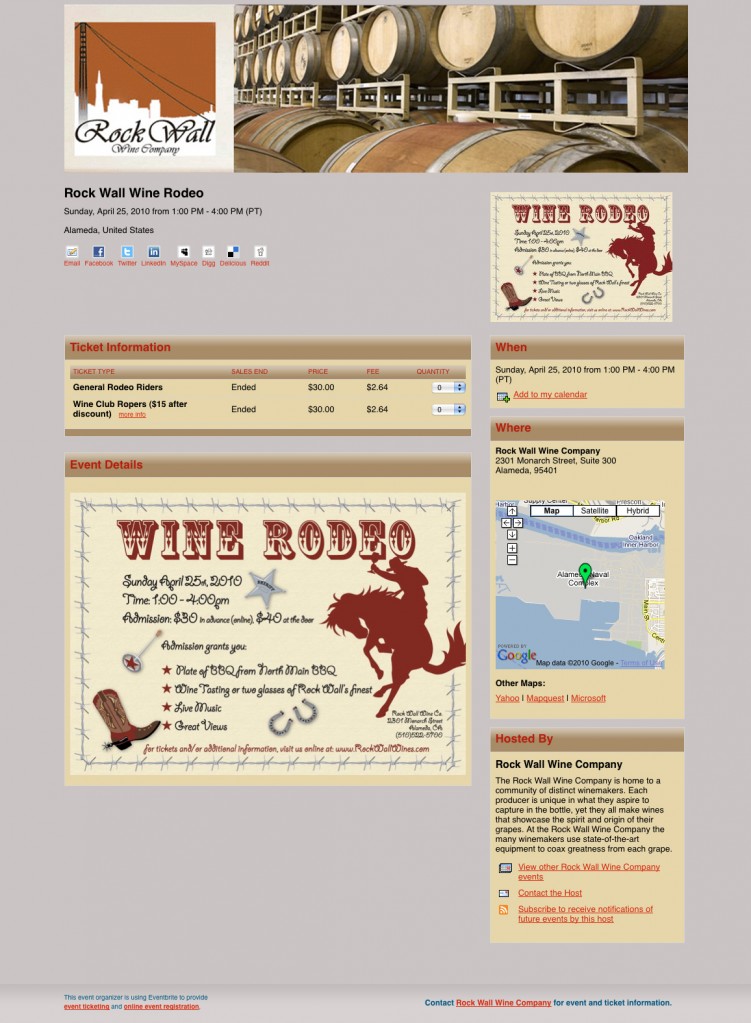
eventbrite1

The one downside I’ve experienced is that the search engine results could improve. It makes sense to list the event on GarysGuide and Upcoming as well, in addition to Plancast, Facebook, and Twitter. Eventbrite can be used for setting up registration, than the other services become marketing tools to direct traffic to Eventbrite.

Summing Up – Is it worth it?

Enterprise Value: 4/5 – Even if you have registration on your own site, an Eventbrite page should be set up

Entrepreneur Value: 5/5 – The small cut Eventbrite takes for paid registration is worth avoiding the hassle

Personal Value: 2/5 – Family or class reunion? Sure. Maps, contact info, attendee list – it’s all there

Let me know what you think!

Todd Hoskins helps small and medium sized businesses plan for the future, and execute in the present. With a background in sales, marketing, and technology, he works with executives to help create thriving organizations through developing and clarifying values, strategies, and tactics. You can learn more at VisualCV, or contact him on Twitter.


Filed Under: Business Life, Successful Blog, Tools Tagged With: bc, Eventbrite, GarysGuide, Todd Hoskins, Upcoming

5 Ways to start a mutiny!

September 16, 2010 by patty

by Patty Azzarello

cooltext466496263_leadership
where-is-the-meaning1

People want their work to matter

I was preparing to write this blog about how to make work more meaningful for people, when I heard a piece of an interview with Dan Ariely about his new book, The Upside of Irrationality.

I didn’t hear the whole interview, but he talked about a test he did to measure how important meaning was in one’s work. The test was to complete a task repeatedly, until you wanted to stop.

The task was to build a Lego robot.

When you completed it, you got asked if you would like to build another robot.

In one case the robot you built was placed to the side so you could admire it while you built the next one.

In the other case if you said you’d like to build another, they dis-assembled the one you just built right in front of you,  gave you back the pieces and said, OK build another one.

How to drain all meaning out of someone’s work

I’m sure I am doing a dis-service to Dan Ariely’s work by taking this out of context, but that is one of the best metaphors I have heard for taking the meaning out of someone’s work!

It got me to thinking, what are all the ways we drain meaning from our employees work, dis-assemble their robots right before their eyes, mabye even without recognizing we are doing it?  And how can we build up the meaning instead?

1. Changing your mind all the time

Someone completes something you said was really important, but you changed your mind since you first assigned the task.  Now instead of accepting the work and thanking them, you gloss over it and ask them to do something else instead.   Then later you change your mind again, maybe even back to the first thing.

Robot parts are flying at this point!

Let people finish things.  Don’t keep switching the task before people can complete things.  Consider the full cost of changing your mind.  If you really have to change your mind, don’t skip the closure.

Thank people for the work, and communicate a reason why THEIR work still counts,  even though YOU have changed your mind.

2. Not accepting something different than you do it

Be careful here, just because it isn’t like you would do it, doesn’t mean that it’s not good enough, or maybe even better.

Build the robot again, but this time use the blue legos for the feet and the red ones for the arms because that is how I do it.

You are far more likely to create meaning if you accept good work, than if you tweak it to death just to make it exactly like you would do it.

3. Skipping the closure

The urgent customer issue or demand has disappeared because you either won the deal or lost the deal. The team has been working frantically to produce or defend something.

When you no longer feel the urgency, you either forget to call off the team, so they keep working round the clock — oops!   Or you just never go back to collect the work, because it no longer matters to you.

Just because it no longer has meaning for you and you have moved on to other things, doesn’t mean you should take the meaning away from the people that did the work.

Save the robot as a resource

If the work is no longer necessary, close out the project, thank them, and have a quick brainstorming about how we can use this important work for another customer or to solve a general issue.

It’s so much easier to just move on to your next urgent thing, but you are sacrificing your team’s motivation an ongoing performance and support if you skip this step.

4. Not being clear about the strategy

This is probably the biggest and most common hazard I have seen.

Companies are fuzzy about what their strategy is.  But they demand lots of hard work from people, and it is utterly impossible to understand if the work matters to the strategy or not.

Unclear strategy causes lots of wasted time and energy working on the wrong things, or waiting for decisions to be made, but it is really de-motivating for people to deliver work into a strategic black hole.

That is like throwing their robots directly into the trash can.

Make the strategy clear.  It’s what creates meaning for the work.

5. Not connecting the dots for people

Even if the strategy is clear to you, don’t expect your staff to automatically see how their work fits into supporting the big picture.

You need to spell it out and show them why their work matters. If you never connect the dots about how their work specifically supports the over-all strategy, there is no meaning in it for them.

Otherwise, they are just putting their robots on a conveyor belt to be used for unknown purposes.

Ensuring that all your employees understand how the business works, and how their work helps move it forward, motivates and enables them make better decisions and add more value.

With our without financial rewards your employees will do better work, faster, if they can personally see why it matters.

How do you create meaning for your employees?

This is a topic where concrete examples are so valuable. What’s worked for you? Please share your ideas in the comment box.

—–
Patty Azzarello works with executives where leadership and business challenges meet. She has held leadership roles in General Management, Marketing, Software Product Development and Sales, and has been successful in running large and small businesses. She writes at The Azzarello Group Blog. You’ll find her on Twitter as @PattyAzzarello

I’m a proud affiliate of

third-tribe-marketing

Filed Under: management, Successful Blog Tagged With: bc, employee motivation, LinkedIn, management

Social Media Book List: Competing for Global Dominance and The New Social Learning

September 15, 2010 by teresa

A Weekly Series by Teresa Morrow

I’m Teresa Morrow, Founder of Key Business Partners, LLC and I work with authors to help manage their online book promotion. As part of my job I read a lot of books (I love to read anyway!).

This week I will be highlighting I book that I am working with the author, Jack Katz, author of ‘Competing for Global Dominance’ and the other book I have had on my reading list, ‘The New Social Learning’ by Tony Bingham and Marcia Conner.

The books I discuss in the Social Media Book List Series will cover a range of topics such as social media, marketing, blogging, business, organization, career building, finance, networking, writing, self development and inspiration.

‘Competing for Global Dominance: Survival in a Changing World’

by Jack Katz

competing4globaldomimance-mid

“Jack Katz has the rare ability to look out over the horizon and see the future that is bearing down on all of us. His vision of globalization and the survival of corporations and individuals is startling and compelling
—another outlook for those wishing to compete in global markets.”
Aviad Kamara, President, Israel Operations: Sagent Management
and Founder of HiTechCare

“Jack Katz presents a comprehensive guide for businesses that are either contemplating entering the U.S. market or have already begun the process. In his book he lays out the foundational legal, cultural, and financial strategies for success. Too often foreign businesses do not appreciate how much time and money can be lost without a comprehensive guide like this showing them the way. I highly recommend this book to my clients—both domestic and international.”
Michael Moradzadeh Esq., Rimon Law Group

Here are a few more powerful experts from ‘Competing for Global Dominance’ I would like to share with you:

Page 9 – “Today, thanks tomodern technology, for the first time in human history the world marketplace is open 24/7. The “sun never sets” on the world market. For the entrepreneur, the entire world is now
within reach in ways that weren’t possible a few years ago.”
—> (Teresa Thoughts)So true, the opportunity to meet, exchange ideas, and gain new clients from any part of the world is well within reach in today’s society and being able to be communicate and “compete” is a great skill to have in this market.

Page 11 – “For companies to become successful in their target markets they will need to identify and appreciate the differences of their diverse consumers.”
—>(Teresa Thoughts) Ideal point to make. Knowing your target market and what they need and want is another key ingredient to be successful to all businesses.

Page 43 -To compete with the world’s best companies requires foreign manufacturers to design and produce quality products incorporating the latest in technology with the leanest supply chain and
manufacturing principles. It also means promoting the uniqueness of your product. Vying for recognition against numerous competitors, you need to differentiate yourself by your country or history.
—>(Teresa Thoughts) No matter whether your company is based in the US or in another country, staying on top of the trend, new products and latest technology is key in staying competitive in most industries.

Page 57 – Products become exceptional when a consumer is impressed but they don’t expect to be.
—>(Teresa Thoughts) Perfect point to emphasis—-create a product or service that is not expected. See what is out there and find a way to make it new, updated and/ or better.

About the Book:
‘Competing for Global Dominance’ sets the stage for a new paradigm required for growth of the globalized market in the 21st century and outlines the issues that entrepreneurs and businesses will face as they compete for survival in a world marketplace no longer hindered by time and distance.

As the Silicon Valley success model moves into its adolescence and transforms its methodology more into using social and business networking as demonstrated on web sites of Facebook, YouTube, LinkIn, LinkSV, Twitter, Ecademy where groups of individuals and businesses from around the world can meet, communicate and collaborate together to expand their influence and market share by developing new ways of doing business. But before this can be effectively accomplished, a new approach needs to be established for how to compete, grow and survive in this new globalized environment. Many governments, educational and private organizations have tried to duplicate the success of Silicon Valley with limited degrees of success, most without really understanding the new dynamics of global competition and how to enter new markets.

This book shows the thought leadership from a practitioners viewpoint who works with entrepreneurs and companies from around the world to position them for survival and expansion in the new world of globalization.

About the Author:

Jack S. Katz, is identified as one of the ten top people to know by Technology Decisions Magazine, Jack is noted for his knowledge and delivery of accurate high technology and business solutions that have had a dramatic impact on the bottom line of global companies.

With over three decades of Information Systems Management, Marketing and Business Development experience in such diverse industries as Retail, Healthcare, Financial Services, and Information Technology, Jack is an internationally recognized author, speaker and business technology expert.

Jack co-founded Red Hill Partners International, LLC a premier market-entry company which works with emerging companies to define, develop and expand their products and services worldwide. He has previously held senior level management positions with Cisco Systems, Sun Microsystems, Providian Financial Services, Blue Shield of California, and Safeway, Inc.

You can purchase a copy of ‘#Competing for Global Dominance’ online at ThinkAha Books.
*I have received a complimentary copy of Competing for Global Dominance by the author as this book mention is part of a virtual book tour I am conducting. However, my comments (highlighted by —>) are my own solely and I have not gotten compensated for those.

A book on my reading list that I have had the pleasure to read (a little bit and eager to read more), ‘The New Social Learning’ by Tony Bingham and Marcia Conner.

The New Social Learning

by Tony Bingham and Marcia Conner

Here are a few gems I found within this insightful book on social media:

This book starts off with The New Social Learning Playground Rules (here are just a few rules):

1) No loitering in the playground areas. The value is in participation and engagement.
—> SO TRUE! Value comes in with social media with two areas—participation (you must be a part of the networks you are a part of or be sure you are adding value to the conversations)

2) The playground is for people of all ages.
–>Yes, within the social network you can be 20 or 80..and you can enjoy the wonderful benefits of being a part of the conversations and connections.

3) Only people interested in having influence are allowed on the premises.
—> It is good to remember when you are involved in social media, to remember you are there to engage, inspire and support others.

Another gem (page 38)—
“Because online communities are not constrained by the need for anyone’s physical presence, we have greater flexibility with our ability to join, learn, and congregate with people who have similar interests no matter their location.”

—>To me this is the great GLORY of social media!

Another helpful nugget (page 81)
“For busy people who need to find ways to manage their attention stream, micro sharing seems just little enough to not seem like a burden. It’s akin to writing a paper or a blog without the time commitment. It’s sufficiently lightweight to fit into the spaces between the critical work people do.”
—>Yes, I agree that micro blogging, such as Twitter, allows people to share their expertise with people in small bits, however, I do feel that it is a piece in between where blogging and marketing goes.

Additional tidbit (page 110)
“To support keeping information current, create systems that support updates and contributions from many people who are affected or who have additional perspectives–where the group can capture, organize, share and use it’s emerging and dynamic knowledge.”
—> Share, share and share—-offer tips, ideas and support to others by using social media tools that can help you get the message out there. (i.e. I use HootSuite to organize my social media accounts).

About the Book:
Most business books on social media have focused exclusively on using it as a marketing tool. Many employers see it as simply a workplace distraction. But social media has the potential to revolutionize workplace learning. People have always learned best from one another—social media enables this to happen unrestricted by physical location and in all kinds of extraordinarily creative ways. The New Social Learning is the most authoritative guide available to leveraging these powerful new technologies.

Tony Bingham and Marcia Conner explain why social media is the ideal solution to some of the most pressing educational challenges organizations face today, such as a widely dispersed workforce and striking differences in learning styles, particularly across genera-tions. They definitively answer common objections to using social media as a training tool and show how to win over even the most resistant employees. Then, using examples from a wide range of organizations—including Deloitte & Touche, IBM, TELUS, and even the CIA—Bingham and Conner help readers sort through the dizzying array of technological options available and decide when and how to use each one to achieve key strategic goals.

Social media technologies—everything from 140-character “microsharing” messages to media-rich online communities to complete virtual environments and more—enable people to connect, collaborate, and innovate on levels never before dreamed of. They make learning dramatically more dynamic, stimulating, enjoyable, and effective. This greatly anticipated book helps organizations create a contemporary learning strategy that is as timely as it is transformative.

About the Author(s):

Tony Bingham is President and Chief Executive Officer of the American Society for Training & Development (ASTD), the world’s largest professional association dedicated to the training and development field. ASTD is focused on helping members lead talent management, build their business skills, understand the impact of social media on informal learning, close skills gaps, and connect their work to the strategic priorities of business.

Marcia Conner Partner with Altimeter Group, works with leaders every day to bridge the gap between the promise of collaborative technologies and the practice of putting them into action. She aligns digital strategy with corporate culture, engaging people and invigorating the value chain across an organization. Former Vice President and Information Futurist at PeopleSoft and Worldwide Manager at Microsoft, she now advises corporations, writes the popular Fast Company column “Learn at All Levels,” and is a Fellow at the Darden School of Business. Follow her on Twitter @marciamarcia.
*this information was provided by Amazon
*I also received a complimentary copy of this book to offer a book mention/review on Successful Blog. However, my —> (my comments) are mine solely and I was not compensated for these.

You can purchase a copy of ‘The New Social Learning’on Amazon.

I truly hope you will check out these books and please comment and let me know your thoughts on them.

Filed Under: Business Book, Business Life, Successful Blog Tagged With: bc, Jack Katz, Marcia Conner, social media books, Tony Bingham

Spice Your Blog With A Dash Of Old Bay Seasoning

September 15, 2010 by Guest Author

cooltext455576688_blogging

By Terez Howard

I didn’t know what Old Bay was until I saw its name on a bag of popcorn in a Virginia Beach gourmet popcorn shop.  (When I reread that sentence, it sounds like the start of a piece of fiction).

But, I’m serious.  I’m from Ohio, and I had never seen it before.  After my trip, I found that my local grocery store’s employees placed the Old Bay seasoning near the fish since the spice is traditionally sprinkled on seafood.  I overlooked it every weekly trip I took to the same store for five years.

So why was Old Bay the flavor of choice for a bag of popcorn?  I’m not really sure.  My husband and I decided that after a sample of this popcorn, we were hooked.  We devoured that bag, and I’ve been craving it ever since.

My point?  Jody’s Gourmet Popcorn got it right.  Jody and her husband, Alan, gave us something unexpected, and we loved it.

Salt, garlic and Old Bay?

This is what I know.  Every recipe I make calls for salt and garlic.  Well, it doesn’t formally call for those spices.  I just cannot imagine a meal without them.  All you knowledgeable cooks, keep quiet!  I know there are ways to spice food without these two.  But they’re my staples, and my family loves them.

When you blog, you have salt and garlic.  You have some general topic, and you create content to support it.  That’s the salt.  You make it unique by peppering it with your personality.  That’s your garlic.  Those are the basics, your staples.  You would not have a decent blog without them.

Now for the Old Bay.  I like to think of this as your own little dose of the unexpected.  I find the most engaging posts I’ve ever read include a little something I cannot foresee.  You can spice up your blog with:

  • A quote from someone famous or not so famous. I read a blog post recently that included a quote from Ernest Hemmingway.  A quote can drive your point home.
  • Results of a study. I find study results to be extremely powerful.  If you’re telling people that they should write more how-to’s, then you could also include how much traffic a blogger has gotten from posting how-to’s.  (You could also conduct your own study).
  • A reference. This can be as simple as referring to a detail someone else made on a blog or in an article.  Link to them, and give your readers a more complete post.
  • A joke. I’m not a comedy writer, but I think most readers are up for a laugh.  A joke can lighten an otherwise heavy topic.
  • A personal story. This one is my favorite things to do because I feel like my life events and blog go hand in hand.  A personal anecdote makes your blog relatable and an enjoyable read.

A little goes a long way

I’m not for drenching a meal in any particular spice.  So, when you are finding your voice by trying to include something a bit unpredictable, don’t over do it.  Every single sentence does not need to be a pun, a quote or another reference.  A dash will do.  Just talk.  Be natural.

How do you dash your blog with Old Bay?

—
Terez Howard operates TheWriteBloggers, a professional blogging service which builds clients’ authority status and net visibility.  She has written informative pieces for newspapers, online magazines and blogs, both big and small.  She regularly blogs at Freelance Writing Mamas . You’ll find her on Twitter @thewriteblogger

Thanks, Terez!

–ME “Liz” Strauss
Work with Liz on your business!!

Filed Under: Successful Blog, Writing Tagged With: bc, blogging, LinkedIn, Terez Howard

5 Reasons You Absolutely MUST Share Your Vision Early and Often

September 14, 2010 by Liz

(Updated in 2020)

10-POINT PLAN: 1.1 Articulate the Vision

Why Define the Vision?

Tom Peters says that a business either supports the over-achievers or the under-achievers. The ones who feel supported call up their friends to say “This is a great place to work!” The other group feels unappreciated and leaves. My experience has shown over and over again that this is true. A business reinforces gets the behaviors it reinforces through its models and processes.

Zappos is a great case study in a how to build a internal community of brand loyal fans. What makes the Zappos culture uniquely strong and attractive is the commitment they make to the core values of the community. The vision is articulated clearly and acted upon in highly visible ways.

“Everyone that’s hired, it doesn’t matter what position–you can be an accountant, lawyer, software developer–goes through the exact same training as our call center reps. It’s a four-week training program and then they’re actually on the phone for two weeks taking calls from customers. At the end of that first week of training we make an offer to the entire class that we’ll pay you for the time you’ve already spent training plus a bonus of $2,000 to quit and leave the company right now.” — Tony Hsieh, CEO Zappos, as interviewed in Fast Company, The Happiness Culture …

They pay new employees to leave!

It’s Not How Or What … It’s Why That’s Important

Zappos says that it’s not a company it’s a mission — the Happiness Culture. That says something about who they are and why they do what they’re doing. Read the the core values of the Zappos culture.

The Zappos Core Values are:

  1. Deliver Wow Through Service
  2. Embrace and Drive Change
  3. Create Fun and a Little Weirdness
  4. Be Adventurous, Creative and Open-Minded
  5. Pursue Growth and Learning
  6. Build Open and Honest Relationships with Communication
  7. Build a Positive Team and Family Spirit
  8. Do More with Less
  9. Be Passionate and Determined
  10. Be Humble

They explain why people work there, why people do business there, and why people talk and write about them.

Tony Hsieh has articulated, built, and protects the community values that make Zappos a great place to work and a great company to work with. No wonder Zappos has such a huge and love-them loyal fan base.

That vision built a company in an enviable position. There is Zappos! and the companies who wish they had what Zappos does.

It’s Not the What or How, It’s the HUGE WHY Behind It

Leaders know where they’re going — direction and vision. They know how they will get there — a strategy and tactics. Leaders who are community builders articulate that direction and strategy with intelligence and resolve, with clarity and passion, and through a generous invitation for collaboration.

At the core of community building are three key understandings:

  1. A community-building business offers financial, professional, and philosophical/political growth for the community. As we invest our time and resources, a thriving community and its members become more successful at earning income / revenue, gain more visibility and professional authority within their industry, and know that their work has meaning and contributes to a higher purpose.
  2. A community-building business looks to align goals rather than trade services. Communities collaborate and communicate to raise a barn. Gone are the hierarchies and silos that used to negotiate to build a coliseum. The difference is in shared ownership of ideas, interactive problem solving, and commitment to the vision. Invest in people and they will return the investment.
  3. A community-building business knows that the people doing the work know what’s working and what isn’t. The exact interpretation of how the HUGE WHY vision is put into action is defined at the team level. Teams discuss and design simple decision models based on the agreed upon core values. As a result, people at every level know how to respond to new situations with positive action.

The vision of where a community-building business is gone draws from those three understandings. It’s good to know them, but it’s not enough.

5 Reasons You Absolutely MUST Articulate Your Vision

It’s critical to put the three key understanding of community building into action by defining and sharing a distinct vision. The vision sets the value of the business and the higher purpose that attracts and unites the community. It defines the internal brand and affects everything from hiring decisions to how employees treat customers.

Here are 5 reasons you absolutely must share your vision early and as often as you can:

  1. To make the thinking concrete and achievable. We all know things better when we have to communicate them. By articulating our vision, we internalize our commitment, begin to know it, and see the reality and flaws our thinking.
  2. To fulfill your leadership responsibility. It’s the role and responsibility of the community leader to define the reality of the community. The vision is and will be what attracts and retains the best employees, vendors, partners, and customers as part of the community.
  3. To visibly underscore the community values. Once the vision is articulated, the core values of the community can be listed, illustrated, discussed and integrated into every part of the business.
  4. To unify the community around one well-defined vision. Without a well-articulated vision, each community manager and member will be forced to make his or her own definition of what the community stands for and how those values are best incorporated into decision making.
  5. To empower and protect the community. In the same way that a budget or a schedule allows people to make decisions with confidence, the definition of the vision allows people to make decisions. A strong vision statement lends confidence to people who want to do the right things for the business.

A loyal internal community is a huge advantage. Every employee becomes a brand ambassador who invests emotionally in building the community as well as the company. Even in a solo practice, not to set your vision is to leave yourself in a place where your idea of where you’re is open to redefinition and loss of focus far too easily.

The strongest businesses know where they’re going and can share that with confidence and clarity. Yet too often we assume that folks understand the importance of where we’re going and why we’re going there. We have to share our vision or folks won’t see it and believe it’s going to happen.

Have you set the vision for your business? Is it HUGE enough to include everyone who helps your business thrive?

Related
To follow the entire series: Inside-Out Thinking to Building a Solid Business, see the Successful Series Page.

–ME “Liz” Strauss

Filed Under: Inside-Out Thinking, Strategy/Analysis, Successful Blog Tagged With: 10-point plan, internal community, LinkedIn, Strategy/Analysis

Attention! Jim Kukral Knows Customer Evangelists Rule

September 13, 2010 by Liz

attention

ATTENTION! Jim Kukral’s Book will make you money! One month ago today, Jim Kukral’s groundbreaking book officially launched and if you’ve not read it yet, what are you waiting for?

Attention marketing is all about attracting attention to your business and your brand — in such a way that you turn that attention into revenue. And that’s what the new book, “Attention! This Book Will Make You Money” is about. — Anita Campbell, Small Business Trends, August 14, 2010

The books opens with a challenge and a genuine opportunity to work with Jim himself … all you have to do is get Jim’s Attention!t Then every page after delivers on ways that a thinking small business can get the right kind of attention in a marketplace where attention is everything.

I’m delighted to share this guest post by Jim Kukral, the man who wrote the book on Attention!

Customer Evangelists Rule
by Jim Kukral

If you’re like me you’re a super fan of a select few things, which makes us both customer evangelists. Being a customer evangelist, or as some call them, super fans, means that you go out of your way to tell other people about the things you love so much. It’s a business’s wet dream to have a rabid fan base of proactive promoters out there spreading the word about you. Or at least it should be.

Assuming you want to be an evangelist for something you love, be wary before you set out on your journey to tell the world. It can be tricky navigating between short-sighted corporate executives who have no vision or tolerance for exuberant customer evangelists and your vision for how you’d like to promote their product. I’ve personally dealt with this situation, having become a vigilant fan of a major hosting company. I went as far as to spend an enormous amount of time and effort and money working on a video commercial to promote the company, only to get contacted by the company’s legal representation telling me “you can’t do that”, in so many boring legal words. Ugh. I guess I should have asked them if I could say how awesome they were before I did it, right?

Smart businesses embrace their customer evangelists and help them by first acknowledging them and then second by providing them tools to help them spread the word. I’m an evangelist for a dietary supplement called JoeBees. It’s bee-pollen that comes in capsules that give me tons of energy (I don’t drink caffeine), better digestion, and helps me sleep like a zombie on NyQuil. I love this product, and I will take every opportunity to tell the rest of the world about it whenever I can, and I do. Joe B., the owner of JoeBees.com, gets this and has personally reached out to me to help me in my quest to promote his product, often sending me free samples to give away and personally phoning me multiple times to just say thanks.

What a concept! Let me ask you this. When was the last time you picked up the phone and called your best customers or fans? You don’t know who those people are? It’s time to find out, and find out fast. If done right, before you know it you can have your own group of customer evangelists out there preaching to the world about you. Or, maybe you’d just like continue spending more and more money on advertising?

Being an evangelist means you want to tell people about what you love. It makes you feel good to do so.

That’s probably what most marketers don’t realize about the power of word of mouth and customer evangelism. It’s not about “getting something in return”; it’s about sharing. It’s about making ourselves feel good by helping others, and a little bit about our ego. The challenge for you is to tap into that feeling from your biggest fans and help perpetuate it.

———

For over 15-years, Jim Kukral has helped small businesses and large companies like Fedex, Sherwin Williams, Ernst & Young and Progressive Auto Insurance understand how find success on the Web. Jim is the author of the book, “Attention! This Book Will Make You Money”, as well as a professional speaker, blogger and Web business consultant. Find out more by visiting www.JimKukral.com. You can also follow Jim on Twitter @JimKukral.

Get Jim’s book and get some attention!

–ME “Liz” Strauss
Work with Liz on your business!!

Buy the Insider’s Guide to Online Conversation.

I’m a proud affiliate of

third-tribe-marketing

Filed Under: Business Life, Marketing /Sales / Social Media, Successful Blog Tagged With: Attention!, bc, Jim Kukral, LinkedIn

  • « Previous Page
  • 1
  • …
  • 178
  • 179
  • 180
  • 181
  • 182
  • …
  • 858
  • Next Page »

Recently Updated Posts

Is Your Brand Fan Friendly?

How to Improve Your Freelancing Productivity

How to Leverage Live Streaming for Content Marketing

10 Key Customer Experience Design Factors to Consider

How to Use a Lead Generation Item on Facebook

How to Become a Better Storyteller


From Liz Strauss & GeniusShared Press

  • What IS an SOB?!
  • SOB A-Z Directory
  • Letting Liz Be

© 2025 ME Strauss & GeniusShared