Successful Blog

  • Home
  • Community
  • About
  • Author Guidelines
  • Liz’s Book
  • Stay Tuned

7 Steps to a Vision that Grabs a Community by Its Soul

September 21, 2010 by Liz

(Updated in 2020)

10-POINT PLAN: 1.2 Articulate the Vision

CommunityPhoto by John Schnobrich on Unsplash

Why Have a Vision?

Last week, I wrote Why You Absolutely Must Share Your Vision Early and Often. Now, it’s about the how-to.

Imagine three corporations that build and sell computers for small business and entrepreneurs. Each corporation defines its business in a different way.

Brand A says: Our company is in the business of making products for consumers who need them. We do the work they can’t do and offer it at a fair price.

Brand B says: We’ve are the leader in quality, creative solutions to the complex technology problems that entrepreneurs and small business owners face today. We make it our business to know their problems and to find a way to solve them. We deliver on our promises and we’re committed to staying the best in the industry.

Brand C says: We are a network of deep and strategic partnerships with employees, vendors, partners, and small businesses leaders who work together to build products and work environments that inspire and generate creativity, competence, performance, and trust and to create jobs and solutions that build the economy now and for future generations.

Brand C is the description that connects the company to every person on the planet.

How Does Vision Attract Community?

The vision is more than the mission. It’s the destination drawn clearly so that every member of the new community can see it, understand it, speak about it with passion, and believe that it will happen. The vision is not a product devised and made by a crowd or a committee. It’s a leadership decision — the original strategy expanded with thought and design to elevate it to a higher calling.

The vision is the cause that attracts and unites the people of the community. It why they invest tireless hours and best efforts — because they are building …

  • something that makes an important difference;
  • something that no other company is building;
  • something that needs every individual’s unique contribution
  • something that no one individual could build alone.

The vision isn’t a dream. It’s a work in progress … a group aspiration in the true sense of it’s definition, breathing toward. The vision gives the community a why for why they are investing the time of their lives each day into this work. The vision is more than economic, more than profession, it is a commitment to accomplish something meaningful in the world.

7 Steps to Communicating a Vision that Grabs Folks by the Soul

If you’re looking to build a thriving business, start with a long-term, loyal internal community of employees. They will build and protect a healthy innovative culture, promote the values of the business, stay with the company, develop expertise with coworkers, and live to serve customers. What better way to build a brand than to agree upon the values that you stand for and create an environment that nurtures brand ambassadors?

It takes the right vision to attract the right people to that kind of community culture. When we meet the best people, we have to tell them about that vision, or how will they see it? Here are 7 steps to articulating a clear vision.

    1. Think contribution. Think partnerships. Re-imagine your team or your business at this highest, most useful place in the world — financially, professionally, and philosophically. Talk through what you see with people you trust until you have a image, a vision, of what that business offers to employees, partners, vendors, and customers.
      We’re inviting the highest quality people who have a stake in teaching and learning technology to join together in building products, services, and opportunities that show other people how business can work better for customers.
    2. Think ideal membership. Make the vision irresistible: smart, feelingful, and life-changing on a world-scale.
      We’re only interested in the best minds, best designs, and the best problem solvers with the highest values. We’re going to align our goals and build stable, successful, ethical business models that freely give support to fledgling business in depressed areas to create an economy that helps us all grow.
    3. Think contributions and returns. Find the words to describe it simply in ways that others can see the value of what you’re going for.
      We’re building the business that listens, learns, contributes, and invests in the people who help it thrive — it will be the business that people want to work with and for — the sort where every person makes a difference.
    4. Think recruitment. Be able to speak to the benefits of being a part.
      One benefit is that under-achievers and those who will sacrifice anything to raise the bottom line won’t want to work here.
    5. Think champions and heroes. Invite the people who see the vision to be involved in highly visible ways. Talk about what they’re doing encourage them to talk too.

The communications team has started a newletter for partners and vendors working with inner city high school enterpreneurs. Let us know if you want to volunteer.

  1. Think honest communication. Talk publicly to everyone in as many ways as you can — live your message.
    I’ll be listening to the folks who have experience where I don’t. I’ll be looking to learn from you how to do this better. That includes everyone I know.
  2. Think evangelism and growth. Invite people to pass on the vision and the invitation.
    Who else belongs here? Tell us.

It’s not the how or what of work that builds community. It’s the why. The underlying vision that unites us toward building something that we can’t build alone. A community needs leadership to set and invest that vision and so that they can feel smart, safe, and powerful in investing too.

Once the community sees the vision and realizes that leadership commitment. People who share those values will pick up the message, the tools, and the passion to contribute to the cause. The culture will grow from their actions.

Humans are wired to be deeply inspired by causes greater than ourselves. To inspire a community to invest its soul, we have to show them why we’re willing to invest our own.

Have you really communicated your vision? Are there ways you might make it clearer to the people who can help it thrive?

Related
To follow the entire series: Inside-Out Thinking to Building a Solid Business, see the Successful Series Page.

–ME “Liz” Strauss

Filed Under: Community, Inside-Out Thinking, Successful Blog Tagged With: 10-point plan, Community, internal community, LinkedIn, Strategy/Analysis, vision

The HUGE Gap Between Reach and Trust

September 20, 2010 by Liz

Do You Trust Yourself?

cooltext443809437_relationships

During a discussion of The Difference Between Begging for and Building Influence a a few weeks ago, @StevePlunkett asked me to do a long think about credibility and reach. I’ve been doing just that and now I’m writing another post his challenge inspired.

The Pulitzer Prize Paper, Reach, and Engagement

Once upon a time, I subscribed to the Chicago Tribune. (I apologize to the New York Times and my friends who Yankees fans. I also live in Wrigleyville.) I subscribed to daily delivery during the period that the Tribune won 11 Pulitzer Prizes. I’m not certain that I read any of the winning articles. Though the paper came as promised, with a job in the city, my schedule often didn’t offer me the time I wished to read it. Even when it did loosen a bit, I didn’t read every word of it.

So though the paper reached me. I wasn’t exposed it. I was on their list and I would bet that I was counted in their ad fees based on circulation.

My point is that reach only meant I was paying for it.

I don’t watch television, so I don’t need a TIVO to skip the commercials. On the rare occasion that a television movie or event might attract me back to the huge screen monitor that we usually use as a computer, we end up talking through the ads or channel surfing just because we can.

I know a number of people online who own online tools that charge small fees and send out informational mailing lists. I know thousands more that belong to social sites and read blogs that carry ads. Whenever I ask about the ads, I find that we’re becoming advertising blind … except when we’re shopping or looking to see what sort of ads our friends are using.

So, technically those ads are reaching me, but they’re equivalent to a sales rep who knocks on my door but never gets an answer.

Then a new algorithm emerges from social media. If I pay close attention and “prune” my power network just right, I should be able to connect to the perfect 150 power people who have each also connected to another 150 power people and so on outward. A mere two generations out would be a network of 3,375,000 power people. But just to hedge the bet, perhaps I should connect to 150,000.

Thing is any message I send to my own group only gets read the same as the Tribune did … when they have time. Probably less than that, because I don’t have 11 Pulitzer Prizes behind what I’m saying.

Let’s not even talk about the email newsletters and direct mail that gets pitched without being opened.

Reach is not a guarantee of engagement, participation or even exposure.
Reach is merely a possibility.

Andrew Smith at marcom international points out,

“For decades, PR has been seen by many marketeers as “cheap reach via editorial” – in other words, the goal of PR was to gain editorial coverage that provided the greatest number of opportunities to see – at a significantly lower cost than advertising.”

But even cheap is expensive if no one is paying attention.

And even when I do pay attention, can you assume that I trust what you’re saying?

No. Not unless I know you.

Reach and Trust

We interact with thousands of people through our lives and if we’re a corporation that number of interactions can grow to millions. Still the fact remains that people prefer to work with people we know and business moves faster, more easily, and with fewer micro-decisions when we can depend on people we trust.

The ability to reach millions with our message means hardly anything if they don’t trust the people or place the message is coming from. Now that we work online even Google has been trying to figure out how to trust.

A good marketer should always be able to reach more people. A great marketer knows that ideal customers who share the marketers’ values might actually pay more for products and services that incorporate those values in everything. An irresistible marketer knows and trusts those customers.

Reach is not nearly as powerful as attraction.

What Moves People to Trust You and Your Brand?

Trust … credibility … authenticity … transparency These words have become key terms in the social business lexicon. But they’re not new to business. Relationships have been the foundation of solid partnerships since growing businesses started growing. Ask any number of successful Venture Capitalists, if they have to choose, they will tell you that they will put their money on the team they can trust.

What moves us to trust?

Steven M. R. Covey, who wrote the book on Trust, points to 4 Cores of Credibility — So that’s where I went to start my think on credibility, with his words. integrity, intent, capability, and results. Together they carry the four reasons we trust ourselves, our friends and the people and companies with whom we choose to work.

And we’re finding that social business has made it more complicated than we might think.

It’s no longer about only about how far our message can reach or how many people will receive and consume it. The question is whether a credible message can travel that far and still be believed.

  • Integrity. A guy runs up to you on the beach, opens his coat and says, “Wanna buy a watch?” Your response is likely to be negative. It’s hard to believe that watch is the deal that he says it is. A man of integrity probably wouldn’t choose that form of work.

    Integrity is the ultimate of walking your talk. he etymology of integrity is “wholeness, soundness” from the Latin, *intetritatern* “sense of uncorrupted virtue.” It makes a foundation upon which a person’s true character can stand. It’s a person’s character who gives “his word,” shakes a hand. makes a promise, and signs a contract.

    Integrity is what we rely on when we say that a person (or a company) will never lie to you, that he has no hidden agenda, that her behavior is stellar, that they will always make good on what say they will do.

    Whether we’re acting as a company or an individual looking in the mirror is what we say we believe totally in line with our standards? Integrity is the conviction to stand up for what is true and valuable to you and to trust yourself to always choose for your values no matter what people are around you. Integrity builds trust and respect in its Have we the personal and professional strength to say “no” to deals and relationships with people who stay sitting down.

    Do you show up as the same person everywhere people find you?
    Do you live your company’s message with the people you work with and with your customers?
    Do you ever keep promises to yourself, your friends, your family, and the people you work with?
    Do you tell the hard truth as easily and with as much love as you tell the great things?

    Decide to BE what you believe. Stand for something.

    How do your actions demonstrate what you believe?

  • Intent. Ever get an email or a request from a friend that sounded like it was just for you, only to find out that it was a sales pitch and he or she send the exact words to a whole list of people? A person of pure intent would never set up a situation that would make you wonder about what his or her agenda might be.

    People and companies live with intent. They lean forward and stretch toward building open relationship before promoting self-interest. It’s good intent to understand the power in partnership that is forthright and mutually beneficial. Think of Warren Buffet and the respect he has earned. He’s a great combination of integrity and intent. And through good intent, Warren Buffet accomplishes many things that benefit others and his own companies.

    Do you reflect on what motivates you and how that might work for others?
    Do you move yourself outside the center to get a more balanced view of world?
    Do you make the success of other people mission critical to our own success?
    Do state your true intentions to yourself and to others before you act?

    Share your plan and your purpose. Focus on mutual benefits.

    How do you make it easy to see what you’re up to?

  • Capabilities. Think of the leaders who inspire. They have knowledge, talent, skills, ethics, attitudes, and identity. They’re not just smart and visible, but they attract us to follow them because they know where they’re doing. They have means and the confidence to do the job and the way they talk about their capabilities raises everyone on their team.

    Do you know your strengths, talents, what comes naturally, and why people follow you?
    Do you have the expertise to do what you set out to do?
    Does your style attract and encourage relationships and learning?
    Do you establish a culture that is open and supportive?

    Be constantly learning. Know what value only you can bring. Do the same for others.

    How do you use your abilities to inspire confidence and leadership?

  • Results. Talent and skills are nothing, if we don’t do, produce, and respond to the right things. People and companies we trust focus on delivering the right results to meet the highest expectations. They bring all of their resources to fulfill their promises — faster, easier, and more meaningfully than anyone might have imagined. Their record for results precedes them.

    Do you show up, make clear decision, and put your best work into all you do?
    Do seek out a team of people who are smarter and more experienced than you?
    Do you focus on delivering outstanding satisfaction to every customer?
    Do you look to consistently raise the bar higher?

    Be engaged. Take responsibility with intent to win.

    How do you make outstanding and successful things happen?

The difference between reach and credibility is the difference between sending a message out to everyone who might listen and communicating integrity, shared intent, competent commitment, and consistent performance.

What all of us wish for is to be able to trust without fear or worry of the wrong results. We prepare for negative consequences because positive outcomes don’t hurt us. In those relationships where trust is truly present, we’re relieved of the burden of having to build extra safety nets because we know that you are looking out for our best interests — we know you’ll be standing beside us if something goes wrong.

The huge gap between reach and trust is that with trust I believe …

I will always be able to say I bet on you and I won?

–ME “Liz” Strauss
Work with Liz on your business!!

Buy the Insider’s Guide to Online Conversation.

I’m a proud affiliate of

third-tribe-marketing

Filed Under: Marketing /Sales / Social Media, Successful Blog Tagged With: bc, capability, credibility, integrity, intent, LinkedIn, results, trust

SOB Business Cafe 09-17-10

September 17, 2010 by Liz

SB Cafe

Welcome to the SOB Cafe

We offer the best in thinking — articles, books, podcasts, and videos about business online written by the Successful and Outstanding Bloggers of Successful Blog. Click on the titles to enjoy each selection.

The Specials this Week are

AdRants
BBDO is out with some new work for FedEx. Four commercials highlight…wait a minute. What the hell is there to explain about FedEx that everyone doesn’t already know? Nothing. Why does the brand still advertise? We have no idea. Oh wait, yea, we do. Because people are so fickle that if you don’t slap them upside the head with your message 3,000 times a day, they’ll defect to your competition.

FedEx Prevents Airport Security From Sleeping on the Job

Hub Spot
This will give you the headlines, but you may want to take the additional time and understand why these experts came up with their practical advice. I cannot remember when I’ve received this much solid advice in such a short amount of time.

60 Proven Ways to Increase Your Online Marketing Influence

JeffBullas
I don’t know if you can remember your days at school where how many friends you had was something to be valued in the school playground.

If you only had one or two friends you were viewed as something of a loser.

Being the leader of a group or “gang” you were seen as influential and could wield power and make your followers take action through coercion or through your influence.

How To Be Influential In A Digital World: 10 Leaders Reveal Their Secrets

IT Professionals
Don’t get me wrong, is some cases, every detail needs to be perfect. However, the problem with always trying to strive for perfection is that it takes much longer to perform tasks.

Can Perfectionism Negatively Impact Your Career?

Smart Blogs On Social Media
You go where your customers are. We have a pretty robust presence on Facebook, Twitter and YouTube. On those platforms we are reaching consumers of all varieties (enthusiasts, gamers, media experts, etc.) We have consistent presence on LinkedIn where we are reaching our business audiences. Our forums and communities on Intel.com are where our developers and IT audiences are highly engaged.

Tailored communities give Intel a social-media boost

Related ala carte selections include

Sales Rescue Team
Is Social Media ROI on your mind? This list can help.

195 Social Media Monitoring Tools

Sit back. Enjoy your read. Nachos and drinks will be right over. Stay as long as you like. No tips required. Comments appreciated.

–ME “Liz” Strauss

Buy the Insider’s Guide to Online Conversation.

I’m a proud affiliate of

third-tribe-marketing

Filed Under: SOB Business, Successful Blog Tagged With: bc, Great Finds, LinkedIn, small business

Steve’s Shorts: SEO Lunch and Client First ROI

September 17, 2010 by Liz

We Interrupt Regular Blogging for Steve’s Shorts

Take a simple few minutes where a guy who is brilliant makes an observation about the social web that you might have already be thinking. This interruption brought to you by the evil conspiracy that is Steve Plunkett and Liz Strauss.

by Steve Plunkett.

cooltext467743303

The Seo process does not start with buying ads on Google.

It starts with examing what your actual business is and compartmentalizing it into a sandwich and some chips. the SEO lunch.

– Bread And Butter -> what is the core of your business, where is the majority of the revenue?

– Meat -> (I know.. butter and meat.. but play along please..) Describe your product/services simply, do you sell sporting goods, golf clubs, lingerie? what? Maybe you are a plumber that specializes in Bidet installation?

– Sandwich spread -> what are all the little things that bring it all together? do you customers come from one geographic area? Are they white males, aged 34-50, usually divorced and have busy professional lives? (not dating silly, cleaning services.. geesh!)

Now that you have your sandwich, you want some chips, right?

What kind of chips? phone chips, form chips, email newsletter chips, what is the preferred method of people contacting you? What is the desired action you want them to take.

Now eat your SEO lunch and what do you think about the questions above?

A Short Look at … What’s Next?

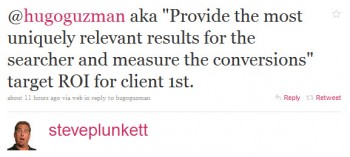
steve-provide-roi

Hope you enjoyed these moments with Steve’s Shorts.

steve_plunkett

M/C/C’s Director, Search, Steve Plunkett, is responsible for all aspects of search engine optimization (SEO) and Internet user behavior. Plunkett’s competitive personality makes him a perfect fit in the competitive world of SEO. As a child and a gamer, he worked hard ensuring that it was his initials at the top of every arcade game unit in his neighborhood. Today, he uses SEO to ensure his clients appear at the top of the search engine results –and offers an array of optimization services that are scoring big for those clients.

Buy the Insider’s Guide to Online Conversation.

Successful-Blog is a proud affiliate of

third-tribe-marketing

Filed Under: SEO, Successful Blog, Tech/Stats Tagged With: bc, LinkedIn, SEO, Steve Plunkett, Steve's Shorts

5 Ways to start a mutiny!

September 16, 2010 by patty

by Patty Azzarello

cooltext466496263_leadership
where-is-the-meaning1

People want their work to matter

I was preparing to write this blog about how to make work more meaningful for people, when I heard a piece of an interview with Dan Ariely about his new book, The Upside of Irrationality.

I didn’t hear the whole interview, but he talked about a test he did to measure how important meaning was in one’s work. The test was to complete a task repeatedly, until you wanted to stop.

The task was to build a Lego robot.

When you completed it, you got asked if you would like to build another robot.

In one case the robot you built was placed to the side so you could admire it while you built the next one.

In the other case if you said you’d like to build another, they dis-assembled the one you just built right in front of you,  gave you back the pieces and said, OK build another one.

How to drain all meaning out of someone’s work

I’m sure I am doing a dis-service to Dan Ariely’s work by taking this out of context, but that is one of the best metaphors I have heard for taking the meaning out of someone’s work!

It got me to thinking, what are all the ways we drain meaning from our employees work, dis-assemble their robots right before their eyes, mabye even without recognizing we are doing it?  And how can we build up the meaning instead?

1. Changing your mind all the time

Someone completes something you said was really important, but you changed your mind since you first assigned the task.  Now instead of accepting the work and thanking them, you gloss over it and ask them to do something else instead.   Then later you change your mind again, maybe even back to the first thing.

Robot parts are flying at this point!

Let people finish things.  Don’t keep switching the task before people can complete things.  Consider the full cost of changing your mind.  If you really have to change your mind, don’t skip the closure.

Thank people for the work, and communicate a reason why THEIR work still counts,  even though YOU have changed your mind.

2. Not accepting something different than you do it

Be careful here, just because it isn’t like you would do it, doesn’t mean that it’s not good enough, or maybe even better.

Build the robot again, but this time use the blue legos for the feet and the red ones for the arms because that is how I do it.

You are far more likely to create meaning if you accept good work, than if you tweak it to death just to make it exactly like you would do it.

3. Skipping the closure

The urgent customer issue or demand has disappeared because you either won the deal or lost the deal. The team has been working frantically to produce or defend something.

When you no longer feel the urgency, you either forget to call off the team, so they keep working round the clock — oops!   Or you just never go back to collect the work, because it no longer matters to you.

Just because it no longer has meaning for you and you have moved on to other things, doesn’t mean you should take the meaning away from the people that did the work.

Save the robot as a resource

If the work is no longer necessary, close out the project, thank them, and have a quick brainstorming about how we can use this important work for another customer or to solve a general issue.

It’s so much easier to just move on to your next urgent thing, but you are sacrificing your team’s motivation an ongoing performance and support if you skip this step.

4. Not being clear about the strategy

This is probably the biggest and most common hazard I have seen.

Companies are fuzzy about what their strategy is.  But they demand lots of hard work from people, and it is utterly impossible to understand if the work matters to the strategy or not.

Unclear strategy causes lots of wasted time and energy working on the wrong things, or waiting for decisions to be made, but it is really de-motivating for people to deliver work into a strategic black hole.

That is like throwing their robots directly into the trash can.

Make the strategy clear.  It’s what creates meaning for the work.

5. Not connecting the dots for people

Even if the strategy is clear to you, don’t expect your staff to automatically see how their work fits into supporting the big picture.

You need to spell it out and show them why their work matters. If you never connect the dots about how their work specifically supports the over-all strategy, there is no meaning in it for them.

Otherwise, they are just putting their robots on a conveyor belt to be used for unknown purposes.

Ensuring that all your employees understand how the business works, and how their work helps move it forward, motivates and enables them make better decisions and add more value.

With our without financial rewards your employees will do better work, faster, if they can personally see why it matters.

How do you create meaning for your employees?

This is a topic where concrete examples are so valuable. What’s worked for you? Please share your ideas in the comment box.

—–
Patty Azzarello works with executives where leadership and business challenges meet. She has held leadership roles in General Management, Marketing, Software Product Development and Sales, and has been successful in running large and small businesses. She writes at The Azzarello Group Blog. You’ll find her on Twitter as @PattyAzzarello

I’m a proud affiliate of

third-tribe-marketing

Filed Under: management, Successful Blog Tagged With: bc, employee motivation, LinkedIn, management

Spice Your Blog With A Dash Of Old Bay Seasoning

September 15, 2010 by Guest Author

cooltext455576688_blogging

By Terez Howard

I didn’t know what Old Bay was until I saw its name on a bag of popcorn in a Virginia Beach gourmet popcorn shop.  (When I reread that sentence, it sounds like the start of a piece of fiction).

But, I’m serious.  I’m from Ohio, and I had never seen it before.  After my trip, I found that my local grocery store’s employees placed the Old Bay seasoning near the fish since the spice is traditionally sprinkled on seafood.  I overlooked it every weekly trip I took to the same store for five years.

So why was Old Bay the flavor of choice for a bag of popcorn?  I’m not really sure.  My husband and I decided that after a sample of this popcorn, we were hooked.  We devoured that bag, and I’ve been craving it ever since.

My point?  Jody’s Gourmet Popcorn got it right.  Jody and her husband, Alan, gave us something unexpected, and we loved it.

Salt, garlic and Old Bay?

This is what I know.  Every recipe I make calls for salt and garlic.  Well, it doesn’t formally call for those spices.  I just cannot imagine a meal without them.  All you knowledgeable cooks, keep quiet!  I know there are ways to spice food without these two.  But they’re my staples, and my family loves them.

When you blog, you have salt and garlic.  You have some general topic, and you create content to support it.  That’s the salt.  You make it unique by peppering it with your personality.  That’s your garlic.  Those are the basics, your staples.  You would not have a decent blog without them.

Now for the Old Bay.  I like to think of this as your own little dose of the unexpected.  I find the most engaging posts I’ve ever read include a little something I cannot foresee.  You can spice up your blog with:

  • A quote from someone famous or not so famous. I read a blog post recently that included a quote from Ernest Hemmingway.  A quote can drive your point home.
  • Results of a study. I find study results to be extremely powerful.  If you’re telling people that they should write more how-to’s, then you could also include how much traffic a blogger has gotten from posting how-to’s.  (You could also conduct your own study).
  • A reference. This can be as simple as referring to a detail someone else made on a blog or in an article.  Link to them, and give your readers a more complete post.
  • A joke. I’m not a comedy writer, but I think most readers are up for a laugh.  A joke can lighten an otherwise heavy topic.
  • A personal story. This one is my favorite things to do because I feel like my life events and blog go hand in hand.  A personal anecdote makes your blog relatable and an enjoyable read.

A little goes a long way

I’m not for drenching a meal in any particular spice.  So, when you are finding your voice by trying to include something a bit unpredictable, don’t over do it.  Every single sentence does not need to be a pun, a quote or another reference.  A dash will do.  Just talk.  Be natural.

How do you dash your blog with Old Bay?

—
Terez Howard operates TheWriteBloggers, a professional blogging service which builds clients’ authority status and net visibility.  She has written informative pieces for newspapers, online magazines and blogs, both big and small.  She regularly blogs at Freelance Writing Mamas . You’ll find her on Twitter @thewriteblogger

Thanks, Terez!

–ME “Liz” Strauss
Work with Liz on your business!!

Filed Under: Successful Blog, Writing Tagged With: bc, blogging, LinkedIn, Terez Howard

  • « Previous Page
  • 1
  • …
  • 101
  • 102
  • 103
  • 104
  • 105
  • …
  • 190
  • Next Page »

Recently Updated Posts

Is Your Brand Fan Friendly?

How to Improve Your Freelancing Productivity

How to Leverage Live Streaming for Content Marketing

10 Key Customer Experience Design Factors to Consider

How to Use a Lead Generation Item on Facebook

How to Become a Better Storyteller


From Liz Strauss & GeniusShared Press

  • What IS an SOB?!
  • SOB A-Z Directory
  • Letting Liz Be

© 2025 ME Strauss & GeniusShared